
Waqf Law in Saudi Arabia determines when a waqf is valid, how it is documented, who manages it, and when the rights of heirs or beneficiaries may arise. The proper path begins with drafting the founder’s terms, documenting the waqf through Najiz, and then organising the trustee’s management of the asset and its income in a way that reduces the risk of later disputes.
A charitable intention alone is not enough. A waqf requires a clear deed, an identifiable asset, a defined purpose or class of beneficiaries, and a trustee who understands the limits of their authority. A waqf may become disputed if the founder’s terms are ambiguous, the income is poorly managed, or objections arise after the founder’s death.
This guide explains the meaning of waqf in Saudi Arabia, the main requirements for establishing a waqf, the documentation process, the distinction between documentation and registration, the role of the General Authority for Awqaf, the responsibilities of the waqf trustee, and situations in which objections or accountability proceedings may arise.
The Most Appropriate Path for Your Waqf Situation
There is no single step that applies to every waqf matter. The appropriate path differs depending on whether you are establishing a new waqf, reviewing an existing one, dealing with an objection from heirs, or addressing a dispute with the trustee.
For this reason, applying Waqf Law in Saudi Arabia begins with identifying the nature of the situation and reviewing the deed and supporting documents before taking any procedural step.
The following table shows a practical starting point for each situation, from reviewing the requirements of a waqf in Saudi Arabia to documenting it or completing the relevant registration procedures:
| Situation | Appropriate First Step |
|---|---|
| You want to establish a new waqf | Review the founder’s terms and identify the endowed asset, the designated purpose or beneficiaries, and the trustee before starting waqf documentation through Najiz. |
| You have a real-estate waqf | Review the title deed, ownership information, and scope of the waqf before proceeding with registration requirements. |
| You are a beneficiary but have not received the waqf income | Collect the waqf deed, income records, and accounts, then assess the appropriate claim or trustee-accountability route. |
| There is a dispute with the waqf trustee | Review the founder’s terms first, then determine whether there is a documented breach or failure in administration. |
| The heirs object to the waqf | Examine when the waqf was created, the founder’s legal capacity, and the relationship between the endowed property and the estate. |
| The founder’s terms are unclear | Begin by interpreting the terms in relation to the beneficiaries, the designated purpose, and the distribution mechanism before implementation. |
| The waqf exists but its records are not properly organised | Check the deed, trustee information, and whether the waqf records need to be updated or registered with the competent authority. |
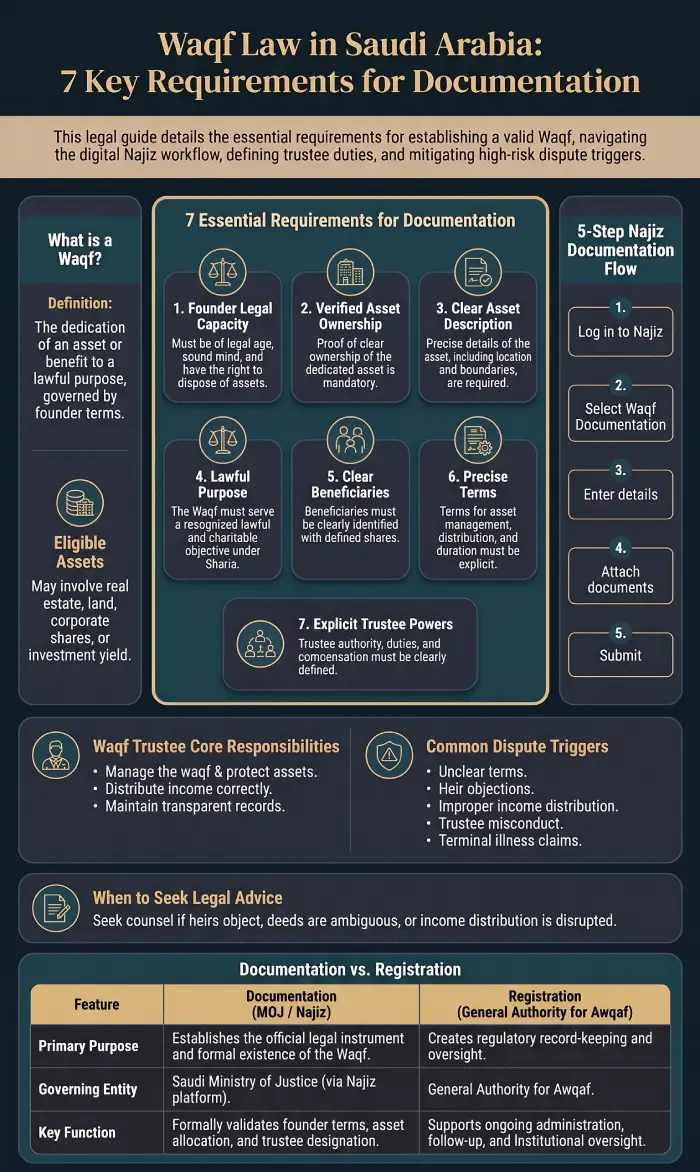
What Is a Waqf Under Saudi Law?
A waqf in Saudi Arabia is the dedication of an asset or benefit to a lawful purpose, with the use of that asset or benefit governed by the founder’s terms.
A waqf differs from an ordinary disposition because it is generally not intended to transfer ownership outright to a particular person. Instead, it is designed to preserve a defined benefit over time.
A waqf may take different forms, including real estate, land, shares, or investment income. Its purpose may be charitable, family-based, or shared among more than one category of beneficiaries.
In practical terms, the founder identifies an asset and dedicates its benefit or income to a particular purpose. This may be a charitable organisation, the founder’s descendants, specified beneficiaries, or more than one category.
The importance of a waqf does not end when it is established. Practical issues often arise later when questions emerge about management of the asset, distribution of income, the trustee’s authority, and compliance with the founder’s terms.
For that reason, a waqf deed should clearly address three elements:
- The endowed asset, its scope, and identifying information.
- The beneficiary or designated purpose and the basis of entitlement.
- The trustee, the trustee’s powers, and the limits of those powers.
Any uncertainty in these elements may create room for interpretation, objection, or disruption of the intended benefit, particularly in real-estate or family waqfs.
The Difference Between a Waqf, a Will and a Gift
Some people confuse a waqf with a will or a gift, although each legal disposition has different consequences in law and practice.
Distinguishing between them is essential before taking any step, particularly where the property concerned is real estate or forms part of a family estate.
| Point of Comparison | Waqf | Will | Gift |
|---|---|---|---|
| Nature of the disposition | Dedication of an asset or benefit to a specified purpose | A disposition generally intended to take effect after death | Transfer of property to another person |
| When it takes effect | Depends on the wording, documentation, and facts | After the testator’s death | During the donor’s lifetime |
| Relationship with the estate | May require examination on death or when challenged | Directly connected with the estate | May give rise to a dispute when made during terminal illness |
| Common area of dispute | Founder’s terms, trustee, and income | Limits of the will and heirs’ rights | Validity of transfer and possession |
This table does not replace a review of the relevant documents, but it helps identify the closest legal route.
A matter may constitute a genuine waqf, a will containing waqf-related provisions, or a gift that has been incorrectly characterised.
The Relationship Between a Waqf, the Estate and Heirs
It cannot be assumed that every waqf is automatically excluded from disputes among heirs without reviewing its deed, timing, and ownership circumstances.
The practical effect depends on the validity of the disposition, the founder’s legal capacity, the time when the waqf was established, and the nature of the endowed property.
If the waqf was established during the founder’s lifetime while the founder had full legal capacity, the property belonged to the founder, and the deed was clear, the scope for objection may generally be narrower.
More complex questions may arise if the waqf was linked to terminal illness, created shortly before death, or concerned all or a substantial part of the founder’s assets.
In such cases, the connection between the waqf and the heirs becomes important, particularly where there is an objection to the deed or a dispute over income.
You may also need to review personal status and inheritance matters to understand how the disposition may affect other rights.
Effect of a Waqf Created During Terminal Illness
If a waqf is created during terminal illness or under significant health circumstances, a dispute may arise concerning its effect on the estate and the rights of heirs.
The date of the document alone is not enough. The founder’s condition, the nature of the asset, the timing of the disposition, and its relationship with the rest of the estate should also be examined.
This issue becomes particularly important when heirs allege that the waqf was used to remove property from the estate.
Such situations require careful review of both the documents and the facts before any conclusion is reached about the validity of the objection.
Requirements for Establishing a Waqf in Saudi Arabia
The requirements under Waqf Law in Saudi Arabia are not limited to one element.
They involve several connected considerations: the founder’s legal capacity, ownership of the property, clear identification of the endowed asset, lawfulness of the designated purpose, precision in the founder’s terms, and clear appointment of the trustee and definition of the trustee’s powers.
The clearer the deed is in identifying the asset, beneficiaries, trustee’s authority, and distribution of income, the more stable the waqf is likely to be in practice.
Broad or imprecise wording may create disputes among heirs, beneficiaries, or the trustee.
7 Practical Requirements Before Documenting a Waqf
Before documenting a waqf, seven practical requirements should be reviewed to reduce the risk of later disputes.
These requirements do not replace a review of the actual deed, but they provide a useful preliminary checklist before an application is submitted.
| Requirement | Why It Matters |
|---|---|
| Founder’s legal capacity | Helps reduce the risk of later objections concerning awareness, understanding, or free consent. |
| Founder’s ownership of the property | A waqf may not be practically stable if ownership of the asset is disputed or uncertain. |
| Clear identification of the endowed property | The asset should be clearly identifiable in the deed, instrument, or registration information. |
| Lawfulness of the designated purpose | The purpose should be clear, capable of implementation, and compliant with applicable rules. |
| Clarity of beneficiaries | Particularly important in family, descendant, or mixed waqfs involving several categories of beneficiaries. |
| Drafting of the founder’s terms | The terms determine administration, distributions, beneficiary priority, and limits on authority. |
| Appointment of the trustee and definition of powers | Helps prevent disputes over management, income, or accountability. |
These requirements help make the waqf deed clearer and help identify what should be prepared before proceeding with registration or documentation through Najiz.
The Founder’s Legal Capacity and Ownership of the Property
The founder, or waqif, is the person who establishes the waqf.
The founder’s intention should be clear and free from coercion. The founder should also have the legal capacity to make the disposition and should own the property being endowed or have an established legally recognised right in relation to it.
Capacity becomes particularly important when heirs later object to the waqf.
The objection may allege that the founder did not understand the nature of the disposition or that the waqf was made under significant health or family circumstances.
For this reason, a family or real-estate waqf should not rely on broad wording.
The deed should be precise and reviewed before documentation, especially where the asset is valuable or several beneficiaries are involved.
Clearly Identifying the Endowed Property
The endowed property should be known and sufficiently identified so that it can be distinguished from other assets without ambiguity.
This is particularly important in a real-estate waqf, where the title deed, location, boundaries, and ownership information should be clear.
The endowed asset may consist of real estate, land, shares, or investment income depending on the nature of the waqf and the competent authority.
The practical requirement is that the asset can be identified, administered, and used for its intended purpose.
Clarity of the Designated Purpose and Beneficiaries
The designated purpose or beneficiaries are the persons or causes that receive the waqf income or benefit.
The purpose may be charitable, family-based, or mixed, combining family beneficiaries with a charitable purpose.
The designated purpose should be lawful, clear, and capable of implementation.
If the wording is too broad, such as “to be spent on charitable causes,” the trustee may later need to make a wide interpretation that could open the door to disagreement.
Where the purpose is more precisely defined, such as education, healthcare, or the founder’s descendants according to a specified order, implementation becomes more structured.
The founder’s terms should also explain what happens if the designated purpose becomes impossible or ceases to exist.
Drafting the Founder’s Terms and Managing the Waqf
The founder’s terms govern how the waqf is managed, its designated purposes, beneficiaries, and the trustee’s powers.
They may be regarded as the practical framework to which the trustee and beneficiaries refer when implementing the waqf.
When drafting these terms, broad wording that does not establish a distribution mechanism or order of beneficiaries should be avoided.
It is also important to define the trustee’s powers, investment limits, accounting arrangements, and how future changes in circumstances should be handled.
If the waqf concerns real estate, shares, or a family estate, reviewing the founder’s terms before documentation can reduce the risk of later disputes.
BMS Legal can review the drafting and supporting documents and explain the appropriate route before an application is submitted.
Types of Waqf in Saudi Arabia
Types of waqf in Saudi Arabia differ according to the designated purpose, beneficiaries, and endowed asset.
The significance lies not only in the name of the waqf but in the practical effect of each structure on administration, entitlement, and oversight.
A founder may choose a charitable waqf, a family or descendant waqf, a mixed waqf, a real-estate waqf, or an investment waqf.
Each structure requires drafting that suits its nature so that the deed remains aligned with the intended purpose.
Simply describing a waqf as charitable, family-based, or mixed does not determine how its income should be managed or resolve entitlement disputes.
For a more detailed explanation, see types of waqf under Saudi law and how each structure affects beneficiaries, the trustee, oversight, and implementation of the founder’s terms.
Charitable Waqf
A charitable waqf dedicates its income or benefit to a public-interest purpose.
This may include education, healthcare, mosques, support for people in need, or other lawful charitable purposes.
The beneficiary is generally not one specific person but rather an organisation or public purpose.
The relevant entity or field should therefore be sufficiently clear to facilitate distributions and proper administration by the trustee.
Family or Descendant Waqf
A family or descendant waqf may allocate income to the founder, descendants, relatives, or other specified beneficiaries.
It may be particularly susceptible to disputes because the number of beneficiaries can increase over time.
Heirs or descendants may disagree over the order of entitlement, each beneficiary’s share, or the trustee’s suitability.
The founder’s terms should therefore answer practical questions before documentation, including:
- Who is entitled first?
- What happens when a beneficiary dies?
- Does the income pass to that beneficiary’s descendants?
- Are male and female beneficiaries treated equally under the terms?
- What happens to the income if the specified class of beneficiaries comes to an end?
Clear answers make administration more closely aligned with the written terms and reduce reliance on conflicting interpretations by beneficiaries or the trustee.
Real-Estate Waqf
A real-estate waqf is a common form of waqf in Saudi Arabia because it is based on a fixed asset capable of generating continuing income.
The property may be land, a house, an apartment building, or commercial premises.
Before establishing a real-estate waqf, the title deed, ownership status, and any existing dispute should be examined.
It should also be clear whether the waqf includes the entire property or only part of it.
When documenting a waqf through Najiz, title-deed and property information become particularly important.
The relevant asset information and the founder’s terms should therefore be prepared before the documentation process begins.
Mixed or Multi-Purpose Waqf
A mixed waqf combines more than one designated purpose.
For example, a founder may allocate part of the income to descendants and another part to a charitable organisation.
This structure requires particular clarity regarding percentages, priorities, and the mechanism for moving allocations between designated purposes.
A mixed waqf may be suitable for families seeking to support descendants while maintaining a continuing charitable benefit.
Its success, however, depends on clear drafting and competent administration by the trustee.
How to Document a Waqf Through Najiz
Waqf documentation is the step that records the waqf in an official instrument through the competent justice authority.
It should not be treated merely as an administrative formality because the wording of the document may govern the waqf for many years.
The wording of the deed, the details of the endowed property, the trustee’s powers, and the order of beneficiaries can all affect future administration.
These matters should therefore be reviewed before the application is submitted rather than after a dispute arises.
Electronic Documentation Steps
Waqf documentation generally begins by logging into the Najiz portal using National Access and selecting the relevant electronic service.
The practical steps are:
- Log in to the Najiz portal using National Access.
- Select all electronic services.
- Open the Social Cases services category.
- Select the Waqf Documentation service.
- Enter the applicant’s and founder’s information.
- Provide the required information relating to the waqf and endowed property.
- Attach the required documents.
- Submit the application and follow its status through the official channels.
The Saudi Ministry of Justice describes the service as an electronic service for documenting a waqf and issuing an official waqf document, and its official service page lists Najiz as the application channel. وزارة العدل
These steps do not replace reviewing the deed before submission.
An error in the founder’s terms or description of the property may not become apparent while completing the form, but it may cause problems later during administration or when an objection arises.
Documents to Prepare Before Applying
The required documents may differ according to the type of waqf and the applicant’s legal capacity.
The requirements for an application submitted directly by the founder may differ from those applying where an agent, trustee, or real-estate asset is involved.
| Situation | Documents Commonly Relevant |
|---|---|
| Real-estate waqf | Property title deed or property information, founder’s information, and description of the endowed property |
| Application through an agent | A valid power of attorney authorising the relevant transaction |
| Family or descendant waqf | Beneficiary information, order of entitlement, and founder’s terms |
| Waqf with a trustee | Trustee information, powers, and accountability arrangements |
| Waqf connected with an estate | Heirship or relationship documents where practically required |
The official Ministry of Justice service page specifically states that a valid power of attorney is required where the applicant is acting as an agent and refers to the property deed or its information among the service-access requirements.
This table is intended as a practical preparation guide and does not replace the live requirements shown by the official service when an application is submitted.
Property Information and Its Effect on Documentation
A title deed or relevant property details are needed where the endowed property consists of real estate or part of a property.
This may include land, a house, an apartment building, commercial premises, or another real-estate asset capable of being documented.
The property description in the waqf deed should correspond with the title-deed information so that registration or administration problems do not arise later.
Any existing dispute concerning the property should also be identified before documentation.
Waqf Registration and the Role of the General Authority for Awqaf
Waqf registration is different from simply documenting the waqf through the justice authority.
Documentation establishes the waqf instrument, while registration concerns recording the waqf and its regulatory information with the General Authority for Awqaf where the applicable requirements call for it.
This distinction matters to founders, trustees, and beneficiaries.
Completing documentation does not necessarily mean that every later regulatory requirement has been completed, as registration, updating records, or trustee-related follow-up may still be relevant.
The Difference Between Documentation and Registration
| Point of Comparison | Waqf Documentation | Waqf Registration |
|---|---|---|
| Purpose | Issue an official waqf instrument | Record the waqf and its information with the competent authority |
| Relevant authority | Ministry of Justice / Najiz | General Authority for Awqaf |
| Practical effect | Officially records the waqf disposition | Organises regulatory information, follow-up, and oversight |
| When relevant | When establishing the waqf | Following documentation or where regulatory registration is required |
Role of the General Authority for Awqaf
The role of the General Authority for Awqaf is not limited to registration.
It is a regulatory and supervisory authority involved in developing the waqf sector and provides services connected with waqf administration, trustees, and related regulatory matters.
Its role may become particularly relevant where a waqf requires trustee-related oversight, involves reports concerning the asset or its administration, or requires its records to be updated. Ministry of Justice in Saudi Arabia
The Waqf Trustee Under Saudi Law
The waqf trustee, or nazir, is the person or entity responsible for managing the waqf and implementing the founder’s terms.
The role is not limited to preserving the asset. It may also include protecting the income, safeguarding the waqf’s interests, and representing the waqf in accordance with the deed.
For a detailed discussion, see waqf trustee rules under Saudi law.
The trustee is a critical part of the waqf structure because poor selection may turn a beneficial arrangement into a prolonged dispute.
The trustee’s powers and duties should therefore be clearly stated in the waqf deed.
Selecting a Trustee and Defining the Trustee’s Powers
The selection of a trustee should take account of competence, integrity, administrative ability, and compliance with the founder’s terms.
The larger or more complex the waqf, the greater the need for a trustee capable of handling financial and organisational responsibilities.
The trustee’s powers should be defined in the deed.
They may include managing the asset, monitoring income, making distributions to designated purposes or beneficiaries, maintaining records, and arranging necessary maintenance.
These powers should not be treated as unrestricted authority over waqf assets.
The trustee remains bound by the founder’s terms, the interests of the waqf, and applicable rules and regulations, especially when dealing with the underlying asset or investing waqf property.
Practical Duties of the Trustee
The trustee’s central duty is to implement the founder’s terms without improper deviation or obstruction.
The trustee should also protect the endowed asset, preserve the income, make distributions to the designated purposes, and document financial and administrative activities.
Practical duties commonly include:
- Preserving the endowed asset and preventing loss or neglect.
- Distributing income according to the founder’s terms.
- Recording income and expenditure.
- Avoiding conflicts of interest.
- Providing appropriate information to entitled beneficiaries where they have legal standing.
Replacing or Removing a Waqf Trustee
Removal or replacement of a trustee may become relevant where there is a material breach, clear failure in administration, conflict of interest, or conduct that harms the interests of the waqf.
A personal disagreement alone is not sufficient to establish mismanagement.
Where a dispute concerns waqf income or the trustee’s authority, it is preferable to collect the deed, accounts, and relevant correspondence before assessing the alleged breach against the founder’s terms.
Removing or replacing a waqf trustee should not begin merely from anger or a family disagreement.
The more precise question is whether the trustee has departed from the founder’s terms, harmed the interests of the waqf, or improperly managed the waqf’s income.
At that point, removal becomes an evidence-based legal issue rather than simply a matter of dissatisfaction.
Waqf Income and Its Management
Waqf income is the return or benefit generated by the endowed property.
It may consist of rental income, share profits, investment income, or another benefit identified by the founder’s terms.
The income cannot be administered independently of those terms.
The founder may have allocated one percentage to maintenance, another to beneficiaries, and another to a charitable purpose, or may have made distribution subject to specific conditions.
Distribution and Investment
Waqf income should be distributed according to the deed and the founder’s terms.
The trustee should comply with the specified purposes, distribution dates, and any other restrictions contained in the document.
Investment may be appropriate where it serves the interests of the waqf and helps preserve its underlying asset.
It does not, however, give the trustee unrestricted authority to assume risk or change the nature of the waqf.
Common Causes of Waqf Income Disputes
Income disputes often arise where transparency is lacking or beneficiaries interpret the founder’s terms differently.
A dispute may begin with a simple request for accounts and later develop into a claim for trustee accountability.
Common causes include:
- Failure to distribute income to entitled beneficiaries.
- Uncertainty over beneficiary priority.
- Using income for a purpose other than the one specified.
- Missing accounts or records.
- A conflict between the trustee’s interests and the interests of the waqf.
Waqf Disputes in Saudi Arabia
Waqf disputes in Saudi Arabia often arise not from the concept of waqf itself but from unclear documentation or poor administration.
Disputes may involve heirs, the trustee, income, or the waqf deed.
A claim or objection should not be initiated without first identifying the actual source of the dispute.
The issue may concern the validity of the waqf, trustee accountability, or interpretation of the founder’s terms.
Heirs’ Objections and Proving a Waqf
Heirs may object to a waqf if they believe it adversely affected their rights or was created under unusual circumstances.
An objection may relate to terminal illness, legal capacity, ownership, or the timing of the disposition.
Questions of proving a waqf may arise where the arrangement was not clearly documented, relevant documents have been lost, or an asset is alleged to have been endowed.
Such cases may require evidence establishing the asset, the designated purpose or beneficiaries, and the trustee.
Invalidity of a Waqf or Objection to a Waqf Deed
A challenge to the validity of a waqf may allege a defect in one of its essential elements, such as the founder’s legal capacity, ownership of the asset, or wording of the designated purpose.
A challenge should identify the alleged defect rather than rely on a general objection.
An objection to a waqf deed likewise requires a specific basis, such as a problem concerning ownership, capacity, drafting, or documentation.
If the objection concerns real estate, the title deed and ownership information should also be reviewed.
When a disagreement develops into a formal claim or objection, the appropriate litigation and dispute-resolution route should be identified before any application is filed.
Trustee Accountability and Breach of the Founder’s Terms
Trustee accountability may become relevant where there are indications of misconduct or failure in administration.
Examples include refusing to provide accounts, using waqf income for a purpose outside the one specified, or acting beyond the trustee’s authority.
A breach of the founder’s terms is particularly significant where those terms are clear.
If the wording itself is ambiguous, interpretation may need to come before any assessment of breach.
Can a Waqf Be Sold or Replaced?
As a general principle, a waqf is not an ordinary asset available for unrestricted sale or disposal.
Its structure is based on preserving the underlying asset and dedicating its benefit or income to the purpose specified by the founder.
However, circumstances may arise in which a sale, replacement, or another special disposition needs to be considered.
No single rule should be applied to every situation because the outcome may depend on the founder’s terms, the condition of the asset, the interests of the waqf, and the competent authority.
Replacement may become relevant where the waqf can no longer be beneficially used, its administration becomes impractical, or an alternative may better serve its intended purpose.
Each case should nevertheless be assessed individually.
Before dealing with the underlying waqf asset, the founder’s terms should be reviewed.
If the deed is silent or unclear, a legal assessment or a procedure before the competent authority may be necessary.
When Should You Seek Legal Advice on a Waqf?
Legal advice may be appropriate where the waqf deed, administration, or beneficiaries involve significant complexity.
A straightforward waqf may proceed through relatively clear procedures, whereas a family or real-estate waqf may require closer review.
Before documenting a family or real-estate waqf, the title deed, beneficiary information, distribution purpose, and trustee’s powers should be reviewed.
These elements can shape the future administration of the waqf and reduce the need for interpretation later.
If you are considering documenting a waqf, legal consultation may help clarify the effect of the proposed wording before the application is submitted through Najiz.
The need for direct legal review becomes more significant where heirs object, there is a dispute with the trustee, the founder’s terms are unclear, or the designated purpose can no longer be implemented.
Such cases require assessment of the documents and facts before the appropriate procedure is selected.
BMS Legal, a law firm in Jeddah reviews waqf matters involving real estate, estates, founder’s terms, and trusteeship and can explain the available legal options before further action is taken.
✓
Legal Review, Sources & Content Scope
This article provides general legal information about
Waqf Law in Saudi Arabia
and is intended for educational purposes only.
Prepared for:
BMS Legal Law Firm
Legal status:
Licensed Saudi law firm — License No. 7053637679
Content focus:
Waqf documentation, trustee duties, registration, beneficiaries, and dispute risks
Official sources:
Saudi Ministry of Justice, Najiz, and the General Authority for Awqaf
When to seek direct legal advice:
If the waqf deed is unclear, heirs object, the trustee is disputed, or the matter involves estate or real-estate issues.
Important:
This content does not constitute legal advice for a specific case. A case-specific assessment requires reviewing the relevant deed, documents, and facts.
Frequently Asked Questions About Waqf Law in Saudi Arabia
What Are the Main Requirements for Establishing a Waqf in Saudi Arabia?
The main requirements include the founder’s legal capacity, ownership of the endowed asset, a lawful purpose, and clear terms governing beneficiaries and administration.
How Is a Waqf Documented Through Najiz?
The application is submitted electronically through Najiz by entering the required information, attaching the relevant documents, and completing the Waqf Documentation service.
What Is the Difference Between Waqf Documentation and Waqf Registration?
Documentation establishes the official waqf instrument, while registration concerns recording the waqf and its regulatory information with the competent authority.
What Should I Do If There Is a Dispute With the Waqf Trustee?
Review the waqf deed, the founder’s terms, accounts, and relevant records first. The next step depends on whether there is a documented breach, mismanagement, or failure to distribute income properly.
Waqf Law in Saudi Arabia does not begin and end with documentation.
A properly structured waqf requires clear identification of the endowed property, carefully drafted founder’s terms, a defined purpose or class of beneficiaries, and properly established trustee powers.
Where these elements are clear, administration is more likely to remain stable.
If the deed is ambiguous, the trustee’s powers are unclear, or heirs raise objections, the waqf may develop into a dispute.
Careful drafting and document preparation before documentation, together with proper review of administration when a problem arises, can therefore be particularly important.
A waqf remains an important means of sustaining benefit and preserving assets, but it requires clear legal governance.
The combination of a lawful purpose, precise documentation, and disciplined administration provides a stronger basis for its continued operation without recurring disputes.
If you have an existing waqf deed that requires an initial review, a dispute with a trustee, or an objection from heirs, you can contact us before taking further action.