
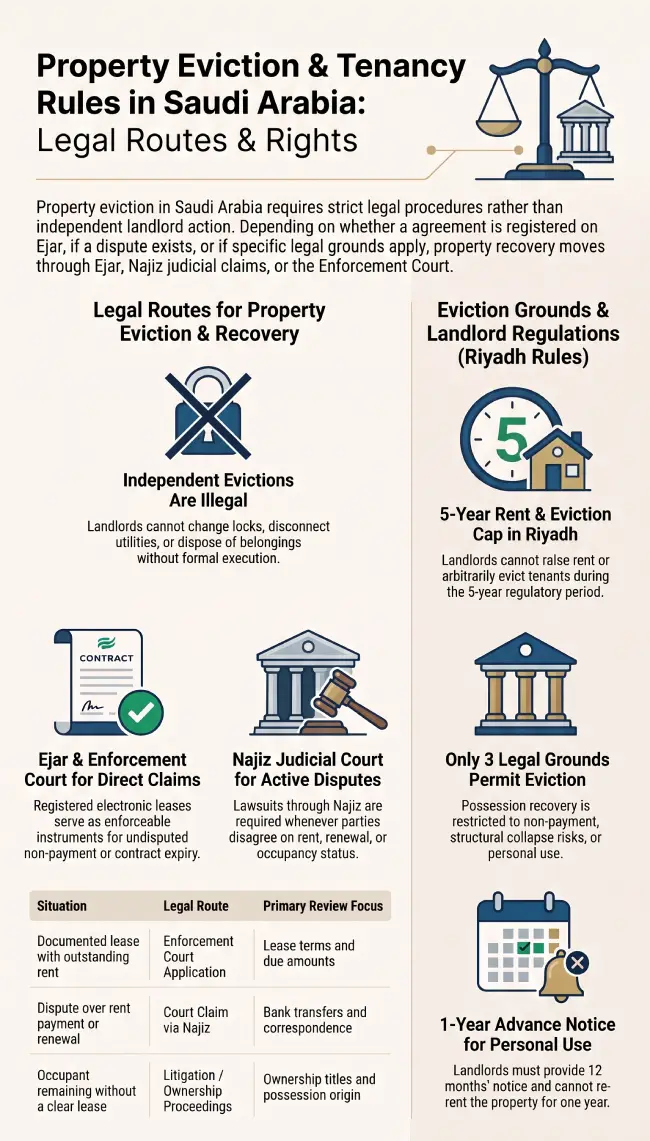
Eviction does not allow a landlord to remove a tenant independently, change the locks, disconnect utilities, or dispose of the tenant’s belongings. The correct procedure depends on the type of lease, the grounds for eviction, the payment history, and whether a dispute exists between the parties.
Depending on the circumstances, the process may begin with lease termination through Ejar, involve filing a lawsuit through Najiz, or proceed to the Enforcement Court where an enforceable judgment or instrument supports the requested remedy.
This guide explains the grounds and requirements for eviction, the evidence landlords and tenants may need, and how to determine the appropriate legal route for residential and commercial properties.
Property Eviction in Saudi Arabia: Choosing the Right Legal Route
Choosing the correct legal route begins with reviewing the lease agreement, the grounds for recovering possession, and the available evidence—not simply selecting an online platform.
Where a lease is properly documented and there is no substantial dispute, certain Ejar procedures or enforcement measures may be appropriate. However, where the parties disagree about unpaid rent, renewal, or the occupant’s legal status, filing a court claim through Najiz may be necessary.
| Situation | Potential legal route | What to review first |
|---|---|---|
| Documented lease with outstanding rent | Enforcement application, where an enforceable instrument supports the claim | Lease details and amounts due |
| Expired lease and refusal to vacate | Notice followed by litigation or enforcement, as appropriate | Renewal provisions and notices |
| Dispute over rent or renewal | Court claim through Najiz | Bank transfers and correspondence |
| Occupant without a clear lease | Determine the legal nature of the occupation | Ownership and how possession began |
| Commercial premises or warehouse | Review the lease and business activities | Licences, inventory, and contractual terms |
This comparison provides an initial framework but does not replace an assessment of the documents.
Confusing lease termination, an eviction lawsuit, and an enforcement application can cause delays or weaken a claim.
What Is the Difference Between Property Eviction, Lease Termination and Enforcement?
Property eviction involves recovering possession of premises from an occupant whose legal entitlement to remain has ended or is otherwise subject to a valid order for possession.
Lease termination, by contrast, concerns the ending of the contractual relationship. Early termination may arise from a material breach, whereas a lease may also end upon expiry of its agreed term.
An enforcement application seeks to implement an established right through the Enforcement Court on the basis of an enforceable judgment or other qualifying instrument.
For example, a landlord may seek to terminate a lease because of unpaid rent or a contractual breach and subsequently pursue possession. Alternatively, the lease may expire without early termination, but a dispute may arise if the tenant refuses to vacate or claims that the agreement was renewed.
Where the relevant service requirements are satisfied, lease termination may be managed through Ejar by selecting the agreement, specifying the reason and effective date, and reviewing the financial settlement.
An eviction lawsuit is generally appropriate where a dispute requires judicial determination, such as disagreements concerning payment, renewal, or the validity of the tenancy.
Procedures also differ depending on the legal relationship. A registered electronic lease is not necessarily treated in the same way as an undocumented agreement. Likewise, an occupant without a lease may have a different legal position from a tenant.
Where possession proceedings overlap with ownership or contractual disputes, consulting a real estate lawyer in Jeddah may help determine whether the appropriate action is an eviction claim, an enforcement application, or another property-related proceeding.
Legal Grounds for Property Eviction in Saudi Arabia
A landlord’s desire to recover a property is not, by itself, sufficient to establish a right to eviction.
The application must be supported by a legally relevant ground, established through the lease agreement, supporting documents, or proven circumstances.
| Ground for eviction | Supporting evidence | Potential weakness |
|---|---|---|
| Lease expiry | Lease, notices, platform records | Evidence suggesting continued tenancy |
| Unpaid rent | Account statements, lease, notices | Unclear amounts or due dates |
| Unauthorised business activity | Lease, licences, inspection evidence | Insufficient details of the breach |
| Unauthorised subletting | Correspondence, agreements, witnesses | Difficulty proving the arrangement |
| Damage to the property | Photographs, technical report, handover record | Failure to connect the damage to the tenant |
| Occupation without a lease | Title deed, correspondence, possession evidence | Unclear legal status of the occupant |
| Commercial property disputes | Lease, licences, contractual obligations | Overlapping financial claims |
When a lease expires, the landlord should examine renewal provisions and communications between the parties.
The dispute may arise not simply because the contractual term has ended, but because the tenant alleges a subsequent agreement or relies on the landlord’s acceptance of payments after expiry.
For unpaid rent, the strength of the claim depends on establishing the amount due, the contractual payment date, and the actual payment history.
Where a contractual breach is alleged, merely stating that the tenant violated the agreement is insufficient. The landlord should identify the relevant clause, describe the breach, specify when it occurred, and provide evidence supporting the allegation.
Legal Requirements for Property Eviction in Saudi Arabia
Property eviction in Saudi Arabia generally requires an identifiable legal entitlement, valid grounds, adequate evidence, and an appropriate formal procedure.
The main requirements include:
- Legal standing of the applicant: The applicant must be the owner, an authorised agent, a lawful representative, or another party legally entitled to seek possession. Supporting documents may include a title deed, power of attorney, or commercial registration.
- Valid grounds for eviction: These may include lease expiry, unpaid rent, a contractual breach, or occupation without a valid legal basis.
- Evidence of the legal relationship: An electronic or written lease may establish the tenancy. Where no written agreement exists, correspondence, bank transfers, or acknowledgements may help establish the relationship.
- Evidence of prior demands: Notices, formal letters, and documented communications may demonstrate that the other party was informed of the claim or alleged breach.
- Accurate property and party details: The identity of the parties, property description, contractual dates, and amounts claimed should be consistent across the application and supporting documents.
- Selection of the appropriate procedure: Depending on the circumstances, the matter may involve Ejar, a court claim through Najiz, or an enforcement application.
- Avoidance of unilateral action: Changing locks, disconnecting utilities, or removing belongings without the appropriate legal process may expose the landlord to further disputes or liability.
Each requirement serves a distinct purpose: establishing entitlement, proving the grounds for possession, or ensuring that the application is procedurally sound.
Preparing a complete evidence file before filing is generally preferable to submitting an incomplete application and attempting to correct deficiencies afterward.
Property Eviction Through Ejar, Najiz and the Enforcement Court
The appropriate platform depends on the lease and the nature of the requested legal remedy.
Ejar is associated with registered tenancy agreements and related lease-management services. Najiz provides access to judicial services, including filing claims and submitting enforcement applications.
The Enforcement Court is responsible for enforcing judgments and other qualifying enforceable instruments.
When Should You Use Ejar?
Ejar may be suitable where a lease is registered and the parties need to manage its termination or related contractual records.
Depending on the applicable service requirements, the process may involve accessing the relevant account, selecting the lease, submitting a termination request, specifying the reason and effective date, and reviewing the financial settlement.
However, terminating or updating a lease through Ejar does not necessarily mean that physical possession has been recovered.
A separate handover may still be required to document the property’s condition, keys, fixtures, and any outstanding obligations.
When Is an Eviction Lawsuit Through Najiz Necessary?
A court claim may be necessary when lease termination alone cannot resolve the matter or where there is no enforceable instrument supporting the requested remedy.
Common examples include disputes concerning the existence of a tenancy, lease renewal, unpaid rent, property damage, or the occupant’s entitlement to remain.
The statement of claim should clearly identify the parties, describe the property, explain the legal relationship, establish the grounds for eviction, and specify the relief requested.
A properly prepared claim should establish a clear timeline: when the tenancy began, which obligation was allegedly breached, when notice was given, and what remedy the claimant seeks.
When Can You Submit an Enforcement Application?
An enforcement application may be available where the applicant holds an enforceable judgment or another instrument that legally supports the requested relief.
A properly documented electronic lease may qualify as an enforceable instrument under the applicable legal framework, although the specific remedy must fall within its enforceable scope.
Before applying, the claimant should verify the identity of the parties, the property details, the underlying instrument, and the supporting documents.
Where an enforceable judgment or instrument already exists, understanding the Enforcement Court procedures in Jeddah can help distinguish the enforcement stage from litigation over the underlying right.
Eviction Through the Enforcement Court: When Is It Appropriate?
Eviction through the Enforcement Court may be appropriate where the right to recover possession is established by an enforceable judgment or another qualifying instrument supporting that specific remedy.
The purpose of enforcement is to implement an established legal right rather than to litigate the underlying entitlement from the beginning.
However, not every rental dispute can proceed directly to enforcement.
A material disagreement over the validity of the lease, the occupant’s legal status, outstanding amounts, or the continued existence of the tenancy may require judicial determination.
The existence of a documented lease should therefore not be treated as an automatic guarantee that every possession-related demand can be enforced directly.
Eviction for Unpaid Rent or Lease Expiry
Non-payment and lease expiry are common grounds for seeking possession, but each requires a different evidentiary assessment.
In a non-payment dispute, the central questions concern the amount due, the contractual payment date, and whether payment has been made.
Relevant evidence may include the lease, bank transfers, account statements, payment receipts, notices, and platform records.
Where the amount is disputed, the landlord should explain how it was calculated and distinguish unpaid rent from utilities, property damage, and other contractual liabilities.
A landlord may seek unpaid rent alongside possession where the legal grounds and evidence support both remedies.
The claims should be clearly organised: establish the contractual relationship, explain the payment default, identify the amounts claimed, and establish the grounds for possession.
Where the lease has expired, the landlord should verify whether an express renewal or subsequent agreement exists, or whether the parties’ conduct may indicate continuation of the tenancy.
If the tenant refuses to vacate, the landlord should review the lease, notices, and payment history before selecting the appropriate procedure.
Acceptance of payments after expiry may be relevant evidence in a dispute about whether the tenancy continued.
The purpose of any payment received after the contractual end date should therefore be documented, particularly where it relates to earlier rent or a final settlement.
Electronic Lease Agreements as Enforceable Instruments
A registered electronic lease may qualify as an enforceable instrument under the applicable Saudi legal framework.
Its importance lies in the potential to pursue certain clearly established obligations without necessarily commencing fresh proceedings on the merits.
An enforceable instrument is a legally recognised document that may support an application to the Enforcement Court, subject to the requirements governing the particular obligation and remedy.
For lease-related claims, the applicant should ensure that the requested relief corresponds to the contractual terms and the enforceable scope of the instrument.
Registration alone does not mean that every disputed claim can be enforced without judicial determination.
A separate lawsuit may be necessary where the claim concerns the validity of the agreement, the identity or standing of the parties, disputed amounts, continuation of the tenancy, or compensation requiring independent proof.
Accurate identification details, rent amounts, lease dates, and property information are particularly important.
Material inconsistencies may lead to objections, requests for clarification, or procedural difficulties.
Landlord and Tenant Rights During Eviction
Property eviction in Saudi Arabia involves protecting the rights of both landlords and tenants.
The landlord may be entitled to recover possession and pursue outstanding contractual claims, while the tenant may raise relevant objections and present evidence supporting continued occupation or payment.
| Party | Principal rights | Relevant evidence |
|---|---|---|
| Landlord | Recover possession where legally justified; claim unpaid rent or proven damage | Lease, ownership or authority documents, notices, payment records |
| Tenant | Contest the claim; establish payment, renewal, or other defences | Receipts, correspondence, lease, bank transfers |
| Both parties | Document handover, deposits, belongings, and financial settlement | Handover report, photographs, statement of account |
A landlord may pursue possession, unpaid rent, or compensation for proven damage where the relevant requirements are satisfied.
These rights should be exercised through the appropriate legal procedure rather than unilateral action.
A tenant may challenge an eviction claim by presenting evidence of payment, renewal, or another legally relevant defence.
Ignoring notices or enforcement proceedings may make it more difficult to respond effectively or arrange an orderly handover.
A documented handover protects both parties by recording the property’s condition, delivery of keys, outstanding payments, security deposits, and any belongings remaining on the premises.
Evicting an Occupant Without a Written Lease
Evicting an occupant without a written lease requires careful assessment of the legal relationship.
The situation may involve an undocumented tenancy, occupation without a valid legal basis, or a broader dispute over ownership or possession.
The property owner should first establish legal standing through a title deed, power of attorney, ownership record, or other relevant documentation.
The next step is to determine how the occupant entered and remained in the property.
Was permission granted? Was rent paid? Are there messages, acknowledgements, or witnesses establishing a tenancy?
These questions help distinguish an undocumented tenant from an occupant who has no established legal entitlement.
Even without a written agreement, bank transfers, correspondence, acknowledgements, and other evidence may establish a contractual relationship.
An occupant who cannot demonstrate a valid basis for possession may be subject to a different type of claim, depending on the facts.
Utility records, inspection reports, witness evidence, and documented communications may also be relevant.
If the occupant asserts ownership or challenges the claimant’s title, the matter may develop into a broader property dispute.
In such circumstances, ownership, legal standing, and possession should be assessed before choosing the appropriate proceedings.
Residential and Commercial Property Eviction
Residential and commercial property eviction share the need for valid grounds, supporting evidence, and an appropriate legal process.
However, the practical issues may differ significantly.
Residential disputes commonly involve lease expiry, unpaid rent, security deposits, and the property’s condition at handover.
Photographs, inspection records, and a signed handover report can help clarify these matters.
Commercial property disputes may involve additional issues such as business licences, inventory, fixtures, equipment, business operations, and contractual obligations to third parties.
Commercial leases may also contain specific provisions governing permitted use, signage, alterations, maintenance, subletting, and reinstatement of the premises.
Those provisions may affect both the grounds for eviction and the evidence required.
For commercial premises, reviewing the relevant lease provisions and contractual obligations is particularly important before initiating proceedings, especially where the dispute concerns permitted business activities, property alterations, or unpaid rent.
Eviction Notices and Required Supporting Documents
An eviction notice is not necessarily a mandatory formality in every situation. Its legal significance depends on the agreement, the applicable requirements, and the circumstances.
Notices may help establish that the landlord demanded payment, objected to a breach, declined renewal, or requested possession by a specified date.
A written eviction notice should generally identify the landlord and tenant, lease reference where available, property description, grounds for the demand, requested handover date, amounts claimed, and a suitable contact method.
The notice should avoid unlawful threats or improper pressure.
Supporting documents are equally important because they establish legal standing, the contractual relationship, and the grounds for the requested remedy.
| Document category | Examples | Purpose |
|---|---|---|
| Proof of legal standing | Title deed, power of attorney, commercial registration | Establish the applicant’s authority |
| Proof of the relationship | Electronic lease, written agreement, correspondence | Establish tenancy or occupation |
| Payment evidence | Account statements, bank transfers, receipts | Identify paid and outstanding amounts |
| Evidence of notice | Written notice, formal demand, documented message | Establish communication of the demand |
| Property condition evidence | Photographs, technical report, handover record | Document damage or condition |
| Enforcement documents | Judgment, enforceable instrument, documented lease | Support an enforcement application |
If the property belongs to a company or an estate, the applicant should also establish their authority to act on behalf of the relevant owner or rights holder.
A tenant contesting eviction should preserve evidence of payments, renewal agreements, and subsequent communications.
Where an eviction matter involves an undocumented lease or disputed rent, BMS Legal Law Firm can review the relevant documents to help identify the appropriate procedure before an application is submitted.
Common Mistakes in Property Eviction Cases
Eviction applications may encounter difficulties because of incomplete documentation, poorly organised facts, or an unsuitable procedural route.
Common mistakes include:
- Landlord mistakes: Changing locks, disconnecting utilities, entering without authority, filing without proof of legal standing, or seeking possession without clearly establishing the grounds.
- Tenant mistakes: Ignoring notices, failing to retain payment receipts, leaving without a handover record, or raising objections without supporting evidence.
- Statement of claim mistakes: Using vague allegations, combining possession and compensation claims without clarity, omitting key dates, or failing to link factual allegations to documents.
- Enforcement application mistakes: Incomplete party details, unclear supporting instruments, inconsistencies between the lease and application, or failure to follow up on procedural requirements.
A well-organised eviction file should identify the grounds for possession, the applicant’s legal standing, supporting evidence, and the precise remedy requested.
This preparation can reduce avoidable procedural complications and make the application easier to assess.
When Should You Consult a Property Eviction Lawyer?
Not every eviction matter requires complex litigation.
However, legal advice may be particularly useful where the lease is undocumented, significant sums are outstanding, the occupant refuses to surrender possession, or renewal is disputed.
Legal assessment may also be important where the property has been damaged, commercial premises are involved, the owner is a company or an estate, or the occupant challenges ownership or enforcement.
In these situations, the main issue is not simply completing an electronic form. It is identifying the correct legal relationship, selecting the appropriate proceedings, and preparing evidence that supports the requested remedy.
Where it is unclear whether the matter concerns property rights, enforcement, or contractual obligations, consulting a lawyer in Jeddah may help identify the appropriate legal specialisation before proceedings begin.
Before filing an eviction application, review three matters: the grounds for possession, the applicant’s legal standing, and the strength of the evidence.
BMS Legal Law Firm can assist with reviewing the lease and supporting documents and assessing the available legal routes without promising a particular outcome.
Property eviction requires valid legal grounds,
supporting evidence, and the correct procedure.
The appropriate route may involve Ejar, Najiz,
or the Enforcement Court, depending on your case.
BMS Legal Law Firm
|
Jeddah, Saudi Arabia
Frequently Asked Questions About Property Eviction in Saudi Arabia
1. When Can a Landlord Legally Evict a Tenant in Saudi Arabia?
A landlord may seek eviction when a lease expires, rent remains unpaid, or a material contractual breach occurs. The landlord must provide supporting evidence and follow the appropriate legal procedure.
2. How Do I File a Property Eviction Claim Through Najiz?
To file an eviction claim, access Najiz, select the appropriate judicial service, provide the parties’ details, explain the grounds for eviction, and attach the lease and supporting documents.
3. Can a Landlord Evict a Tenant for Unpaid Rent?
Yes, unpaid rent may justify eviction, subject to the lease terms and applicable legal requirements. The landlord must establish the outstanding amount and follow the appropriate judicial or enforcement procedure.
4. How Long Does Property Eviction Take in Saudi Arabia?
There is no fixed timeframe for every eviction case. The duration depends on the legal procedure, available evidence, potential objections, and whether an enforceable judgment or instrument already exists.
Property eviction in Saudi Arabia involves more than choosing a platform or submitting an application. A successful legal approach begins with identifying the nature of the occupation, the grounds for possession, and the evidence supporting the claim.
A qualifying enforceable instrument may allow the matter to proceed through enforcement, while disputes over the lease, unpaid rent, renewal, or the occupant’s legal status may require judicial determination. Ejar remains relevant to the administration and termination of documented tenancy relationships where the applicable service conditions are satisfied.
Whether the property is residential or commercial, the appropriate approach is to organise the evidence, establish the legal basis for recovering possession, and follow the relevant formal procedure.
Early legal review may help reduce procedural difficulties where unpaid rent, undocumented agreements, disputed renewal, or refusal to vacate makes the matter more complex.
Official Resources: