
However, filing a lawsuit is not always the correct first step. If the landlord holds a properly documented electronic lease that qualifies as an enforceable instrument, enforcement proceedings may be more appropriate than initiating a new court case. Saudi Arabia’s Ejar rental platform, overseen by the Real Estate General Authority, supports the use of standardized electronic lease agreements within the Kingdom’s rental framework.
The key question is whether you already possess an enforceable instrument or need to file a new eviction statement of claim.
Before preparing the claim, understanding the legal requirements for property eviction under Saudi law helps distinguish situations requiring litigation from those that may proceed through enforcement.
Urgent Legal Advice for Landlords
Is a tenant delaying payment or refusing to vacate, and are you concerned about the complications of eviction? Do not leave your investment idle. BMS Legal can help you identify the most direct legal route to recover your property and pursue your financial rights. Speak with a real estate lawyer now, or keep reading to understand the procedure first.
Enquiries are handled confidentially · No specific court outcome can be guaranteed
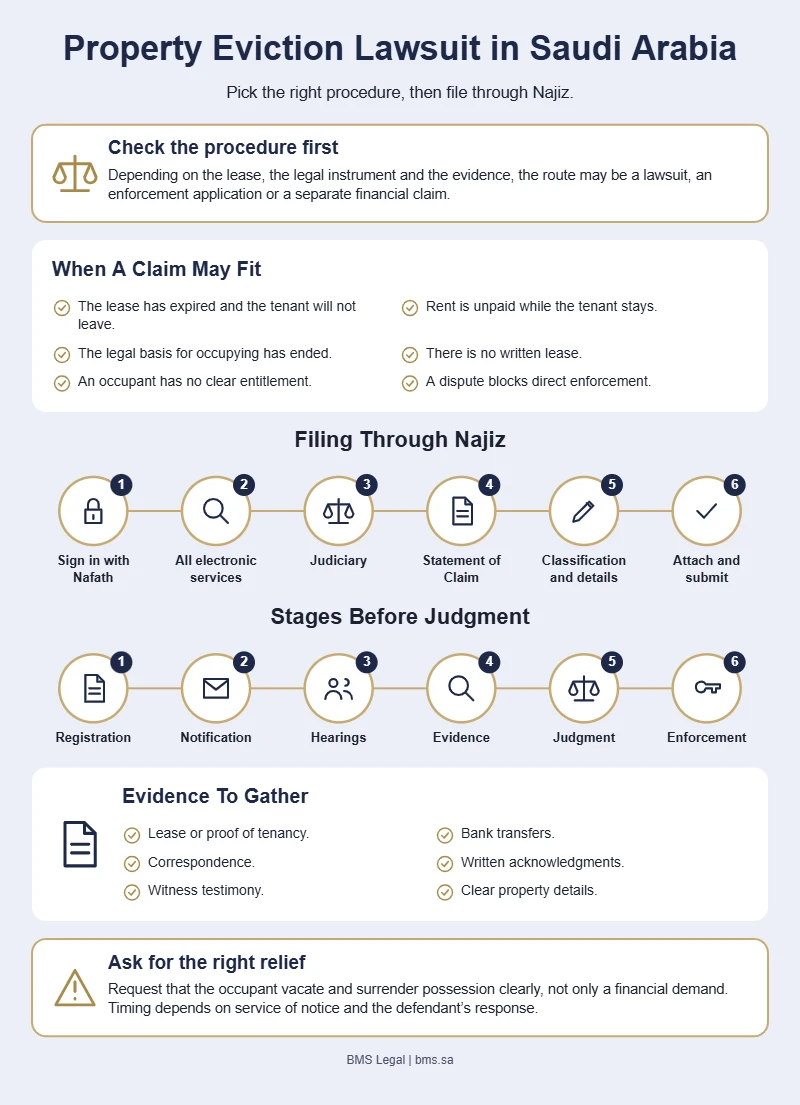
Property Eviction Lawsuit in 60 Seconds
A property eviction lawsuit is generally required when the owner needs a new judicial judgment ordering a tenant or occupant to vacate and return the property. If a legally enforceable judgment or electronic lease already exists, an enforcement application may be the appropriate alternative.
| Situation | Potential Legal Route |
|---|---|
| Documented electronic lease eligible for enforcement | Enforcement application |
| Existing enforceable eviction judgment | Enforcement application |
| Paper lease involving a disputed obligation to surrender possession | Eviction lawsuit |
| Occupant without a clear lease | Claim based on the legal circumstances |
| Ownership or partnership dispute | Legal assessment before pursuing eviction |
| Tenant refuses to vacate after lease expiration | Lawsuit or enforcement, depending on the instrument |
The appropriate legal route depends on the documents, enforceability of the instrument, and circumstances of the dispute.
What Is a Property Eviction Lawsuit?
A property eviction lawsuit in Saudi Arabia is a judicial claim through which a property owner or landlord seeks an order requiring an occupant to vacate real estate and surrender possession.
The owner’s desire to recover the property is not sufficient by itself. There must be a legally relevant basis for the claim, such as lease expiration, unpaid rent, or occupation without a valid legal entitlement.
Eviction also differs from a claim for unpaid rent. Eviction concerns recovery of possession, while a rent recovery claim seeks payment of money. Depending on the facts and applicable procedural rules, both types of relief may be requested in the same proceedings.
| Legal Action | Purpose | Practical Outcome |
|---|---|---|
| Eviction lawsuit | Recover possession | Occupant vacates and returns the property |
| Lease termination | End the contractual relationship | Contractual obligations terminate as legally applicable |
| Unpaid rent claim | Recover outstanding rent | Monetary judgment or enforceable instrument |
| Compensation for use and occupation | Recover the value of unauthorized occupation | Assessment of reasonable occupation charges |
| Recovery of possession from an unauthorized occupant | Address occupation without a tenancy relationship | Restoration of lawful possession |
An eviction lawsuit against a tenant normally involves an existing or previous tenancy relationship.
If no tenancy relationship can be established, the legal claim may instead concern unauthorized occupation or recovery of possession. In such circumstances, a standard tenant eviction template may not adequately describe the dispute.
When Can You File a Property Eviction Lawsuit in Saudi Arabia?
A property eviction claim may be appropriate when a landlord or owner needs a court judgment to recover possession.
Common situations include:
- The lease has expired, but the tenant refuses to surrender the property.
- The tenant has failed to pay rent while continuing to occupy the premises.
- The legal basis for occupying the property has ended.
- A person occupies the premises without a written lease agreement.
- An occupant remains in possession without an identifiable legal entitlement.
- A substantive dispute prevents the owner from proceeding directly with enforcement.
The absence of a written lease does not necessarily prevent judicial proceedings. However, establishing the relationship between the parties and the grounds for possession becomes particularly important.
Bank transfers, correspondence, acknowledgments, witness testimony, and other relevant evidence may help establish the tenancy relationship or occupation.
Where the dispute concerns ownership, co-ownership, partnership rights, or an agreement to sell property, the legal characterization may differ. In such cases, the owner should not automatically use a standard eviction claim.
When Is an Eviction Lawsuit Not the First Step?
A property eviction lawsuit in Saudi Arabia is not always necessary.
If the owner already holds an enforceable instrument, an enforcement application may be more appropriate than filing a new lawsuit.
Before proceeding, consider:
- Is the electronic lease properly documented and legally enforceable?
- Has an enforceable eviction judgment already been issued?
- Is the disagreement limited to unpaid money rather than recovery of possession?
- Does the occupant claim ownership or partnership rights?
- Are there significant disputes involving the claimant’s standing or contractual rights?
The essential distinction is that a lawsuit seeks a new judgment, whereas enforcement proceedings rely on an existing enforceable instrument.
The Saudi Ministry of Justice provides the Statement of Claim service through Najiz, allowing eligible applicants to submit the details of their claims, identify the parties, and attach supporting documents.
Where an enforceable judgment or instrument already exists, attention shifts to the enforcement stage.
Understanding the time required to enforce a property eviction judgment in Saudi Arabia can help owners understand what may happen after the judgment becomes enforceable or an enforcement application is accepted.
Before Filing: Verify the Correct Legal Procedure
In eviction disputes, preparing an appropriate statement of claim is only one part of the process. Depending on the lease, the legal instrument, and the supporting evidence, the appropriate procedure may be litigation, enforcement, or a separate financial claim.
1. Examine the Legal Instrument
Determine whether you hold an enforceable electronic lease or require a new judicial judgment.
2. Organize the Facts
Present lease expiration, non-payment, or unauthorized occupation in a clear chronological sequence.
3. Identify the Relief Requested
The request to vacate and surrender possession should be explicit rather than expressed as a vague or purely financial demand.
A preliminary review of the documents can help determine whether the case requires a property eviction statement of claim or an enforcement application.
Requirements for Filing a Property Eviction Lawsuit
Before initiating proceedings, review the following essential elements.
Legal Standing
The claimant must have the relevant legal capacity or authority, such as being the property owner, landlord, authorized attorney-in-fact, or lawful representative of the rights holder.
Grounds for Eviction
The claim should identify a legally relevant reason for recovering possession, including lease expiration, non-payment, a material contractual breach, or unauthorized occupation.
Property Identification
The property should be accurately identified by its city, district, unit number, property type, and relevant lease or title deed details.
Supporting Documents
Relevant records may include the lease agreement, title deed, power of attorney, notices, bank transfers, payment records, and correspondence.
Specific Relief
The statement of claim should expressly request an order requiring the defendant to vacate and surrender possession.
Avoid vague wording such as “resolve the problem” or “remove the tenant.”
Instead, identify the property and request an order requiring the defendant to vacate and surrender it, together with any adequately supported claim for unpaid rent or compensation.
Property Eviction Statement of Claim: Essential Information
An eviction statement of claim is the formal document setting out the relevant facts and relief requested from the competent court.
A clear statement of claim should generally contain:
- The claimant’s and defendant’s identifying details and legal capacities.
- An accurate description of the property.
- The relationship between the parties, including any lease or other basis of occupation.
- The grounds for seeking eviction.
- The specific orders requested from the court.
- Supporting documents and evidence.
The wording should reflect the actual circumstances.
For example, a claim against a tenant whose lease has expired differs from a claim involving an occupant without a written agreement. It also differs from a dispute where the tenant alleges that rent has been paid or the agreement has been renewed.
How to Draft the Requested Relief
Depending on the facts, the requested relief may include:
- An order requiring the defendant to vacate the property.
- An order requiring the defendant to surrender possession free from occupants and belongings, as appropriate.
- Payment of proven outstanding rent.
- Compensation or reasonable occupation charges where legally justified.
- Litigation costs as determined by the court.
Sample Property Eviction Statement of Claim Against a Tenant
The following sample is provided for general guidance and must be adapted to the relevant lease, facts, evidence, and applicable law.
It should not be treated as a universal court document.
First: Case Information and Parties
To the Presiding Judge and Members of the Competent Judicial Circuit
Respectfully,
Claimant: [Name of property owner or landlord]
Identification/Registration Number: [….]
Address: [….]
Defendant: [Name of tenant or occupant]
Identification/Registration Number: [….]
Address: [….]
Second: Subject of the Claim
A claim seeking eviction and handover of the property due to [lease expiration / failure to pay rent / continued occupation without lawful entitlement].
Third: Statement of Facts
The claimant entered into a lease agreement with the defendant concerning the property located at [city/district/unit number/property details].
The agreement was executed on [date], with the lease term commencing on [date] and ending on [date].
The defendant has [remained in possession after lease expiration and refused to surrender the premises / failed to pay outstanding rent / continued occupying the property without valid legal entitlement].
The claimant requested that the defendant surrender the property. However, the defendant has not vacated the premises as of the filing date.
Fourth: Supporting Documents and Evidence
The claimant relies on the following documents, where applicable:
- The lease agreement or other evidence establishing the relationship.
- The property title deed or proof of legal standing.
- Any relevant demand notice or eviction notice.
- Payment records or evidence of outstanding rent.
- Relevant correspondence and supporting evidence.
Fifth: Relief Requested
The claimant respectfully requests that the court:
- Order the defendant to vacate the property identified in the claim.
- Order the defendant to surrender possession of the property free from occupants and belongings, as appropriate.
- Order payment of outstanding rent where established by the documents.
- Preserve the claimant’s right to pursue other legally available claims arising from property damage or unauthorized occupation.
- Award litigation costs as determined by the court.
Sixth: Closing Statement
For the reasons stated above, the claimant respectfully requests that the court register and consider this claim and issue the appropriate judgment in accordance with applicable Saudi law.
Submitted by: [….]
Date: [….]
Signature: [….]
This sample illustrates the general structure of an eviction statement of claim.
The wording must be adapted where the lease is electronic, no written lease exists, or the occupant asserts another legal right to the property.
How to File a Property Eviction Lawsuit Through Najiz
Filing a property eviction lawsuit in Saudi Arabia generally begins with the Statement of Claim service available through the Saudi Ministry of Justice.
The procedure involves signing in, choosing the relevant judicial service, entering the case details, and attaching supporting documents.
Steps to Submit an Eviction Claim
- Access the Najiz electronic services platform using National Single Sign-On (Nafath).
- Select All Electronic Services.
- Open the Judiciary services category.
- Choose Statement of Claim.
- Select Submit New Application.
- Choose the appropriate case classification and review its requirements.
- Enter the claimant’s, defendant’s, and case details, including the property information.
- State the facts and relief requested, and attach the required documents.
- Review the application and submit it.
These steps follow the official Saudi Ministry of Justice instructions for filing a Statement of Claim.
Before submission, verify the case classification, legal basis, and requested orders.
Where an enforceable instrument already exists, an enforcement application may be more appropriate than a new lawsuit.
Documents Required for a Property Eviction Lawsuit
The required documents vary according to the legal relationship, the grounds for eviction, and the nature of the dispute.
Commonly relevant documents include:
- An electronic or paper lease agreement.
- The property title deed or other proof of the claimant’s legal standing.
- A valid power of attorney where a representative files the claim.
- Any relevant eviction or demand notice.
- Evidence of unpaid rent or lease expiration.
- Correspondence and other evidence supporting the claim.
- Accurate information identifying the property.
Where no written lease exists, other forms of evidence become especially important.
Bank transfers, WhatsApp messages, acknowledgments, witness testimony, and relevant correspondence may help establish the relationship between the parties or the fact of occupation.
Such evidence should be organized and presented clearly in the statement of claim.
Stages of an Eviction Lawsuit Before Judgment
After an eviction statement of claim is submitted, the case may proceed through several judicial stages.
The duration of each stage depends on the completeness of the application, service of notice, the defendant’s response, and the complexity of the dispute.
Main Stages of the Proceedings
- Registration: The statement of claim and supporting documents are submitted and processed.
- Notification: The defendant is notified of the proceedings through the applicable procedure.
- Hearings and submissions: The parties present their arguments and defenses.
- Examination of evidence: The court reviews the lease, supporting documents, and relevant evidence.
- Judgment: The court may grant, reject, or partially grant the requested relief.
- Enforcement: Once the judgment becomes enforceable, the successful party may proceed through the applicable enforcement procedures.
The Ministry of Justice explains the broader sequence through its official guide to the judicial case process in Saudi Arabia.
After obtaining an enforceable decision, the next issue is enforcement of the property eviction judgment and completion of the handover procedure.
Common Mistakes That Can Weaken an Eviction Claim
Avoid the following mistakes before submitting an eviction statement of claim:
- Filing a new lawsuit despite having a directly enforceable instrument.
- Failing to identify the property accurately.
- Omitting evidence establishing the claimant’s legal standing.
- Failing to request handover of the property expressly.
- Confusing eviction with a claim for unpaid rent.
- Copying a generic claim template without adapting the facts.
- Changing locks or disconnecting utilities without following lawful procedures.
- Submitting numerous documents without organizing or identifying them.
An effective statement of claim does not require unnecessary length.
It requires a clear chronology, relevant evidence, and specific requests that the court can assess.
When Should You Consult a Property Eviction Lawyer?
Legal review becomes especially important when the facts are disputed or the supporting documents are incomplete.
The issue is not merely how to prepare the statement of claim, but whether filing that claim is the appropriate procedure.
Consider obtaining legal advice where:
- The lease is undocumented or its terms are unclear.
- The tenant claims to have paid rent or renewed the agreement.
- No written lease exists.
- Outstanding rent or compensation is also being claimed.
- Ownership or the claimant’s legal standing is disputed.
- An eviction judgment has already been issued and enforcement is required.
- The tenant has raised substantive objections or defenses.
In these situations, a legal assessment can help determine whether the appropriate course is litigation, enforcement, a separate monetary claim, or settlement.
Where lease terms are unclear, payment is disputed, or an occupant remains without an identifiable legal entitlement, consulting a real estate disputes lawyer in Jeddah may help clarify the available legal options.
Frequently Asked Questions About Property Eviction Lawsuits in Saudi Arabia
What is a property eviction lawsuit in Saudi Arabia?
A property eviction lawsuit is a judicial claim through which a landlord or property owner seeks a court order requiring an occupant to vacate and surrender possession. The claim must be supported by an appropriate legal basis, such as lease expiration or unauthorized occupation, and by relevant evidence.
When can a landlord file an eviction lawsuit?
A landlord may seek eviction where there is a legally relevant ground for recovering possession, such as lease expiration, failure to pay rent, or continued occupation without lawful entitlement. Whether litigation is necessary depends on the lease, available evidence, and whether an enforceable instrument already exists.
What are the requirements for an eviction lawsuit?
The main requirements include establishing the claimant's legal standing, identifying the property, explaining the grounds for eviction, and providing supporting documents. The statement of claim should also specify the relief requested, particularly the order to vacate and surrender possession of the property.
How do I file an eviction lawsuit through Najiz?
Eligible applicants can use the Najiz Statement of Claim service . After signing in, they select the relevant judicial service, choose the case classification, enter party and claim details, attach documents, and submit the application. The classification and requirements should be checked before filing.
What information must an eviction statement of claim contain?
An eviction statement of claim should identify the claimant and defendant, accurately describe the property, explain the legal relationship and grounds for eviction, and specify the orders requested. It should include supporting documents that establish the claimant's standing and relevant facts.
Is there a standard property eviction claim template?
There is no single template suitable for every eviction dispute. The appropriate wording depends on the lease, the parties' relationship, the grounds for recovery of possession, and the available evidence. A sample may help organize the document, but the final claim must be adapted to the particular circumstances.
Other Points Landlords Should Check
Can I file a property eviction lawsuit without a lease agreement?
The absence of a written lease does not automatically prevent judicial proceedings. However, the claimant may need to rely on other evidence, such as bank transfers, correspondence, acknowledgments, or witness testimony, to establish the relevant relationship or occupation and support the request for possession.
Does an electronic Ejar lease require an eviction lawsuit?
Not necessarily. A qualifying documented electronic lease may be enforceable without obtaining a new judgment, depending on the terms, obligation involved, and applicable requirements. The Saudi Real Estate General Authority’s Ejar information provides official background on the electronic rental framework.
Can a landlord change the locks or disconnect utilities?
A landlord should not assume that changing locks, disconnecting utilities, or physically removing an occupant is a lawful substitute for court proceedings or enforcement. Such measures may create additional legal risks. The appropriate approach is to establish the right to possession and follow the applicable judicial or enforcement procedure.
Conclusion: Choosing the Correct Property Eviction Procedure
A property eviction lawsuit in Saudi Arabia begins with examining the available legal instrument before preparing the statement of claim.
If a qualifying electronic lease or enforceable judgment exists, an enforcement application may be appropriate. If the dispute concerns the lease, legal standing, or unauthorized occupation, a new judicial claim may be necessary.
Before filing, organize the lease, title deed, power of attorney where applicable, property information, and evidence supporting the grounds for eviction.
Do not rely on a generic eviction claim template without adapting it to the facts of your case.
For a preliminary assessment, you may contact BMS Legal Law Firm to discuss whether the appropriate route is an eviction lawsuit, an enforcement application, or another legal procedure.
Official Legal and Procedural Sources
- Saudi Ministry of Justice — Statement of Claim Service. Official information on filing a lawsuit, selecting the case classification, and submitting supporting documents.
- Saudi Ministry of Justice — Judicial Case Process. An overview of case submission, processing, and judicial proceedings.
- Real Estate General Authority — Ejar Platform. Official information about Saudi Arabia’s regulated electronic rental platform and standardized leasing framework.
Disclaimer: This article is for general legal awareness and is not advice on an individual case, and reading it does not create a lawyer–client relationship. The legal assessment varies with the facts, the documents and the rules that apply to each case.