
Forgery penalties in Saudi Arabia vary depending on the type of document and how the offence was committed. In certain aggravated cases, penalties can reach 10 years’ imprisonment and a fine of SAR 1 million. Forging a private document, by contrast, may result in imprisonment for up to three years and a fine of up to SAR 300,000, or either penalty.
For individuals facing existing allegations, understanding the available legal representation in forgery cases can help clarify the scope of legal assistance and the next procedural steps.
Saudi Arabia’s Penal Code for Forgery Offenses determines the applicable penalties according to the nature of the offence and its statutory requirements. It also addresses the liability of individuals who knowingly use forged documents.
This guide explains seven major categories of forgery and their penalties, the differences between official and private documents, and the initial steps to consider when dealing with a document suspected of being forged.
Facing a Forgery Allegation in Saudi Arabia?
Forgery penalties depend on the document, alleged alteration and evidence.
BMS Legal can review your circumstances and explain the available legal
options under Saudi law.
Enquiries are handled with discretion. Case outcomes depend on the facts,
evidence and applicable legal procedures.
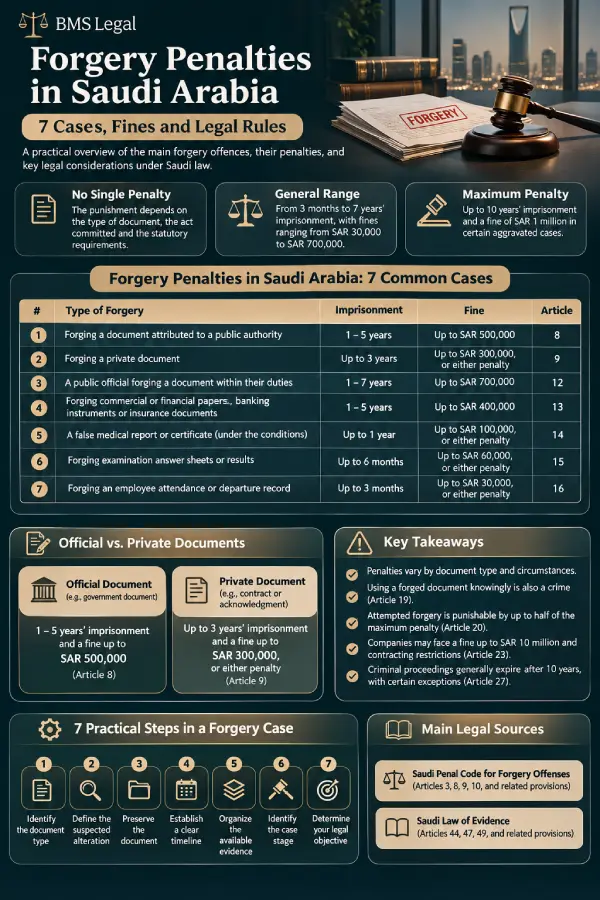
Forgery Penalties in Saudi Arabia at a Glance
Forgery penalties in Saudi Arabia vary depending on the type of document and the nature of the offence. There is no single penalty applicable to every forgery case.
Forging a document attributed to a public authority may result in imprisonment for one to five years and a fine of up to SAR 500,000. Forging a private document carries a maximum of three years’ imprisonment and a fine of SAR 300,000, or either penalty.
Certain aggravated offences carry significantly higher penalties, reaching 10 years’ imprisonment and a fine of SAR 1 million.
These distinctions are established under Articles 3, 8, 9 and 10 of the Saudi Penal Code for Forgery Offenses.
What Is the Punishment for Forgery in Saudi Arabia?
Forgery penalties in Saudi Arabia depend on the type of document or object involved, the nature of the alleged conduct, and whether the legal elements of the offence have been established.
Article 8 of the Penal Code for Forgery Offenses prescribes imprisonment for one to five years and a fine not exceeding SAR 500,000 for forging certain documents attributed to public authorities.
Article 9 provides a different penalty for forging private, non-official documents.
These provisions appear in the official Saudi legislation governing forgery offences, which provides the primary legal basis for distinguishing between categories of forgery.
Forgery Penalties in Saudi Arabia: 7 Common Cases
The following table summarizes seven categories addressed by the law, including imprisonment, financial penalties and the relevant statutory provisions.
| Type of forgery | Imprisonment | Fine | Article |
|---|---|---|---|
| Forging a document attributed to a public authority | 1–5 years | Up to SAR 500,000 | 8 |
| Forging a private document | Up to 3 years | Up to SAR 300,000, or either penalty | 9 |
| A public official forging a document within their official duties | 1–7 years | Up to SAR 700,000 | 12 |
| Forging commercial or financial papers, banking instruments or insurance documents | 1–5 years | Up to SAR 400,000 | 13 |
| Knowingly falsifying or issuing a false medical report or certificate under the statutory conditions | Up to 1 year | Up to SAR 100,000, or either penalty | 14 |
| Forging examination answer sheets or results by a person with the relevant responsibility | Up to 6 months | Up to SAR 60,000, or either penalty | 15 |
| Forging an employee attendance or departure record | Up to 3 months | Up to SAR 30,000, or either penalty | 16 |
Important Legal Distinction When Reading the Penalty Table
A provision requiring imprisonment and a fine is different from one allowing the court to impose either penalty.
Similarly, the maximum statutory punishment does not mean that every defendant will receive the maximum sentence.
The applicable punishment depends on the specific provision, the established facts and the circumstances considered by the competent court.
What Constitutes Forgery Under Saudi Law?
Understanding forgery penalties in Saudi Arabia begins with the legal definition of forgery. Article 1 of the Penal Code for Forgery Offenses defines the offence as altering the truth through a method prohibited by law, in bad faith and with the intention of using the forged material.
The alteration must concern a document, seal, mark or stamp protected by law and be capable of causing material, moral or social harm to a natural or legal person.
Consequently, the mere existence of differences between two versions of a document does not automatically establish a criminal forgery offence.
The discrepancy could result from an authorized amendment, an administrative error or an intentional alteration made without the consent of the relevant party.
What Are the Legal Elements of Forgery?
An assessment of suspected forgery generally involves three connected elements:
- Alteration of the truth: The truth has been changed through a method criminalized by law.
- Bad faith and intention to use: The conduct involves the required dishonest intention and purpose of use.
- Potential harm: The alteration is capable of causing the type of harm recognized by the law.
The harm does not necessarily have to involve an actual financial loss, as the statutory definition also covers moral and social harm.
Conversely, an unintentional mistake or a disagreement over the interpretation of a valid contract does not automatically constitute forgery.
How Can Signatures and Documents Be Forged?
Article 2 identifies various methods through which forgery may occur, including:
- Creating a document that has no genuine original.
- Imitating a signature, fingerprint or seal.
- Changing recorded information through addition, deletion or substitution.
- Recording a false event or statement as though it were genuine.
- Using a genuine signature or fingerprint obtained through deception.
- Misusing a signature or fingerprint entrusted to someone on a blank document.
Practical example: A person signs a contract specifying an agreed amount. The amount is later changed without that person’s consent, with the intention of using the altered document.
This situation may raise suspicion of forgery. However, criminal responsibility and the applicable penalty depend on establishing the alteration, its circumstances and the legal classification of the document.
Official vs. Private Document Forgery Penalties in Saudi Arabia
One of the most important distinctions in forgery penalties in Saudi Arabia concerns documents attributed to public authorities, private documents and instruments subject to specific statutory provisions.
The classification of the document can significantly affect the applicable punishment.
Penalty for Forging an Official Document
Under Article 8, forging a document attributed to a public authority, or to one of its employees acting in an official capacity, may result in:
- Imprisonment for one to five years.
- A fine not exceeding SAR 500,000.
The provision also covers other documents falling within the specific categories stated in the law.
Article 12 separately addresses a public official who forges a document that falls within the official’s responsibility to prepare.
In that case, the penalty is imprisonment for one to seven years and a fine not exceeding SAR 700,000.
It is therefore important to distinguish between forging a document attributed to a government authority and a public official personally forging a document within their official responsibilities.
Penalty for Forging a Private Document
Article 9 prescribes imprisonment for a period not exceeding three years and a fine not exceeding SAR 300,000, or either of these penalties, for forging a private document.
Such a document may include a private agreement, written acknowledgment or document exchanged between individuals, provided that the statutory elements of forgery are established.
However, a disagreement over the amount stated in a contract or the validity of a financial claim does not establish forgery without evidence of a criminal alteration of the truth.
The Saudi Law of Evidence distinguishes between official and ordinary documents and regulates their evidentiary value in civil and commercial matters.
The criminal penalty itself remains governed by the applicable provisions of the Penal Code for Forgery Offenses.
When Can Forgery Carry a 10-Year Prison Sentence?
Certain aggravated offences under Saudi law carry some of the most severe forgery penalties in Saudi Arabia, including imprisonment for up to 10 years and a fine of up to SAR 1 million.
These include specific categories involving high-level official seals under Article 3 and documents attributed to certain senior officials under Article 10.
These aggravated penalties must not be applied indiscriminately to every forgery allegation.
Each offence has its own statutory elements and prescribed sentencing range.
| Aggravated forgery offence | Imprisonment | Fine | Article |
|---|---|---|---|
| Forgery of specified high-level official seals | 3–10 years | Up to SAR 1 million | 3 |
| Forgery of a seal or mark attributed to a public authority under the applicable provision | 1–7 years | Up to SAR 700,000 | 4 |
| Forgery of documents attributed to the senior officials specified in Article 10 | 3–10 years | Up to SAR 1 million | 10 |
| Forgery of bonds or instruments of value issued by the public treasury | 2–7 years | Up to SAR 1 million, plus compensation for the public treasury’s losses | 11 |
The law also contains provisions concerning other seals, stamps and historical documents.
This guide focuses on the categories most directly relevant to determining the potential punishment, while the full statutory requirements remain available in the official Penal Code for Forgery Offenses.
What Is the Penalty for Forging Checks and Promissory Notes?
Under Article 13 of the Saudi Penal Code for Forgery Offenses, forging commercial or financial papers, banking instruments, or insurance documents carries imprisonment for one to five years and a fine not exceeding SAR 400,000.
Forgery penalties in Saudi Arabia for checks and promissory notes may therefore differ from those applicable to ordinary private documents. The correct legal classification depends on the nature of the instrument and the alleged conduct.
A dispute involving a forged check or promissory note should not automatically be classified as private-document forgery, as commercial instruments may fall under the specific provisions of Article 13.
Are Penalties for Forged Medical Reports Different?
Yes. Article 14 specifically addresses situations involving the falsification or knowing issuance of a false medical report or certificate under the conditions stated in the provision.
The prescribed punishment is:
- Imprisonment for up to one year.
- A fine not exceeding SAR 100,000.
- Or either of these penalties.
This provision should not automatically be applied to every document connected with a healthcare institution.
The nature of the document, the act committed and the statutory requirements must first be examined.
What Is the Penalty for Using a Forged Document in Saudi Arabia?
Forgery penalties in Saudi Arabia also apply to individuals who knowingly use forged documents, even if they did not personally create or alter them.
Article 19 provides that a person who knowingly uses an object or document whose forgery is criminalized under the law may face the same punishment prescribed for the relevant forgery offence.
Accordingly, someone who did not personally forge a document may still incur criminal liability if they knowingly used it and the statutory conditions are satisfied.
Can Someone Be Punished for Using a Forged Document Without Knowing?
When assessing forgery penalties in Saudi Arabia, it is essential to distinguish between knowingly using a forged document and using one without awareness of its falsification. Article 19 requires knowledge of the forgery for criminal liability under this provision.
Possessing or submitting a document is therefore not, by itself, sufficient to establish that the person knew it was forged.
Relevant evidence may include how the document was obtained, communications relating to it and the circumstances preceding its use.
The person’s knowledge must be examined in light of the available evidence rather than assumed from possession alone.
What Is the Penalty for Attempted Forgery?
Forgery penalties in Saudi Arabia also cover attempted offences. Under Article 20 of the Penal Code for Forgery Offenses, an attempt is punishable by a penalty not exceeding half of the maximum penalty prescribed for the completed offence.
For example, if the maximum prison sentence for a completed offence is three years, the imprisonment imposed for an attempt under this rule cannot exceed one year and six months.
However, merely considering or preparing for an offence does not necessarily establish a punishable attempt.
The nature of the actions actually undertaken must be examined to determine whether they satisfy the relevant legal requirements.
Can Someone Who Assists in Forgery Be Punished?
Article 21 provides that anyone who participates in a forgery offence through agreement, incitement or assistance is subject to the same penalty prescribed for the offence.
Nevertheless, being employed alongside a person who committed forgery, or having a personal relationship with that person, does not independently establish criminal participation.
The alleged participant’s actual conduct and the evidence connecting that conduct to the offence must be assessed.
Can a Company Be Held Liable for Forgery in Saudi Arabia?
A private business may incur separate statutory liability when its manager or an employee commits a forgery offence for the business’s benefit and with its knowledge, subject to the conditions established in Article 23.
Penalties for Private Entities Involved in Forgery
Where Article 23 applies, a private entity may face:
- A fine of up to SAR 10 million.
- Disqualification from contracting with public authorities for two to five years.
These penalties do not eliminate the criminal liability that may arise against the individual who committed the offence.
It is also important to understand that the mere appearance of a company’s name on a disputed document, or the fact that an alleged offender works for the company, is not sufficient to establish corporate liability.
The authority must examine whether the offence was committed for the entity’s benefit, whether the entity knew of it and whether the remaining statutory conditions are satisfied.
Does Saudi Forgery Law Cover Electronic Documents?
Yes. Forgery offences under Saudi law may involve electronic documents stored or processed using information technology, provided that the statutory elements of the relevant offence are established.
However, the existence of an electronic file or digital signature does not mean that every subsequent modification constitutes forgery.
An alteration may be authorized or form part of a legitimate correction.
By contrast, changing a financial amount, date or material information after approval, without authorization and with the intention of using the altered document, may raise suspicion of forgery.
How Should Suspected Electronic Forgery Be Handled?
Where an electronic document is suspected of having been altered, relevant evidence should be preserved lawfully.
This may include:
- Available original and subsequent versions.
- Modification histories.
- Approval records.
- Related communications.
- Available digital evidence showing when and how the document was handled.
The Saudi Law of Evidence addresses the evidentiary value of digital evidence, while criminal punishment continues to depend on the applicable provisions of the Penal Code for Forgery Offenses.
How Can You Challenge a Document Suspected of Forgery?
It is essential to distinguish between a criminal investigation into forgery and an allegation that a document submitted in a civil or commercial dispute has been forged.
The criminal procedure concerns potential criminal responsibility.
By contrast, the Saudi Law of Evidence establishes specific rules for challenging documents within civil and commercial proceedings falling under that law.
These two procedural routes should not be treated as identical.
How to Raise a Forgery Allegation Before a Saudi Court
Article 44 of the Law of Evidence regulates allegations of forgery concerning documents submitted in relevant proceedings.
A party may raise the allegation through a written memorandum submitted to the court or by recording it in the hearing minutes.
The allegation must identify the disputed parts of the document, the supporting indications of forgery and the investigative measures requested.
Procedural Steps for Challenging a Document as Forged
- Identify the disputed document: Specify which document is being challenged and how it relates to the proceedings.
- Identify the alleged alterations: Explain whether the disputed element concerns a signature, date, amount or other recorded information.
- Present supporting indications: Identify the evidence and relevant investigative steps.
- Submit the allegation: File a memorandum or record the allegation in the court hearing minutes.
- Await the court’s assessment: The court determines whether the allegation is material and whether further investigation is justified.
- Follow the procedural outcome: Review any order for investigation and its consequences under the Law of Evidence.
The court does not automatically order an investigation merely because a party alleges forgery.
Under Article 44, an investigation may be ordered when the allegation is material to the dispute, the available facts and documents are insufficient to resolve authenticity, and the requested investigative procedure is relevant and legally permissible.
Does Alleging Forgery Automatically Suspend Enforcement?
No. Simply alleging that a document has been forged does not automatically suspend enforcement.
Article 47 of the Saudi Law of Evidence provides that an order to investigate an allegation of forgery suspends the enforceability of the disputed document, without prejudice to precautionary measures.
The distinction is between merely submitting a forgery allegation and the court actually ordering an investigation into it.
This distinction can affect the procedural steps available while a claim, lawsuit or enforcement matter is pending.
When Can a Court Reject a Forgery Allegation?
A court may decline to order an investigation where:
- The allegation is not material to the dispute.
- The existing facts and documents are sufficient to determine authenticity.
- The requested investigation would not assist in resolving the dispute.
- The proposed investigative measure is legally impermissible.
These requirements arise under Article 44 of the Law of Evidence.
Article 49 also provides for a fine not exceeding SAR 10,000 in specified circumstances involving the rejection of an allegation or the loss of the right to prove it, subject to the exceptions stated in the law.
Judicial Fine vs. Filing Fee
The SAR 10,000 amount stated in Article 49 is the maximum judicial fine applicable in certain circumstances.
It is not a fixed government fee for filing a forgery allegation, nor does it represent a law firm’s professional fees.
Confusing judicial penalties with procedural fees can lead to an inaccurate assessment of the financial implications of challenging a document.
Is There a Statute of Limitations for Forgery in Saudi Arabia?
Article 27 of the Penal Code for Forgery Offenses provides for the expiry of criminal proceedings after 10 years, beginning on the day following the commission of the offence.
However, this rule excludes the offences specified in Articles 3 and 10.
It is essential to distinguish between the expiry of criminal proceedings and the punishment prescribed for forgery.
The 10-year period concerns the termination of criminal proceedings in the situations addressed by Article 27. It does not mean that a sentence already imposed automatically expires after 10 years.
The limitation period should also not be confused with the duration of an investigation, the time required for trial or the rules governing private claims.
For a more detailed explanation of limitation periods and the distinction between public and private rights, see our guide to the criminal statute of limitations in Saudi Arabia.
Can Forgery Charges Be Dropped Through Waiver or Exemption?
A victim’s decision to waive a private claim does not automatically terminate the public criminal action or eliminate the criminal penalty for forgery.
Similarly, withdrawing an allegation concerning a disputed document in civil or commercial proceedings is not equivalent to obtaining an exemption from criminal punishment.
Article 25 of the Penal Code for Forgery Offenses establishes specific circumstances in which an offender may be exempted from punishment.
When Can an Offender Be Exempted From Punishment?
The provision requires exemption when an offender reports the offence before its discovery and before the forged material is used, subject to the statutory conditions.
It also allows the court to exempt an offender after discovery of the offence if the offender identifies other perpetrators and facilitates their apprehension.
Consequently, remorse or an admission alone does not automatically establish entitlement to exemption.
The applicable statutory requirements must be satisfied.
Practical Guide: 7 Steps Before Taking Action in a Forgery Case
When a document is suspected of forgery, or someone faces an allegation involving its use, organizing the available information can help clarify the legal issue and procedural stage.
These steps do not establish that forgery has occurred and do not replace the procedures required by the competent authorities.
Initial Forgery Case Checklist
1. Identify the type of document
Determine whether the document is a private contract, government document, commercial instrument, medical report or electronic record.
2. Identify the suspected alteration
Specify whether the concern involves a signature, amount, date, seal, added information or false attribution to an authority or person.
3. Preserve the document
Keep the original and any available copies lawfully, without altering, destroying or improperly handling the material.
4. Establish a timeline
Record when the document was created and signed, when the suspected alteration occurred and when the document was first known to have been used.
5. Organize the available evidence
Identify relevant correspondence, earlier versions, transmission records, approval logs and other supporting documents that can lawfully be obtained or retained.
6. Identify the procedural stage
Determine whether the matter involves initial suspicion, a report, criminal investigation, referral, court proceedings or enforcement.
7. Define the legal objective
Clarify whether the purpose is to report suspected wrongdoing, challenge a document’s authenticity, defend against an allegation or protect a right arising from the disputed document.
If the case proceeds to an investigation or court, understanding the stages of a criminal case in Saudi Arabia can help distinguish an initial report from a formal accusation or final judicial ruling.
Practical Example: Different Amounts on a Promissory Note
When assessing forgery penalties in Saudi Arabia, consider a situation involving two versions of the same promissory note.
The first states an amount of SAR 80,000, while the second states SAR 180,000.
The difference alone does not establish that forgery has occurred or determine the applicable criminal penalty.
However, it warrants examining when the amount was changed, who made the alteration, and whether it was properly authorized. The legal classification and potential punishment depend on the established facts and the applicable provisions of Saudi forgery law.
If the evidence establishes that the amount was changed without authorization, with the intention of using the altered instrument, a suspected forgery offence may arise.
The legal classification of the promissory note as a commercial instrument must also be examined in light of Article 13.
Conversely, if no unlawful alteration of the truth can be established, the dispute may remain one concerning the debt, the validity of the obligation or the interpretation of the instrument.
This example is hypothetical and illustrates the method of legal analysis. It does not describe an actual BMS Legal client matter.
What Can Affect the Duration of a Forgery Case?
The duration of a forgery case and the application of forgery penalties in Saudi Arabia depend on the complexity of the allegations, the available evidence, and the procedural stage. The Penal Code for Forgery Offenses does not establish a fixed timeframe for completing every investigation or trial.
The time required may depend on:
- The nature of the documents.
- Whether technical or forensic examination is needed.
- The number of parties involved.
- The completeness of available evidence.
- The procedural stage of the case.
- The steps required by the competent authorities.
Therefore, it would be inaccurate to promise a particular completion date without reviewing the case file, the competent authority and the proceedings already underway.
Before Filing an Objection or Taking Legal Action in a Forgery Case
The appropriate legal approach may depend on the type of document, when it first appeared, how it was used and whether a criminal investigation or court case is already pending.
Organizing this information can help identify the issues that require examination before taking the next procedural step.
At BMS Legal Law Firm, the assessment process begins with a summary of the circumstances, followed by identifying the nature of the dispute and determining which documents are necessary for the review.
Further information about this approach is available on our How We Work page.
No specific judicial outcome can be guaranteed before examining the facts, documents and applicable legal procedures.
Not Sure What Your Forgery Case Requires?
Whether you are challenging a suspicious document or responding
to a forgery allegation, the appropriate next step depends on
the evidence and the stage of your case.
BMS Legal can assess the available information and explain
your legal options under Saudi law.
✓
Identify the disputed document and alleged alteration.
✓
Understand the applicable legal procedure.
✓
Determine which evidence requires examination.
Share a brief case summary first. Avoid sending sensitive documents
before an appropriate review channel is established.
Legal outcomes depend on the facts, evidence and applicable procedures.
Frequently Asked Questions About Forgery Penalties in Saudi Arabia
Warning: Undefined array key "name" in /home/u798195860/domains/bms.sa/public_html/wp-content/plugins/seo-by-rank-math-pro/includes/modules/schema/shortcode/faqpage.php on line 31
Warning: Undefined array key "text" in /home/u798195860/domains/bms.sa/public_html/wp-content/plugins/seo-by-rank-math-pro/includes/modules/schema/shortcode/faqpage.php on line 32
What is the maximum penalty for forgery in Saudi Arabia?
The maximum penalty for certain aggravated forgery offences is 10 years' imprisonment and a fine of up to SAR 1 million under Articles 3 and 10 of the Saudi Penal Code for Forgery Offenses. Other offences carry different penalties depending on the document type and circumstances.
Can you go to prison for forging a signature in Saudi Arabia?
Yes. Forging a signature may constitute a criminal offence if the statutory elements of forgery are established. The punishment depends on the document involved. Forgery of a private document may result in up to three years' imprisonment and a SAR 300,000 fine, or either penalty.
Is using a forged document a crime if you did not create it?
Yes, if the person knowingly uses the forged document. Under Article 19, knowingly using forged material may carry the same punishment as the underlying forgery offence. Merely possessing or submitting a document does not automatically prove knowledge of the forgery.
Can a forgery case be dismissed after 10 years in Saudi Arabia?
Article 27 generally provides for the expiry of criminal proceedings after 10 years, calculated from the day following the offence. However, offences under Articles 3 and 10 are excluded. This rule concerns criminal proceedings and does not automatically cancel an existing sentence.
Does reporting forgery automatically stop enforcement of a disputed document?
No. Alleging forgery does not automatically suspend enforcement. Under Article 47 of the Saudi Law of Evidence, a court order investigating the forgery allegation suspends the disputed document's enforceability, without affecting applicable precautionary measures.
Conclusion
Forgery penalties in Saudi Arabia depend on the type of document, the method used to alter the truth and the legal capacity or status of the person responsible.
Certain aggravated offences may carry up to 10 years’ imprisonment and a fine of SAR 1 million, while other categories are subject to lower statutory penalties.
Criminal liability may also extend to a person who knowingly uses forged material, participates in the offence or operates a private entity meeting the conditions for corporate liability.
For any ongoing case, the most important initial step is to identify the document, the alleged alteration, the available evidence and the current procedural stage before deciding on an appropriate course of action.
Where the facts require legal assessment, the relevant circumstances and documents should be examined without assuming or promising a particular judicial outcome.
Legal Disclaimer
This article provides general legal information about the laws and regulations of Saudi Arabia. It does not constitute legal advice concerning an individual case, and reading it does not establish an attorney-client relationship.
Any assessment of a forgery matter depends on the relevant facts, documents, legal procedures and statutory provisions applicable to the particular circumstances.