
The types of cybercrimes in Saudi Arabia cover a wide range of conduct, from unauthorized access to accounts and systems to blackmail, defamation, fraud, data attacks, and unlawful digital content. The mere use of a phone, computer, or the internet does not automatically make an act a cybercrime. The legal classification depends on what occurred, the applicable statutory provision, and the available evidence.
Saudi Arabia’s Anti-Cyber Crime Law regulates prohibited conduct and the corresponding penalties, while reporting, investigation, prosecution, and trial are governed by the relevant criminal procedure rules. This guide explains the main types of cybercrimes in Saudi Arabia, their practical examples, penalties, legal elements, methods of proof, and reporting procedures, while also outlining the key steps for both victims and defendants.
7 Types of Cybercrimes in Saudi Arabia at a Glance
The main types of cybercrimes in Saudi Arabia can be grouped into seven practical categories that help explain the nature of an incident before considering penalties or procedures. This is a practical classification for ease of understanding rather than a literal statutory classification, as the Anti-Cyber Crime Law identifies specific offences under the provisions applicable to each case.
A single incident may involve more than one offence. For example, a person may first gain unauthorized access to an account, obtain private images, and later use those images for threats or defamation. The applicable penalty should therefore not be determined solely from the commonly used name of the offence. The sequence of events, evidence, and purpose behind the use of technology must also be considered.
| Type | Simple Example | Key Legal Issue |
|---|---|---|
| Unauthorized access | Accessing an account without permission | Method of access and scope of authorization |
| Cyber fraud | Obtaining money through fraudulent means | Fraudulent method, funds, and evidence |
| Data and system attacks | Deleting data or disrupting a system | Conduct and affected data |
| Blackmail and threats | Threatening to disclose private content | Threat and demand |
| Defamation and privacy violations | Publishing harmful content or invading privacy | Content and manner of use |
| Identity impersonation | Using another person’s identity online | Purpose and related conduct |
| Content-related offences | Producing or distributing prohibited content | Nature of content and applicable law |
If an incident does not clearly fall within only one category, the priority is not to search immediately for the maximum penalty. The first step is to identify exactly what happened and what evidence relates to each act.
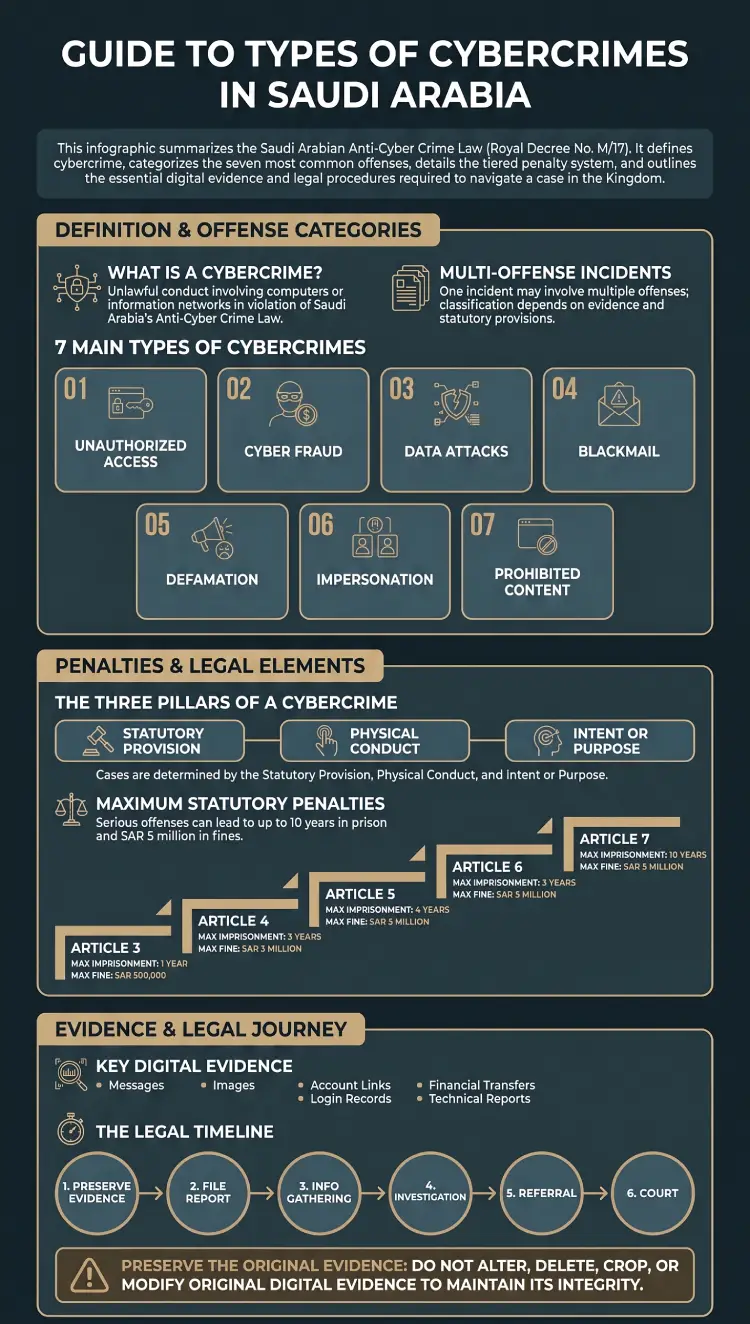
What Are Cybercrimes and What Are Their Main Types?
A cybercrime is conduct involving the use of a computer or information network in violation of Saudi Arabia’s Anti-Cyber Crime Law. Technology may itself be the target of the offence, such as when a system is disrupted or data is deleted, or it may be used as the means to commit another offence, such as fraud, blackmail, or defamation.
For this reason, cybercrimes are not limited to sophisticated hacking. They may be committed through a mobile phone, email account, website, messaging service, or social media platform.
The phrase types of cyber crimes is commonly used by the public, while Saudi legislation officially uses the concept reflected in the Anti-Cyber Crime Law. This difference in terminology does not by itself change criminal liability. Saudi courts focus on the conduct, evidence, and applicable statutory provision rather than the label used by the complainant.
Cybercrimes Targeting Accounts, Data, and Systems
Unauthorized access and hacking are among the most common forms of cybercrime involving accounts and information systems. Unauthorized access occurs when someone accesses an account, website, or system without permission, and it may also include exceeding the limits of an authorization that was originally granted.
For example, an employee who is authorized to view certain customer information does not automatically have the right to use that information for unrelated personal purposes.
This category also includes attacks against data and systems, such as deleting, damaging, leaking, altering, or republishing data, as well as certain forms of network disruption or interference with access to services. Not every technical failure is a criminal offence; the disruption must be linked to identifiable conduct and supporting evidence.
Identity impersonation and account misuse may also arise when another person’s name, identity, or account is used to create the impression that the offender is that individual. The legal classification depends on what the false identity was used to accomplish, particularly where it is connected to fraud, blackmail, or defamation.
Cybercrimes Targeting Money, Reputation, and Privacy
Cyber fraud may involve the use of technology, false representations, or fraudulent methods to obtain money or financial information. Examples include fake payment links or accounts impersonating trusted institutions to obtain sensitive information or unauthorized transfers.
However, not every online financial dispute constitutes fraud. The legal classification depends on how the money was obtained, the representations made, and the documents, communications, and transaction records connected to the incident.
Cyber blackmail and threats involve the use of technology to pressure another person into acting or refraining from acting under threat. The demand does not necessarily have to involve money; it may concern private images, information, relationships, or other demands.
If you are exposed to such conduct, preserve the messages, account details, links, and timestamps before taking any step that could result in the loss of evidence. The applicable penalty for cyber blackmail in Saudi Arabia depends on the legal characterization of the conduct, the circumstances, and the available evidence.
Saudi law also distinguishes between defamation and invasion of privacy, although both may arise from the same incident. Defamation may involve harming another person through information technology, while privacy violations may involve misuse of devices or private content. Publication is not a necessary element in every privacy-related case, and not every negative online comment automatically amounts to criminal defamation.
Content-related offences and social media offences also depend on the nature of the material produced, sent, published, or stored. A post or message is not criminal merely because it appears on a social media platform; liability arises when the content or its use falls within conduct prohibited by law.
What Are the Penalties for Cybercrimes in Saudi Arabia?
The penalties for the different types of cybercrimes in Saudi Arabia vary according to the conduct proven in the case and the statutory provision that applies. There is therefore no single penalty for hacking, blackmail, defamation, fraud, or attacks against data.
The figures below represent the maximum penalties provided under the Anti-Cyber Crime Law. They do not mean that a court will automatically impose the maximum penalty in every case.
| Article | Main Conduct Covered | Imprisonment Up To | Fine Up To |
|---|---|---|---|
| Article 3 | Interception, certain forms of unauthorized access, blackmail, privacy violations, and defamation | 1 year | SAR 500,000 |
| Article 4 | Fraudulent acquisition of money and certain unlawful access to financial information | 3 years | SAR 2 million |
| Article 5 | Attacks against data and disruption of networks or services | 4 years | SAR 3 million |
| Article 6 | Certain prohibited content and offences committed through information networks | 5 years | SAR 3 million |
| Article 7 | Certain offences involving terrorism, national security, or the national economy | 10 years | SAR 5 million |
Article 13 also allows the court, subject to the statutory requirements, to order confiscation of certain devices, software, tools used to commit the offence, and proceeds derived from it.
A single case may involve more than one prohibited act, so the highest published penalty should not be applied automatically before identifying the provisions that actually govern the incident.
Penalties may also differ depending on the nature of the conduct, the harm caused, and the means used. In cases involving reputational harm, the penalty for online defamation in Saudi Arabia depends on the conduct, evidence, and surrounding circumstances.
What Are the Legal Elements of a Cybercrime and How Is It Proven?
The legal elements of a cybercrime do not follow one identical formula in every case. The analysis begins with identifying a statutory provision that criminalizes the conduct, followed by examining the physical act and any intent or specific purpose required by that provision.
The conduct may involve access, deletion, publication, threats, or unlawful acquisition, while the mental element may relate to the accused person’s knowledge, intention, or a particular purpose required by law.
The proper attribution of the act, the existence of criminal intent, and the sufficiency of the evidence can directly affect the available criminal defence arguments in cybercrime cases based on the allegation and the elements that must be established.
Evidence is particularly important because many examples of cybercrimes arise in a digital environment where information may be altered or deleted. The evidence should therefore connect the content to the relevant account, device, timing, and incident rather than relying on isolated digital material.
Digital Evidence and Source Integrity
Evidence in cybercrime cases may include conversations, messages, images, videos, account links, login records, financial transfers, and technical reports. The weight of each item depends on its source, integrity, ability to be verified, and connection to the alleged conduct.
A screenshot alone may not always resolve the case because its source, originating account, and surrounding context may require verification. It is therefore advisable to preserve the original material, account link, username, date, and time, and to avoid altering original files or deleting conversations.
In threat and blackmail cases, arranging messages chronologically and preserving the account and original source may help clarify how communication developed into a threat or demand. These factors are particularly important when considering how to prove a blackmail case before potentially important digital evidence is lost.
How Does a Cybercrime Case Proceed in Saudi Arabia?
A cybercrime case generally begins with preserving evidence and submitting a report through the appropriate official channel. It may then proceed through information gathering, preliminary inquiries, and investigation.
The Public Prosecution handles criminal investigations within its jurisdiction, and the file may ultimately be closed or referred to the competent court. Understanding the stages of a criminal case in Saudi Arabia can help clarify where the case currently stands and what procedural step may follow.
Before reporting the incident, preserve relevant account information, messages, links, timestamps, bank transfers, and files. Avoid extended confrontation that may encourage the other party to delete content or change accounts, and do not attempt to access the other person’s account unlawfully to recover your information.
Official reporting channels include services for cybercrime reports and the Kollona Amn platform for certain incidents involving blackmail, threats, impersonation, account hacking, and defamation. Once the matter reaches the investigation stage, the authorities may request statements, technical data, devices, or other relevant documents.
What Should You Do If You Are a Victim or a Defendant?
If you are a victim of a cybercrime, begin by preserving the account, messages, links, timestamps, transfers, and other files connected to the incident. Then use the appropriate official reporting channel and avoid deleting material or engaging in a prolonged confrontation that could increase the harm or result in the loss of evidence.
If you are accused of a cybercrime, first understand the specific conduct attributed to you, the statutory provision involved, and the evidence connected to the allegation. Do not delete data or alter devices in an attempt to affect the investigation. Preserve information that may identify device users, access permissions, and other circumstances relevant to the incident.
Legal review becomes particularly important when the case involves several acts or has progressed to investigation or trial. At that stage, a cybercrime lawyer in Jeddah can assist in assessing the legal classification, available evidence, and the next procedural step.
Frequently Asked Questions About Types of Cybercrimes
What are the main types of cybercrimes in Saudi Arabia?
They include unauthorized access, cyber fraud, data attacks, blackmail, defamation, privacy violations, impersonation, and content-related offences.
What is the difference between cybercrimes and electronic crimes?
“Electronic crimes” is a common term, while Saudi law officially uses the term “cybercrimes” under the Anti-Cyber Crime Law.
What are the penalties for cybercrimes in Saudi Arabia?
Penalties vary by offence and may reach up to 10 years’ imprisonment and SAR 5 million in fines.
Is hacking someone’s account a cybercrime?
It may constitute unauthorized access if the legal elements required under Saudi law are met.
Are blackmail and defamation considered cybercrimes?
Yes, both may fall under the Anti-Cyber Crime Law when the required elements are established.
Is a screenshot enough to prove a cybercrime?
It may support the case, but its value depends on its source, context, authenticity, and connection to the incident.
How can I report a cybercrime in Saudi Arabia?
Reports can be submitted through official government channels, including cybercrime reporting services and Kollona Amn.
What happens after a cybercrime report is filed?
Authorities may gather evidence, investigate the incident, and either close the case or refer it to the competent court.
7 Types of Cybercrimes in Saudi Arabia and Their Penalties are not simply a fixed checklist. A single incident may involve hacking, blackmail, and defamation at the same time, while another apparently similar case may require a different legal classification because the conduct, evidence, or purpose is different.
Where a case requires an integrated review of the incident, evidence, and procedural stage, a law firm in Jeddah such as BMS Legal can help clarify the available legal options and relevant documents under its principle of clarity before action, without making advance promises about the outcome of the case.
Official Source: