
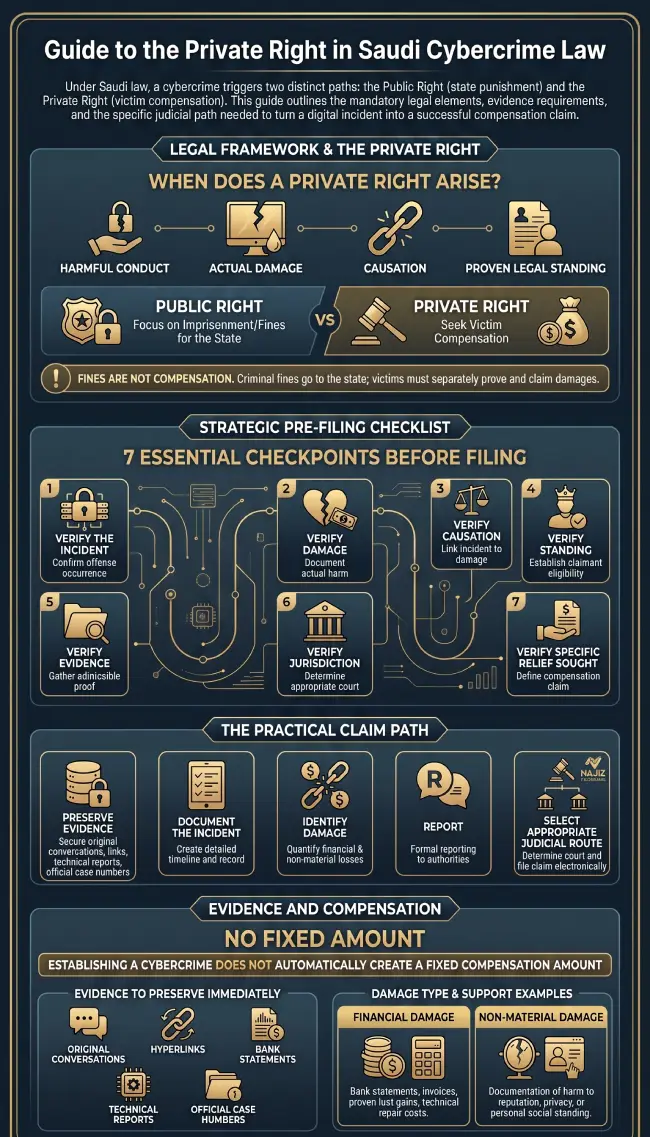
A Private Right in Cybercrime is the injured party’s right to seek redress for damage caused by conduct connected to a cybercrime in Saudi Arabia. A prison sentence or fine imposed on the offender does not automatically entitle the victim to financial compensation. Criminal penalties relate to the public right, while the private claim focuses on the actual damage suffered by an individual or business and the evidence supporting that damage.
The harm may be financial, such as loss of money or costs incurred to restore compromised systems. It may also be non-material, including damage to reputation, privacy, or personal standing. A properly prepared claim therefore begins by identifying the incident, the resulting harm, and the connection between them before determining the compensation sought.
When Does a Private Right in Cybercrime Arise?
A Private Right in Cybercrime may arise when the injured party suffers damage that can be linked to the conduct forming the basis of the cybercrime and supported by appropriate evidence. Filing a report or establishing that unlawful electronic conduct occurred does not, by itself, create an automatic entitlement to a fixed amount of compensation. The nature of the damage, its connection to the conduct, and the specific relief requested must also be considered.
A private claim will generally require four core elements: conduct that caused harm, actual damage, a causal connection between the conduct and the damage, and legal standing to bring the claim. Compensation may relate to direct financial loss or lost gains where the applicable requirements are met. Depending on the circumstances, non-material damage may also form part of the claim.
For this reason, the question “do cybercrime cases have a private right in Saudi Arabia?” cannot be answered by referring to a standard compensation figure. The answer depends on the damage suffered, the available evidence, and the appropriate legal route for pursuing the claim.
What Is a Private Right in Cybercrime?
A private right is the injured party’s claim for redress arising from damage caused by a criminal act under Saudi law. Depending on the circumstances, the claimant may be an individual or a business. The Saudi Law of Criminal Procedure also regulates the right of a person harmed by an offence, and in relevant cases that person’s heirs, to pursue a private claim.
The type of claim available depends on what happened. Defamation, blackmail, fraud, and unlawful interference with data may produce different forms of damage and different legal issues. The broader distinctions between these offences are explained in our guide to Types of Cybercrime in Saudi Arabia.
The expression private right in electronic crimes is sometimes used in English discussions of Saudi cases. In practice, the concept refers to the injured party’s right to seek redress for harm arising from conduct governed by the Saudi Anti-Cyber Crime Law and related legislation. It remains distinct from the criminal penalty imposed on the offender.
Public Right vs. Private Right in Cybercrime
The public right concerns the State’s interest in prosecuting criminal conduct and enforcing the penalties prescribed by law. The private right, by contrast, concerns the damage suffered by the victim and the redress that may be claimed for that damage.
The distinction between the public and private rights in cybercrime becomes particularly important when a fine is imposed. A fine ordered under the Saudi Anti-Cyber Crime Law is not automatically transferred to the victim and does not represent the amount of the victim’s private claim.
A criminal penalty should therefore be separated from cybercrime compensation, which depends on the proven damage and the circumstances of the individual case.
When Is a Private Right Established and How Is Damage Proven?
Proving a Private Right in Cybercrime does not depend solely on the name or classification of the offence. The facts, evidence, and resulting harm must be examined together. A case may involve defamation, blackmail, fraud, or an attack on data, but the scope of the private claim will depend on what the injured party actually suffered.
The claimant should clearly explain what happened, what damage followed, and how the unlawful conduct caused that damage. The claimant must also have legal standing and present requests that are specific and capable of being understood and supported by evidence. Organising these elements before filing a private claim helps avoid vague demands or compensation figures that have no clear evidential basis.
| Element | What Should Be Explained? |
|---|---|
| Incident | What electronic conduct occurred and to whom it is attributed |
| Damage | The financial loss or other harm caused by the incident |
| Causation | How the conduct caused the damage being claimed |
| Standing | Who has the legal right to bring the claim |
| Evidence | What proves both the incident and the resulting damage |
| Relief sought | The compensation or other remedy requested |
Digital Evidence and Proof of Damage
Depending on the case, digital evidence in cybercrime cases may include conversations, hyperlinks, messages, account information, timestamps, photographs, media files, and digital records. Original content should be preserved whenever possible rather than relying exclusively on isolated screenshots when the complete conversation, webpage, or digital record remains available.
Evidence proving that an incident occurred is not necessarily the same evidence required for proving damage in a cybercrime claim. A threatening message may establish that a threat was made, but it does not automatically establish the value of an alleged financial loss.
Financial damage may therefore require supporting records such as bank statements, invoices, technical reports, or contracts connected to the incident. Non-material damage may relate to matters such as reputation or social standing where the relevant compensation rules apply.
If the incident has just occurred, preserve conversations, account details, hyperlinks, and other available material before deleting anything. You can then follow the appropriate steps for reporting cybercrime in Saudi Arabia while the available evidence remains properly documented.
How Much Is a Private Right Claim in a Cybercrime Case?
Saudi law does not set a single fixed amount or compensation schedule for every Private Right in Cybercrime claim. The amount depends on the nature of the damage, whether it can be established, its causal connection to the conduct, the supporting documents, and the circumstances of the particular case.
Cybercrime compensation may cover financial damage where the legal requirements are met, including proven direct losses and lost gains in appropriate circumstances. Non-material harm may also form part of the claim depending on the nature and effects of the incident.
The amount of compensation should not be calculated by using the maximum criminal fine as a reference point or copying a figure awarded in an unrelated case. Similarly, there is no standard tariff for compensation arising from online defamation or electronic blackmail.
A stronger claim identifies each category of damage, explains its value where possible, and connects it to the document or evidence supporting it.
How to Claim a Private Right in a Cybercrime Case
The private-right claim in a cybercrime case should begin with organising the case file rather than selecting a compensation figure. If the incident is recent, preserve the available evidence and document the sequence of events before proceeding with the reporting and investigation stages applicable to the case.
The Saudi Law of Criminal Procedure regulates private claims brought before the court hearing the public criminal action in the circumstances provided by law. Failure to submit the claim at the earliest possible moment does not automatically mean that the right has been lost. However, delaying the organisation of evidence and documentation may make the claim less clear.
Before preparing a private cybercrime claim, collect:
- A concise chronology of the incident.
- Available conversations, hyperlinks, and digital content.
- Account details, usernames, or phone numbers connected to the incident.
- Financial and technical documents supporting the alleged damage.
- The report or case number and available procedural documents.
- A clear description of the harm and the relief being sought.
A generic template should not be treated as a universal cybercrime private-claim form. A defamation case will not involve the same damage, evidence, or requested relief as blackmail, fraud, or an attack on a company’s data.
Where a report is already pending or financial or non-material damage requires proper assessment, a Cybercrime Lawyer in Jeddah can review the evidence and requested relief and assess the appropriate next step based on the current stage of the case.
Competent Court and Najiz
The competent court for a Private Right in Cybercrime depends on the procedural status and route of the case. A private claim may be presented before the court hearing the criminal proceedings where the applicable procedural rules allow it. A different route may apply where compensation is pursued independently.
Searching for a “private right in cybercrime through Najiz” does not mean that every case follows one standard service or classification. Najiz provides electronic judicial services, but the appropriate service and filing category depend on the nature of the application, the status of the case, and the court’s jurisdiction.
Where a report is pending or the case has already been referred to court, BMS Legal’s cybercrime team can review the current procedural stage, available evidence, and alleged damage before a further step is taken. This allows the relevant documents and procedural route to be identified without making assumptions about the outcome before the file is reviewed.
Waiver, Settlement, and When the Private Right May End
A waiver of a Private Right in Cybercrime, withdrawal of the private claim, and settlement should not be treated as identical concepts. Their consequences may depend on the wording of the document and the procedural stage of the case.
The Saudi Law of Criminal Procedure provides that withdrawal of the private claimant’s action does not affect the public criminal action. Other forms of waiver or settlement may have different consequences depending on the offence and the rules governing the particular case.
There is therefore no universal answer to whether waiving a private right automatically ends the public right. The type of offence, procedural status, and wording of the settlement or waiver should be considered before any document is signed, particularly where payment or performance obligations are involved.
Before signing a settlement or waiver, first identify where the case currently stands. Understanding the Stages of a Criminal Case in Saudi Arabia helps place the proposed step within the investigation and trial process and assess what may follow.
Questions about when a private right may expire also depend on the nature and procedural status of the claim. Saudi civil law contains rules governing the time limits applicable to claims arising from harmful acts, including specific provisions where the claim arises from a criminal offence. For that reason, the time available to pursue cybercrime compensation should not be reduced to one number without considering the nature of the claim and the underlying criminal proceedings.
Examples of Private Rights in Common Cybercrime Cases
The nature of the private claim depends on the conduct and resulting harm. A private claim for online defamation may focus on damage to reputation, while a private claim arising from electronic blackmail may involve both financial and non-material harm depending on the facts.
A private claim for invasion of privacy may arise from the publication or misuse of photographs, conversations, or private data where the relevant legal requirements and damage are established. Claims involving online insults, defamatory allegations, or similar conduct likewise depend on the content, circumstances, legal classification, and resulting harm.
Where the incident involves online defamation or causing harm to others through information technology, the conduct may need to be assessed under Article 3 of the Saudi Anti-Cyber Crime Law before the separate question of private compensation is considered.
| Incident | Main Focus of the Private Claim | Potential Supporting Evidence |
|---|---|---|
| Online defamation | Damage to reputation | Content, hyperlink, account details, scope of publication |
| Electronic blackmail | Financial or non-material harm | Threats, conversations, transfers |
| Invasion of privacy | Harm caused by the privacy violation | Images, content, publication data |
| Publication of images or conversations | Extent and consequences of publication | Originals, hyperlinks, destination of publication |
| Interference with data | Repair or downtime costs | Technical reports and invoices |
Frequently Asked Questions About Private Rights in Cybercrime
Do cybercrime cases have a private right in Saudi Arabia?
Yes. A private claim may arise where the cybercrime causes damage to the victim and the connection between the conduct and the damage can be established.
What is the difference between the public right and the private right?
The public right concerns prosecution and criminal punishment. The private right concerns redress for the specific damage suffered by the injured party.
How much is a private right claim in a cybercrime case?
There is no fixed amount. Compensation depends on the proven damage, supporting evidence, causal connection, and circumstances of each case.
Does the criminal fine go to the victim?
No. A criminal fine is different from compensation claimed by the victim for the damage suffered.
How can I prove damage in a cybercrime case?
Preserve evidence of the incident and provide financial, technical, or other documents showing the resulting damage and its connection to the conduct.
Is a screenshot enough as evidence?
A screenshot may assist in documenting an incident, but its evidential value depends on context and whether it can be connected to the original content or record.
Can compensation include non-material damage?
Non-material damage may be compensable where the applicable legal requirements are satisfied, including certain harm affecting reputation or personal standing.
Is there a fixed amount for online defamation compensation?
No. Compensation for online defamation depends on the proven harm and the circumstances of the case rather than a standard tariff.
How do I claim my private right?
Organise the incident, damage, and evidence first, then determine the appropriate judicial route according to the procedural stage and jurisdiction.
Can a private-right claim be filed through Najiz?
Najiz provides electronic judicial services, but the appropriate filing service and classification depend on the case status and court jurisdiction.
Private Right in Cybercrime: 7 Points Before Filing a Claim provides a practical framework for reviewing your position before taking action. Start with seven issues: the incident, the damage, causation, legal standing, evidence, jurisdiction, and the relief being sought.
Do not assume that a criminal fine represents compensation payable to you, or that establishing a cybercrime automatically produces a predetermined financial award. Compensation depends on proven financial or non-material harm and the specific circumstances of the case.
If a settlement or waiver has been proposed, its effect on your rights and the proceedings should be understood before it is signed. Where a case involves compensation, procedural questions, or a proposed settlement, the file may be reviewed by a Law Firm in Jeddah before a step is taken that may be difficult to reverse.
Official Sources: