
Article 107 of the Saudi Labor Law regulates overtime pay in Saudi Arabia and establishes the basis for calculating the compensation due when an employee performs qualifying overtime work. It also addresses hours exceeding the applicable weekly standard, work performed on public holidays, and the possibility of granting compensatory paid leave instead of monetary overtime pay under specific conditions.
The provision becomes particularly important when an employee and employer disagree over the number of overtime hours, the amount payable, or which components of remuneration should be included in the calculation. A proper assessment therefore begins by identifying the employee’s applicable working hours, basic wage, and actual wage before calculating the amount due and documenting the overtime worked.
Article 107 should also be read alongside the broader provisions of the Saudi Labor Law, which regulate working hours, wages, and the respective rights of employees and employers.
Quick Answer: What Does Article 107 of the Saudi Labor Law Provide?
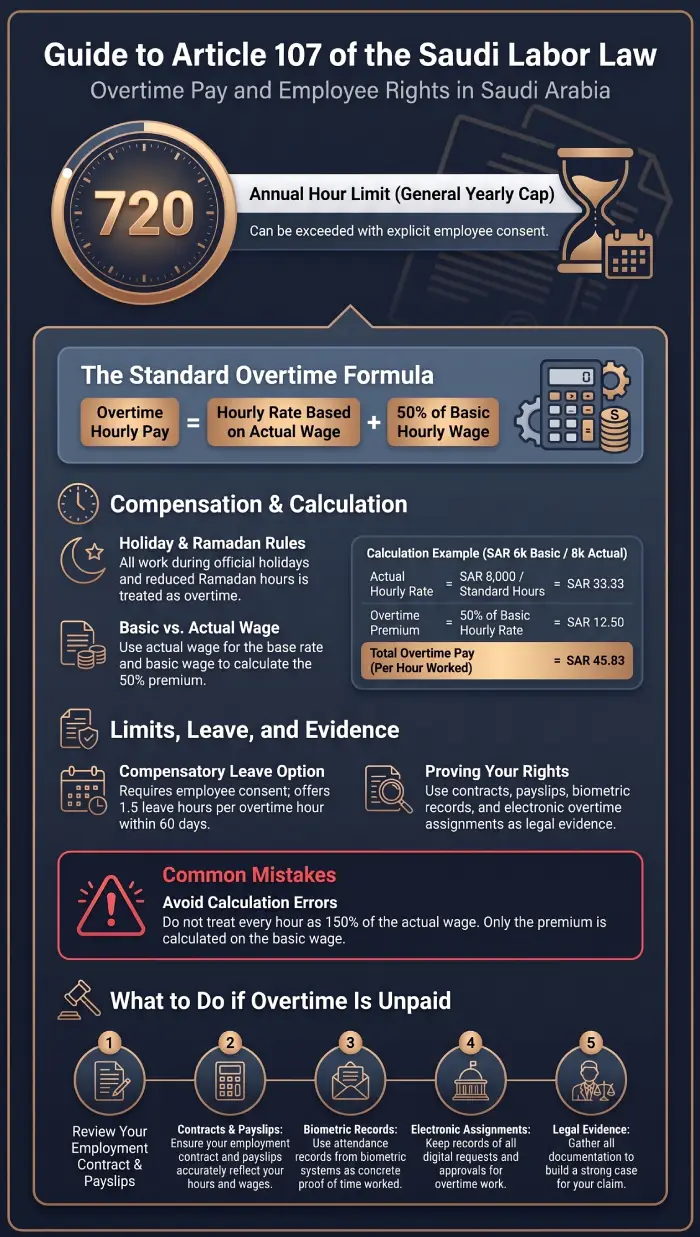
Article 107 requires an employer to pay overtime compensation equal to the employee’s hourly wage plus 50% of the basic hourly wage. Hours exceeding the adopted weekly working-hours standard are treated as overtime, and all hours worked during official holidays and public holidays are also considered overtime. Compensatory paid leave may be granted instead of overtime pay with the employee’s consent. (Ministry of Human Resources and Social Development)
| Issue | Rule |
|---|---|
| Overtime pay | Hourly wage + 50% of the basic hourly wage |
| Weekly standard | Hours above the applicable standard are overtime |
| Holidays and public holidays | All hours worked are treated as overtime |
| Annual limit | 720 overtime hours as the general limit |
| Compensatory leave | Permitted with the employee’s consent and subject to regulatory conditions |
What Counts as Overtime Under Article 107?
Overtime generally refers to working hours that legally exceed the applicable normal working hours or the adopted working-hours standard. The law also expressly treats certain hours as overtime, including work performed during official holidays and public holidays.
Determining entitlement cannot be based on the employee’s clock-out time alone. The working-hours system applicable to the employee, the work schedule, and the nature of the establishment must first be identified.
Hours Exceeding Normal Working Hours
As a general rule, actual working hours are limited to eight hours per day or forty-eight hours per week. However, the Saudi Labor Law contains specific rules for certain activities, shift arrangements, and other regulated circumstances.
It is therefore not accurate to assume automatically that every period worked after the eighth hour qualifies as overtime. The employee’s applicable schedule and working-hours arrangement must first be examined. Certain regulated situations also allow different working-hour arrangements, including shift-based work where the statutory requirements are met. (Ministry of Human Resources and Social Development)
Weekly Working-Hours Standard and Public Holidays
Where an establishment applies a weekly working-hours standard, hours exceeding that standard are treated as overtime.
Article 107 also expressly provides that all hours worked during holidays and official public holidays are overtime hours. The employee does not first need to exceed a particular number of weekly hours for those holiday hours to receive overtime treatment. (Ministry of Human Resources and Social Development)
How to Calculate Overtime Pay in Saudi Arabia
The correct overtime calculation in Saudi Arabia requires a distinction between the employee’s actual wage and basic wage. This distinction matters because the additional 50% is not applied to the entire actual wage in the same way many employees assume.
Overtime Pay Formula
The practical formula is:
Overtime hourly pay = hourly rate based on the actual wage + 50% of the basic hourly wage
Official guidance issued by the Ministry of Human Resources and Social Development illustrates the calculation by starting with the hourly rate derived from the actual wage and then adding 50% of the hourly basic wage. (Ministry of Human Resources and Social Development)
For this reason, saying that overtime always equals “150% of salary” can be misleading. The employee’s basic wage may differ from the actual wage because of other remuneration components.
Are Allowances Included in Overtime Pay?
Allowances such as housing or transportation are not automatically included in the basic hourly wage merely because they appear on the employee’s payslip, unless the employment contract, workplace regulations, or another applicable basis changes their treatment.
At the same time, the first part of the overtime formula is based on the actual wage as legally defined. (Ministry of Human Resources and Social Development)
The employee’s remuneration components should therefore be reviewed before the calculation is made. It would be equally inaccurate to include every allowance in the basic wage or to exclude all allowances without considering their legal nature.
Example of an Overtime Calculation
Assume that an employee has a monthly basic wage of SAR 6,000 and an actual wage of SAR 8,000 for the purposes of this example.
| Calculation | Result |
|---|---|
| Hourly rate from actual wage: 8,000 ÷ 30 ÷ 8 | SAR 33.33 |
| Basic hourly wage: 6,000 ÷ 30 ÷ 8 | SAR 25.00 |
| 50% of basic hourly wage | SAR 12.50 |
| Overtime hourly pay | SAR 45.83 |
If the employee works 10 qualifying overtime hours under these assumptions, the illustrative overtime amount would be SAR 458.30.
In an actual case, the remuneration components, working schedule, and number of qualifying overtime hours should be verified before a final amount is adopted.
What Is the Maximum Number of Overtime Hours?
Saudi labor regulations impose a general annual limit on overtime work. This prevents overtime from operating as an unrestricted extension of ordinary working hours while still allowing additional work where the regulatory conditions are satisfied.
The 720-Hour Annual Overtime Limit
As a general rule, overtime hours must not exceed 720 hours per year. The implementing regulations allow this number to be exceeded with the employee’s consent.
The annual 720-hour limit should not be confused with the limits of ten working hours per day or sixty hours per week. Those limits arise in the context of the exceptional circumstances regulated by Article 106 rather than as a general ceiling applicable to every overtime arrangement. (Ministry of Human Resources and Social Development)
Overtime During Ramadan and Public Holidays
Working hours for Muslim employees are reduced during Ramadan in accordance with the applicable working-hours rules. The normal hours applicable during Ramadan should therefore be identified first before determining any excess hours.
By contrast, Article 107 expressly treats work performed during holidays and public holidays as overtime. The same overtime calculation formula applies when determining the compensation due for those hours. (Ministry of Human Resources and Social Development)
Can Overtime Be Replaced With Compensatory Leave?
Yes. Article 107 of the Saudi Labor Law allows an employee to receive paid compensatory leave instead of monetary overtime compensation. However, an employer cannot impose this arrangement unilaterally; the employee’s consent is required.
How Much Compensatory Leave Is Granted?
The implementing rules provide that compensatory leave must be no less than one and a half hours for each overtime hour worked.
The leave should generally be used within 60 days from the date the overtime work was performed unless the parties agree otherwise. Compensatory leave must also not exceed 30 days during the year. (Ministry of Human Resources and Social Development)
Compensatory leave is therefore not simply a one-hour-for-one-hour replacement. It is subject to a specific conversion rate, timing rules, and an annual limit.
If the employment relationship ends while other financial entitlements remain outstanding, Article 88 of the Saudi Labor Law explains the statutory periods associated with settling those entitlements after termination.
How Can You Prove Overtime and Claim Unpaid Overtime Pay?
When a dispute arises, knowing the overtime formula is only part of the issue. The employee may also need to establish the hours worked, the relevant period, the nature of the assignment, and the amounts already paid.
What Documents May Help Prove Overtime?
The evidentiary value of each document depends on the facts of the case. An overtime claim may involve:
- the employment contract;
- payroll records and payslips;
- attendance and departure records;
- biometric attendance records;
- shift schedules;
- written or electronic overtime assignments; and
- work-related correspondence.
A biometric attendance record should not automatically be described as conclusive evidence of overtime entitlement. It may show that an employee was present during a particular period, while the significance of that presence for an overtime claim depends on the other facts and supporting evidence.
What Should You Do if Overtime Pay Is Not Paid?
Start by identifying the disputed period, the number of overtime hours, the basic wage, the actual wage, and any amounts already paid. Then organize the documents supporting the claim. A clear calculation tied to a defined period and supporting records reduces uncertainty in the dispute.
If the matter is not resolved internally, amicable settlement is generally the first stage for labor disputes. If settlement is unsuccessful, the dispute may proceed to the labor court through the applicable procedures.
The Ministry of Human Resources and Social Development states that the amicable settlement service is designed to refer unresolved disputes within 21 working days from the first session where settlement cannot be reached.
If the dispute concerns the number of overtime hours, the method of calculation, or the evidence supporting them, the labor lawyer in Jeddah page explains how an employment claim file can be organized before amicable settlement or litigation.
Common Mistakes When Applying Article 107
Some errors arise not from ignoring Article 107 altogether, but from applying one part of the rule without considering the wage structure, working-hours arrangement, or evidentiary requirements.
The most common mistakes include:
- treating every overtime hour as exactly 150% of the actual hourly wage;
- calculating overtime only on the basic salary without considering the applicable formula;
- treating every allowance as part of the basic wage without reviewing its legal nature;
- assuming every hour beyond eight hours automatically qualifies as overtime;
- confusing the 720-hour annual limit with the exceptional rules under Article 106;
- imposing compensatory leave without the employee’s consent; and
- relying on one attendance record without organizing the remaining supporting evidence.
Frequently Asked Questions About Article 107 of the Saudi Labor Law
Is Overtime Calculated on the Basic Salary or Total Salary?
It is not calculated solely on the basic salary or by applying one percentage to the employee’s total remuneration. The first part of the formula uses the hourly rate derived from the actual wage, while the additional 50% is calculated from the basic hourly wage.
Is an Overtime Hour Always Paid at 150%?
Not necessarily. Article 107 provides for the hourly wage plus 50% of the basic hourly wage. If the employee’s actual wage is higher than the basic wage because of other remuneration components, the result may differ from simply calculating 150% of the actual hourly wage.
Can an Employee Work More Than 720 Overtime Hours per Year?
Yes. The general annual limit is 720 overtime hours, but the implementing regulations permit that number to be exceeded with the employee’s consent.
Can an Employer Give Compensatory Leave Instead of Overtime Pay?
Yes, but only with the employee’s consent. Compensatory leave must be at least one and a half hours for every overtime hour worked, should generally be used within 60 days unless otherwise agreed, and may not exceed 30 days per year.
How Can I Prove Unpaid Overtime?
Relevant evidence may include the employment contract, payslips, attendance records, shift schedules, written or electronic assignments, and work-related correspondence.
Article 107 of the Saudi Labor Law: Overtime Pay Rules ultimately turns on two practical questions: how many hours qualify for overtime, and which wage components must be used in the calculation?
The answer requires a distinction between the actual wage and the basic wage, together with attention to the annual overtime limit, work performed during holidays, and the rules governing compensatory leave.
Where a dispute arises, organizing working-hour records, payroll information, overtime assignments, and relevant correspondence is more useful than relying on an approximate figure. The clearer the disputed period, calculation, and supporting documents are, the easier it becomes to assess the claim and determine the appropriate settlement or litigation route.