
The Saudi Labor Law governs the employment relationship between workers and employers from the beginning of employment through termination, settlement of entitlements, and labor disputes. It regulates employment contracts, probation periods, wages, working hours, leave, resignation, termination, end-of-service benefits, and the procedures available for claiming employment rights.
Understanding these rules helps employees identify their legal position before making decisions that may affect their entitlements. It also enables employers to manage employment matters in line with the rules currently in force.
This guide addresses the 2026 Saudi Labor Law as it applies today, including the major amendments that took effect in 2025 and subsequent regulatory developments. Searchers may also use terms such as Saudi employment law, Saudi labor regulations, or the new Saudi Labor Law, although the official legal framework remains the Saudi Labor Law.
Saudi Labor Law at a Glance: From Contract to Claim
The Saudi Labor Law covers the full lifecycle of an employment relationship. It begins with the employment contract, job duties, salary, and contract duration, then regulates the day-to-day relationship between the employee and employer.
This includes probation, wage payment, working hours, overtime, weekly rest, annual leave, and sick leave. The Law also determines what happens when an employee resigns or when an employer terminates an employment contract.
Once employment ends, other issues arise, including unpaid salary, unused leave balances, end-of-service benefits, and possible compensation for unlawful termination. If the matter develops into a dispute, the process generally begins with amicable settlement before the dispute may proceed to the Labor Court.
For that reason, knowing the number of a legal article is rarely enough. The employment contract, notices, correspondence, reason for termination, salary, and length of service can all affect the employee’s rights and the appropriate legal procedure.
What Is the Saudi Labor Law and What Has Changed?
The Saudi Labor Law is the principal legal framework governing employment relationships in which a worker performs work for an employer, under the employer’s management or supervision, in return for remuneration.
It regulates employment, contracts, non-Saudi workers, wages, working conditions, leave, termination, employment benefits, and disciplinary matters. The expression new Saudi Labor Law is commonly used in search queries to describe the Law following its recent amendments rather than a completely separate law.
The latest major Saudi Labor Law amendments took effect in 2025. References to the Saudi Labor Law in 2026 therefore mean the Law as currently in force, together with its applicable implementing regulations and subsequent regulatory developments.
The Implementing Regulations of the Saudi Labor Law supplement the statutory provisions by setting out detailed rules and procedures where the Law requires further regulation. A legal issue should therefore be considered together with the applicable regulations and decisions rather than through an isolated statutory provision.
Who Is Covered by Saudi Private-Sector Labor Law?
The Saudi Labor Law for the private sector generally applies where an individual performs work for an employer under its management or supervision in exchange for wages. The Law also identifies additional categories falling within its scope.
Certain categories, however, are governed by separate rules or specific exclusions. Domestic workers and similar categories, for example, are subject to a separate regulatory framework.
Determining whether the Saudi Labor Law applies should therefore come before calculating benefits or selecting a dispute procedure. The title given to an individual as an “employee,” “consultant,” or “contractor” does not necessarily determine the applicable rules by itself.
The actual nature of the relationship, the contract, remuneration, supervision, and how the work is performed may all be relevant. This makes identifying the legal nature of the employment relationship an important first step before assessing salary claims, leave entitlements, termination, or compensation.
What Are an Employee’s Rights and an Employer’s Obligations?
Employee rights under the Saudi Labor Law include receiving agreed wages, benefiting from statutory leave and rest periods, receiving lawful treatment in the workplace, and obtaining applicable entitlements when employment ends.
The Law also protects workers against forced labor and unlawful withholding of wages. Employers are expected to treat employees appropriately and comply with the statutory framework governing the employment relationship.
Employees also have obligations. These include performing the agreed work in accordance with lawful instructions, protecting the employer’s property, observing workplace conduct requirements, and complying with occupational safety rules.
Employer obligations also extend to following proper procedures when disciplinary measures or termination decisions are taken. A penalty should not be imposed outside the legally permitted framework or applicable workplace regulations.
Some Saudi Labor Law violations may result in regulatory sanctions or employment claims depending on the nature and consequences of the violation. Where a dispute concerns a deduction, disciplinary measure, or termination, employees should retain written decisions, notices, correspondence, and documents showing why and when the action was taken.
How Does Saudi Labor Law Regulate Employment Contracts and Probation?
An employment contract under Saudi Labor Law establishes the main terms governing the employment relationship. It should address essential information including the parties, job duties, workplace, salary, benefits, commencement date, and contract duration where applicable.
Contract documentation through the Qiwa platform has also become an important part of recording employment terms and evidencing what both parties have accepted.
The main types of employment contracts in Saudi Arabia include fixed-term and indefinite-term contracts, alongside other forms of work subject to specific regulations.
A fixed-term employment contract generally expires at the end of its agreed period. An indefinite-term employment contract, by contrast, is subject to different rules governing notice and termination.
In certain circumstances, a fixed-term contract may become indefinite when the statutory conditions are satisfied, subject to the special rules applicable to non-Saudi employees. The type of employment contract can therefore directly affect termination rights, notice periods, and potential compensation.
What Are the Rules for Probation Periods?
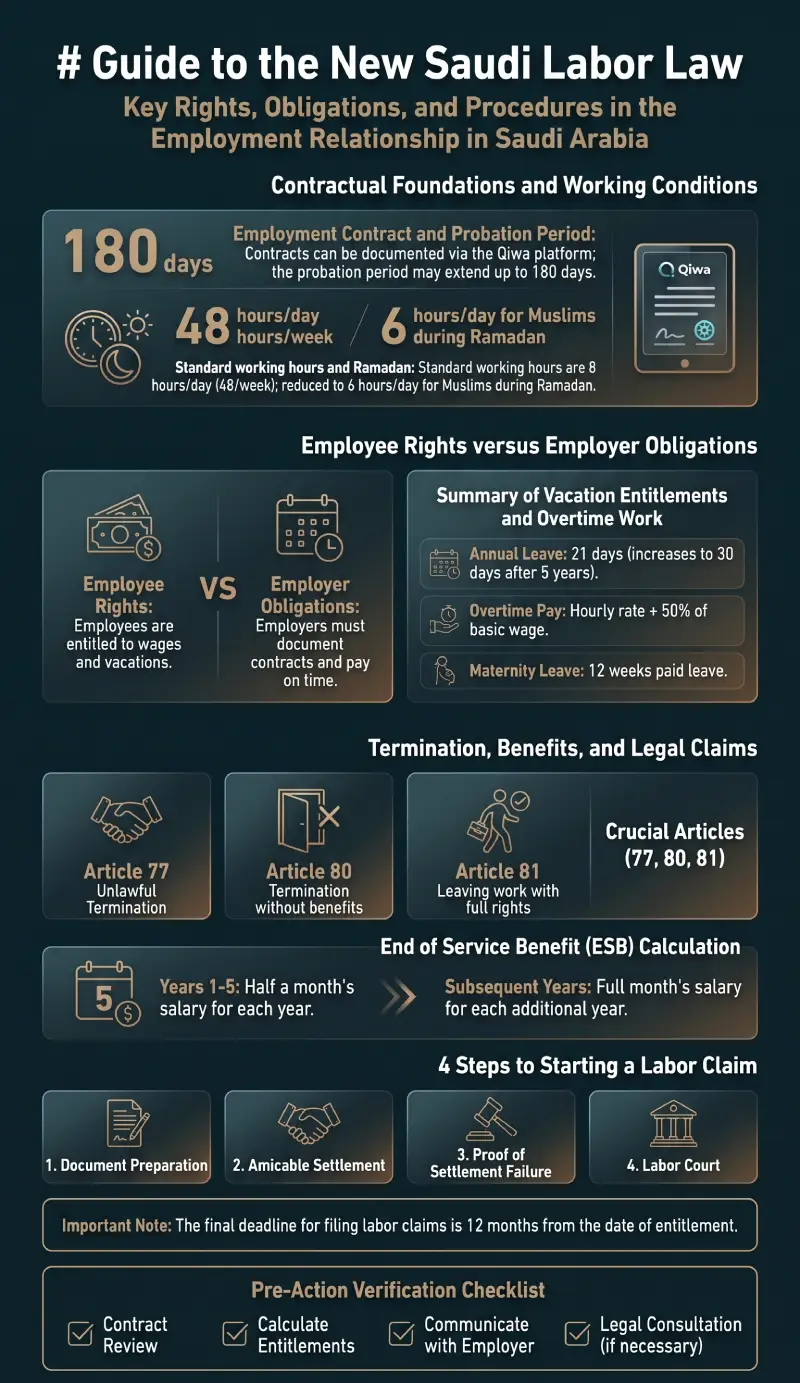
A probation period under Saudi Labor Law must be expressly stated in the employment contract. Its total duration may not exceed 180 days.
Either party may terminate employment during probation in accordance with the applicable rules. Where termination occurs during the probation period, neither party is entitled to compensation solely because the contract ended during that period, and the worker does not receive an end-of-service award for that period.
An employee may not generally be placed on probation more than once by the same employer unless a statutory exception applies and the arrangement is recorded in writing. Exceptions include probation for a different profession or type of work, or circumstances where at least six months have passed since the previous employment relationship ended.
However, employee rights during probation in Saudi Arabia do not disappear entirely. The worker remains in an employment relationship governed by the Law except where the specific probation provisions provide otherwise.
How Are Wages, Working Hours and Leave Regulated?
Wages, working hours, and leave are among the most frequently disputed employment matters in Saudi Arabia. Employers must pay wages when due in accordance with the applicable wage arrangements, while deductions must remain within the legally permitted circumstances.
Where there are delayed salaries in Saudi Arabia, the employee should identify the affected months, the amount due, and any payments already received before filing a wage claim or selecting the appropriate procedure.
Under the general rules on working hours in Saudi Arabia, actual working time should not normally exceed eight hours per day when the daily standard is applied, or 48 hours per week when the weekly standard applies.
For Muslim employees during Ramadan, the limit is reduced to six hours per day or 36 hours per week.
Employees performing overtime work in Saudi Arabia are entitled to the hourly wage plus an additional amount equal to 50% of the basic hourly wage. Subject to the applicable conditions and employee consent, paid compensatory leave may also be used instead of the financial overtime payment.
| Matter | General Rule | Practical Note |
|---|---|---|
| Working hours | 8 hours daily or 48 weekly | Depends on the applicable working-time standard |
| Ramadan for Muslims | 6 hours daily or 36 weekly | Applies during Ramadan |
| Daily rest | After no more than 5 continuous working hours | At least 30 minutes |
| Overtime | Hourly wage + 50% of basic hourly wage | Compensatory leave may apply with employee consent |
| Weekly rest | 24 consecutive paid hours | Friday is the general rule, subject to lawful substitution |
What Leave Rights Do Employees Have?
Leave rights under Saudi Labor Law begin with annual leave of at least 21 days. This increases to 30 days once an employee completes five consecutive years of service with the same employer.
An employee may not waive statutory annual leave for a cash payment while employment continues. However, unused annual leave may have financial consequences when the employment relationship ends in accordance with the applicable rules.
The Law also regulates sick leave in Saudi Arabia, public holidays, occasion-based leave, Hajj leave, and other statutory leave entitlements subject to the requirements governing each category.
A female employee is entitled to 12 weeks of fully paid maternity leave, including six compulsory weeks following childbirth, while the remaining period is subject to the statutory rules governing its use.
After returning to work, she may also take breastfeeding periods totaling no more than one hour per day under the applicable provisions. Leave entitlements should therefore be considered separately, since the duration, payment, and conditions differ according to the type of leave involved.
When Does Employment End and What Rights Arise?
An employment contract may end because its term expires, both parties agree to terminate it, the employee resigns, one party exercises a lawful termination right, or another statutory ground applies.
Termination of an employment contract in Saudi Arabia must therefore be distinguished from termination based on a specific statutory ground that may produce different consequences for notice, compensation, or end-of-service benefits.
An employee’s rights after dismissal cannot be determined simply from the fact that the employer ended the employment relationship. The reason for termination, type of contract, notices, previous disciplinary steps, and supporting documentation should all be reviewed.
This is particularly important in cases involving unfair dismissal in Saudi Arabia or disputed termination. Whether compensation is payable depends on the legal basis of termination and the facts supporting it.
The result may also differ depending on whether the contract is fixed-term or indefinite-term, or whether the contract itself contains an agreed compensation clause.
What Do Articles 77, 80 and 81 of the Saudi Labor Law Cover?
Article 77 of the Saudi Labor Law deals with compensation where an employment contract is terminated for an unlawful reason and the contract does not specify compensation.
For an indefinite-term contract, the statutory formula is 15 days’ wages for each year of service. For a fixed-term contract, compensation is based on the wages for the remaining contractual period. In both cases, the statutory minimum is the equivalent of two months’ wages.
Article 80 of the Saudi Labor Law identifies specific circumstances in which an employer may terminate employment without an end-of-service award, notice, or compensation, provided the statutory conditions are satisfied and the employee is given an opportunity to state objections to the termination.
By contrast, Article 81 of the Saudi Labor Law allows an employee to leave employment without notice while retaining statutory rights in specified situations. These include certain serious breaches by the employer and particular forms of assault or unjust treatment.
Articles 77, 80, and 81 therefore serve different purposes and should not be treated as interchangeable termination provisions. The facts should be matched against the requirements of the relevant article before compensation or other entitlements are calculated.
How Does Resignation Work Under Saudi Labor Law?
Article 79 bis provides a more detailed framework for resignation under Saudi Labor Law.
A resignation request is considered accepted if 30 days pass without a response from the employer. The employer may postpone acceptance for up to 60 days where the interests of work require it, subject to the statutory conditions and a written, reasoned explanation within the required period.
The employee may withdraw the resignation within seven days of submitting it unless the employer has already accepted the request.
The employment contract remains in force while the resignation request is pending, and both parties must continue performing their obligations until the employment relationship legally ends.
Employee rights after resignation in Saudi Arabia include the entitlements provided by law, while the employee’s length of service may affect the amount of the end-of-service award.
Before submitting a resignation, it is therefore useful to review the expected termination date, type of contract, salary, unused leave balance, end-of-service benefits, and any contractual provision that may affect post-employment rights.
How Is the End-of-Service Benefit Calculated?
The end-of-service benefit in Saudi Arabia is one of the principal financial entitlements arising when an employment relationship ends.
The basic calculation is half a month’s wage for each of the first five years of service, followed by one month’s wage for each subsequent year. The employee’s final wage is used as the basis for the calculation, while partial years are calculated proportionately.
The amount payable following resignation depends on the worker’s length of service. An employee who resigns after completing between two and five years receives one-third of the benefit. If service exceeds five years but remains below ten years, the employee receives two-thirds. After ten years of service, the employee receives the full award.
Certain statutory exceptions may also result in full entitlement. Accordingly, calculating end-of-service benefits under Saudi Labor Law requires the exact service period, relevant final wage, and reason for termination rather than salary information alone.
| Service Period on Resignation | Entitlement |
|---|---|
| Less than 2 years | Article 85 proportional entitlement does not apply |
| 2 to 5 years | One-third of the benefit |
| More than 5 but less than 10 years | Two-thirds of the benefit |
| 10 years or more | Full benefit |
What Rights Do Non-Saudi Employees Have?
A non-Saudi employee in Saudi Arabia benefits from the general employment protections under the Law while also being subject to specific rules concerning contract duration, work permits, occupation, and certain recruitment and residency costs.
A non-Saudi worker’s employment contract must be written and fixed-term. If the contract does not specify a term, the duration is determined according to the statutory rule governing such contracts and their renewal.
An employee may not be assigned to an occupation different from the occupation recorded on the work permit until the required legal procedures have been completed.
Non-Saudi employee rights also include applicable wage, leave, and end-of-service entitlements, subject to the special provisions governing their employment relationship.
The employer bears the recruitment, residence, work-permit, renewal, and other costs that the Law specifically places on the employer.
Where a dispute involves an expatriate employee, the documented contract, service period, registered occupation, and reason for termination should all be reviewed because they may affect the employee’s legal position and financial claim.
How Do You Start a Labor Complaint or Claim?
Most employment disputes begin through the amicable settlement of labor disputes process administered by the Ministry of Human Resources and Social Development.
This stage is intended to allow the employee and employer to resolve the dispute before court proceedings become necessary. The application is submitted electronically with details of the parties, the employment relationship, the claim, and supporting documents.
If settlement is reached, the agreement is formally recorded. If the parties cannot resolve the dispute, the employee may proceed with the claim before the competent Labor Court in accordance with the applicable procedures.
Searchers often use the term Labor Office complaint in Saudi Arabia to describe this process. However, the legal claim should clearly identify the nature of the dispute, the amount sought, and the basis for the demand.
Documents relevant to a labor claim in Saudi Arabia may include the employment contract, payroll records, bank transfers, termination decisions, warnings, correspondence, leave requests, and resignation records.
Article 234 also provides that claims involving rights arising from the Saudi Labor Law or the employment contract are generally not accepted after 12 months from the end of the employment relationship, subject to the statutory exceptions.
When Should an Employment Matter Be Legally Reviewed?
Not every workplace disagreement requires litigation. Legal review becomes particularly important when a decision may significantly affect compensation, employment benefits, or either party’s legal position.
Examples include reliance on Article 80 or Article 81, disputes over unfair dismissal in Saudi Arabia, early termination of a fixed-term contract, unpaid wages, or substantial overtime claims. Employers may also benefit from reviewing termination and disciplinary decisions before implementation where the facts or supporting documents could later be disputed.
If the matter concerns dismissal, resignation, unpaid wages, or end-of-service entitlements, an appropriate review begins by identifying the contract type, chronology of events, amounts involved, and supporting records.
Where a case involves termination, resignation, delayed wages, or end-of-service entitlements, an employment lawyer in Jeddah can review the contract and relevant documents and help identify the appropriate route before amicable settlement or litigation.
Frequently Asked Questions About Saudi Labor Law
1. What is the Saudi Labor Law?
It regulates employment relationships, including contracts, wages, leave, termination, benefits, and labor disputes.
2. What are the main recent Saudi Labor Law amendments?
They include updates to resignation rules, probation periods, maternity leave, and other employment provisions.
3. What rights do private-sector employees have in Saudi Arabia?
Key rights include wages, statutory leave, rest periods, end-of-service benefits, and the right to pursue employment claims.
4. How long can a probation period last in Saudi Arabia?
A probation period must be stated in the contract and may not exceed 180 days in total.
5. What is the difference between fixed-term and indefinite-term contracts?
A fixed-term contract has an agreed end date, while an indefinite-term contract continues without a specified expiry date.
6. How many working hours are allowed in Saudi Arabia?
The general limit is 8 hours per day or 48 hours per week, subject to statutory exceptions.
7. How is overtime pay calculated?
Overtime is generally paid at the hourly wage plus 50% of the basic hourly wage.
8. How much annual leave is an employee entitled to?
Employees receive at least 21 days annually, increasing to 30 days after five consecutive years of service.
Understanding these New Saudi Labor Law: 9 Key Areas leads to a more useful principle than simply memorizing article numbers: understand the legal effect of an action before taking it. The employment contract, salary, length of service, reason for termination, correspondence, and supporting records determine how the rules apply to an individual situation.
Employees should therefore retain their employment contracts, wage records, resignation notices, and termination decisions before beginning a claim. Employers should likewise document their procedures and reasons before implementing a decision that may later become the subject of a labor dispute.
Where the facts or documents require individual legal review, you can contact a law firm in Jeddah to assess the appropriate next step before taking action that may affect your legal position.
Official Sources: