
Enforcing a visitation order in Saudi Arabia begins when there is a court judgment or enforceable instrument establishing a visitation right, and the other party refuses to hand over the child, attend, or comply with the specified schedule. At this stage, exchanging messages or repeatedly waiting is not enough. The appropriate procedure should be initiated through Najiz and the Enforcement Court.
The problem may involve completely preventing visitation, delaying the handover of the child, or failing to return the child after the visitation period ends. It may also concern the judgment itself if it does not clearly specify the time, location, or handover arrangements. The first step is therefore to distinguish between enforcing the judgment, seeking its modification, and filing an objection to the visitation judgment.
The Short Answer: Enforcing a Visitation Order in Saudi Arabia
If you have a clear and enforceable visitation judgment, the appropriate route is generally to submit a visitation judgment enforcement request through Najiz or follow up on an existing enforcement application. If the dispute concerns the duration of visitation, its location, overnight stays, or the handover arrangements, you may instead need to seek a modification of the judgment or file an objection, depending on the procedural stage of the case.
The Saudi Personal Status Law establishes the non-custodial parent’s right to visit, receive, and accompany the child when the child is in the custody of one of the parents. Where the parents disagree, the court determines what it considers appropriate in the child’s best interests.
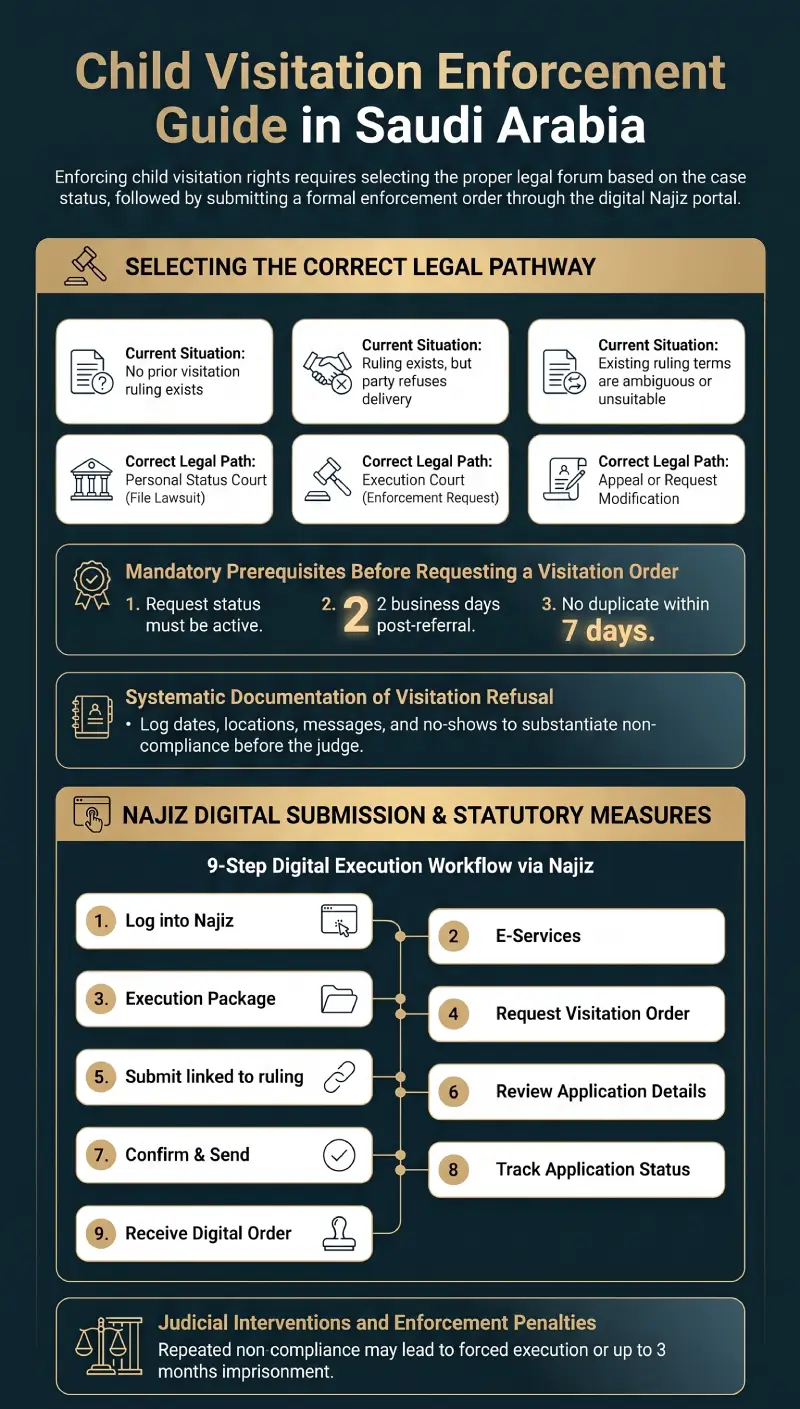
Is the Visitation Judgment Enforceable or Does It Need an Objection or Modification?
This guide helps distinguish between a visitation judgment enforcement request, a request to issue a visitation order through Najiz, and situations where the appropriate route is to object to or modify the judgment before enforcement.
When Is This Guide Relevant?
When there is a visitation judgment or enforceable instrument and the other party refuses to hand over the child, attend, or comply with the specified visitation schedule.
What Does It Explain?
It explains the practical difference between enforcement, objecting to a visitation judgment, and modifying the judgment when the time, location, or handover arrangements are unclear.
Basis of the Legal Review
The content is based on the enforcement process through Najiz, the visitation provisions of the Saudi Personal Status Law, and the applicable provisions of the Enforcement Law.
Before Filing an Enforcement Request
Prepare the visitation judgment, the enforcement application number if one exists, and any evidence showing refusal or non-attendance. Then determine whether the problem concerns enforcement of the judgment or the wording of the judgment itself.
What Does Enforcing a Visitation Order Mean?
Enforcing a visitation order means turning a judicial judgment from written terms into an actual procedure. The Enforcement Court does not generally reconsider the underlying right; instead, it examines the enforceable instrument and its limits. Once the judgment requires one party to enable visitation, the objective is to enforce that obligation.
A judgment is easier to enforce when it clearly specifies the duration of visitation, the time, the location, and the handover arrangements. It is also preferable for the judgment to clarify whether the visitation includes taking the child with the visiting parent or an overnight stay. The more precise the operative part of the judgment is, the fewer disputes are likely to arise during enforcement.
Custody is different from visitation. Custody concerns the child’s day-to-day care, whereas visitation concerns enabling the non-custodial parent to see or accompany the child. For a broader understanding of the underlying right and its requirements, see the Guide to Child Custody in Saudi Arabia before moving to enforcement procedures.
The Difference Between a Visitation Case and a Visitation Judgment Enforcement Request
Confusing the original case with enforcement can cause significant delays. A visitation case is used when there is no existing judgment regulating visitation. A visitation judgment enforcement request is used when a judgment already exists but the other party is failing to comply with it.
| Comparison | Visitation Case | Visitation Judgment Enforcement Request |
|---|---|---|
| Competent authority | Personal Status Court | Enforcement Court |
| Purpose | Establish or regulate the visitation right | Compel compliance with the existing judgment |
| When is it used? | When there is no existing judgment | When there is a judgment and non-compliance |
| Subject of the request | The underlying right or its regulation | Enforcement of the operative part of the judgment |
| Practical example | Requesting a specific visitation schedule | Requesting an order requiring the other party to hand over the child |
If you want to increase the visitation duration, change the location, or add overnight stays, you will generally need a substantive request or modification. If the judgment is clear and the other party is refusing to comply, the appropriate route is enforcement.
How to Enforce a Visitation Order Through Najiz
The process for enforcing a visitation order through Najiz begins with an enforceable instrument. The applicant then submits an enforcement request through the enforcement services. If an enforcement application is already pending, the Request to Issue a Visitation Order service may be available when its requirements are satisfied.
The practical steps are generally as follows:
- Log in to the Najiz portal using National Unified Access.
- Select All Electronic Services.
- Enter the Enforcement package.
- Select Request to Issue a Visitation Order.
- Click Submit a New Request.
- Select the enforcement application associated with the visitation judgment.
- Open Other Procedure Requests.
- Select Request to Issue a Visitation Order.
- Specify the reason and submit the request.
The Ministry of Justice identifies specific conditions for this service. Among them is that the enforcement application must have the status “Under Enforcement” or “Partially Enforced.” Two business days must also have passed from the referral of the application to the judicial circuit, and there must not be another similar request that has been pending for less than seven days.
| Your Situation | Closest Procedure |
|---|---|
| There is no visitation judgment | File a visitation case |
| There is a judgment and the other party refuses to comply | Submit a visitation judgment enforcement request |
| An enforcement application is already pending | Submit a request to issue a visitation order |
| The judgment is unclear or unsuitable | Object to or request modification of the judgment |
| Non-compliance is repeated and documented | Submit an appropriate request before the Enforcement Judge |
If the issue is not enforcement of a visitation judgment but rather proving custody or obtaining the appropriate document, the procedure is different. In that situation, see How to Get a Child Custody Document in Saudi Arabia to understand the distinction between documentation, litigation, and objection.
Documents Required to Enforce a Visitation Order
Preparing the documents before submitting the request can reduce the possibility of delays. The key is to provide documents connected to the enforcement issue rather than general documents that do not establish non-compliance.
The main documents and information generally include:
- The visitation judgment or enforceable instrument.
- The enforcement applicant’s details and national ID number.
- The respondent’s details and available contact information.
- Information about the child and the child’s relationship to the parties.
- The visitation dates and handover location, if stated in the judgment.
- Evidence of non-attendance or refusal to hand over the child.
- The previous enforcement application number, if applicable.
- A valid power of attorney if the application is submitted by an authorized representative.
If non-compliance has occurred repeatedly, organize the incidents chronologically. Connect each incident to the scheduled visitation date. Keep evidence showing attendance, refusal to hand over the child, or disruption of the scheduled appointment. This organization helps the Enforcement Judge understand the file more efficiently.
The Role of the Enforcement Court in Enforcing a Visitation Order
The role of the Enforcement Court is to apply the enforceable instrument. Therefore, the court does not normally reconsider whether the parent is entitled to visitation in the first place when a valid and enforceable judgment already exists.
The Enforcement Judge may intervene when there is refusal or obstruction. The procedure may begin with organizing enforcement or issuing an order to the competent authority. If the refusal continues, the case may move to stronger enforcement measures available under the law.
The procedures may include following up on the enforcement application, issuing a visitation order, addressing non-attendance, or dealing with refusal to hand over the child. Where there is practical ambiguity, the Enforcement Judge may determine an appropriate enforcement mechanism without creating a new right beyond the terms of the judgment.
Enforcement should generally take the child’s interests into account. Visitation is not simply a dispute between two parents; it is a right connected to the child’s stability and relationship with family members.
Refusing to Comply With a Visitation Judgment
Refusing to comply with a visitation judgment means failing to follow the judgment despite the existence of an enforceable instrument. The refusal may be direct, such as refusing to hand over the child, or indirect, such as repeatedly changing the appointment without an acceptable reason.
Common forms of non-compliance include failing to attend, refusing to hand over the child at the specified location, changing the visitation date without agreement, blocking communication channels, or failing to return the child after the visitation period.
If the refusal is repeated, do not rely on a general narrative. Document every incident with its date and scheduled time. State precisely what occurred, then submit the appropriate request within the enforcement file. Organized documentation is more useful than broad accusations.
Failure to attend a scheduled visitation may establish non-compliance with the obligation to enable visitation, particularly when it happens repeatedly. Failure to return the child after visitation may have more serious implications because it exceeds the limits established by the judgment itself.
Compulsory Enforcement of a Visitation Order in Saudi Arabia
Compulsory enforcement of a visitation order means requiring the respondent to comply with the judgment when there is refusal or obstruction. The purpose is not personal pressure but enforcement of the binding effect of the judgment while taking the child’s interests into account.
It may become relevant when there are repeated refusals to hand over the child, non-attendance, concealment of the child, or deliberate changes to the handover location intended to obstruct enforcement. The request should be based on documented facts rather than general allegations.
The Saudi Enforcement Law provides for compulsory enforcement of judgments concerning custody and visitation where necessary. This may include assistance from the competent authorities and, where legally permitted and ordered by the Enforcement Judge, entry into homes within the limits of the enforceable instrument.
Compulsory enforcement does not mean that the court immediately starts with the most severe measure. The judge considers the circumstances of the child and the family. Enforcement also remains limited by the operative part of the judgment. If the judgment does not provide for an overnight stay or travel, those rights cannot simply be added through enforcement proceedings.
Penalty for Refusing to Comply With a Visitation Judgment
A penalty for refusing to comply with a visitation judgment may apply when refusal, resistance to enforcement, or obstruction is established. The facts should therefore be clearly documented before requesting a particular enforcement measure.
The Enforcement Law provides for punishment where a parent or another person refuses to comply with a judgment concerning custody, guardianship, or visitation, or resists or obstructs its enforcement. The penalty may include imprisonment for a period not exceeding three months.
Imprisonment is not an automatic consequence of every dispute. The decision depends on the Enforcement Judge’s assessment, the clarity of the judgment, the repetition of the refusal, and its effect on the child.
Repeated non-compliance may adversely affect the respondent’s position. It may also become relevant later when the court considers a request to modify visitation or custody, particularly where the evidence establishes harm to the child’s interests.
Objecting to a Visitation Judgment in Saudi Arabia
Objecting to a visitation judgment is different from enforcing it. An objection challenges the judgment itself, whereas enforcement seeks to compel the other party to comply with an existing judgment.
You may need to file an objection to a visitation judgment when the problem lies in the operative terms of the judgment. Examples include an unsuitable visitation duration, an impractical location, or handover arrangements that do not adequately take the child’s interests into account.
The objection may also concern overnight stays, taking the child with the visiting parent, or the child’s health or educational circumstances. In such cases, enforcement does not solve the underlying problem because enforcement applies the judgment rather than rewriting it.
If the judgment is appropriate and clear but the other party refuses to comply, the appropriate route is a visitation judgment enforcement request. The judgment should therefore be reviewed first to determine whether the problem lies in the judgment itself or in the other party’s refusal to comply.
There is no single rule governing how an objection affects enforcement. The position may differ depending on the procedural stage and the enforceable status of the judgment. It is therefore necessary to determine whether the judgment has become an enforceable instrument or remains subject to an effective challenge.
If the objection concerns the child’s interests, age, or care circumstances after divorce, the visitation schedule should not be considered in isolation. See New Child Custody Law in Saudi Arabia to understand the relationship between visitation, custody, and the child’s interests.
Practical Cases Involving Enforcement of a Visitation Order
The following are some of the most common situations involving enforcement of a visitation order in Saudi Arabia:
Preventing contact with children despite an existing judgment: If the judgment is clear and the other party refuses to comply, start an enforcement request or follow up on the existing application. Document each incident of refusal.
Failure to return the child after visitation: Review the operative terms and limits of the visitation judgment. Document the incident immediately and submit the appropriate request within the enforcement file.
Failure to attend the visitation center: Try to obtain evidence confirming the non-attendance. Attach the evidence to the enforcement file and request the appropriate procedure.
Changing the visitation date without agreement: A one-time change may have a practical reason. Repeated changes may indicate obstruction. The key is documentation rather than relying on general messages.
Different city of visitation or residence: If one party moves to another city, modification of the location or schedule may be necessary. Enforcement should not be used to go beyond the terms of the judgment.
The Effect of Preventing Visitation on Custody
Preventing visitation does not automatically terminate custody. However, repeated and proven prevention may constitute relevant evidence. Where the issue is connected to a request to transfer custody or examine custody restrictions, it is important to understand when custody becomes the father’s right in Saudi Arabia.
If the custodial parent uses visitation as a means of pressure, the judge may consider the conduct as a negative factor. The outcome nevertheless depends on the evidence, the repetition of the incidents, and the child’s interests.
More precisely, preventing visitation may support a request to regulate visitation or modify custody. It does not, by itself, always justify transferring custody. The application should be based on clear facts demonstrating the effect of the existing situation on the child.
When Do You Need a Visitation Enforcement Lawyer?
You may need a visitation enforcement lawyer when the case involves enforcement, objection, and modification at the same time. Filing the wrong type of request can delay the matter, particularly when the judgment is unclear or the refusal is repeated.
Legal review can be particularly useful when the judgment does not clearly specify the dates or location. It is also relevant when it is unclear whether to submit a visitation judgment enforcement request, a request to issue a visitation order, or an objection to the visitation judgment.
A lawyer may also be needed when the child has not been returned or when visitation is connected to travel, overnight stays, or custody. In these situations, the process should begin by reviewing the judgment and then identifying the appropriate legal route.
If the visitation file is connected to custody, an objection, or a modification request, you may need advice from a Child Custody Lawyer in Jeddah to determine the appropriate procedure before submitting a request that could delay enforcement.
Frequently Asked Questions About Enforcing a Visitation Order
1. How can I enforce a visitation order in Saudi Arabia?
If the visitation judgment is clear and enforceable, you can submit or follow up on a visitation judgment enforcement request through Najiz. You should also document any refusal or non-compliance.
2. What can I do if the other parent refuses to comply with a visitation order?
You can submit an enforcement request through Najiz and provide evidence of the refusal. Repeated non-compliance should be documented with the dates, times, and circumstances of each incident.
3. Can I object to a visitation judgment in Saudi Arabia?
Yes. An objection may be appropriate when the problem concerns the judgment itself, such as the visitation duration, location, overnight arrangements, or handover method. Enforcement does not replace an objection or modification request.
4. What happens if a parent refuses to comply with a visitation judgment?
The Enforcement Court may take enforcement measures when refusal or obstruction is established. Under the Enforcement Law, a person who refuses, resists, or obstructs enforcement of a visitation judgment may face imprisonment for a period of up to three months.
Enforcing a visitation order in Saudi Arabia does not begin simply by complaining about prevented visitation. It starts with carefully reviewing the judgment, confirming that there is a clear enforceable instrument, and selecting the appropriate procedure through Najiz or the Enforcement Court. The clearer the facts and the more specific the requests, the easier it is to handle the enforcement file in an organized manner.
If you have an existing judgment and the other party is not complying with it, the appropriate route is generally to submit a visitation judgment enforcement request or follow up on the existing enforcement application. If the issue concerns the visitation duration, location, or handover arrangements, an objection to the visitation judgment or a modification request may instead be appropriate, depending on the stage of the judgment and the nature of the problem.
If the incidents are repeated or the judgment is unclear, organize the documents first and then contact our Personal Status Team to assess the appropriate route between enforcement, objection, and modification.
Official References: