
The New Child Custody Law in Saudi Arabia does more than answer who keeps a child after divorce. It regulates how the child’s best interests are protected when parents disagree. Custody is neither a bargaining tool between parents nor an automatic consequence of divorce. It is a legal responsibility covering the child’s daily care, education, medical treatment, housing, safety, and stability.
When examining child custody after divorce in Saudi Arabia, three connected questions matter: who has priority, what conditions a custodian must satisfy, and how the child’s age affects the dispute. It is also important to distinguish between custody that continues without disagreement and cases requiring judicial intervention because the parents cannot agree.
This guide explains the New Child Custody Law in Saudi Arabia after divorce, focusing on eligibility, custody conditions, the child’s age, priority between parents, and circumstances in which custody may be lost or transferred. It also explains when a legal assessment may be necessary before taking action that could affect your legal position or the child’s stability.
If your situation extends beyond custody conditions and age, you may also review the comprehensive guide to child custody in Saudi Arabia to understand custody claims, enforcement, and related procedures.
New Child Custody Law in Saudi Arabia: Quick Answer
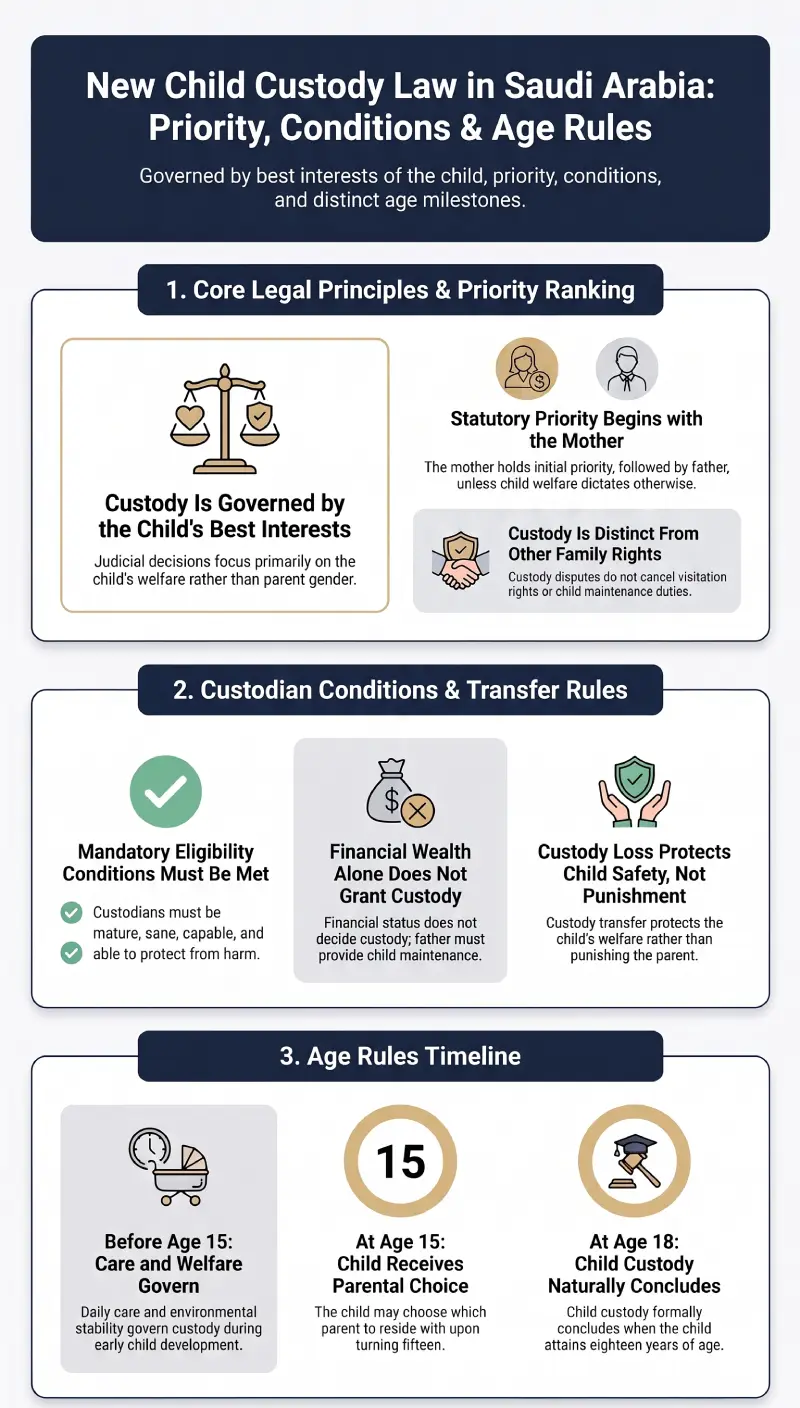
The term New Child Custody Law in Saudi Arabia generally refers to the custody provisions contained in the Saudi Personal Status Law, together with the relevant judicial procedures and Ministry of Justice services. These rules move custody disputes away from an open-ended conflict between parents and toward a legal framework based on the child’s best interests, the custodian’s eligibility, the child’s age, and the circumstances of the dispute.
The primary consideration in Saudi custody cases is the best interests of the child rather than the parental status of the mother or father alone. Courts may therefore consider the custodian’s ability to provide care, the stability of the child’s living environment, the child’s safety, and how parental conflict may affect the child.
What Does Child Custody Mean in Practice?
Child custody means protecting and caring for a person who cannot independently manage their own affairs and attending to their everyday needs in a manner that serves their best interests. This includes housing, food, education, medical treatment, supervision, and protection from harm. Custody should therefore not be treated simply as an abstract right belonging to one parent without considering the child.
Custody also does not mean that the custodial parent has exclusive authority over every decision concerning the child. Saudi law distinguishes between custody, guardianship, visitation, and maintenance. This distinction matters because many post-divorce disputes arise when these separate legal issues are treated as though they were the same.
| Concept | Practical Meaning | Effect on a Dispute |
|---|---|---|
| Child custody | Daily care, residence, and supervision | Usually determines who the child lives with |
| Guardianship | Broader legal decisions concerning the minor | May affect matters such as travel or legal representation |
| Visitation | The non-custodial parent’s ability to see the child | Preserves the child’s relationship with the other parent |
| Maintenance | Financial responsibility for the child’s needs | Does not end merely because a custody dispute exists |
Understanding these distinctions helps identify the correct legal issue before taking action. A dispute may concern custody priority, visitation, maintenance, or enforcement of an existing obligation, and each requires a different procedural approach. The New Child Custody Law in Saudi Arabia therefore does not regulate residence alone; custody interacts with guardianship, visitation, and child maintenance.
Because the child’s daily care is closely connected with financial support, understanding how much child maintenance is payable after divorce in Saudi Arabia may also be relevant when assessing the child’s everyday needs.
Custody Priority After Divorce: Mother or Father?
When determining custody after divorce, asking whether the mother or father automatically receives custody is too simplistic. The more accurate question is which arrangement provides the child with greater stability, safety, and protection.
As a general rule, the mother has priority in custody after separation when the statutory conditions are satisfied. The father and other eligible persons follow according to the legal order of priority.
However, custody rights under Saudi law are not applied mechanically when there is an actual dispute. The outcome may differ where evidence shows that the child’s interests require another arrangement or that remaining in a particular environment could negatively affect the child’s care or stability. Under the New Child Custody Law in Saudi Arabia, being the mother or father alone does not necessarily determine the outcome.
Where custody overlaps with divorce, maintenance, or visitation, the dispute becomes part of the broader field of personal status cases in Saudi Arabia, where the underlying facts and supporting documents must be assessed carefully.
The Mother’s Priority When the Conditions Are Met
A mother’s right to custody is one of the most frequently raised issues after divorce, especially where young children are involved. In many cases, the mother remains the person best positioned to provide daily care during the child’s early years, provided that the legal conditions for custody are met and no circumstance exists that materially harms the child’s interests.
This does not mean that custody belongs to the mother permanently in every situation. Circumstances involving travel, remarriage, neglect, interference with visitation, or inadequate care may affect the court’s assessment depending on the evidence and the particular facts of the case.
Circumstances That May Strengthen the Father’s Custody Claim
A father may seek custody where he believes that continuing the child’s residence with the mother is harmful or where the mother has lost an important condition required for custody.
The claim itself is not enough. The court will look for specific facts and evidence connected with the child’s actual circumstances.
Relevant facts may include neglect of education, delayed medical treatment, repeated interference with visitation, or an unsuitable living environment. General allegations that the other parent is “unfit” are usually less persuasive where they are unsupported by evidence.
The Child’s Best Interests Come Before the Order of Priority
The statutory order of priority remains relevant, but it does not remove the court’s ability to assess the child’s best interests in a disputed case.
The mother may therefore have the stronger entitlement in one case, while the father’s position may become stronger in another if the evidence shows that living with him would better protect the child’s welfare.
For this reason, a custody position should not be based on broad statements such as “custody always belongs to the mother” or “the father automatically receives custody after a certain age.” The conditions for custody, the child’s age, the facts, and the evidence relating to the child’s interests must all be considered together.
Child Custody Conditions After Divorce
The conditions for child custody after divorce are intended to ensure that the custodian is capable of providing appropriate care without exposing the child to harm.
These conditions generally concern the custodian’s ability to raise and care for the child, trustworthiness, the safety of the child’s environment, and the absence of a circumstance that materially affects the child’s welfare. Courts may also consider the child’s practical stability, including schooling, healthcare, housing, and daily supervision.
Financial capacity alone does not determine custody under Saudi law. The practical assessment concerns whether the custodian can combine everyday care with psychological stability, a safe living environment, and preservation of the child’s relationship with the other parent where appropriate. The custody conditions therefore make application of the New Child Custody Law in Saudi Arabia dependent on the child’s actual circumstances rather than on the parents’ disagreement alone.
The Mother’s Ability to Provide Daily Care
The mother must be able to provide appropriate care and maintain a safe and stable environment for the child without exposing the child to harm.
Employment or living independently does not automatically cause a mother to lose custody. The relevant question is whether those circumstances have actually resulted in serious neglect or identifiable harm to the child.
A mother’s remarriage and its effect on custody require a separate assessment. Remarriage may be relevant in some cases, but it should not automatically be treated as determinative in every case.
The court may consider the nature of the new household, the child’s age, the continuity of daily care, and whether the remarriage has any practical effect on the child’s best interests.
The Father’s Ability to Provide an Appropriate Environment
A father seeking custody must also demonstrate an ability to provide proper care. Financial capacity on its own is insufficient.
The court may consider the time available for childcare, the family environment, the child’s existing stability, and whether appropriate assistance is available when necessary.
Where the application concerns transferring custody to the father, the request should explain why the proposed transfer serves the child’s best interests. Focusing solely on alleged mistakes by the other parent without explaining what the child’s living arrangements would look like after the transfer may weaken the practical basis of the request.
Effect of Housing, Employment, and Remarriage
Housing, employment, and remarriage are not automatically sufficient reasons to remove or transfer custody.
What matters is their actual effect on the child. A mother may work while continuing to provide stable care, and either parent may remarry without the new marriage causing any harm to the child.
Courts therefore examine the practical circumstances rather than the label attached to them. Is the child attending school consistently? Is necessary medical treatment being provided? Is the living environment safe? Is the child’s relationship with the other parent being preserved?
These questions are generally more significant than broad accusations between the parents.
If custody is disputed, begin by identifying the precise point of disagreement before filing any application. BMS Legal’s personal status team can review the circumstances and help determine the appropriate legal route confidentially.
Child Custody Age in Saudi Arabia for Girls and Boys
The age rules for custody in Saudi Arabia require careful explanation because age is not the only factor affecting a dispute.
The court may consider the child’s age, best interests, preference at the legally relevant stage, quality of care, and stability of the environment in which the child is living.
Under the Saudi Personal Status Law, once a child reaches the age of fifteen, the child may choose to reside with either parent unless the child’s best interests require otherwise. Custody generally ends when the child reaches eighteen, while care may continue in situations requiring continued assistance, including severe illness or incapacity.
The New Child Custody Law in Saudi Arabia therefore treats age as an important factor, but not one that can be separated from the child’s best interests.
Before the Age of Fifteen
Before the child reaches fifteen, custody is more closely connected with daily care, stability, and whether the custodian satisfies the required conditions.
A dispute at this stage is therefore not decided by the child’s preference alone. The court considers which arrangement provides a more suitable and stable environment.
This stage is particularly relevant to child custody after divorce in Saudi Arabia because younger children often require direct care and continuous supervision. Housing, education, healthcare, and psychological stability may therefore carry significant weight when assessing the child’s interests.
The Child’s Choice After the Statutory Age
Once the child reaches fifteen, their preference regarding residence with either parent becomes legally relevant.
That choice is still considered in the context of the child’s best interests. If the circumstances indicate that the preferred arrangement would be harmful or materially undermine the child’s stability, the court may give priority to the child’s welfare rather than treating the preference as decisive on its own.
Custody Age for a Girl in Saudi Arabia
The custody age for a girl in Saudi Arabia should not be considered in isolation from her individual circumstances.
Age is relevant, but it is not the sole determining factor. The quality of the living environment, daily care, education, and psychological stability may all affect the assessment of the girl’s best interests during a custody dispute.
The same principle applies to boys. Saudi custody rules focus on the interests of the child rather than applying a different underlying welfare standard solely because of gender.
The practical question therefore remains: which living arrangement provides the child with better protection and stability at that stage?
Loss or Transfer of Child Custody
Loss of custody should not be treated as a punishment imposed on the custodial parent. Its purpose is to protect the child where the existing arrangement has become harmful or unsuitable.
Custody may be affected if the custodian loses an essential eligibility condition, serious harm is established, or continued custody under the existing arrangement no longer serves the child’s best interests.
The New Child Custody Law in Saudi Arabia therefore approaches loss of custody as a protective measure rather than a penalty against either parent.
Practical circumstances that may affect a custody dispute include serious neglect of education, medical treatment, or everyday care; travel that prevents visitation; or an unsuitable living environment. Each case remains subject to judicial assessment based on its particular facts and evidence.
Where the marriage ended through Khula, separate questions may arise concerning the mahr, personal property, custody, and children’s rights. Reviewing wife’s rights after Khula in Saudi Arabia can help distinguish these issues.
Does the Mother Lose Custody After Remarriage?
A mother’s remarriage may be relevant in some cases, but it does not automatically mean that custody is lost in every situation.
The primary question remains whether the remarriage affects the child’s best interests and the stability of the child’s everyday environment.
Relevant factors may include the child’s age, living arrangements, the child’s relationship with the mother’s new husband, continuity of daily care, and any identifiable impact on the child.
A claim seeking loss of custody should therefore not be based on remarriage alone without examining the complete facts and available evidence.
Employment, Travel, and Interference With Visitation
A mother’s employment does not by itself result in loss of custody because working does not necessarily mean that the child is being neglected.
What matters is whether the employment has actually caused a serious failure in care or stability, such as leaving the child without appropriate supervision or repeatedly disrupting essential needs.
Travel with the child may become relevant where it prevents visitation, interferes with the child’s affairs, or conflicts with applicable legal requirements.
Repeatedly preventing visitation may also form part of a custody dispute where the conduct harms the child’s relationship with the other parent or breaches an existing order.
Loss of an Essential Custody Condition
Custody may be transferred where the custodian loses an essential condition required for custody or where evidence shows that the existing environment is no longer suitable for the child.
An allegation alone is insufficient. Evidence should establish a connection between the alleged failure and its actual effect on the child’s interests.
Before seeking loss or transfer of custody, evidence should be organised around the child’s welfare rather than around the dispute between the parents. BMS Legal can review the facts and assess whether they provide a sufficient basis for a custody application or objection.
Transferring Custody From the Mother to the Father
Transferring custody from the mother to the father cannot be based solely on personal disagreement or the father’s desire to assume custody.
There must be a material reason showing that transferring care would serve the child’s best interests. A court may consider transfer where there is established harm, loss of an eligibility condition, or an inability to continue providing suitable care.
Grounds raised in practice may involve neglect of education, delays in obtaining medical treatment, unstable housing, or repeated interference with visitation in a manner that harms the child.
In each case, the facts should be specific and presented in a way that demonstrates their effect on the child.
Evidence That May Support a Custody Claim
The relevant evidence depends on the circumstances, but it should be clear and directly connected to the child’s interests.
General allegations unsupported by documents or verifiable evidence should be avoided.
Depending on the case, relevant evidence may include:
- School records showing repeated absence or serious educational neglect.
- Medical reports showing delayed treatment or inadequate medical follow-up.
- Documented messages showing repeated denial of visitation or refusal to hand over the child.
- Enforcement records or decisions relating to custody or visitation.
- Clear digital evidence that does not rely solely on personal impressions.
A distinction should also be made between loss of custody and transfer of custody.
Loss of custody focuses on whether the current custodian has lost an essential condition required for care. Transfer of custody focuses on moving responsibility to another eligible person where that arrangement better serves the child’s interests.
In either case, the court does not assess the interests of the mother or father independently from the welfare of the child.
When Do You Need a Child Custody Lawyer?
A child custody lawyer may be necessary where the facts overlap or where it is difficult to identify the correct procedural route.
Some situations may be suitable for custody documentation, while others require a court claim, enforcement proceedings, or an objection to an existing judgment.
Legal assessment becomes particularly relevant where the case involves:
- A dispute over custody priority after divorce.
- An application to remove or transfer custody.
- Travel with the child or a change in the child’s residence.
- Refusal to hand over the child.
- Interference with or restriction of visitation.
- Overlap between custody, maintenance, and enforcement proceedings.
- An objection to an existing custody judgment.
In these cases, completing an online form alone may not be sufficient without understanding the legal effect of the application.
The important step is to identify the correct procedure, organise the relevant documents, and determine which facts directly support the child’s best interests.
If the disagreement does not concern custody priority or eligibility, the matter may instead involve obtaining custody documentation through Najiz to establish an existing custody arrangement before schools, healthcare providers, or government authorities.
Where the dispute concerns who is legally entitled to custody, whether custody should be lost, or whether it should be transferred, legal assessment is generally appropriate before selecting the procedure.
has been reviewed by the BMS Legal team with reference to the Saudi Personal Status Law
and the relevant Ministry of Justice and Najiz procedures concerning child custody,
custody documentation, and related family-law matters.
Child custody outcomes depend on the facts of each case, the child’s best interests,
the applicable custody conditions, and the evidence presented. This content provides
general legal information and does not replace an individual legal assessment.
Frequently Asked Questions About the New Child Custody Law
Who has custody of children after divorce in Saudi Arabia?
The mother generally has priority if she meets the custody conditions, but the child’s best interests remain the primary consideration.
Does custody automatically transfer to the father when the child turns seven?
No. Saudi law does not provide for an automatic transfer of custody to the father at age seven solely because of the child’s age.
When can a mother lose custody in Saudi Arabia?
Custody may be affected if an essential custody condition is lost, serious neglect is proven, or the existing arrangement harms the child’s best interests.
Can child custody be documented through Najiz without filing a lawsuit?
Yes, where there is no custody dispute, the existing custody arrangement may be documented electronically through Najiz, subject to the service requirements.
The New Child Custody Law in Saudi Arabia: 7 Key Rules and Conditions After Divorce is based primarily on protecting the child’s best interests. Custody is therefore not determined simply because one party is the mother or father, nor merely because the parents disagree after divorce or one parent wants the child to live with them.
The correct legal approach begins with identifying the custody conditions, the child’s age, the reason for the dispute, and the appropriate procedural route. Depending on the facts and available documents, the matter may involve custody documentation, a custody claim, enforcement proceedings, or an objection to an existing judgment.
Understanding the New Child Custody Law in Saudi Arabia can therefore help you identify custody priority and the applicable conditions before entering a dispute. Where the facts are complex or documents require assessment, you may consult a child custody lawyer in Jeddah at BMS Legal to identify the most appropriate legal route confidentially.
Official Reference: