
An incident may occur during a court hearing, outside the courthouse following a judgment, or through electronic communications. Understanding these distinctions helps clarify the potential legal consequences, how an incident is investigated, the effect of a settlement or waiver, and the lawful ways to challenge a judicial decision.
Quick Answer
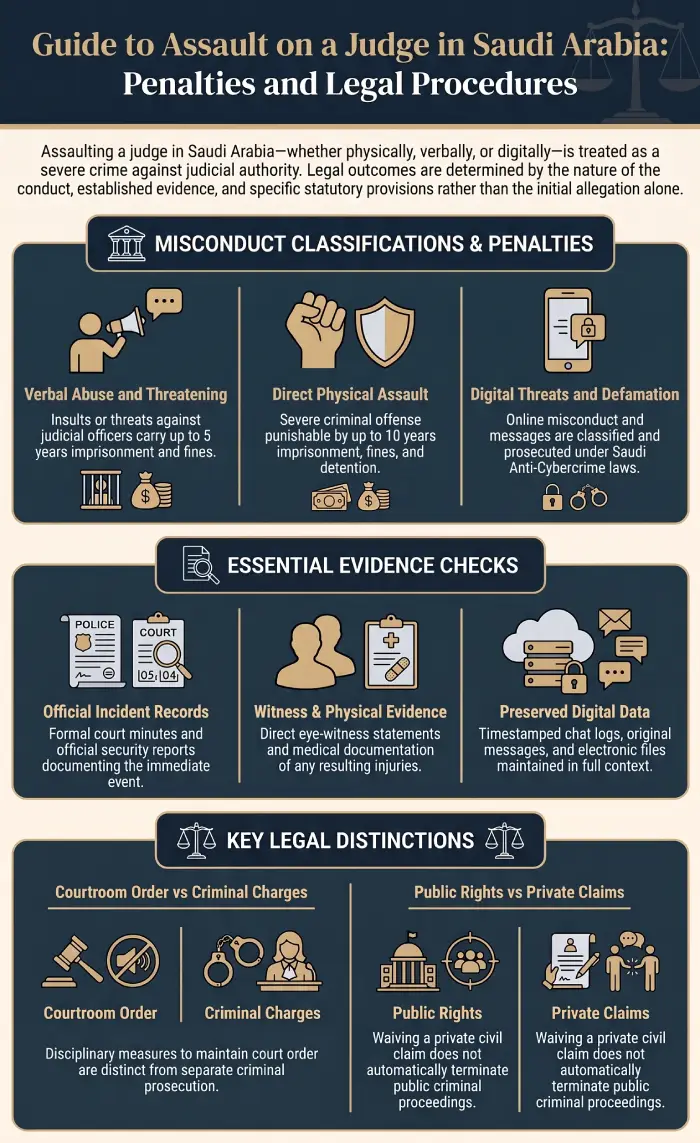
The penalty for assault on a judge in Saudi Arabia depends on the nature of the conduct, the circumstances, and the available evidence. Physical violence, verbal abuse, threats, and courtroom disruption do not necessarily carry the same consequences.
Measures taken to maintain courtroom order differ from criminal penalties for a separate offence,
which depend on the applicable Saudi law.
What Is the Penalty for Assault on a Judge in Saudi Arabia?
Not every instance of inappropriate behaviour towards a judge amounts to the same criminal offence. Some incidents involve disruption of courtroom proceedings, while others may constitute physical assault, threats, or separate acts of misconduct requiring criminal investigation.
The legal assessment considers the alleged conduct, the circumstances in which it occurred, its connection to the judge’s official duties, any injury or damage, and the evidence supporting the allegations.
When Does Disrupting a Court Hearing Differ from Assault?
The distinction matters when a person disrupts court proceedings or refuses to comply with the presiding judge’s directions without necessarily committing a separate act of assault.
Article 73 of the Saudi Law of Civil Procedure gives the presiding judge authority to remove a person who disrupts the hearing. If the person refuses to comply, the court may order detention for up to 24 hours, subject to the conditions set out in that provision.
Article 142 of the Saudi Law of Criminal Procedure contains a corresponding rule concerning courtroom order in criminal proceedings.
However, when physical violence or threats occur during a hearing, the matter may extend beyond removing the individual or imposing a measure to restore order. The authorities may also need to assess whether a separate criminal offence has been committed.
What Determines the Alleged Offender’s Criminal Liability?
Several factors influence the assessment of assault on a judge, including the nature of the act, any resulting harm, and whether witness statements, messages, recordings, or reports support the allegations.
The connection between the conduct and the judge’s official duties may also be relevant. A spontaneous disagreement is factually different from following and threatening a judge because of a judgment, although each situation requires an independent assessment of the evidence and applicable legal provisions.
A fixed prison term or automatic increase in punishment should not be assumed merely because an incident occurred inside a courthouse or arose from a judicial decision.
Types of Assault Against Judges in Saudi Arabia
Allegations involving judges may concern physical violence, verbal abuse, threats, or conduct carried out through electronic communications. Each category raises different questions of evidence, legal classification, and potential responsibility.
Physical Assault and Violence Against a Judge
Physical assault may include striking a judge or other conduct affecting the judge’s bodily safety. The assessment depends on the act itself, any resulting injury, and the available evidence.
These incidents fall within the broader legal considerations discussed in the guide to assault and battery penalties in Saudi Arabia. Where the injured person is a judge, the circumstances of the incident and any connection to judicial duties must also be considered when determining the applicable legal classification.
If a physical confrontation occurs inside a courthouse, an official incident report, witness testimony, and medical evidence may help establish what happened. The absence of a visible injury does not, by itself, resolve every question concerning the alleged conduct.
There is no single penalty that can be applied to every case of physically assaulting a judge without identifying the relevant law and the facts established in the case. Judicial decisions arising from previous incidents should not automatically be treated as mandatory sentencing rules for different cases.
Insulting, Verbally Abusing, or Threatening a Judge
Verbal misconduct may involve insults, abusive language, or threats of harm. However, expressing dissatisfaction with a judicial ruling does not automatically amount to a criminal offence, even where the disagreement is strongly worded.
The words used, their context, and whether they amount to a threat or another legally relevant act must be considered. Speaking loudly during an argument is not necessarily equivalent to directing a specific threat at a judge.
Accordingly, it would be misleading to suggest that every angry remark automatically leads to imprisonment. The precise conduct, the applicable legal elements, and the available evidence must first be examined.
Assault on a Judge Inside or Outside the Courtroom
The location of an incident may influence how it is documented and handled. Nevertheless, the nature of the alleged act remains central to determining whether liability exists independently of the court’s authority to maintain order.
Assault During a Court Hearing
Saudi courts have powers to maintain order so that hearings can proceed and the parties can present their cases. These powers may include directing a disruptive person to leave the courtroom and taking further measures permitted by law where the person refuses to comply.
Article 73 of the Saudi Law of Civil Procedure also addresses the recording of an offence committed during a hearing and the referral of the matter for the necessary legal procedures. The provision further addresses the presiding judge’s authority to order the arrest of the person involved, subject to its terms.
A distinction must therefore be made between measures intended to maintain courtroom order and procedures relating to a suspected criminal offence committed during the hearing.
An arrest order or the commencement of an investigation does not, by itself, establish criminal guilt.
Assault Outside the Courthouse Following a Judicial Ruling
A judge may face threats or violence after a hearing because one of the parties is dissatisfied with the outcome. Such conduct does not cease to be legally relevant simply because it occurs outside the courthouse.
However, any alleged connection between the conduct and a judicial ruling must be supported by evidence. Messages, statements, witness accounts, and other relevant circumstances may help establish that connection.
Saudi law provides formal procedures for challenging judgments. Disagreement with a ruling does not justify threatening or physically attacking the judge who issued it.
Are Online Threats or Defamation Against a Judge Punishable?
Abusive conduct may occur through WhatsApp messages, email, or social media. In such cases, the content of the communication, the method used, and the elements of any alleged cybercrime require careful assessment.
Article 3 of the Saudi Anti-Cyber Crime Law provides for imprisonment of up to one year, a fine of up to SAR 500,000, or either penalty for specified offences, including defaming others and causing harm through information technology.
The same article also addresses unlawful access undertaken to threaten or blackmail another person into performing or refraining from an act.
This does not mean that every threatening message necessarily involves unlawful access or automatically falls within that particular provision.
When a judge is threatened or defamed electronically, retaining the original messages, publication links, timestamps, and surrounding context may be important for establishing what was communicated and identifying its source.
Examining such material and determining the applicable legal classification are relevant considerations in cybercrime cases under Saudi law.
How Is Assault on a Judge Proven and Investigated?
Proving an alleged assault does not depend on a single category of evidence in every case. Court records may be particularly relevant to incidents occurring during hearings, while medical evidence may be important in physical assault cases and original messages may be central to allegations involving electronic threats.
The evidential significance of each item depends on its origin, integrity, and connection to the alleged conduct.
Arrest, Investigation, and Court Proceedings
Where an alleged offence occurs during a hearing, the rules governing courtroom order and official incident records may provide an initial procedural framework.
A suspected separate criminal offence, however, is dealt with under the applicable provisions of the Saudi Law of Criminal Procedure, subject to the competent authorities’ jurisdiction.
The process may involve gathering information, taking statements, examining documents, requesting expert or medical reports where appropriate, and deciding how the matter should proceed.
A summons, arrest, or pretrial detention must not be confused with a criminal sentence. Each has a different legal purpose and is subject to its own requirements. None of these steps, by itself, proves guilt.
If you are involved in an incident, review the summons, any approaching deadline, and the documents available to you. A criminal lawyer in Jeddah can help assess the applicable procedures and legal options in light of the case file.
Five Elements to Review When Assessing the Evidence
Before criminal liability can be assessed, five elements may help establish the facts and identify gaps in the available evidence.
1. Official incident record
Was the alleged conduct documented in the court hearing record or in a report filed with the competent authority?
2. Witnesses
Who was present, and what did each witness directly see or hear?
3. Medical evidence
Was physical violence alleged, and is there medical documentation of any injury?
4. Digital evidence
Have the original messages, recordings, or online publications been preserved together with their dates and surrounding context?
5. Current procedural status
Has a complaint been filed, a summons issued, or an investigation commenced? Which authority is handling the matter?
The evidence required will vary from case to case. Not all five elements must be present in every investigation.
Does a Judge’s Waiver End the Public Criminal Case?
An incident involving a judge may give rise to criminal proceedings pursued in the public interest as well as a separate private claim where an individual has suffered harm.
A waiver of a personal claim does not necessarily terminate the public criminal proceedings.
The legal effect of a settlement depends on the rights covered by the agreement, its terms, the stage of the proceedings, and the applicable provisions. A settlement may resolve a particular private claim without bringing every related legal issue to an end.
A compensation claim also requires assessment of the alleged damage and its connection to the conduct complained of. There is no fixed compensation amount payable solely because the injured person holds judicial office.
It would therefore be unsafe to assume that a settlement guarantees closure of the criminal case or that a waiver can never affect any aspect of the proceedings.
What Is the Difference Between Assaulting a Judge and Appealing a Judgment?
A party may challenge a judicial decision through the appeal procedures available under Saudi law, provided the relevant requirements and deadlines are met.
Requesting judicial review of a decision is not, by itself, an assault on the judge who issued it.
There is an important distinction between disputing the legal reasoning of a judgment and directing personal threats or physical violence at the judge. Likewise, submitting a complaint through the appropriate official channel does not automatically constitute a criminal insult.
If you believe a judgment contains an error, identify the appropriate route of appeal, the filing deadline, and the competent court.
Where the concern relates to a judge’s conduct or a ground for requesting the judge’s recusal, the applicable procedure may differ from an appeal against the judgment itself. These processes should not be treated as interchangeable.
When Should You Consult a Lawyer About an Alleged Assault on a Judge?
Legal advice may be particularly important where an investigation summons has been issued, physical violence or threats are alleged, witness accounts conflict, digital evidence requires examination, or a private claim has been raised.
An early assessment can help identify the relevant documents, explain the procedural position, and clarify the legal options before further decisions are made.
BMS Legal Law Firm and Legal Consultations provides criminal law services from Jeddah. Its legal service process begins with understanding the circumstances, identifying the relevant documents, and explaining the scope of services before proceeding.
BMS Legal | Legal Information
Legal References and Content Transparency
BMS Legal – Law Firm and Legal Consultations
The legal consequences of assault on a judge
depend on the alleged conduct, available evidence,
and surrounding circumstances. This article
distinguishes measures for maintaining courtroom
order from liability for a separate criminal offence.
Applicable Saudi Legal Framework
The legal issues discussed in this article
relate to the
Saudi Law of Criminal Procedure
,
the
Saudi Law of Civil Procedure
,
and the
Saudi Anti-Cyber Crime Law
where applicable.
Basis of Legal Assessment
Criminal liability depends on the legal
classification of the alleged act, supporting
evidence, resulting harm, and circumstances.
No single penalty applies automatically
to every incident.
Publisher and Editorial Standards
Published by BMS Legal – Law Firm and
Legal Consultations. Learn more about
our
legal content editorial standards
.
Legal Notice:
This article provides general legal information.
An assessment of any specific case requires
reviewing its facts, evidence, and applicable
legal procedures.
Frequently Asked Questions About Assault on a Judge in Saudi Arabia
Does Every Assault on a Judge Result in Imprisonment?
No single prison sentence applies automatically to every form of misconduct involving a judge. Disrupting a hearing must be distinguished from committing a separate criminal offence.
Can You Be Penalised for Insulting a Judge During a Hearing?
Abusive language or disruption during a hearing may lead to measures permitted under the rules governing courtroom order. Separate criminal liability may also require consideration, depending on the words used and the circumstances.
Is Threatening a Judge on WhatsApp a Cybercrime?
A threatening WhatsApp message may give rise to criminal liability depending on its content and the circumstances in which it was sent. However, not every threat falls automatically under the same provision of the Saudi Anti-Cyber Crime Law.
Does a Judge’s Waiver Bring the Entire Case to an End?
A waiver of a private claim does not automatically terminate criminal proceedings pursued in the public interest. Its effect depends on the rights being waived, the stage of the case, and the applicable legal provisions.
Can You Appeal a Judge’s Decision Without Facing Criminal Penalties?
Yes. Challenging a judgment through the legally prescribed appeal process does not, by itself, constitute an assault on the judge.
Assault on a Judge in Saudi Arabia: 4 Key Cases can lead to different legal consequences because physical violence, verbal abuse, threats, and courtroom disruption do not necessarily fall under the same rules. The decisive questions concern the conduct involved, the evidence supporting the allegations, and the Saudi legal provisions applicable to the particular incident.
If you are involved in an alleged assault on a judge or have received a summons for questioning, reviewing the relevant documents and understanding your procedural position can help you identify the appropriate next step. You may contact a law firm in Jeddah for legal advice tailored to the circumstances of your case and handled with due regard for confidentiality.