
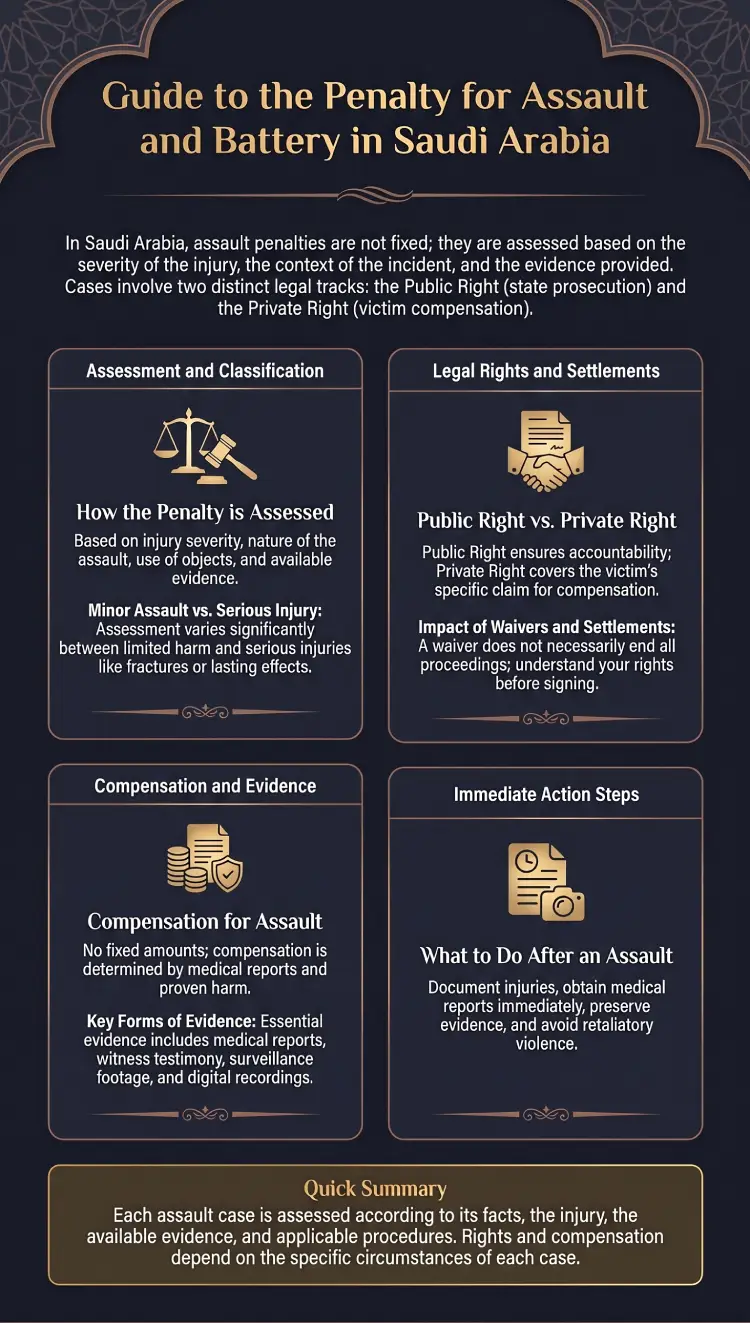
The penalty for assault and battery in Saudi Arabia depends on the circumstances of the incident, the severity of the injury, the nature of the assault, and the evidence presented in the case. There is therefore no single penalty that applies to every physical assault case; each incident is assessed according to its facts and consequences.
Assault cases generally involve two distinct issues: liability for the unlawful act itself and the rights of the injured person, including the right to pursue a private claim and seek compensation for proven harm.
Understanding the applicable procedures and methods of proof can help a person make more informed decisions, whether they have been assaulted or are facing an allegation arising from a physical confrontation.
What Is the Penalty for Assault and Battery in Saudi Arabia?
The penalty for assault and battery in Saudi Arabia varies according to the seriousness of the incident, the extent of the injury, the surrounding circumstances, and what can be established before the competent authorities.
Not every physical assault is treated in the same way. There is a substantial difference between an incident causing limited harm and one resulting in significant injury, the use of an object, or more serious consequences.
Factors considered when assessing the case may include:
- the nature of the assault and how it occurred;
- the extent of the resulting harm;
- medical reports relating to the injury;
- evidence establishing the incident; and
- the circumstances of the parties involved.
The legal characterization of an assault may therefore differ according to its facts and consequences. Understanding the different types of criminal cases in Saudi Arabia can help clarify the nature of the case and the procedural route that may apply.
How Is the Penalty in an Assault Case Determined?
Assessing an assault case begins with examining the conduct itself and the consequences that followed. The legal outcome does not depend solely on the fact that physical contact occurred; the effect of the act and the circumstances surrounding it also matter.
Relevant considerations may include:
- the severity of the injury;
- whether the act was intentional and the circumstances surrounding it;
- the manner in which the assault was carried out; and
- the evidence available to establish what happened.
The existence of an injury does not, by itself, establish who caused it. Responsibility must be assessed in light of the evidence and the facts of the case as a whole.
Minor Assault and Assault Causing Physical Injury
The penalty for a minor physical assault in Saudi Arabia may differ from the consequences of an assault resulting in more significant bodily harm, because the effect of the conduct is an important part of the assessment.
An incident causing limited harm is different from one resulting in:
- visible injuries;
- wounds or fractures;
- continuing medical effects; or
- harm that significantly affects the injured person’s daily life.
More serious physical assaults are assessed according to the extent of the injury, the circumstances of the incident, and the evidence demonstrating the resulting harm.
For that reason, simply describing an incident as “assault” is not enough to determine its legal consequences. The entire factual context must be considered.
Effect of Using an Object During an Assault
The use of an object during an assault may affect how the seriousness of the case is assessed, because the method used to carry out the act may be relevant to the level of risk involved.
The consequences of assault using an object in Saudi Arabia may depend on factors such as:
- the type of object used;
- how it was used;
- the location of the injury; and
- the extent of the resulting harm.
The use of an object should therefore not be assessed in isolation. It forms part of the broader factual picture of the case.
What Factors Affect the Assessment of an Assault Penalty?
Physical assault cases are not assessed solely on whether physical contact occurred. Several factors may influence the legal characterization of the incident and the potential consequences.
Severity of the Injury and the Medical Report
A medical report is often an important document in an assault case because it records the medical condition resulting from the incident.
It may identify:
- the nature of the injury;
- its location;
- its medical effects; and
- the need for treatment or follow-up care.
A medical report can provide important evidence of injury, but it does not necessarily establish every aspect of the case, such as how the incident occurred or who was responsible. It is therefore considered alongside the other available evidence.
Circumstances and Manner of the Assault
The circumstances surrounding an incident can materially affect its assessment. There may be a significant difference between a deliberate assault, a confrontation involving several people, and an incident arising while a person is attempting to respond to an immediate threat.
Relevant circumstances may include:
- where the incident occurred;
- how many people were involved;
- how the confrontation began; and
- the actions taken by each person.
Accordingly, the penalty for physically assaulting another person in Saudi Arabia cannot be properly assessed without understanding the complete circumstances.
Self-Defense and Mutual Fighting
Some assault cases involve an allegation of self-defense or a physical confrontation in which both parties used force.
Such cases require examination of the circumstances, the proportionality of the response to the perceived threat, and the conduct of each person involved. Simply describing an incident as a “fight” does not establish the responsibility of either party.
Public and Private Rights in Assault Cases
An assault case may involve two separate legal interests: the public interest in holding a person accountable for unlawful conduct and the injured person’s private right to seek remedies for the harm suffered.
Understanding the distinction helps clarify the effect of filing a complaint, reaching a settlement, waiving a claim, or seeking compensation while the case is pending.
What Is the Public Right in an Assault Case?
The public right concerns accountability for conduct that affects public order and is dealt with through the applicable criminal procedures before the competent authorities.
Whether an assault case involves a public-right aspect depends on the legal characterization and circumstances of the incident. It does not necessarily depend solely on whether the injured person wishes to continue the case or waive a private claim.
In some situations, public proceedings may continue despite a settlement or waiver, depending on the nature of the incident and the applicable procedures.
What Is the Injured Person’s Private Right?
The private right is the injured person’s right to pursue remedies arising from the harm caused by the assault.
In physical assault cases, this commonly relates to seeking redress for the injury and its consequences.
Claims may include:
- compensation for injury-related harm;
- financial losses connected to the injury; and
- other proven losses or consequences resulting from the assault.
The scope of the private claim depends on the facts, available evidence, and the extent of the proven harm.
Public Right vs. Private Right in an Assault Case
The key distinction is that the public right concerns society’s interest in accountability for unlawful conduct, while the private right concerns the injured person’s individual remedies.
| Comparison | Public Right | Private Right |
|---|---|---|
| Holder of the right | Society through the competent authorities | The injured person |
| Main purpose | Accountability for the unlawful conduct | Redress and compensation for harm |
| Nature | Criminal | Private claim and compensation |
The conclusion or modification of one aspect of the case does not necessarily bring the other to an end, because each serves a different legal purpose.
Effect of Waiver and Settlement in an Assault Case
A waiver or settlement should be considered carefully because its effect may vary depending on the nature of the case and the rights involved.
A waiver in an assault case may affect certain private claims, but it does not necessarily mean that every aspect of the public proceedings will end.
A settlement should also clearly identify:
- the rights covered by the agreement;
- the obligations accepted by each party; and
- the future consequences of the waiver.
Agreeing to a waiver before fully understanding the scope of the injured person’s rights may result in the loss of options that would otherwise have remained available.
Compensation for Assault and Battery in Saudi Arabia
Compensation for assault and battery in Saudi Arabia is intended to address harm suffered by the injured person. Its assessment depends on the nature of the injury and the consequences arising from it.
There is no fixed amount of compensation applicable to every assault case. The assessment may depend on:
- the nature of the injury;
- the extent of the harm;
- the duration and consequences of treatment; and
- documents establishing the loss or injury.
For this reason, there is no single answer to the question, “How much compensation can be awarded for assault in Saudi Arabia?” The facts and proven harm must first be examined.
When Can an Injured Person Claim Compensation?
An injured person may seek compensation where harm can be established and linked to the assault in question.
Relevant harm may include:
- physical injury;
- treatment-related expenses;
- consequences arising from the injury; and
- other losses that can be supported by documents or reports.
Evidence is particularly important in compensation claims because it helps establish the nature and extent of the loss.
How Is Compensation for Assault-Related Harm Assessed?
Compensation is assessed by examining the actual harm resulting from the assault rather than the mere fact that an assault occurred.
Relevant material may include:
- medical reports;
- documents relating to treatment;
- evidence describing the injury and its effects; and
- proof of other losses arising from the incident.
A claim for compensation for bodily injury therefore depends on clear evidence of the nature and consequences of the harm.
Claiming Private Rights and Compensation
An injured person may pursue a private claim where the assault caused harm that can be established.
The claim should identify:
- the nature of the harm;
- how it resulted from the assault; and
- the documents supporting the claim.
Preserving evidence from the beginning of the incident can therefore be important when pursuing private rights and compensation.
How Is Assault and Battery Proven in Saudi Arabia?
Proving physical assault generally depends on a combination of evidence establishing that the incident occurred and linking responsibility to the person accused of committing it.
Relevant evidence may include:
- medical reports;
- witness testimony;
- surveillance-camera footage;
- photographs and recordings; and
- digital evidence and other relevant circumstantial evidence.
The case is generally assessed on the overall evidentiary picture rather than on a single item considered in isolation.
Role of the Medical Report in an Assault Case
A medical report is an important form of technical evidence because it documents the existence and nature of an injury.
It may assist in establishing:
- the type of injury;
- its location;
- its medical effects; and
- whether treatment is required.
However, a medical report establishes the injury from a medical perspective. Determining who caused that injury may require consideration of the remaining evidence.
Is a Medical Report Alone Enough to Prove Assault?
A medical report does not necessarily establish every element of an assault case because its primary function is to document the injury.
Other evidence may be required to establish who was responsible, including:
- witness testimony;
- recordings;
- admissions;
- surveillance footage; and
- digital or circumstantial evidence.
The medical report is therefore assessed as part of the overall evidentiary record.
Legal review / trust box intentionally omitted as requested.
Procedures for Filing an Assault Case in Saudi Arabia
An assault case generally begins with documenting the incident and taking the appropriate procedural steps. Prompt preservation of evidence can help clarify the position of the parties before the competent authorities.
The course of the case may vary depending on the circumstances, the nature of the injury, and the available evidence. In general, it may involve reporting the incident, submitting relevant documents, and having the matter examined by the competent authorities.
Investigation, prosecution, trial, and private claims are governed by the procedures set out under Saudi Arabia’s Law of Criminal Procedure.
Reporting and Documenting the Incident
After an assault, it is important to preserve evidence connected to the event and report the matter to the competent authority.
Useful steps may include:
- documenting the time and place of the incident;
- obtaining a medical report where an injury exists;
- preserving photographs or recordings; and
- providing any information that helps clarify what occurred.
Early documentation can help establish the factual circumstances of the case.
Investigation and Review of Evidence
After a report is filed, the statements of the parties and available evidence are examined. A broader understanding of the procedural stage can be obtained through the stages of a criminal investigation in Saudi Arabia and how a case progresses before moving to the next stage.
The assessment may include:
- the description of the alleged assault;
- medical reports;
- other evidence presented; and
- statements of the parties and witnesses, where available.
The course of each case depends on its individual facts, so neither the outcome nor the duration can be determined without reviewing the particular file.
Claiming a Private Right During the Case
The injured person may pursue a private claim where the assault caused harm that can be established.
The claim generally requires clarification of:
- the type of harm suffered;
- the link between the assault and that harm; and
- the documents supporting the claim.
This becomes particularly important where physical injury or measurable financial loss is involved.
Following the Case and Expected Procedures
The length of an assault case in Saudi Arabia may vary according to factors such as:
- the complexity of the incident;
- whether the evidence is complete;
- the number of parties involved; and
- the procedural steps required.
There is therefore no fixed answer to how long an assault case will take.
Once a dispute reaches the judicial stage, the Saudi Ministry of Justice’s case journey explains the general stages of filing, case review, hearings, judgment, and appeal.
What Should You Do If You Are Physically Assaulted?
If you have been physically assaulted, taking organized steps can help preserve your rights and clarify your legal position.
Consider:
- documenting injuries and preserving any evidence connected to the incident;
- obtaining a medical report if bodily harm occurred;
- keeping the details of witnesses or other relevant information;
- avoiding any response that could develop into a mutual physical confrontation; and
- understanding the legal consequences before agreeing to a waiver or settlement.
These steps can help create a clearer evidentiary record and support any later claim arising from the incident.
Mistakes to Avoid After an Assault
Actions that may weaken a person’s position include:
- failing to document the injury;
- deleting messages or recordings connected to the incident;
- becoming involved in another confrontation as retaliation; and
- signing a waiver or settlement without understanding its consequences.
Understanding the available rights and procedures before making a decision can help preserve important legal options.
When Should You Seek Legal Advice in an Assault Case?
Legal advice may be useful when the facts require closer assessment, particularly where there is:
- an injury or medical report;
- a potential compensation claim;
- a complaint or accusation of assault;
- a dispute over evidence; or
- uncertainty about the consequences of waiver or settlement.
If the incident has become the subject of a complaint, investigation, or private claim, consulting a criminal lawyer in Jeddah can help you understand your legal position, the available evidence, and the next procedural step before making a decision.
Frequently Asked Questions About Assault and Battery Penalties
What is the penalty for assault and battery in Saudi Arabia?
The penalty varies depending on the circumstances, severity of the injury, nature of the assault, and the evidence available in the case.
Does assault and battery involve a public right in Saudi Arabia?
It may involve a public-right aspect depending on the legal characterization of the incident and the procedures applicable to the case.
What is the difference between public and private rights in an assault case?
The public right concerns accountability for the unlawful act, while the private right concerns the injured person’s claim for compensation and other personal remedies.
Does waiving an assault claim end the public-right proceedings?
Not necessarily. The effect of a waiver depends on the nature of the case and the rights involved.
How much compensation can be awarded for assault in Saudi Arabia?
There is no fixed amount. Compensation depends on the injury, proven harm, supporting documents, and the circumstances of the case.
Is a medical report enough to prove assault?
A medical report helps prove the injury, but additional evidence may be needed to establish who caused it.
The penalty for assault and battery in Saudi Arabia: 7 key points on rights and compensation can be understood through seven core issues: the nature of the assault, the severity of the injury, the available evidence, public rights, private rights, compensation, and the procedures that follow the incident.
The outcome of each case depends on its particular facts and what can be established through evidence. Careful documentation and understanding the effect of a waiver or settlement can therefore help protect a person’s legal position before further steps are taken.
Where a case requires a broader review of the evidence, rights, and applicable procedures, a law firm in Jeddah can assess the file and explain the legal options that may be appropriate to the circumstances.