
The timeline does not begin merely when the eviction judgment is issued. A judgment establishes the legal entitlement, but recovering possession requires an enforceable instrument, an enforcement application, formal notification, and action by the competent Enforcement Court.
In practice, the overall period between submitting an application through Najiz and obtaining physical possession may be longer. Delays can arise from incomplete documentation, notification difficulties, belongings remaining on the premises, or an enforcement dispute.
Before estimating the timeline, it is important to understand the broader legal framework for property eviction in Saudi Arabia, including the distinction between enforcing a court judgment and relying on an enforceable instrument such as a properly documented lease.
How Long Does Eviction Order Enforcement Take After Notification?
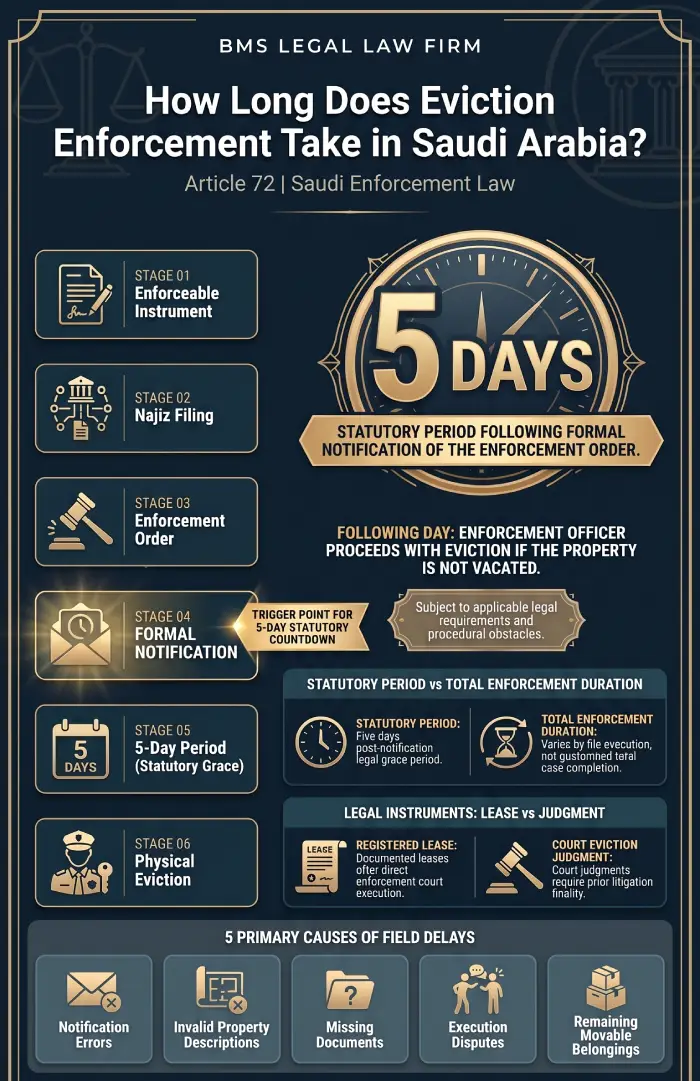
The statutory five-day period begins when the person subject to enforcement is formally notified of the enforcement order.
If the property is not vacated within that period, the enforcement process moves to physical eviction by the enforcement officer on the following day, provided the necessary conditions are satisfied and no legally effective procedural obstacle prevents enforcement.
This distinction is essential when calculating the duration of eviction order enforcement in Saudi Arabia. The relevant statutory countdown is linked to notification of the enforcement order, not simply the date of the court judgment.
The application itself is submitted electronically through the Saudi Ministry of Justice’s Najiz platform, using the appropriate enforcement services and supporting documents.
| Enforcement stage | Effect on the eviction timeline |
|---|---|
| Valid judgment or enforceable instrument | Establishes the legal basis for enforcement |
| Application submitted through Najiz | Initiates proceedings before the Enforcement Court |
| Enforcement order issued | Prepares the case for formal notification |
| Notification of the enforcement order | Starts the five-day statutory period |
| Expiry without voluntary compliance | Allows the process to move to physical eviction |
| Action by the enforcement officer | Enables possession to be handed over when the requirements are satisfied |
Key takeaway: The five-day period runs from notification of the enforcement order. Where the occupant does not comply voluntarily, the enforcement officer proceeds with eviction on the following day under the applicable rules. This does not guarantee that every case will be completed within six calendar days from filing.
Does the Eviction Timeline Start From the Judgment or the Enforcement Notice?
An eviction judgment does not automatically result in the immediate removal of the tenant or delivery of the property.
The judgment or other enforceable instrument must first be eligible for enforcement. The successful party must then submit an enforcement application, after which the relevant enforcement order is issued and notified to the person against whom enforcement is sought.
A common misunderstanding is to calculate the eviction period from the judgment date. In reality, the statutory five-day period is triggered by formal notification of the enforcement order.
Any time spent preparing the judgment for enforcement, submitting the application, reviewing the documents, or correcting procedural deficiencies falls outside that five-day period.
| Event | Legal significance | Does the five-day period begin? |
|---|---|---|
| Judgment issued | Determines the dispute | No |
| Judgment becomes enforceable | Allows enforcement to be pursued | No |
| Application submitted through Najiz | Starts the enforcement application process | Not necessarily |
| Enforcement order formally notified | Triggers the statutory period | Yes |
| Five-day period expires | Allows physical eviction to proceed if there is no voluntary compliance | The period has ended |
Legal Notice: The Judgment Date Is Not the Starting Point
The central statutory timeframe is five days following notification of the enforcement order.
However, the actual handover of the property depends on the enforceability of the underlying instrument, the accuracy of the submitted information, and completion of the required procedures.
The Difference Between a Judgment and Notification
- The judgment establishes the right. It does not necessarily deliver physical possession immediately.
- Notification activates the statutory period. The five-day countdown is linked to formal notification of the enforcement order.
- Incomplete information may delay enforcement. Errors in the instrument, party details, or property description can affect the progress of the application.
Before filing, property owners should confirm that their judgment or lease is enforceable, the respondent’s information is accurate, and the property can be clearly identified.
How Does Najiz Affect Eviction Order Enforcement in Saudi Arabia?
Najiz provides an electronic route for submitting and tracking enforcement applications in Saudi Arabia. It can simplify administrative steps, but it does not make every eviction immediate.
An application for enforcement generally requires accurate information about the parties, the requested enforcement action, and the supporting enforceable instrument.
The quality and completeness of the application can be more important than the speed at which it is submitted.
For example, an incorrect identification number, an inaccurate property description, or an incomplete enforcement document may delay processing even when the application is filed electronically.
Before submitting an eviction enforcement application through Najiz, review:
- The applicant’s and respondent’s identification details.
- Identification numbers and available national address information.
- The property description and unit number.
- The clarity and enforceability of the judgment or other instrument.
- The validity of any power of attorney where an authorized representative submits the application.
- Whether the requested action matches the terms of the enforceable instrument.
After submission, applicants can monitor the status of their enforcement request through the relevant Najiz services.
Regular monitoring helps identify whether the application has progressed, requires correction, or needs additional documents.
Can a Registered Lease Agreement Accelerate Eviction Enforcement?
A properly documented lease agreement may qualify as an enforceable instrument under Saudi law, subject to the applicable legal requirements.
Where the lease is enforceable, the party entitled to enforcement may be able to proceed directly before the Enforcement Court without first obtaining a separate judgment through ordinary litigation.
This can shorten the overall process compared with a dispute involving an undocumented lease or contested contractual relationship.
However, an enforceable lease and an eviction judgment are not identical.
A lease-based enforcement application depends on the terms of the agreement, the nature of the obligation, and whether the relevant requirements for enforcement are met.
Disputes concerning payment, lease expiry, contractual details, or the identity of the occupant may require additional examination.
| Situation | Potential effect on the timeline |
|---|---|
| Properly documented and enforceable lease | May avoid a separate litigation stage |
| Enforceable eviction judgment | Can proceed to enforcement upon a valid application |
| Undocumented lease | May require prior judicial proceedings |
| Dispute over payment or lease expiry | May create additional procedural or legal issues |
| Incomplete supporting information | May delay processing or notification |
For property owners, the important question is not simply whether a lease exists, but whether the specific document provides a legally sufficient basis for the enforcement action being requested.
When Is a Tenant Evicted After a Court Judgment?
A tenant may be evicted after the judgment becomes enforceable, the enforcement application is submitted, formal notification is completed, and the statutory period expires without voluntary compliance.
If the tenant vacates the premises during the notice period, the matter may be resolved without extensive physical enforcement measures.
If the tenant refuses to leave, the case proceeds through the official enforcement process.
The property owner should not independently change the locks, remove the tenant’s belongings, or use personal force to recover possession.
The actual timing of eviction following a judgment may depend on:
- Whether the judgment is enforceable.
- Whether the Najiz application is complete.
- Successful notification of the enforcement order.
- The tenant’s willingness to comply.
- The presence of furniture or other movable property.
- Any enforcement dispute that legally affects the proceedings.
There is no single guaranteed completion date for every case.
The statutory notice period is a key milestone, while the overall enforcement timeline depends on the circumstances of the property, the parties, and the enforcement file.
What Happens if a Tenant Refuses to Vacate After the Judgment?
A tenant’s refusal to vacate does not, by itself, invalidate an enforceable eviction judgment.
Instead, the property owner must continue through the Enforcement Court and the legally prescribed procedures.
Following the applicable notice period, the enforcement officer is responsible for carrying out the physical eviction and arranging the handover of possession in accordance with the law.
Where necessary, the competent authorities may provide assistance within the official enforcement process.
The property owner should avoid:
- Changing the locks without official authorization.
- Disconnecting water or electricity to pressure the tenant.
- Forcibly entering the premises.
- Removing furniture or other belongings without proper official documentation.
- Sending threats or intimidating communications.
Such actions may create additional legal disputes and complicate the recovery of possession.
The appropriate course is to follow the enforcement application until the competent officer completes the required procedures.
Common Reasons for Delays in Eviction Judgment Enforcement
Delays in eviction order enforcement in Saudi Arabia are often procedural or practical. They do not necessarily mean that the property owner’s legal position is weak.
A judgment may be valid and enforceable, yet physical eviction may still be delayed because of missing information, unsuccessful notification, or issues arising at the property.
Notification is particularly important because the statutory five-day period depends on the enforcement order being properly communicated to the person against whom enforcement is sought.
| Cause of delay | Possible effect on enforcement |
|---|---|
| Unsuccessful notification | Delays the start of the statutory period |
| Incorrect property information | May require corrections or additional documents |
| Incomplete enforcement instrument | May delay acceptance or processing |
| Enforcement dispute | May require judicial consideration and, where applicable, affect enforcement |
| Significant movable property | May extend the practical handover process |
| Commercial premises | May require additional logistical coordination |
When assessing how long an eviction will take, reviewing the actual enforcement file is therefore more useful than relying on the five-day period alone.
Does Eviction Enforcement Take Longer for Residential or Commercial Properties?
The core enforcement procedure generally follows the same legal framework for residential and commercial properties.
Both require a valid enforceable instrument, an enforcement application, the necessary notification, and action by the competent enforcement officer.
However, practical circumstances can differ substantially.
Residential premises may involve household furniture and arrangements for handing over keys. Commercial premises may contain inventory, machinery, equipment, signage, or business records that require additional coordination.
| Property type | Factors that may affect physical eviction |
|---|---|
| Residential apartment | Furniture, household occupants, and key handover |
| Retail premises | Inventory, equipment, and signage |
| Warehouse | Stored goods, transportation, and security |
| Office premises | Records, computers, and office equipment |
| Industrial property | Machinery, safety requirements, and site coordination |
These differences do not automatically create a separate statutory notice period for each property category.
They explain why the practical duration of eviction enforcement may vary even when the underlying legal process is similar.
When Should You Seek Legal Advice Before Starting Eviction Enforcement?
Legal advice may be useful when the enforcement timeline is uncertain because of an unclear judgment, incomplete property information, an undocumented lease, or an earlier application that has stopped progressing.
For example, if an enforcement application was previously delayed or the property description does not match the underlying document, consulting a real estate lawyer in Jeddah may help identify the issue before the application is corrected or resubmitted.
BMS Legal Law Firm follows an approach centered on clarity before legal action.
For eviction-related matters, this involves reviewing the enforceable instrument, identifying the appropriate legal route, and checking the information required for an enforcement application.
A preliminary review can also help distinguish between a case that is ready for enforcement and one that requires additional legal or documentary steps.
Under Article 72 of the Saudi Enforcement Law,
the five-day statutory period begins after formal notification of the enforcement order,
not when the judgment is issued. Actual enforcement may take longer depending on
the case and applicable procedures.
Saudi-licensed law firm | Jeddah
Frequently Asked Questions About Eviction Enforcement in Saudi Arabia
How long does it take to enforce an eviction order in Saudi Arabia?
The statutory period under Article 72 of the Saudi Enforcement Law is five days following notification of the enforcement order.
Can a landlord evict a tenant immediately after winning a court case?
Not merely because the judgment has been issued. The judgment must be enforceable, and the appropriate enforcement procedures must be followed.
Can a registered lease be enforced without a separate eviction judgment?
A properly documented lease may qualify as an enforceable instrument, allowing the entitled party to seek enforcement directly when the relevant legal requirements are met.
What should a landlord do if the tenant refuses to leave?
The landlord should continue through the Enforcement Court rather than attempting self-help eviction. Once the relevant legal requirements are satisfied, the enforcement officer handles the physical eviction.
Why can eviction take longer than the five-day period?
The five-day period is not the total time required for every enforcement case. Additional time may be needed to prepare and submit the application, complete notification, correct documentation.
The most important distinction in eviction order enforcement in Saudi Arabia is between the statutory period following notification and the total time required to recover possession.
Article 72 provides for a five-day period after notification of the enforcement order, followed by action by the enforcement officer on the next day where the conditions are satisfied and the property has not been vacated voluntarily.
A properly documented lease may provide a more direct route to enforcement, while a court judgment must be ready for enforcement before the application proceeds.
Incomplete documentation, notification difficulties, and disputes can affect the final handover date.
If you hold an eviction judgment or an enforceable lease and need to determine the appropriate next step, you can contact BMS Legal Law Firm to discuss your case with the relevant documents and property details available for review.
Official Legal Sources: