
Although establishing a Waqf may initially appear to be a single legal act, the resulting endowment deed can govern assets, determine financial entitlements, and regulate beneficiary rights for generations.
Understanding the relevant category before documentation is essential because the distinction between charitable, family, and mixed endowments may affect administration, income distribution, and the authority of the Waqf supervisor in the event of a dispute.
Quick Answer: What Are the Types of Waqf in Saudi Arabia?
The three principal types of Waqf in Saudi Arabia are charitable Waqf (public endowment), family Waqf (private or descendant-based endowment), and mixed Waqf. They differ according to their designated beneficiaries, the purposes for which income is allocated, their management arrangements, and their potential effects on heirs and beneficiaries.
Article 1 of the Law of the General Authority for Awqaf identifies public, private, and mixed endowments. A private or family Waqf is established for designated descendants or relatives, while a mixed Waqf combines more than one type of endowment under the founder’s conditions.
Knowing the category of an endowment is not merely a theoretical consideration. It affects documentation, income distribution, supervisory powers, and the legal nature of objections or disputes.
The appropriate classification should therefore be established before drafting the founder’s conditions, documenting the endowment through Najiz, or registering it with the General Authority for Awqaf.
For a broader explanation of establishment requirements and management rules, see our Guide to Waqf Laws and Regulations in Saudi Arabia.
What Is Waqf Under Saudi Law?
Waqf, commonly described in English as an Islamic endowment, is an arrangement through which an asset is dedicated to specified beneficiaries or purposes while its underlying property is preserved and its benefits are applied according to the founder’s conditions.
In Saudi Arabia, endowments commonly involve real estate, financial assets, endowment funds, or other property capable of generating continuing income or benefits.
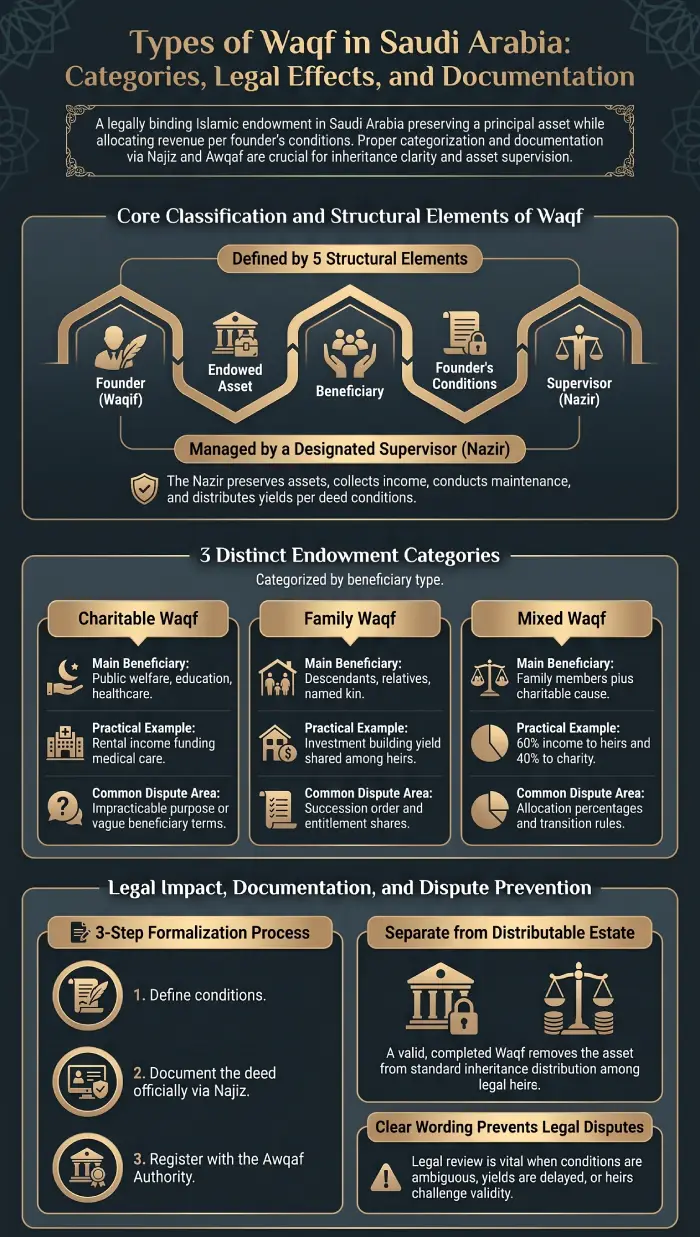
Five elements are particularly important:
- Waqf Founder (Waqif): The person who establishes the endowment.
- Endowed Property: The property or asset dedicated to the Waqf.
- Waqf Beneficiary (Mawquf Alayh): The individual, group, or entity entitled to receive its income or benefits.
- Founder’s Conditions (Shurut Al-Waqif): The provisions governing administration, beneficiaries, income allocation, and entitlement.
- Waqf Supervisor (Nazir): The person or legal entity responsible for administering the endowment and implementing its governing conditions.
These elements become significant when establishing the Waqf, distributing income, interpreting its deed, or resolving a disagreement.
If the designated beneficiary is a charitable institution or public-benefit purpose, the arrangement will generally fall within the charitable category. If beneficiaries are the founder’s children, descendants, or relatives, it will generally constitute a private or family Waqf.
Waqf also has a recognized legal status within the framework of real rights under Saudi law. It should therefore not be treated as a simple informal family arrangement, particularly where real estate, income entitlements, or inheritance-related interests are involved.
The 3 Main Types of Waqf in Saudi Arabia
The practical classification of an endowment primarily depends on its beneficiaries and the purposes for which its income or benefits are allocated.
Three principal categories should be distinguished.
1. Charitable Waqf (Public Endowment)
A charitable Waqf is an endowment whose income or benefits are dedicated to a public-benefit purpose or charitable cause, such as education, healthcare, poverty relief, or mosques.
Beneficiaries are generally identified by their characteristics or by the designated charitable institution rather than by reference to a particular individual.
Examples of charitable Waqf include:
- An investment building whose rental income supports medical treatment for patients unable to afford healthcare.
- Land dedicated to constructing a mosque or educational facility serving the community.
- A financial endowment fund supporting low-income individuals and families.
- Real estate whose income finances specified healthcare or social programs.
The effectiveness of a charitable Waqf depends significantly on the clarity of its designated purpose.
Broad or ambiguous wording may lead to disagreements between the supervisor, beneficiaries, or relevant authorities.
The deed should therefore clearly identify the charitable purpose and address situations in which the designated beneficiary becomes unavailable or the original objective can no longer be implemented as intended.
2. Family Waqf (Private or Descendant-Based Endowment)
A private or family Waqf is an endowment established for designated individuals, commonly the founder’s descendants or relatives.
The term Waqf Dhurri is generally used to describe an endowment intended to benefit the founder’s children, grandchildren, or subsequent descendants.
Examples of family Waqf include:
- A residential property whose use is allocated to children according to an arrangement established by the founder.
- An investment building whose income is distributed among descendants under the endowment deed.
- Land or real estate whose returns are allocated to daughters or grandchildren in specified proportions.
- Financial assets generating investment returns for relatives identified by name or description.
This category requires particular care when drafting beneficiary provisions because it frequently intersects with family relationships, entitlement rules, and income allocation.
Common disputes may concern whether descendants through daughters are included, how successive generations are ranked, what happens to a deceased beneficiary’s entitlement, and where income should be directed if the designated family line ends.
These matters should be addressed in the founder’s conditions wherever possible.
3. Mixed Waqf (Family and Charitable Endowment)
A mixed Waqf combines more than one endowment category.
For example, part of the income may benefit the founder’s descendants while another portion supports a charitable institution.
The arrangement may combine family and charitable beneficiaries from the outset or provide for a change in beneficiaries when specified conditions are fulfilled.
Examples of mixed Waqf include:
- Allocating 60% of distributable income to descendants and 40% to a charitable organization.
- Directing property income to descendants and subsequently to people in need if the designated family line ends.
- Allocating one portion of income to grandchildren’s education and another to a charitable cause.
- Establishing a family endowment with a permanent or contingent charitable allocation.
Mixed endowments require careful drafting because disagreements may arise over allocation percentages, timing, beneficiary succession, or the transition between different purposes.
The distribution mechanism should be expressly defined rather than left entirely to the supervisor’s discretion or to future agreements among beneficiaries.
Comparison of the Main Waqf Categories
The following table highlights the principal differences between charitable, family, and mixed endowments.
| Waqf Type | Beneficiaries | Practical Example | Common Dispute |
|---|---|---|---|
| Charitable Waqf | Charitable organizations or public-benefit purposes | Rental income supporting education or poverty relief | Impracticability of the designated purpose |
| Family Waqf | Descendants, relatives, or designated individuals | A residential property endowed for children | Income allocation and beneficiary succession |
| Mixed Waqf | Family beneficiaries and charitable purposes | Income divided between descendants and charity | Allocation percentages and changes in entitlement |
These distinctions demonstrate that the types of Waqf in Saudi Arabia differ in substance rather than terminology alone.
The most significant differences concern beneficiary rights, income allocation, supervisory responsibilities, potential disputes, and documentation requirements.
Practical Examples of Waqf Arrangements in Saudi Arabia
Practical examples help illustrate how the endowment category affects beneficiaries, income, and administration, particularly following the founder’s death or when the endowed property ceases to serve its intended purpose.
A house dedicated to children: This will generally constitute a family Waqf. The deed should clarify who may occupy the property, whether income may be generated, and whether sons, daughters, and grandchildren are included.
An investment building benefiting descendants: Rental income is distributed according to the founder’s conditions. The deed should address beneficiary succession and the treatment of entitlements following a beneficiary’s death.
A property generating income for charity: This will generally be a charitable Waqf. The designated purpose should be sufficiently clear to prevent interruption when the charitable institution changes or implementation becomes impracticable.
Land dedicated to a public facility: Examples include a mosque, educational institution, or healthcare facility. The deed should identify the intended use and the arrangements governing administration.
An endowment combining family and charitable beneficiaries: This may constitute a mixed Waqf where part of the income is allocated to descendants and another part to a charitable purpose.
A financial Waqf fund: Financial assets may be dedicated to a designated beneficiary group or charitable project. Their management, investment returns, and distribution arrangements should be clearly established.
These examples show that disagreements frequently arise not from the name of the endowment, but from ambiguous conditions, insufficient beneficiary definitions, or unclear income allocation rules.
Legal Requirements for Establishing Different Types of Waqf
The legal and practical requirements for establishing a Waqf should be examined in light of its purpose and category.
A family endowment involving real estate raises different drafting concerns from a charitable endowment or a mixed arrangement with several beneficiary groups.
Before documentation, the following matters should be reviewed:
- The founder’s legal capacity and authority to make the disposition.
- Clear identification of the endowed asset.
- Evidence of ownership of the property being endowed.
- Identification of beneficiaries or the designated charitable purpose.
- Clear conditions governing income allocation and beneficiary entitlement.
- Appointment of a supervisor or an appropriate mechanism for appointing one, where required.
In a family Waqf, particular attention should be given to beneficiary classes and succession arrangements.
In a charitable Waqf, the designated purpose and eligible recipients should be defined precisely.
In a mixed Waqf, the deed should clearly establish allocation percentages and distinguish the rights of different beneficiary groups.
How Does the Type of Waqf Affect Inheritance and Heirs?
A validly established and effective Waqf will generally not be treated as freely distributable estate property in the same manner as assets that remain personally owned by the deceased.
However, disputes may arise where an endowment is intended to take effect after death or where heirs challenge its validity, legal characterization, or surrounding circumstances.
A distinction must therefore be made between an effective lifetime Waqf and a will.
A lifetime endowment is intended to produce legal effects during the founder’s lifetime, subject to its terms and applicable requirements.
A will, by contrast, concerns dispositions that take effect following death and is governed by its own legal rules.
When examining inheritance-related implications, it is important to consider the relevant Waqf regulations, the treatment of testamentary dispositions, and the applicable provisions of the Saudi Personal Status Law.
Common Disputes Between Waqf Beneficiaries and Heirs
Disagreements may arise where:
- A principal family property is endowed for only some beneficiaries.
- The deed uses ambiguous expressions such as “descendants” or “children.”
- Certain heirs allege that the disposition was intended to prejudice their interests.
- The parties disagree over whether the arrangement constitutes a Waqf or a will.
- Beneficiaries claim income following the founder’s death.
These issues cannot be determined reliably without examining the Waqf deed, property title, timing of the disposition, and legal status of the interested parties.
Where an endowment intersects with inheritance matters or involves several heirs, advice from a Licensed Family Law Lawyer in Jeddah may help identify the appropriate legal issues and supporting documents.
How the Founder’s Conditions Determine the Type of Waqf
The founder’s conditions are among the most important provisions of an endowment deed.
They identify beneficiaries, determine income allocation, regulate supervisory authority, establish management arrangements, and address situations where implementation becomes impracticable.
The conditions also help determine whether the endowment is charitable, family-based, or mixed.
A carefully drafted deed should answer the following questions:
- Who is entitled to benefit from the Waqf?
- How will income be distributed?
- Are sons, daughters, and grandchildren included?
- Who will supervise the endowment after the current supervisor’s death?
- What happens if the designated descendants no longer exist?
- Is there a subsequent charitable beneficiary?
- Should maintenance expenses be paid before distributing income?
Clear provisions reduce the likelihood of disputes.
Conversely, overly general or abbreviated conditions may create substantial uncertainty when beneficiaries disagree or circumstances change.
Sometimes a dispute begins not with income allocation, but with a more fundamental question: who has legal authority to administer the endowment?
Where the deed is unclear, the supervisor dies, or beneficiaries challenge supervisory authority, a Legal Claim to Establish Waqf Supervisory Authority may become relevant before financial accounting or distribution issues can be resolved.
Respecting the founder’s conditions does not necessarily mean that every provision can be implemented without interpretation.
Some conditions may require legal examination where they are ambiguous, impracticable, or affected by circumstances that prevent the endowment from serving its original purpose.
Documenting and Registering Waqf in Saudi Arabia
Two distinct stages should be considered: formally documenting the endowment and registering it with the General Authority for Awqaf.
Documentation concerns the formal issuance of an endowment deed.
Registration concerns recording the endowment’s information with the relevant authority after documentation, subject to applicable requirements.
The Saudi Ministry of Justice provides a Waqf Documentation Service through Najiz.
The service allows eligible applicants to initiate the documentation process and obtain an official endowment deed.
According to the Ministry’s published service information, applicants access Najiz using the National Single Sign-On system, select the relevant service, enter the required information, and submit supporting documents.
The General Authority for Awqaf separately provides services for registering endowments and maintaining their regulatory records.
Its Waqf Registration Service concerns registration within the authority’s systems.
Documents and Information to Prepare Before Documentation
Before initiating documentation, it is advisable to prepare:
- The founder’s identification and evidence of legal capacity or authority.
- A clear description of the endowed asset.
- The property title deed if the endowment involves real estate.
- The proposed founder’s conditions and income allocation provisions.
- The supervisor’s identity and powers, where a supervisor is appointed.
- Details of beneficiaries or designated charitable recipients.
- Any supporting documents affecting ownership, administration, or entitlement.
The wording of the endowment deed should be reviewed before formal documentation.
Amending an established endowment arrangement may be more complicated than resolving ambiguities and omissions during the initial drafting stage.
Applicants should also check the current requirements published by the relevant government platform before submitting a request.
The Role of the Waqf Supervisor and Income Distribution
A Waqf supervisor, known in Arabic as a Nazir, is responsible for administering the endowed property within the scope of the founder’s conditions and applicable Saudi legal requirements.
The role extends beyond ordinary property management.
It requires balancing the preservation of endowed assets, implementation of the founder’s instructions, and protection of beneficiary entitlements.
For a detailed explanation of appointment, supervisory powers, and accountability, see Rules Governing Waqf Supervisors in Saudi Arabia
.Typical responsibilities include:
- Preserving the endowed asset.
- Collecting rental income and other returns.
- Arranging necessary maintenance.
- Recording expenses and financial transactions.
- Distributing income in accordance with the founder’s conditions.
- Representing the endowment within the supervisor’s authorized powers.
- Maintaining accounts and relevant supporting records.
The supervisor must not treat endowed property as personal property.
Where maintenance is neglected, income distribution is improperly delayed, or the founder’s conditions are breached, beneficiaries may seek a legal review of the supervisor’s conduct and responsibilities.
For a mixed Waqf, it is particularly important to distinguish between the family allocation and the charitable allocation.
Inadequate accounting or the improper mixing of beneficiary funds may result in prolonged disputes over administration and financial entitlements.
When Do Different Types of Waqf Lead to Legal Disputes?
Disputes concerning the types of Waqf in Saudi Arabia may arise when parties disagree about beneficiaries, income distribution, supervisory authority, or the validity and interpretation of the endowment deed.
Family and real estate endowments may present particularly sensitive issues because they frequently involve relatives, inheritance-related expectations, and valuable property.
Common disputes include:
- Objections raised by heirs against an endowment.
- Claims for unpaid or undistributed Waqf income.
- Disagreements over the founder’s conditions.
- Uncertainty about beneficiary succession or different generations.
- Requests for financial accounting by the supervisor.
- Applications seeking removal or replacement of the supervisor.
- Proposed sale or replacement of endowed property.
- Loss or interruption of the endowed asset’s intended benefit.
The sale or replacement of endowed property must not be treated as an ordinary transaction involving privately owned assets.
Such arrangements require examination of the applicable regulatory framework, the founder’s purpose, and the interests of the endowment.
The appropriate legal approach therefore begins with collecting and reviewing the relevant documents rather than immediately initiating proceedings.
Important records may include the Waqf deed, property title, supervisor appointment documents, financial statements, correspondence, and previous judgments or applications.
When Should You Seek Legal Advice About a Waqf?
Legal advice may be appropriate when an issue extends beyond understanding the endowment category and concerns the practical consequences of its establishment, administration, or enforcement.
The matter may involve documenting a new endowment, registering an existing one, interpreting the founder’s conditions, claiming income, or addressing an ongoing dispute.
Legal review is particularly relevant where:
- A family or mixed endowment requires clear beneficiary definitions and allocation percentages.
- Real estate is being endowed for children or relatives.
- Multiple heirs or beneficiaries have competing interests.
- The founder’s conditions are ambiguous.
- Income distribution has been delayed.
- A disagreement exists with the Waqf supervisor.
- Sale or replacement of endowed property is being considered.
- An existing endowment deed is being challenged.
Where a Waqf deed or a dispute over income or supervisory authority already exists, reviewing the deed and supporting documents is a useful first step.
If you require an assessment of an endowment-related matter, you can Contact BMS Legal Law Firm in Jeddah to discuss the relevant documents and the legal issues that may need examination.
The appropriate course of action depends on the circumstances of the individual matter and the applicable Saudi legal requirements.
LEGAL INFORMATION & PROFESSIONAL GUIDANCE
Waqf classification, beneficiaries, and income distribution
depend on the endowment deed, the founder’s conditions,
and applicable Saudi regulations.
BMS Legal Law Firm
|
Commercial Registration: 7053637679
Legal guidance should be based on the relevant documents
and individual circumstances. No particular legal outcome
is guaranteed.
Frequently Asked Questions About Types of Waqf in Saudi Arabia
1. What are the main types of Waqf in Saudi Arabia?
The three main types are charitable Waqf, family Waqf, and mixed Waqf. They differ in their beneficiaries, purposes, and income distribution arrangements.
2. What is the difference between charitable Waqf and family Waqf?
Charitable Waqf supports public-benefit purposes, such as education or healthcare, while family Waqf benefits designated relatives or descendants.
3. Does Waqf property form part of an inheritance?
A valid and effective Waqf is generally excluded from the distributable estate. However, its legal status depends on the deed, timing, and applicable Saudi law.
4. How can a Waqf be documented in Saudi Arabia?
Waqf documentation is available through the Najiz platform, subject to applicable requirements. Registration with the General Authority for Awqaf is a separate process.
Understanding the types of Waqf in Saudi Arabia is essential when establishing an endowment, interpreting an existing deed, or assessing beneficiary rights.
Charitable Waqf serves public-benefit purposes, family Waqf supports designated relatives or descendants, and mixed Waqf combines different objectives under specified conditions.
A properly considered arrangement should begin by identifying the appropriate category, defining the founder’s conditions, and determining the relevant documentation and registration procedures.
The precision of the endowment deed remains central to reducing disputes and preserving the intended purpose.
Clearly identifying beneficiaries, supervisory powers, income allocation rules, and arrangements for changing circumstances can help maintain continuity and reduce uncertainty.
At BMS Legal Law Firm in Jeddah, the relevant documents and circumstances can be examined to identify the appropriate legal approach without promising a particular judicial outcome.