Buying property in Saudi Arabia as a foreigner does not start with viewing the property or agreeing a price. The right decision starts with knowing whether the deal can be transferred and registered in the name of a non-Saudi buyer.
A property can suit you on location and price and still run into trouble when the deed is checked or ownership is transferred. So treat the purchase as a procedure that begins before the deposit is paid, with an understanding of the terms of a real estate sale agreement and of the controls that apply to non-Saudi buyers.
Found a property? Check it before the deposit
Ask for the deed, confirm your buyer status and review the deposit clause. A BMS Legal lawyer in Jeddah can give the documents an initial review.
Enquiries are handled confidentially · No specific court outcome can be guaranteed
Your Quick Decision Before You Pay Anything
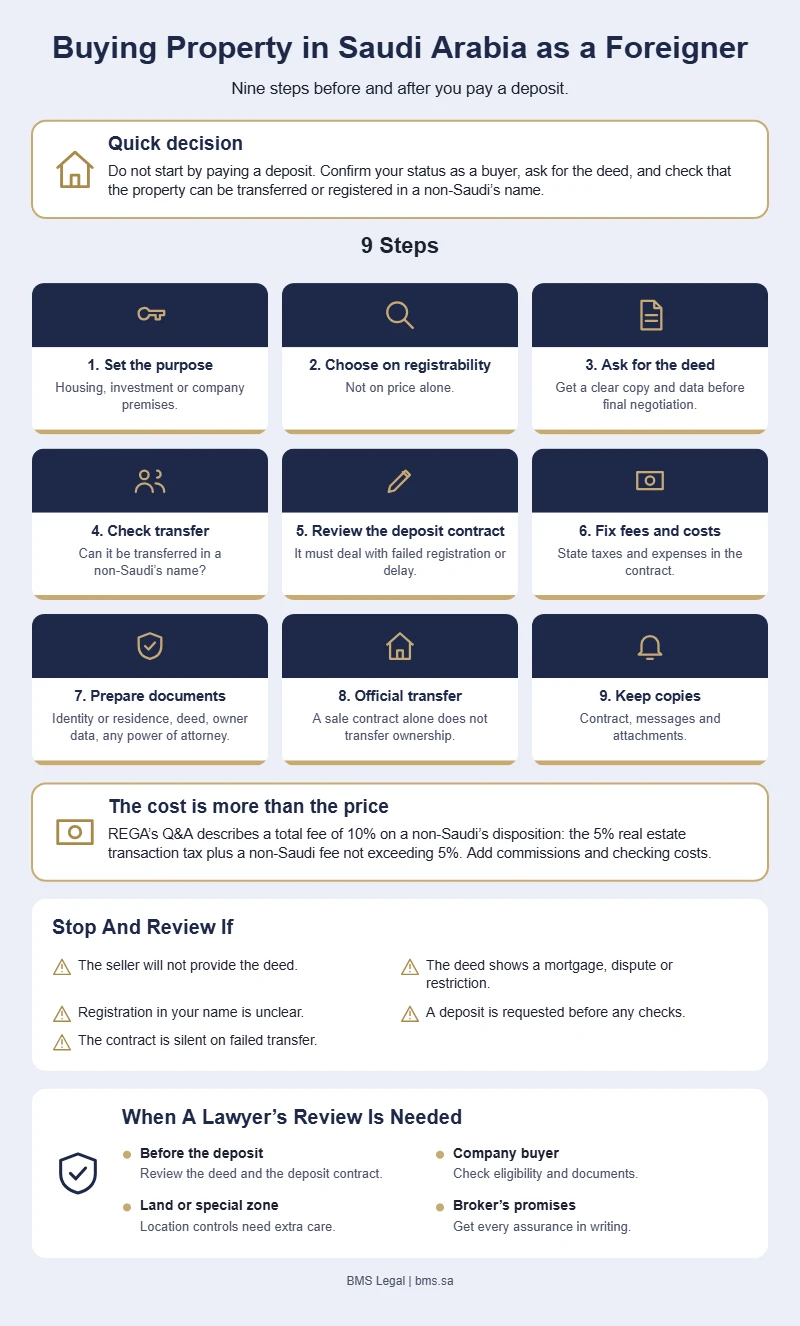
If you are a foreigner and have found a suitable property, do not start by paying a deposit. Start by confirming your status as a buyer, ask for a copy of the deed, and check that the property can be transferred or registered in a non-Saudi’s name.
A foreigner may be able to buy property in Saudi Arabia under defined controls, but the success of a deal depends on the property itself. The seller’s agreement is not enough, a general contract template is not enough, and a price offer alone is not enough.
Before any financial commitment, run through these points:
- The buyer’s status as a non-Saudi, and how clearly it appears in the documents.
- The state of the deed: whether it is current, and any restriction, mortgage or dispute.
- Whether the property can be transferred or registered in a non-Saudi’s name.
- A clear clause dealing with failure to register or refusal of transfer.
- The fees and costs, and who bears them, settled before signing.
If any point is unclear, delay the deposit until the check is complete. The rules and zones were updated recently, so confirm the current position with the General Authority for Real Estate (REGA) as well.
Can a Foreigner Buy Property in Saudi Arabia?
A foreigner can buy property in Saudi Arabia under legal controls, but that does not mean purchase is open in every case. The practical question is not whether the law permits it in general, but whether this particular property can be completed in your name.
The result can differ between a residential unit, land, an apartment, a commercial property or a property bought in a foreign company’s name. It also differs where the buyer is a resident, a premium residency holder, an investor or a company.
Once you have a specific property and are considering a deposit, organise the conditions for non-Saudis owning property in Saudi Arabia before signing: the buyer’s status, the deed, the location and whether transfer is possible.
Before You Look for a Property: Fix Your Status as a Buyer
The buying journey does not begin with an advertisement or a call from a broker. It begins with your status, because the status changes how the property is checked, how the contract is drafted and how transfer is handled.
You may be:
- A resident in Saudi Arabia looking for housing.
- A premium residency holder who wants regulated ownership.
- A foreign investor studying a real estate asset.
- A foreign company seeking premises or an operating property.
- A non-resident who wants to understand how to buy from abroad.
Knowing your status does not mean the deal is accepted or refused at once, but it fixes the questions to ask before you request the deed, draft the contract and pay a deposit. Buying a ready apartment is not like buying land, and buying in a person’s name is not like buying in a company’s name. Know your route before entering a binding financial negotiation.
Buying Property in Saudi Arabia as a Foreigner: The Steps
The steps need a clear order. The aim is to move from choosing a property to signing without leaving a gap that can block transfer.
Follow this order before paying a deposit:
- Set the purpose of the purchase. Housing, investment, company premises or commercial property linked to an activity.
- Choose on registrability, not on price alone. The cheapest property is not always best if the deed or location causes trouble later.
- Ask for the deed and the data before the final negotiation. Do not rely on a broker’s or seller’s description; ask for a clear copy.
- Check whether transfer in a non-Saudi’s name is possible. This is the real test of the deal, not an administrative step after the contract.
- Review the deposit contract before paying. It should deal with failure to register, a restriction that appears, or delay in transfer.
- Fix the fees and costs in the contract. Do not leave taxes or expenses to general wording that becomes a dispute.
- Prepare the buyer’s and seller’s documents. Identity or residence, the deed, the owner’s data, any power of attorney and any document that affects the deal.
- Move to official transfer or registration. The sale contract proves the agreement but does not on its own transfer ownership.
- Keep copies of the contract and correspondence. Messages, agreements and attachments can matter if a dispute arises.
A sale contract proves the agreement between the parties, but the procedures for transferring a property in Saudi Arabia are a separate path from signing the contract or paying the price. A real estate transfer agreement template in Saudi Arabia shows how the undertakings may be arranged.
How to Check the Property Before Paying a Deposit
Checking before the deposit does not complicate the deal. It makes sure there is no visible obstacle before you commit money. Ask the seller or broker for proof that the deal is sound from the start, and review these points:
- That the name of the deed’s owner matches the person who will sign the sale contract.
- A valid power of attorney that expressly allows sale, if a representative signs.
- That the property is free of a mortgage or finance that needs a financier’s approval.
- No attachments, disputes or restrictions that block transfer.
- The position of the property if it is let, and the term of any existing leases.
- Any violations or service obligations linked to the property.
- That the area and boundaries in the deed match reality.
- That transfer can be completed within a stated period written into the contract.
Do not rely on a verbal description. Ask for the deed first, then check the ownership details and the property’s status before the final negotiation.
If you already have a deed or a draft deposit contract, send the details so that the points that could block transfer can be reviewed before signing.
A Practical Example: A Resident Finds an Apartment
If a resident finds a suitable apartment in Jeddah, the first step is not the final price. The resident asks for the deed, checks the owner’s data, then looks for a mortgage, restriction or existing lease.
The draft deposit contract is then reviewed to see what happens if transfer cannot be completed in a non-Saudi’s name. That way the decision to buy rests on documents, not on a verbal promise.
This example does not mean every resident’s case ends the same way. It shows the right order of thinking before any money is transferred or any binding contract is signed.
Contract Terms That Protect a Foreign Buyer
A contract for a foreign buyer should not be a general sale template. A non-Saudi buyer makes some terms more sensitive before signing.
Make sure the contract includes:
- A link between the final payment and completion of transfer or registration.
- What happens to the deposit if ownership cannot be transferred.
- A duty on the seller to provide a clear, up-to-date deed.
- Who bears tax, fees and expenses.
- A specific period for completing the transfer of ownership.
- How any mortgage, tenant or existing restriction will be dealt with.
- A clear way to end the contract if a legal obstacle appears.
- A written record of correspondence and promises that affect the deal.
A good contract does not stop at the price, the property name and the payment date. It says what happens if the deal is not completed, and who bears the result.
Before you transfer any money
Ask for the deed, confirm your status as a buyer, and make sure the contract says what happens to the deposit if transfer fails. A price agreement is not a registered purchase.
Enquiries are handled confidentially · No specific court outcome can be guaranteed
Apartment, Land or Commercial Property: What Changes in Practice?
The type of property changes the checks before purchase, so an apartment, land and a commercial property should not be treated in the same way.
| Type of property | What the buyer should check first |
|---|---|
| Apartment | The deed, shared parts, the owners’ association, whether transfer is possible |
| Villa | The land, the building, licences, boundaries, services |
| Land | Classification, use, the plan, development potential |
| Commercial property | The activity, leases, obligations, licensing |
| Investment property | Return, operation, restrictions, maintenance costs |
For an apartment, the check usually centres on the deed, the unit and the shared parts. Land needs more care, because classification and use can affect the property’s value. A commercial or investment property needs a different check: review the leases, the obligations, the permits and the effect of the activity on registration before signing.
When Should You Stop the Deal?
Some deals should not continue before a deeper review. A temporary stop protects the deposit and shows whether the purchase is viable.
Stop and review the file if you see any of these signs:
- The seller refuses to provide the deed before the deposit.
- The deed does not match the property’s data.
- A power of attorney is unclear or expired.
- A mortgage or restriction appears without a written way of dealing with it.
- The contract bars recovery of the deposit even if transfer fails.
- There is no clear period for transferring ownership.
- The contract does not say who bears fees and tax.
- There are tenants and their leases are not explained.
- The broker makes promises without documents.
- The buyer has not confirmed his or her own legal route.
A mortgage on the property does not always mean the deal fails, but the steps for selling a mortgaged property have to be built into the contract: settlement of the debt, release of the mortgage and the timing of transfer.
The Cost of Buying Property as a Foreigner
The property price is not the final cost. Count the expected obligations before signing, so that a fair price does not become an unplanned burden.
The cost usually includes:
- The agreed value of the property.
- Real estate transaction tax, where it applies.
- Any additional fee that applies to non-Saudi acquisitions under the updated law.
- Other statutory fees or expenses.
- The broker’s commission, where a broker is used.
- The cost of checking the deed and the contract.
- Mortgage or finance costs, if any.
- Any operating or rental obligations attached to the property.
REGA’s published Q&A describes a total fee of 10% on a non-Saudi’s real estate disposition, made up of the 5% real estate transaction tax and an additional non-Saudi fee not exceeding 5%, with the percentages set by the implementing regulation. Confirm the current figures with REGA and the Zakat, Tax and Customs Authority before budgeting.
When Is a Lawyer’s Review Necessary Before the Deposit?
A lawyer’s review becomes necessary when you move from a general enquiry to a real deal. The need increases if there is a deposit, a mortgage, a foreign company or a deed that needs review.
The review matters more the greater the chance that transfer stalls or the deposit is lost. This often shows in deals with a large deposit, a mortgaged property, land or a commercial property, or a purchase in the name of a company or foreign investor. It is also worth a closer look if the property is let, the deed does not match reality, a representative signs for the seller, fees are unclear, or the termination clause is unbalanced.
Where there is a mortgage, an unclear deed or a large deposit contract, advice from a real estate lawyer in Jeddah helps to identify the points that could hold up transfer before financial commitment.
Trust and Legal Basis
Trust and Legal Basis
Legal basis
This guide is based on the official REGA Q&A on the updated Law of Real Estate Ownership by Non-Saudis and the REGA platform page listed below, and is written for general legal awareness rather than as advice on a specific case. Rules, zones and fees are updated by regulation, so confirm the current position with REGA before acting.
Published by: BMS Legal Law and Legal Consultancy Company.
Address: Jeddah, Al-Mishrifah District, Palestine Street, Al-Safeer Tower
Frequently Asked Questions About Buying Property as a Foreigner
What is the first step before buying property in Saudi Arabia as a foreigner?
Identify your status as a buyer, then ask for the deed and check that the property can be transferred before paying a deposit.
Should I check the property or my status first?
Do both together. Your status fixes the route, and the deed shows whether the deal can be completed.
What should I ask the seller for before the deposit?
The deed, the property details, the owner's details, any power of attorney, and information on any mortgage or lease.
When is a deposit contract risky for a foreign buyer?
It is risky if it does not say what happens to the deposit when transfer cannot be completed or a legal obstacle appears.
Is a sale contract enough before transfer?
No. The contract proves the agreement, but it does not replace official transfer or registration of ownership.
What costs should I count before signing?
Count the price, real estate transaction tax, any additional non-Saudi fee, other fees, the broker's commission, checking costs and any existing obligations. Confirm current rates with REGA.
Conclusion
Buying property in Saudi Arabia as a foreigner is a sequence of steps, not a single decision. A good deal begins when you know what to check before signing the contract: your status, the deed, the contract terms, the costs and whether transfer is possible.
If you have found a property, do not let the price alone lead you. Ask for the deed, review the contract, fix your status as a buyer and calculate the final cost before committing.
Where there is a mortgage, a foreign company, an unclear deed or a large deposit, you can contact us and send the property details for review before signing.
To have your deed and deposit contract reviewed before you pay, contact BMS Legal in Jeddah for a preliminary review.
Mortgage, a company buyer or a large deposit?
Send us the property details and a BMS Legal lawyer in Jeddah will tell you which points could hold up transfer before you sign.
Enquiries are handled confidentially · No specific court outcome can be guaranteed
Official Legal and Government Sources
- General Authority for Real Estate: Q&A about the updated Law of Real Estate Ownership by Non-Saudis (English-language official document)
- General Authority for Real Estate: non-Saudi real estate ownership platform page (official website)
Disclaimer: This article is for general legal awareness and is not advice on an individual case, and reading it does not create a lawyer–client relationship. The legal assessment varies with the facts, the documents and the rules that apply to each case.