
A Real Estate Transfer Agreement Template must reflect the true nature of the transaction, the ownership details, and each party’s obligations before signing. A transfer made for payment may be treated as a sale when ownership is exchanged for a genuine price. A transfer made without payment may instead be treated as a gift when the intention to donate and the applicable requirements are established.
The legal effect of the document depends on the consideration, the parties’ intentions, and the rights created by the agreement. A signed contract may establish personal obligations between the parties, but transferring a registered real estate right may still require official documentation or registration through the applicable procedure.
Real Estate Transfer Agreement Template Summary Before Signing
A Real Estate Transfer Agreement Template records an arrangement under which an owner transfers an entire property or a defined ownership share to another person. It should identify the transferor and transferee, describe the property, specify the transferred share, explain the consideration, disclose registered restrictions, and allocate documentation costs and procedural obligations.
Signing a property transfer agreement does not necessarily complete the official transfer of ownership. The agreement may prove that the parties reached a binding arrangement, while the registered right remains in the transferor’s name until the required tax, documentation, and registration procedures are completed. The agreement must therefore correspond with the official ownership document and the property’s registered details.
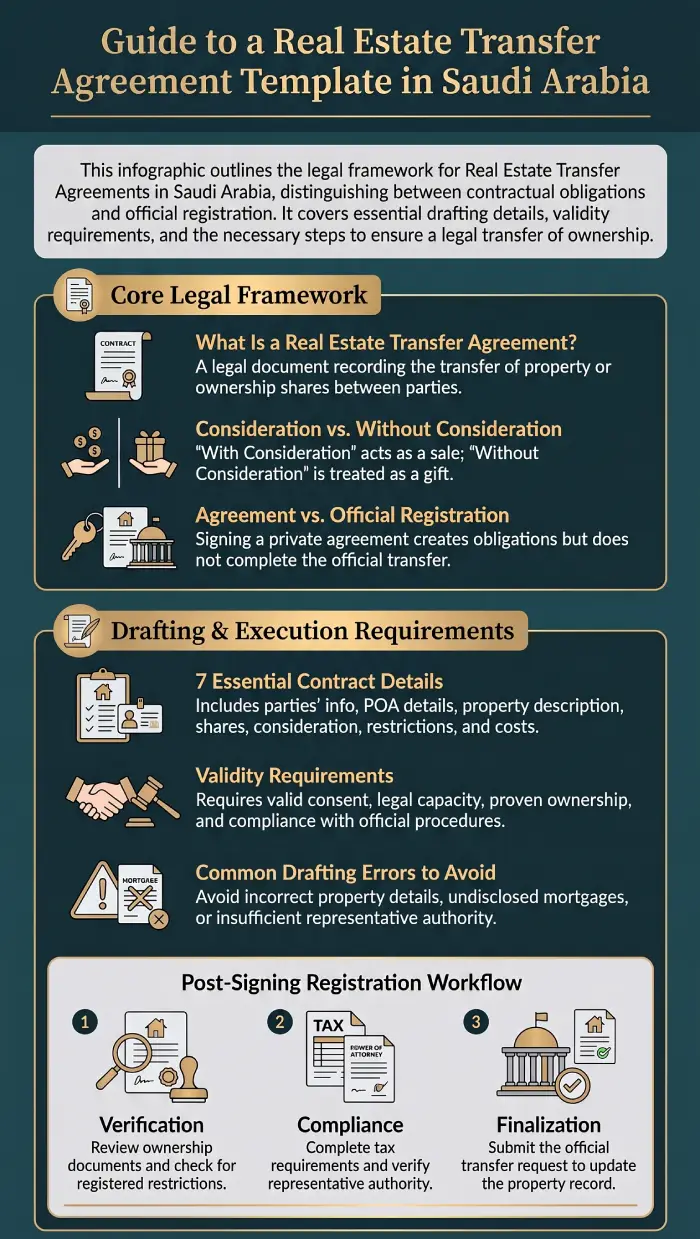
What Is a Real Estate Transfer Agreement?
A real estate transfer agreement records an owner’s decision to transfer a property right to another person. However, the expression does not have one fixed legal characterization in every case. The substance of the transaction, the existence of consideration, and the parties’ actual obligations are more important than the title placed on the document.
The transaction may involve an entire property, an undivided ownership share, or an inherited interest. Before drafting the agreement, the parties should identify the transferor’s precise right, confirm that it can be transferred, and determine whether the property is subject to a mortgage, attachment, restriction, or pending dispute.
Transfer With or Without Consideration
When the transferee pays an amount in exchange for ownership, the transaction may be treated as a sale if the essential elements of a sale are present. The agreement should then specify the price, payment method, completion date, delivery obligations, and warranties relating to ownership and registered restrictions.
A property transfer without consideration may be treated as a gift when the transferor intends to donate the property and the transferee accepts it. The agreement should expressly state that no price is payable and should not disguise a genuine sale as a gift. The applicable Real Estate Transaction Tax treatment must be examined when the transaction is registered.
When the consideration is a genuine purchase price, the provisions of a real estate sale agreement template concerning payment, delivery, warranties, and default should be addressed, regardless of the document’s chosen title.
Agreement Versus Unilateral Transfer Declaration
A transfer agreement is based on the consent of two parties and regulates consideration, delivery, registration, and the consequences of non-performance. A unilateral transfer declaration is issued by one person to record the surrender of a particular right and may be used in certain inheritance-related situations.
A declaration is not automatically a substitute for a Real Estate Transfer Agreement Template. The nature of the transferred right may still require the transferee to complete an official ownership-registration procedure. The source of ownership, the scope of the right, and each party’s legal capacity should therefore be established before selecting the document.
7 Details a Property Transfer Agreement Should Include
A Real Estate Transfer Agreement Template for Saudi Arabia should include seven groups of information. Omitting any of them may create uncertainty concerning the property, the transferred share, the consideration, or the parties’ responsibilities.
Before approving the details, the parties should verify property ownership and compare the owner’s name, registration number, ownership share, and recorded restrictions with the available official documents.
The seven essential groups are:
- Party details: Full names, national identification numbers, addresses, and each party’s capacity.
- Power of attorney details: The instrument number, validity, and scope of the representative’s authority.
- Property details: Title deed or registration number, location, area, plot number, and plan details where applicable.
- Scope of the transfer: The entire property or the exact percentage of an undivided ownership share.
- Consideration: The amount and payment method, or an express statement that the transfer is made without consideration.
- Restrictions and warranties: Mortgages, attachments, disputes, registered rights, and confirmation of the ownership information provided.
- Documentation and costs: Completion date, document delivery, tax obligations, registration steps, and allocation of agreed expenses.
Additional provisions may be required when the transaction involves a minor, several heirs, deferred payment, vacant possession, or delivery of the property.
Sample Real Estate Transfer Agreement Template
The agreement should begin with its date and the complete details of the transferor and transferee. It should then identify the transferor’s basis of ownership, describe the property accurately, and specify whether the transaction covers the entire property or a particular ownership share.
It should also state the consideration and payment method, or confirm that the transfer is made without consideration. The transferor should disclose mortgages, attachments, disputes, and other known rights affecting the property. Both parties should undertake to complete the applicable tax, documentation, and registration procedures.
A basic structure may include:
- First Party: [Transferor’s name, identification number, address, and capacity].
- Second Party: [Transferee’s name, identification number, and address].
- Property: [Ownership-document number, location, area, and transferred share].
- Consideration: [Amount and payment terms] or [Transfer without consideration].
- Restrictions: [Mortgage, attachment, third-party rights, or pending disputes].
- Completion: [Date, required documents, competent authority, and expenses].
- Signatures: [Parties and authorized representatives, where applicable].
This template should not be adopted without modification when the property is mortgaged, held by several heirs, partly owned, or connected with a minor. Those circumstances require provisions tailored to the ownership documents and the applicable procedure.
Validity Requirements and Effect on Ownership
A complete document does not by itself ensure that the transaction will achieve its intended result. The parties must have legal capacity, the transferor must own the relevant right, consent must be genuine, and the property or share must be clearly identifiable.
The representative’s authority should also be examined, particularly when the transaction may involve a conflict of interest. Existing mortgages, attachments, usufruct rights, and other restrictions should be disclosed before signing.
A valid agreement may create obligations to pay the consideration, deliver documents, attend completion, and cooperate with registration. However, those obligations do not always amount to an immediate transfer of registered ownership. The distinction between proving an agreement and updating the official ownership record remains essential.
Requirements for a Valid Transfer Agreement
The principal requirements include valid consent, legal capacity, confirmed ownership, a sufficiently defined property, and clear consideration where payment is involved. The document should not result from coercion, fraud, or materially incorrect information.
Where a representative signs the agreement, the power of attorney should be current and should expressly cover the proposed transaction. If the property is mortgaged, attached, or burdened by another real right, the effect of that restriction and any required consent should be reviewed before the parties assume obligations that may be difficult to perform.
Different considerations arise where the transfer concerns a minor, an unsettled estate, or property subject to an unresolved ownership dispute.
Does the Agreement Prove Property Ownership?
The agreement may prove the existence of an arrangement and the obligations accepted by the transferor and transferee. However, it may not replace official registration or the updating of the property’s ownership record.
Its evidential value depends on the property, the registration status, the nature of the transaction, and the procedures completed after signing. Where registration fails, the agreement, payment records, correspondence, and completion documents may help determine the appropriate claim.
If the agreement conflicts with the registered ownership information, the available methods of proving real estate ownership in Saudi Arabia will depend on the official documents, registration status, possession, and other admissible evidence.
Transfer Procedures, Tax, and Ownership Registration
The process normally begins by examining the ownership document and confirming the owner’s identity, ownership share, and registered restrictions. The parties should then determine the true legal nature of the transaction and register it with the Zakat, Tax and Customs Authority when required to establish whether Real Estate Transaction Tax applies or an exemption may be claimed.
The applicable tax treatment depends on the substance of the transaction and the conditions of any exemption. Describing a transaction as a transfer or gift does not, by itself, determine whether it is taxable. Saudi Arabia’s Real Estate Transaction Tax is generally imposed at 5% on taxable real estate transactions.
After completing the applicable tax requirements, the parties may submit the ownership-transfer request through the service appropriate to the property’s registration status. Required elements may include the approval of owners and rights holders, valid authorization for a representative, and the relevant tax reference number. The Real Estate Registry service permits full or partial transfers of registered property once the applicable requirements are satisfied.
Special Cases in Real Estate Transfers
Some transactions require provisions beyond a general template because the nature of the ownership right or registered restriction changes the documents, procedure, and legal risk.
Common examples include the transfer of an undivided share, an inherited interest, a mortgaged or attached property, a transaction involving a minor or representative, and an attempt to withdraw from the transfer after signing or registration.
The agreement should identify precisely which right can be transferred and whose approval is required. An owner of an undivided share should not describe a physically separated portion as exclusively owned unless an official subdivision or partition establishes that ownership.
Transfer of an Undivided or Inherited Share
When an undivided share is transferred, the agreement should state the percentage accurately and connect it to the official ownership document. It should not assign a physically separated part of the property unless that part has been formally divided and recorded.
An inherited interest requires confirmation of the heirs and the precise scope of the transferor’s entitlement. It is also necessary to distinguish between transferring an interest in the estate generally and transferring a registered share in a specific property.
The appropriate inheritance procedure should be selected according to the documents and the status of the estate. Additional review becomes particularly important when a minor is involved or when the heirs disagree about the property.
Mortgaged Property and Withdrawal From the Transfer
Where the property is mortgaged or attached, the parties should review the registered restriction and the secured party’s rights before signing an agreement that may not be capable of completion. Ownership transfer may require the rights holder’s consent, settlement of the secured obligation, or removal of the restriction.
The possibility of transferring the property and the rights that continue to affect it will depend on the applicable real estate mortgage rules in Saudi Arabia, the registration terms, and any required approval.
Withdrawal from the transaction depends on its legal characterization, the registration stage, the agreement’s provisions, the parties’ consent, and the existence of grounds for termination or invalidity. The parties may agree to cancel before registration, while reversing a completed registered transfer may require additional formal procedures.
Errors That Require Legal Review
Problems often arise when a Real Estate Transfer Agreement Template does not correspond with the ownership document, the real consideration, or the transferred share. Common errors include incorrect document numbers, inconsistent property areas, misspelled party names, undisclosed mortgages or attachments, and signatures by representatives without sufficient authority.
Other risks include failing to define the payment terms, completion date, responsibility for expenses, or consequences of refusing to attend registration. Greater care is required where the transaction involves heirs, a minor, an undivided share, a mortgage, or a failed ownership transfer.
A real estate lawyer in Jeddah can examine the agreement, ownership documents, restrictions, and available evidence before identifying the appropriate procedure. BMS Legal defines the scope and cost of its services after an initial review of the matter.
Frequently Asked Questions About Real Estate Transfer Agreements
What effect does signing the agreement have on ownership?
Signing proves the parties’ agreement and contractual obligations, but it does not always transfer registered ownership.
When is a property transfer treated as a sale?
It may be treated as a sale when ownership is transferred in exchange for a genuine purchase price and the essential elements of a sale are present, regardless of the document’s title.
What is the position when property is transferred without payment?
A transfer without consideration may be treated as a gift where the transferor intends to donate the property and the transferee accepts the transfer.
How does the agreement protect the transferee’s rights?
It records the agreed terms, consideration, warranties, and obligations. It may also be relied upon in a dispute, although it does not replace mandatory ownership registration.
.
What are the requirements for transferring an undivided share?
The agreement should identify the share precisely, confirm the transferor’s ownership, disclose registered restrictions, and avoid describing an unpartitioned physical area as separately owned.
What should I do if the agreement was signed but ownership was not transferred?
Review the agreement, correspondence, reason for the delay, and current registration stage. Depending on the evidence, possible remedies may include performance, termination, or compensation.
When does Real Estate Transaction Tax apply?
Tax treatment depends on the transaction’s substance and whether the requirements of an available exemption are satisfied.
How can an heir transfer an interest in real estate?
The heir should first confirm the heirs’ documentation and the extent of their entitlement, then select the procedure appropriate to an estate interest or a registered property share.
Can the transfer be reversed after signing?
This depends on the nature of the transaction, the registration stage, the agreement’s terms, the parties’ consent, and whether grounds for termination or invalidity exist.
Which documents are needed for legal review?
They commonly include the ownership document, signed agreement, party identification, power of attorney, mortgage or attachment details, and inheritance documents where applicable
A Real Estate Transfer Agreement Template: 7 Key Details identifies what should be addressed before the parties assume a binding obligation. Effective drafting begins by establishing the transaction’s true nature and confirming the ownership details, transferred share, consideration, restrictions, authorization, and registration process.
A general template should not replace tailored review when the property is inherited, mortgaged, jointly owned, connected with a minor, or affected by a dispute. In those circumstances, the agreement and supporting documents should be examined before completion.
BMS Legal, a law firm in Jeddah, accepts a brief summary of the matter to identify the documents required, define the scope of the service, and explain the applicable fees before work begins.
Official Sources: