
A first drug offence in Saudi Arabia is not decided solely by whether the defendant has previous convictions. The assessment begins with the legal classification of the conduct, the alleged purpose of possession, the strength of the evidence and the lawfulness of the arrest, search and seizure.
The case may involve drug use established through a biological test or an admission. It may instead concern possession for personal consumption, or facts that the Public Prosecution believes indicate another purpose carrying different penalties.
The defendant’s age, personal history, employment, family circumstances and any associated offence may also affect the outcome. However, a clean criminal record does not automatically result in an acquittal, the minimum sentence or suspension of imprisonment.
In a Saudi drug case, knowing the possible prison term is only the starting point. The more important questions concern the classification adopted by the Public Prosecution, the evidence supporting it and the legal route available at the current stage.
Direct Answer on a First Drug Offence
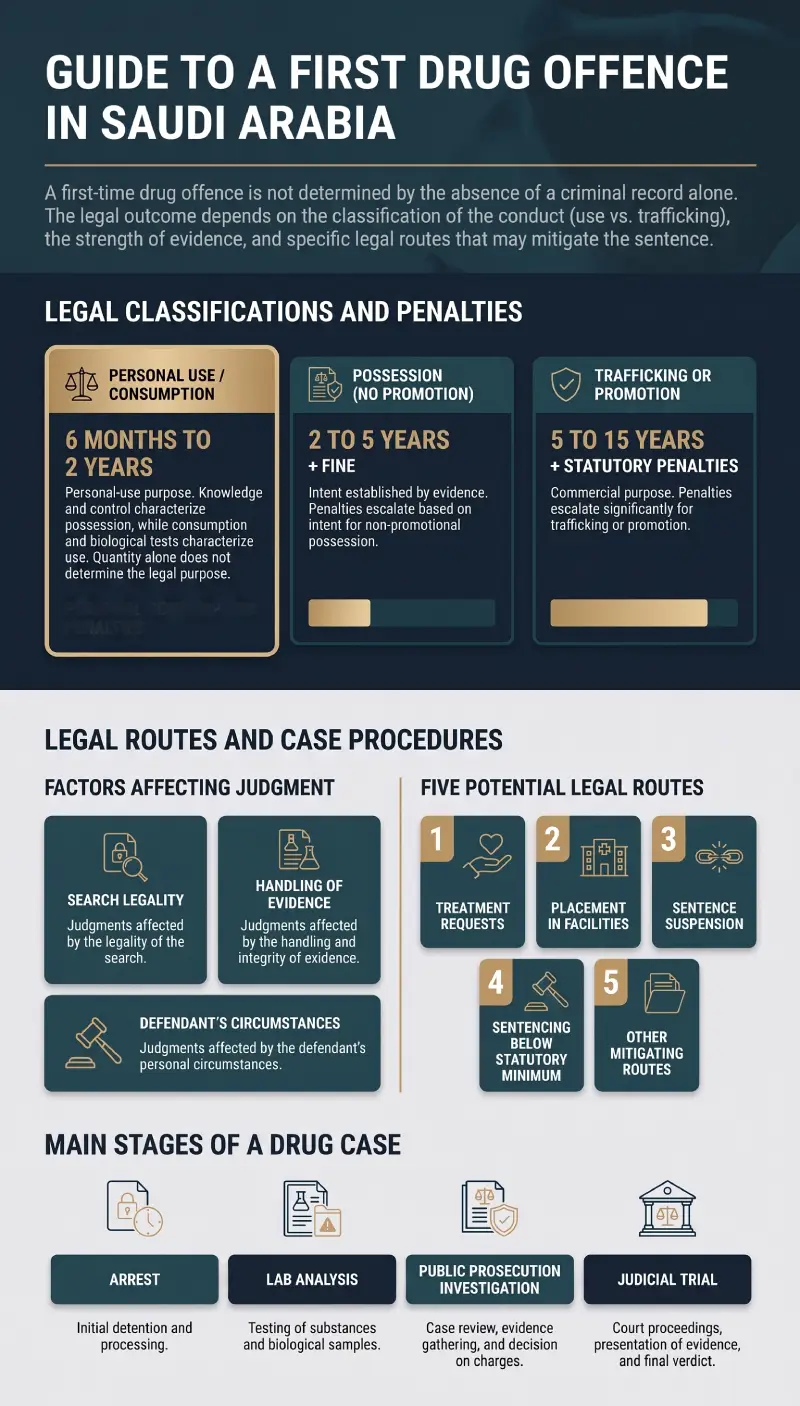
A person convicted of an act committed for drug use or personal consumption may face imprisonment ranging from six months to two years. The final outcome cannot be determined from this range alone because the court must examine the legal classification, evidence, procedures and circumstances of the defendant.
Depending on the facts and procedural stage, the following legal routes may require consideration:
- Closure of the investigation in qualifying cases.
- A treatment request before criminal proceedings begin.
- Placement in an addiction treatment facility.
- A sentence below the statutory minimum.
- Suspension of the prison sentence.
None of these routes applies automatically because the matter is a first drug offence in Saudi Arabia. Each route has separate statutory conditions, a competent authority and a particular procedural stage.
The position may also differ for a non-Saudi defendant. A final conviction may carry deportation consequences after the sentence is served, subject to the applicable legal provisions and any relevant exception.
What Is the Penalty for a First Drug Offence in Saudi Arabia?
Article 41 of the Law of Combating Narcotic Drugs and Psychotropic Substances provides for imprisonment from six months to two years when the relevant act is committed for use or personal consumption.
This may include possession, acquisition, receipt, transport or delivery when the proven purpose is personal use. Saudi law does not prescribe a separate punishment simply because the case is described as a first offence.
The expression “first offence” describes the defendant’s previous criminal record. The court must still determine the nature of the act, the purpose behind it and the applicable statutory provision.
The Statutory Penalty for Drug Use
The court first determines whether the conduct falls within drug use or possession for personal consumption. It then examines whether the evidence reliably connects the defendant to the act and establishes the alleged purpose.
Relevant evidence may include:
- A biological sample result.
- Statements made during the investigation.
- An admission before the court.
- The laboratory report on the seized substance.
- Items associated with personal consumption.
- Messages or digital communications.
- Statements from arresting officers or witnesses.
The name of a particular form of evidence does not establish its reliability by itself. A positive test, for example, must be connected to the correct person through a properly identified, collected, stored and examined sample.
The Effect of Having No Previous Convictions
The absence of previous convictions may support an application for mitigation. It does not, by itself, require the court to acquit the defendant, impose the minimum sentence or suspend imprisonment.
The court may also consider:
- The defendant’s age.
- Educational or employment status.
- The circumstances of the incident.
- Conduct during the investigation.
- The existence of another offence.
- Personal and family responsibilities.
- Indicators relevant to the risk of reoffending.
These circumstances should be supported by documents rather than general statements. Employment letters, educational records, family documents and relevant medical or treatment reports may help establish the circumstances relied upon.
The Difference Between Drug Use and Drug Possession
Drug use means that a substance was consumed and entered the person’s body. Possession means that the substance was under the person’s control, with knowledge of its presence and an ability to exercise control over it.
Drug use may be alleged even when no substance is found in the defendant’s physical possession. Conversely, a substance found nearby does not automatically prove that every person present knew about it or controlled it.
When Can Possession Be Established?
Possession requires evidence connecting the defendant to the seized substance. Finding drugs inside a shared vehicle, room or property does not automatically establish possession against every occupant.
The court may examine:
- The exact place where the substance was found.
- Ownership or control of the vehicle or premises.
- The defendant’s access to the location.
- Whether other people were present.
- The defendant’s statements.
- Witness accounts.
- Fingerprints or other forensic material.
- Messages connected to the substance.
Possession may be direct, such as a substance found in the defendant’s clothing. It may also be constructive when the evidence establishes control over the place where the substance was concealed.
How Does the Alleged Purpose Affect the Judgment?
The purpose of possession distinguishes possession for personal consumption from possession for another purpose. Quantity may be relevant, but quantity alone does not conclusively determine the legal classification.
The assessment may include:
- The quantity of the substance.
- Packaging and division into separate units.
- The presence of weighing equipment.
- Items indicating personal consumption.
- Messages or financial transfers.
- The defendant’s explanation.
- The surrounding circumstances of the seizure.
A small quantity may support an argument of personal consumption, but it does not prove that purpose on its own. A larger quantity does not automatically establish promotion or trafficking without additional supporting evidence.
| Legal description | Main issue to be proved | Basic statutory range |
|---|---|---|
| Use or possession for personal consumption | Personal-use purpose | Imprisonment from 6 months to 2 years |
| Possession for neither personal use nor promotion | Absence of personal or commercial purpose | Imprisonment from 2 to 5 years with the prescribed fine |
| Possession for promotion or trafficking | Promotional or commercial purpose | Imprisonment from 5 to 15 years with additional statutory penalties |
How Long Is the Prison Sentence for a First Drug Offence?
For drug use or possession with the proven purpose of personal consumption, the statutory range is six months to two years. This does not mean that every first-time drug case results in the same period of imprisonment.
The court may review:
- The legal classification of the conduct.
- The strength and consistency of the evidence.
- The circumstances of the arrest and seizure.
- The defendant’s age and prior record.
- Any associated criminal conduct.
- Documented personal circumstances.
- Whether statutory mitigation may apply.
- Whether suspension of the sentence is justified.
Two cases may appear similar while producing different outcomes. One may contain a consistent admission and laboratory findings, while another may involve a dispute over possession, sample identification or the legality of a search.
The Difference Between Detention and Imprisonment
Pretrial detention is an investigative measure used before a final judgment. Imprisonment is a penalty imposed by the court after the criminal case has been heard and decided.
An initial detention order may be extended according to the powers and limits established by the Law of Criminal Procedure. In qualifying circumstances, the aggregate period may reach 180 days before referral to the competent court or release.
These periods are maximum procedural limits rather than an automatic timetable for every case. Continued detention must remain supported by a valid order and reasons connected to the investigation.
Five Routes That May Affect the Sentence
The five routes discussed below are not promises that imprisonment will be avoided. They are statutory possibilities requiring separate assessment according to the defendant’s age, the facts, the procedural stage and the competent authority.
The five routes are:
- Closure of the investigation.
- A voluntary treatment request.
- Placement in a treatment facility.
- Sentencing below the statutory minimum.
- Suspension of the prison sentence.
Closure of the Investigation
In qualifying first-use or first-consumption cases involving a person who has not exceeded the statutory age threshold, the law may allow the investigation to be closed when all conditions are met.
Age alone is not sufficient because associated conduct may prevent this route from applying. Possible barriers may include:
- An associated offence requiring prosecution.
- A traffic incident involving death and private rights.
- Serious resistance to the arresting officers.
- Failure to satisfy the age condition.
- A previous offence of the same nature.
The complete incident must therefore be reviewed before treating investigation closure as an available result.
Requesting Treatment
The law provides a treatment-related route where the person, or certain specified relatives, approaches the competent authority seeking treatment before criminal proceedings are initiated.
The timing, manner and seriousness of the request are central to this route. Relevant conditions may include:
- Making the request at the legally relevant stage.
- Surrendering any substance still in the person’s possession.
- Identifying its location when required.
- Demonstrating that the request is genuinely directed towards treatment.
- Complying with the competent treatment authority’s procedures.
Expressing a wish to receive treatment after arrest does not automatically produce the same legal effect. The procedural timing and circumstances in which the request was made must be examined.
Placement in a Treatment Facility
Where addiction is established, the court may consider placement in a specialised treatment facility instead of imposing the ordinary punishment.
This route differs from a voluntary treatment request made before the criminal case is initiated. The medical position must be properly assessed and documented.
Placement, duration and discharge remain subject to the applicable statutory and treatment controls.
Sentencing Below the Statutory Minimum
Article 60 gives the court discretionary authority to impose a sentence below the statutory minimum when legally relevant reasons justify that result.
The judgment should identify the circumstances upon which the mitigation is based. Relevant circumstances may include:
- Young age.
- No previous convictions.
- Health circumstances.
- Family responsibilities.
- Regular education or employment.
- The circumstances in which the conduct occurred.
- Documented indicators suggesting a low risk of repetition.
A list of personal circumstances is not sufficient without supporting evidence. Each circumstance should be linked to a document and to the mitigation request made before the court.
Suspension of the Prison Sentence
The court may suspend the execution of a prison sentence when the statutory requirements and the defendant’s circumstances justify doing so.
A suspended sentence is discretionary and is not an automatic entitlement in a first drug case. Suspension also does not convert the judgment into an acquittal.
The conviction remains in place, while execution of imprisonment is suspended subject to the period and conditions stated in the law and judgment.
| Legal route | Competent authority | Possible result |
|---|---|---|
| Closure of the investigation | Public Prosecution | No referral to the criminal court |
| Treatment request | Competent authority | No criminal action when all conditions are satisfied |
| Treatment facility placement | Court and treatment authority | Treatment instead of the ordinary punishment |
| Sentence below the minimum | Court | Reduced sentence supported by stated reasons |
| Suspended sentence | Court | Prison term suspended while the conviction remains |
Procedure in a First-Time Drug Case
A drug case usually begins with an official record stating when and where the incident occurred, who was present and what substance or related item was found.
The record should explain how the material was discovered and the alleged connection to the defendant. The case may pass through the following stages:
- Arrest and preliminary evidence gathering.
- Search of the person, vehicle or premises.
- Seizure and sealing of the substance.
- Laboratory analysis.
- Collection of a biological sample where required.
- Questioning by the Public Prosecution.
- A decision on release or detention.
- Referral to the criminal court when the evidence is considered sufficient.
Arrest and Search
An arrest or search must have a lawful basis. This may arise from a legally recognised case of flagrante delicto, a warrant issued by the competent authority or another situation permitted under the Law of Criminal Procedure.
The defendant’s procedural rights remain relevant throughout the investigation. These include being informed of the allegation and having access to legal representation under the applicable procedures.
A procedural review may address:
- The original reason for stopping the defendant.
- The time and place of arrest.
- The authority that conducted the search.
- The scope of any search warrant.
- The precise location of the substance.
- The people present during the procedure.
- Whether the official record accurately reflects what occurred.
A procedural error does not automatically invalidate the entire case. The court examines the nature of the defect, the evidence produced by it and whether independent evidence remains.
Sealing and Laboratory Analysis
After seizure, the substance should be sealed, identified and documented before it is transferred for laboratory analysis.
The laboratory report ordinarily identifies the nature, weight and analytical result of the tested material. The review should include:
- The description in the seizure record.
- The number and identification of the sealed exhibits.
- The recorded weight.
- The date the exhibit was sent.
- The date it was received by the laboratory.
- Consistency between the tested sample and the seized material.
- The substance identified in the final report.
A biological sample taken from the defendant should also be reviewed. Identity, collection time, storage, transfer and the final analytical result may all be material.
Evidence Affecting the Case
The court does not assess evidence by its label alone. It examines its source, reliability, connection to the defendant and consistency with the remaining case material.
Common forms of evidence include:
- Laboratory analysis of the seized substance.
- Biological sample results.
- Statements made during the investigation.
- Admissions made before the court.
- The location of the seized material.
- Statements of arresting officers.
- Witness testimony.
- Messages and digital communications.
- Photographs, recordings and video material.
- Items connected with use, packaging or distribution.
Admissions and Confessions
An admission may be significant, but the court should examine whether it was made voluntarily and with sufficient awareness.
Allegations of physical or psychological coercion require a fact-specific assessment. The admission should also be compared with the laboratory report, seizure circumstances and other evidence.
A material inconsistency may affect the weight given to the admission. Withdrawing it does not automatically remove it from consideration.
The court may examine why it was withdrawn, when it was made and whether independent evidence supports it.
A Positive Drug Test
A positive result may be important evidence that a substance or its metabolite was present in the body.
Its value depends on proving that the sample belonged to the defendant and that collection, storage and analysis were properly handled.
A challenge may concern:
- Incorrect sample information.
- Unclear collection time.
- A gap in sample custody.
- A lawfully prescribed medication.
- Inconsistency between the report and the official record.
- Lack of connection between the result and the alleged time of the incident.
Raising a challenge does not mean that it will automatically be accepted. It should be supported by a document, identifiable discrepancy or expert issue capable of judicial examination.
Defences That May Affect Proof of the Charge
There is no single defence memorandum suitable for every drug case. The appropriate arguments depend on the prosecution’s classification, seizure record, laboratory material, defendant’s statements and digital evidence.
Possible defence issues include:
- No proven connection between the defendant and the substance.
- Lack of knowledge that the substance was present.
- No actual or constructive control.
- Failure to prove a personal-use purpose.
- Incorrect legal classification of the facts.
- An unlawful or defective arrest or search.
- A break or discrepancy in exhibit handling.
- Failure to connect the biological sample to the defendant.
- Material inconsistencies in witness accounts.
- An involuntary or unreliable admission.
- Incomplete digital evidence.
- Insufficient evidence when the case is considered as a whole.
The strength of a defence depends on its connection to a specific part of the case file. A general argument is unlikely to assist unless it identifies the disputed record, report, procedure or finding.
Trial and Judgment
If the Public Prosecution considers the evidence sufficient, it prepares the charge and refers the case to the competent criminal court.
The charging document sets out the alleged conduct, the evidence relied upon and the orders requested. During the trial, the defendant may:
- Be informed of the charge.
- Respond to the allegation.
- Present a written defence.
- Challenge reports and statements.
- Seek legal representation.
- Submit supporting documents.
- Make procedural and evidential applications.
- Appeal the judgment within the prescribed period.
The court may request clarification, a supplementary report or witness evidence before deciding the case.
The judgment should explain the accepted facts, legal classification, principal evidence and sentence. A copy of the judgment and hearing records should be retained for any later appeal or review.
Does a First Drug Case Create a Criminal Record?
Arrest, investigation and conviction are legally different stages. An arrest or allegation does not by itself amount to a final criminal conviction.
A case may end through:
- Closure of the investigation.
- A finding that the evidence is insufficient.
- Acquittal.
- Conviction with an enforceable sentence.
- Conviction with a suspended prison term.
- Treatment placement where legally applicable.
If a conviction becomes final, consequences relating to the criminal record may arise. Suspension of imprisonment does not convert the conviction into an acquittal.
There is no single period that applies to every question about rehabilitation or removal of a criminal record. The answer depends on the type of judgment, its finality, execution and the rules applicable to the defendant’s circumstances.
The Effect of the Judgment on a Non-Saudi Defendant
A non-Saudi convicted under the applicable narcotics law may face deportation after serving the sentence.
This consequence should be reviewed separately from the prison term because it may affect residency, employment and family arrangements in Saudi Arabia.
The final wording of the judgment, nationality status and any legally relevant exception must be examined before determining the full effect.
Appealing a First Drug Offence Judgment
The ordinary period for filing an appeal is 30 days, subject to the applicable rules governing delivery and notification of the judgment.
An effective appeal addresses the reasons relied upon by the first-instance court. Repeating a general request for acquittal or leniency without identifying an error is usually insufficient.
Possible appeal grounds include:
- Incorrect classification of the conduct.
- Failure to address a material defence.
- Inadequate reasoning.
- Reliance on insufficient evidence.
- Material inconsistencies between evidence.
- Failure to consider an established circumstance.
- Rejection of an application without adequate reasons.
- Failure to consider an available mitigation ground.
- An error in determining the sentence.
The objection may be filed electronically through the relevant service on Najiz. The Court of Appeal may uphold, amend or overturn the first-instance judgment according to the case and applicable procedures.
The date on which the judgment is received should be recorded immediately. Delay may cause the appeal period to expire.
When Do You Need a Criminal Lawyer?
Legal assistance may be important from the beginning of the investigation, rather than only after judgment.
The seizure record, early statements, laboratory reports and classification adopted by the Public Prosecution can influence the direction of the entire case.
Legal review becomes particularly important when the defendant is detained, the substance was found in a shared location or there is a dispute about the legality of the search.
When the allegation involves drug use, possession or promotion, reviewing the case with a drug lawyer in Jeddah can help identify the legal classification, evidential issues and procedural applications appropriate to the current stage.
It may also be necessary where the prosecution alleges a purpose more serious than personal consumption.
A lawyer can examine the defendant’s connection to the seized material, exhibit handling, analytical findings, statements and digital evidence.
The purpose is to identify arguments and applications supported by the file, rather than rely on unsupported expectations about acquittal or sentence suspension.
Review is also time-sensitive after judgment because an appeal must be prepared within a fixed period.
Mistakes to Avoid
Early actions can affect the case more than expected. Records, communications and procedural dates should therefore be handled carefully from the beginning.
Avoid:
- Treating a clean record as a guarantee of acquittal.
- Signing a record without reading it.
- Giving inaccurate or speculative details.
- Withholding material facts from legal counsel.
- Confusing use, possession and promotion.
- Deleting messages or electronic files.
- Publishing case details on social media.
- Sending sensitive documents to unverified recipients.
- Ignoring detention or judgment dates.
- Waiting until the appeal period is about to expire.
- Assuming another person’s case will produce the same result.
- Relying on promises of guaranteed release or acquittal.
The safer approach is to preserve documents, record dates and assess the matter according to the actual case file.
Every defence and application should also match the current procedural stage.
Frequently Asked Questions About a First Drug Offence
What is the punishment for a first drug offence in Saudi Arabia?
Drug use or possession for personal consumption may be punished by imprisonment from six months to two years.
Does a first drug offence always result in prison?
Imprisonment is within the statutory penalty when the offence is proved.
How long is the prison sentence for a first drug offence?
The statutory range for personal consumption is six months to two years.
What is the penalty for first-time possession for personal use?
Where personal-use purpose is proved, the applicable range may be six months to two years.
Does a small quantity prove personal use?
No. Quantity is one factor and must be considered with packaging, associated items, communications and the circumstances of seizure.
Can the investigation be closed in a first case?
It may be possible in qualifying cases involving the statutory age and other required conditions.
Can requesting treatment prevent prosecution?
A legally compliant treatment request made through the proper route and at the relevant time may prevent criminal proceedings in qualifying circumstances.
Can treatment replace imprisonment?
The court may consider placement in a specialised treatment facility when addiction is established and the applicable requirements are satisfied.
Can the court impose less than the statutory minimum?
The court has discretionary mitigation authority where legally relevant circumstances justify a lower sentence and are properly established.
Can the prison sentence be suspended?
The court may suspend execution when the legal requirements and circumstances support that decision.
First Drug Offence in Saudi Arabia: 5 Legal Routes provides a framework for understanding the possible paths through a drug case, rather than promising one particular result.
The outcome depends on the legal classification, alleged purpose, quality of the evidence, procedural legality and documented circumstances of the defendant.
Investigation closure, voluntary treatment, treatment placement, sentencing below the minimum and suspension of imprisonment may each be relevant in a qualifying case.
Where a drug case also affects employment, residency or family arrangements, working with a law firm in Jeddah may help coordinate the criminal proceedings with the related legal and administrative consequences.
Official Sources: