
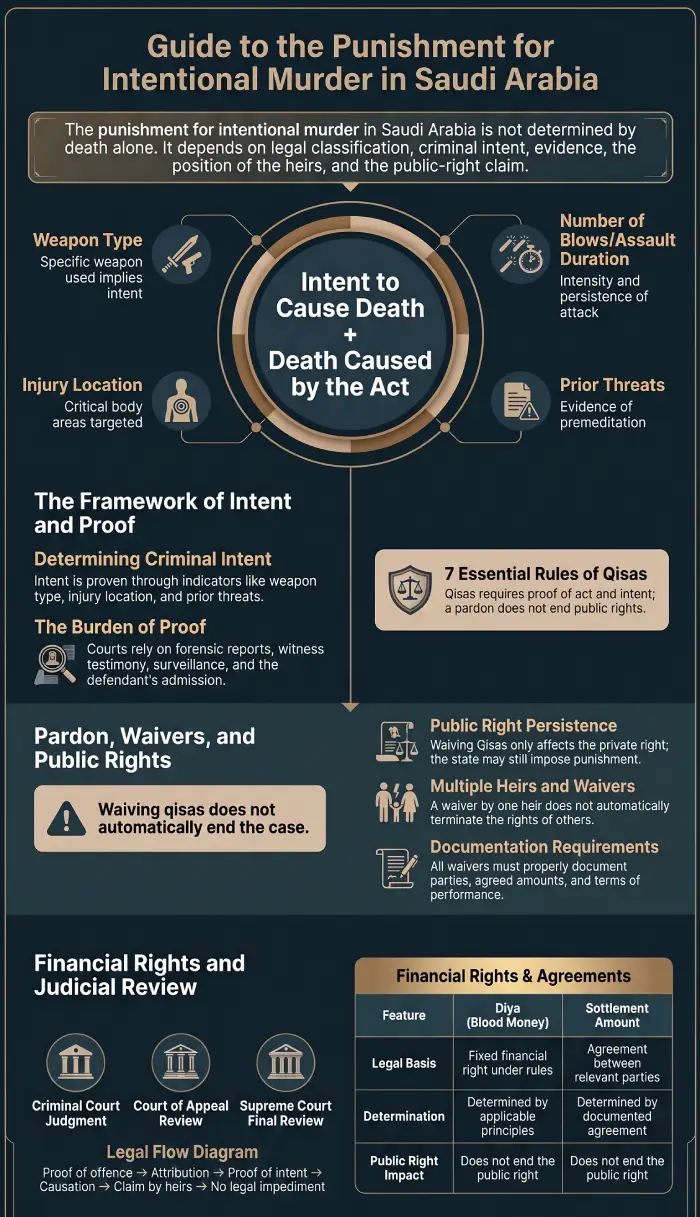
The punishment for intentional murder in Saudi Arabia is not determined merely by the fact that a death occurred. The court must first classify the incident, determine the accused person’s intent, and examine the evidence connecting the act to the death.
The court may consider the weapon used, the location and severity of the injuries, the sequence of events, forensic reports, witness statements, digital evidence, and each defendant’s role.
These factors affect whether qisas may be claimed, how the victim’s legal heirs can exercise their private rights, and whether the public-right claim continues after a pardon or settlement.
Quick Answer: 7 Rules Governing Intentional Murder Cases
The punishment for intentional murder in Saudi Arabia may include qisas when the offence, the intention to cause death, and the applicable requirements are established.
If the holders of the private right grant a pardon or enter a settlement, the case does not necessarily end. The State’s public-right claim may continue before the criminal court.
Seven central rules shape the outcome:
- Qisas depends on proving the act, criminal intent, and the causal connection between the assault and death.
- A qisas claim must be made by persons legally entitled to exercise the victim’s private right.
- A pardon by the victim’s heirs does not automatically terminate the public-right claim.
- A waiver by one heir does not automatically terminate the remaining heirs’ rights.
- Diya differs from a negotiated settlement amount paid in exchange for a waiver.
- There is no single prison term that applies to every case after qisas is waived.
- Judgments involving murder and qisas undergo enhanced judicial review before becoming final.
A complete answer therefore depends on the evidence, the position of the heirs, and the current procedural stage.
When Is an Incident Classified as Intentional Murder?
Intentional murder involves an unlawful act committed with the intention of causing the victim’s death, followed by a death causally connected to that act.
Intentionally striking or injuring another person does not always prove an intention to kill. A person may intend to cause harm without intending the fatal result.
The court determines intent from the circumstances as a whole rather than relying solely on one weapon, statement, or injury.
An incident that begins suddenly may still be classified as intentional murder. The manner of attack in murder arising from a fight may reveal an intention to kill and clarify each participant’s responsibility.
Criminal Intent and Evidence of an Intention to Kill
An intention to kill may be inferred from the location of the injuries, the number of blows, the continuation of the attack, earlier threats, preparation, or attempts to conceal evidence.
Purchasing a weapon, monitoring the victim, or arranging to bring the victim to a particular location may indicate prior planning or lying in wait.
Premeditation is not required in every intentional murder case. The intention to kill may arise during a sudden confrontation and become apparent through the severity and continuation of the assault.
The prosecution must also establish a causal connection between the defendant’s conduct and the death. If an independent cause interrupts that connection, the legal classification may change.
Intent, the nature of the assault, and the resulting harm also determine where the incident falls within the broader types of homicide offences in Saudi Arabia.
When Can Qisas Be Ordered for Intentional Murder?
Qisas is not ordered merely because a person has been accused of intentional murder. The offence, the defendant’s involvement, and the intention required for the intentional classification must be established.
The court also examines the legal standing of the persons asserting the private right, their position regarding qisas or pardon, and any impediment affecting enforcement.
The cause of death, reliability of the medical reports, consistency of witness evidence, and role of each defendant must be assessed. Presence at the scene alone does not establish participation in the offence.
Requirements for Qisas and Review of the Judgment
The principal considerations include:
- Proof that the offence occurred.
- Attribution of the relevant act to the defendant.
- Proof of the intention to cause death.
- A causal link between the act and the fatal result.
- A claim by persons legally entitled to exercise the private right.
- Absence of an impediment affecting enforcement of qisas.
An initial judgment must be distinguished from a final judgment. Murder and qisas judgments pass through the Court of Appeal and are subsequently reviewed by the Supreme Court before acquiring final status.
Judicial review may address the classification, evidence, procedure, defences, and any material error affecting the judgment.
The stages of a criminal case in Saudi Arabia therefore extend from investigation and trial to appeal, Supreme Court review, and finality.
When Can Qisas Fall Away?
Qisas may fall away because of a pardon, settlement, or another legally recognised impediment affecting enforcement.
The loss of qisas does not mean that the defendant has been acquitted. An acquittal concerns failure to prove the offence or attribute it to the defendant, while a pardon may occur after criminal responsibility has been established.
A pardon may be granted without compensation, in exchange for diya, or through a documented financial settlement identifying the parties, payment terms, and method of performance.
Pardon, Waiver, and Disagreement Among the Heirs
A waiver of qisas requires verification that the person granting it has legal standing. The document should state whether the pardon is unconditional or linked to compensation.
A payment made outside a properly documented arrangement does not, by itself, prove that the private claim has ended.
Where several heirs hold rights, a waiver by one heir does not automatically terminate the remaining heirs’ rights. The legal standing of every heir, the position of any minor, and the scope of each waiver must be identified.
A pardon differs from a settlement:
- Pardon: relinquishing the demand for qisas, usually without compensation.
- Settlement: resolving the qisas demand under agreed and documented conditions.
The wording of the waiver should also clarify the amount, beneficiaries, payment schedule, and consequences of non-performance.
The Public Right, Diya, and Settlement Amounts
Waiving qisas does not automatically terminate the public-right claim. The waiver addresses the private right held by the victim’s entitled heirs.
The criminal court may continue examining the State’s claim and determine any discretionary punishment, or ta’zir, after considering the seriousness and circumstances of the offence.
There is no fixed answer to how long a defendant will be imprisoned after the heirs waive qisas. The outcome may be affected by prior planning, the number of participants, use of a weapon, concealment of evidence, and each defendant’s conduct.
Effect of Waiver on Punishment and Financial Rights
Diya and a negotiated settlement amount should not be treated as identical concepts.
| Element | Diya | Settlement Amount |
|---|---|---|
| Legal basis | A financial right governed by the applicable legal principles | An agreement between the entitled parties and other participants |
| Amount | Determined under the applicable rules | Determined by the documented agreement |
| Purpose | Addresses the relevant financial right | Resolves the demand for qisas under agreed conditions |
| Public right | Does not automatically end | Does not automatically end |
Transferring money alone does not close the case. The agreement should identify the beneficiaries, payment dates, method of payment, and consequences of breach.
How Is Intentional Murder Proved?
Proof of intentional murder depends on evidence establishing the act, intent, fatal result, and causal connection between them.
Evidence may include examination of the scene, seizure and analysis of relevant objects, witness accounts, recordings, digital material, and expert reports.
The forensic medical report identifies the cause of death and nature of the injuries. Digital evidence may reveal earlier threats, preparation, communications, or relevant movements.
Technical Evidence, Witness Statements, and Circumstantial Evidence
The court assesses a defendant’s admission alongside the remaining evidence. An admission may lose weight if it conflicts with established facts or was obtained through a procedurally defective process.
Witness testimony is assessed according to what each witness directly saw or heard, together with its consistency with recordings and technical reports.
| Evidence | What It May Clarify |
|---|---|
| Forensic medical report | Cause of death and nature of injuries |
| Weapon or instrument | Whether the injuries are consistent with the alleged instrument |
| Location of the injury | Direction and seriousness of the assault |
| Digital evidence | Earlier threats, planning, or communications |
| Surveillance footage | Sequence of events and roles of the participants |
| Witness testimony | What each witness directly observed |
The intentional classification may become weaker if causation is interrupted, reports conflict, or the relevant act cannot be attributed to the defendant.
Technical evidence, witness accounts, and recordings are collected during the criminal investigation process in Saudi Arabia before the charge is finalised and the case is referred to court.
Intentional Murder and Related Legal Classifications
Intentional murder differs from quasi-intentional killing, accidental killing, and attempted murder according to the defendant’s intent and whether death occurred.
| Offence | Intent | Result | Main Classification Issue |
|---|---|---|---|
| Intentional murder | Intent to commit the act and cause death | Death occurred | Intention and manner of execution |
| Quasi-intentional killing | Intent to assault without intending death | Death occurred | Nature of the assault and instrument |
| Accidental killing | No intention to assault or cause death | Death occurred | Fault and causation |
| Attempted murder | Intent to kill and commencement of execution | Death did not occur | Why the intended result failed |
Intentional murder differs from accidental killing in Saudi Arabia when there is no intention to assault or cause death and liability centres on fault and causation.
Attempted murder, in contrast, involves an intention to kill and a direct commencement of execution without the fatal result occurring.
Liability of Accomplices, Inciters, and Other Participants
Criminal responsibility is not necessarily limited to the person who carried out the final physical act. A case may include an accomplice, assistant, or inciter.
The court determines each person’s responsibility by examining knowledge of the plan, intention, nature of participation, and effect on the final result.
An accomplice may provide an instrument, facilitate access, or assist in execution. An inciter may encourage another person through threats, inducement, pressure, or direction.
The punishment for incitement to murder depends on the inciter’s intention, the method used, and the connection between the incitement, execution, and result.
Each Defendant’s Role and the Course of the Case
The case normally begins with a report and evidence-gathering measures. The Public Prosecution then conducts the investigation, obtains relevant reports, questions the parties, and determines the charge.
Following referral, the Criminal Court examines the public-right claim, the private-right requests, the prosecution’s evidence, and the defence submissions.
The judgment may then be reviewed by the Court of Appeal and the Supreme Court. Statements, reports, legal arguments, and the heirs’ requests may all affect the final outcome.
When Do You Need a Criminal Lawyer?
Legal representation may be necessary when there is a summons, arrest, accusation, qisas demand, proposed waiver, or settlement negotiation.
Early statements and initial reports may influence the classification of the incident. Legal advice should therefore be obtained before submitting a defence, signing a waiver, or entering a financial settlement.
The role of a criminal lawyer in Jeddah depends on the procedural stage and may include reviewing the accusation, analysing the evidence, representing the defendant, or acting for the holders of the private right.
The role of a criminal lawyer in Jeddah depends on the procedural stage and may include:
- Reviewing the accusation and available evidence.
- Attending or preparing for the investigation.
- Analysing forensic and digital reports.
- Representing the defendant before the court.
- Acting for the holders of the private right.
- Reviewing the wording and effect of a pardon or settlement.
- Preparing an appeal where legally justified.
Before making contact, prepare:
- The case or report number.
- The current procedural stage.
- The next hearing date.
- A copy of the judgment, if issued.
- Available reports and documents.
- Your legal relationship to the case.
Do not send sensitive investigation records, medical reports, or identity documents through an unverified communication channel.
Frequently Asked Questions About Intentional Murder Punishment
What is the punishment for intentional murder in Saudi Arabia?
The punishment may include qisas when its requirements are established. A pardon or settlement may affect the private right, while the public-right claim may continue.
When can a court order qisas?
Qisas may be ordered after the offence, criminal intent, defendant’s involvement, causation, and entitlement of the private-right claimants are established.
Who is entitled to request qisas?
The request must come from persons who legally hold the victim’s private right and can establish their status before the court.
What happens if one heir grants a pardon?
The waiver affects that heir’s position but does not automatically terminate the remaining heirs’ rights or the public-right claim.
Does the public-right claim end after qisas is waived?
Not automatically. Waiver addresses the private right, while the State’s criminal claim may continue before the court.
Is there a fixed prison term after a pardon?
No single prison term applies to every case. The court considers the classification, evidence, seriousness, circumstances, and each defendant’s role.
How does the court establish an intention to kill?
Intent may be inferred from the manner of attack, instrument, injuries, prior threats, forensic reports, witness statements, and digital evidence.
Can a qisas judgment be appealed?
Yes. Murder and qisas judgments undergo enhanced judicial review before acquiring final status.
The punishment for intentional murder in Saudi Arabia cannot be reduced to one sentence or a fixed prison term. It depends on seven interconnected rules beginning with legal classification and evidence.
The case then extends to the requirements for qisas, the victim’s heirs, the effect of a pardon, the public-right claim, financial rights, and judicial review.
The private right may end through qisas, pardon, or settlement, while the public-right claim remains connected to the facts and the court’s assessment.
When evidence, heirs’ rights, and procedural stages overlap, these seven rules on intentional murder punishment in Saudi Arabia provide a clearer starting point before any legal step is taken.
As a licensed law firm in Jeddah, BMS Legal handles criminal matters through a structured process based on legal assessment, document review, confidentiality, and clear communication before any action is taken.
Official Sources: