
The death threat penalty in Saudi Arabia depends on how the threat was made, how serious it appears, the available evidence, and the level of risk involved. A threat may be made verbally, through WhatsApp, by text message, from an anonymous account, or together with blackmail or a weapon.
A death threat is not always treated as a simple verbal dispute. Some words or messages may reveal a real risk to personal safety. The correct response starts with preserving the evidence, avoiding a counter-threat, and filing the report through the proper channel.
Death Threat Penalty: What Should You Do in the First Hour?
The death threat penalty in Saudi Arabia is not fixed as one penalty for every case. It depends on the method, legal classification, and facts. If the threat is made through WhatsApp or another technical means, it may fall under cybercrime rules when the legal elements are met.
A verbal or direct threat is assessed by looking at the seriousness of the wording, witnesses, surrounding circumstances, the relationship between the parties, and whether the threat was repeated. If the threat involves a weapon, blackmail, or immediate danger, the case may become more serious than a passing statement.
Before taking any step:
- Do not respond with threats, insults, or defamation.
- Do not delete messages, recordings, or account details.
- Save the sender’s number, message time, date, and full conversation context.
- Do not publish the threat on social media.
- File the report through the channel that matches the nature of the incident.
- Seek a legal assessment if there is blackmail, a weapon, or repeated threats.
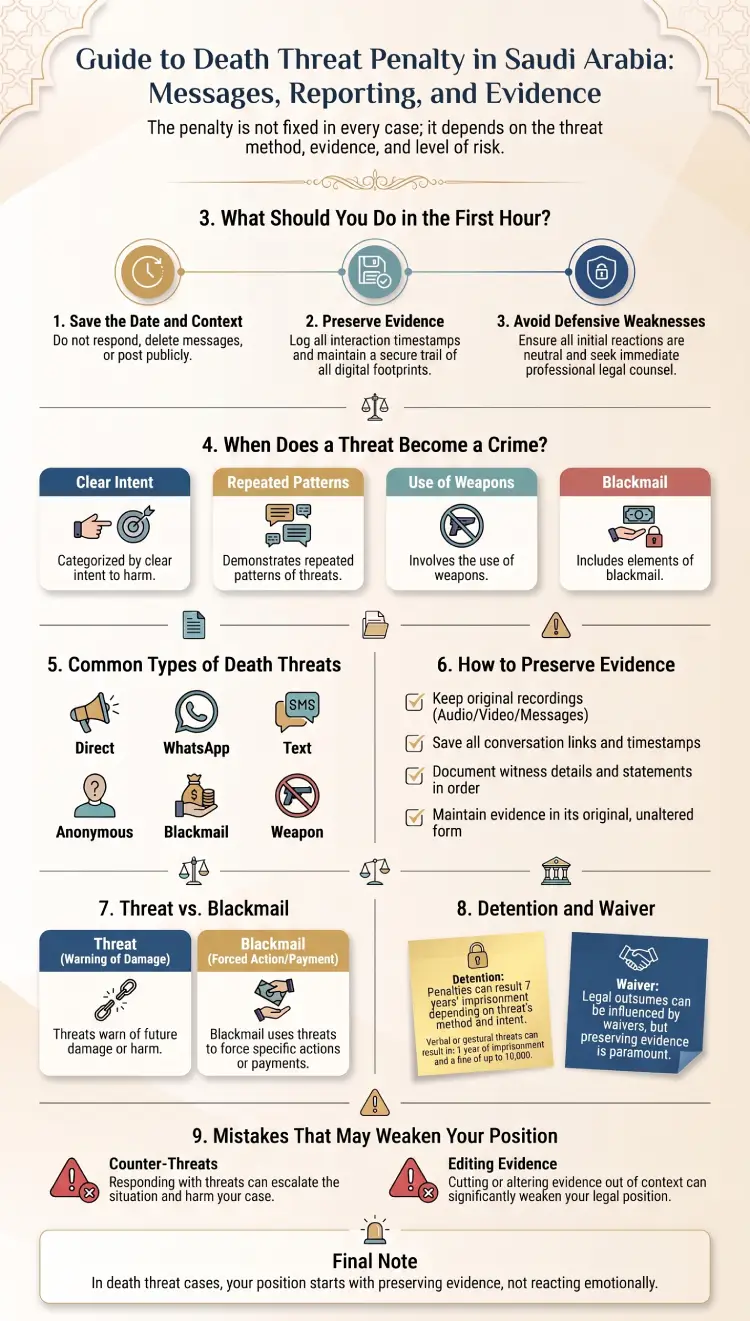
Legal Classification of a Death Threat: When Does It Become a Crime?
A death threat means any statement, message, or act that an ordinary person would understand as a threat to take someone’s life. Physical harm does not need to occur before the matter can be reviewed, because the threat reaching the victim may be enough to start a report.
If the wording does not only threaten the victim but encourages another person to commit the act, the case may require a separate review of the incitement to murder penalty in Saudi Arabia.
Still, a threat is not assessed by the words alone. Context matters. A short message may be serious if it is repeated, sent by someone with a history of aggression, or accompanied by a weapon image.
If the matter moves beyond a threat and becomes an actual attack on life, the legal classification shifts to a broader area related to murder crimes in Saudi Arabia and their separate rules.
The Difference Between a Serious Threat and a Passing Statement
A serious threat is one supported by circumstances that would make an ordinary person fear actual harm to themselves or their family. These circumstances include repeated messages, an existing dispute, weapon images, or following the victim near home or work.
A passing statement may be said in anger without other supporting indicators. It remains subject to the competent authority’s assessment. For this reason, you should not ignore any threat, but you should also preserve the full context before escalating.
Penalty Structure in Death Threat Cases
There is no single penalty that applies to all death threat cases. The legal assessment differs according to the method and circumstances. A direct threat is assessed through evidence and surrounding facts, while a threat made through digital tools may fall within cybercrime rules.
| Situation | Possible classification | What affects assessment? | Practical note |
|---|---|---|---|
| Direct verbal threat | Threat subject to criminal assessment | Witnesses, repetition, dispute, serious indicators | Preserve context and do not rely on words alone |
| Death threat by messages | Written threat capable of review | Number, date, original conversation | Keep the full conversation without cutting it |
| Threat via WhatsApp | May fall under cybercrime rules | Technical method, known account, message content | Save account details before blocking |
| Threat with blackmail | Threat with unlawful pressure | Money, photos, waiver, or requested action | Different from a mere warning |
| Threat with a weapon | Higher-risk incident | Weapon type, proximity, witnesses | Avoid confrontation and report quickly |
When a threat with a weapon moves from warning to an actual act directed at harming the victim, the case may require a separate review of the attempted murder penalty in Saudi Arabia.
Verbal or Direct Death Threats
A verbal threat cannot be separated from its circumstances. The statement may be part of a passing dispute, or it may reflect a serious warning. The competent authority considers the tone, witnesses, prior dispute, and the apparent ability of the person to carry out the threat.
It is not accurate to state one fixed penalty for every verbal threat. The penalty changes according to legal classification and facts. The stronger the indicators, such as repetition, weapons, or pursuit, the stronger the reporting position becomes.
Death Threat Penalty by WhatsApp or Messages
Digital messages are among the most common forms of threats because they leave a record that can be saved and reviewed. When discussing the penalty for death threats by messages, it is important to distinguish between the message as evidence and the legal system that may apply.
If the threat is made through an information technology method, it may fall under cybercrime rules when the legal conditions are met. Save the sender’s number, account name, profile image, message date, and the original conversation on the device.
Does a Death Threat Lead to Detention?
Detention is not automatic in every threat report. It depends on the competent authority’s assessment of the facts, evidence, and level of risk. It may become more likely when there is a weapon, repetition, immediate danger, or a threat affecting public safety.
Your response should not be based on one expectation. The incident should be presented accurately, with clear evidence. Avoid exaggerating the complaint or hiding exchanged messages, because that may weaken the reporter’s account.
If you become a party to an active investigation, understanding the rights of the accused during investigation helps distinguish between report procedures and legal defense guarantees.
Elements of a Death Threat Case
Proving a threat is not based on fear alone. It requires elements that can be reviewed and connected to the incident. Usually, attention is given to the threatening act, the intention to cause fear, and whether the statement or message can be linked to a specific person.
The material element may include messages, recordings, gestures, images, or materials suggesting a threat, such as a weapon image. Intent may appear through repetition, a demand attached to the threat, a prior dispute, or following the victim.
The victim must also be identifiable, and the source of the threat should be linked as much as possible. For anonymous accounts, preserve the username, page link, image, number, message time, and any related data.
Practical Evidence Guide: How to Preserve Proof Without Weakening Your Position
Proving a death threat depends on the quality and integrity of the evidence, not the number of screenshots. Handle evidence calmly, preserve it as received, and avoid any response that may later be used against you.
Preserve evidence as follows:
- WhatsApp messages: keep the full conversation with the number, date, time, and context.
- Voice recordings: keep the original recording without publishing or cutting it.
- Witnesses: record the names of those present, the place, and the time.
- Screenshots: use them as initial evidence, but do not delete the original conversation.
- Anonymous account: save the link, username, image, and any prior communication.
In verbal threats, witnesses become more important when the incident is presented according to the rules of witness testimony in criminal evidence, with the place, time, and involved parties clearly identified.
A screenshot alone is not always enough, but it becomes stronger when supported by the original conversation and account data. A voice recording may also be useful if it is clear and can be linked to the speaker.
Procedural Guide for Reporting a Death Threat in Saudi Arabia
Before filing a report, organize the facts so the competent authority can understand the incident clearly. A weak report is not necessarily false; it may simply be incomplete, unclear, or missing the essential evidence.
Follow these practical steps:
- Preserve the original evidence before blocking the sender or deleting the conversation.
- Arrange events chronologically: when the dispute began, when the threat arrived, and how it repeated.
- Do not respond with a counter-threat and do not publish the messages publicly.
- File the report with the competent security authority, or through digital channels for electronic threats.
- Include the reporter’s details, the threatening person if known, the wording, the method, and the evidence.
After the report is filed, the matter may move, depending on the facts, into the broader stages of proceedings before the criminal court, starting with reviewing evidence and then taking the appropriate action.
Public Right and Private Right in Death Threat Cases
In threat cases, it is important to distinguish between the victim’s private right and society’s interest in pursuing a punishable act. This distinction matters when discussing waiver, settlement, or compensation.
The private right relates to the victim’s personal harm and claim, and it may be affected by waiver or settlement depending on the case. The public right relates to society’s interest, and it may continue if the authority considers the incident a matter affecting safety or public order.
Where there is a private right with the possibility of an ongoing public right, presenting the facts to a law firm in Jeddah may help clarify the effect of waiver or settlement before making a decision that affects the report.
A waiver does not always end every legal effect of the incident, especially where there is a weapon, repetition, or immediate danger. Understand the effect of a waiver before signing it.
Special Situations in Death Threat Cases
The strength of a report changes according to the surrounding circumstances. A threat from an anonymous account is different from a threat by a known person. A threat because of debt is also different from a threat involving a weapon or blackmail.
Common situations include:
- Threat from an anonymous person: save the account, link, image, and message time.
- Threat from a known person: document the relationship and the reason for fearing execution.
- Threat from a spouse or ex-spouse: save messages, show repetition, and avoid direct confrontation.
- Threat because of debt: financial claims have legal channels and do not justify threats.
- Threat with a weapon: mention the weapon type, how it appeared, the time, and witnesses.
If the incident escalates and defensive force is used, the facts must be assessed carefully under the rules related to killing in self-defense penalty in Saudi Arabia.
Difference Between Threat and Blackmail
A threat is a warning of harm or damage. Blackmail is using fear to obtain a benefit or force the victim to act. This distinction matters because some reports start as threats, then become blackmail when a specific demand appears.
The act is a threat when someone makes a warning without demanding money, photos, or a waiver. It becomes blackmail when the person uses the threat to force payment, send information, or carry out an unlawful request.
In electronic blackmail, preserve the demand itself with the threat, because the demand reveals the offender’s purpose. Do not negotiate, pay, or comply before receiving proper legal guidance.
Mistakes That May Weaken the Reporter’s Position and the Role of a Criminal Lawyer
Some reporters make mistakes that weaken their position even when the threat is real. The most common mistakes include responding with a counter-threat, deleting the original conversation, publishing messages, cutting evidence, or delaying action despite immediate risk.
A lawyer’s role becomes important when the evidence is complex, or when there is blackmail, a weapon, an existing report, or a private claim. The lawyer helps organize the evidence, determine the legal classification, and choose the proper reporting or claim path.
When there is repeated threatening conduct, blackmail, a weapon, or an existing report, the file may be reviewed by a criminal cases lawyer in Jeddah to organize the evidence and identify the proper path.
Frequently Asked Questions About the Death Threat Penalty
What is the death threat penalty in Saudi Arabia?
The penalty differs according to the method, seriousness, and evidence. There is no single penalty for all cases.
Is a death threat through WhatsApp a crime?
Yes. It may be a crime if it contains a clear and serious threat that can be linked to the sender.
What is the penalty for a death threat by messages?
It depends on the message content, method, evidence integrity, and legal classification of the incident.
How do I report a death threat in Saudi Arabia?
Preserve the evidence first, then report it to the competent security authority or suitable digital channel.
Are WhatsApp messages enough to prove a threat?
They may be important evidence when the full conversation, number, date, and account data are preserved.
Is a screenshot enough in a threat case?
It helps as initial evidence, but it often does not replace the original conversation and message context.
Does a death threat lead to detention?
Detention is not automatic. It depends on seriousness, evidence, and whether there is immediate risk.
Does a waiver drop a threat case?
A waiver may affect the private right, but it does not always end the public right.
What is the difference between threat and blackmail?
A threat is a warning of harm. Blackmail uses that warning to force a demand.
Someone threatened to kill me on WhatsApp. What should I do first?
Do not threaten them back. Save the full conversation with the number, date, and time, then report it or seek legal assessment if the threat is repeated or serious.
Death Threat Penalty in Saudi Arabia: 5 Report Steps is not just a search for a punishment figure. It is a practical path that begins with preserving the evidence, identifying the method of the threat, and understanding when a report is the right step.
A WhatsApp message, a verbal threat before witnesses, or a warning from an anonymous account should not be handled the same way. Each case needs proper documentation, calm assessment, and a legal path that does not weaken your position.
If you have threat messages, recordings, or an existing report, you may contact BMS Legal for Law and Legal Consultations to present the facts confidentially and identify the appropriate legal step.
Official Sources: