
An urgent property condition claim preserves the physical condition of a property before its features change or disappear. Understanding the types of real estate lawsuits in Saudi Arabia also helps you identify the appropriate route when a dispute concerns ownership, liability, or compensation.
Before filing the claim, collect the contracts, photographs, technical reports, correspondence, and documents connected to the property. You should identify the property, the damage, and the reason an urgent inspection is needed.
Avoid removing or concealing the features that need to be documented unless immediate work is necessary to protect people or prevent further damage.
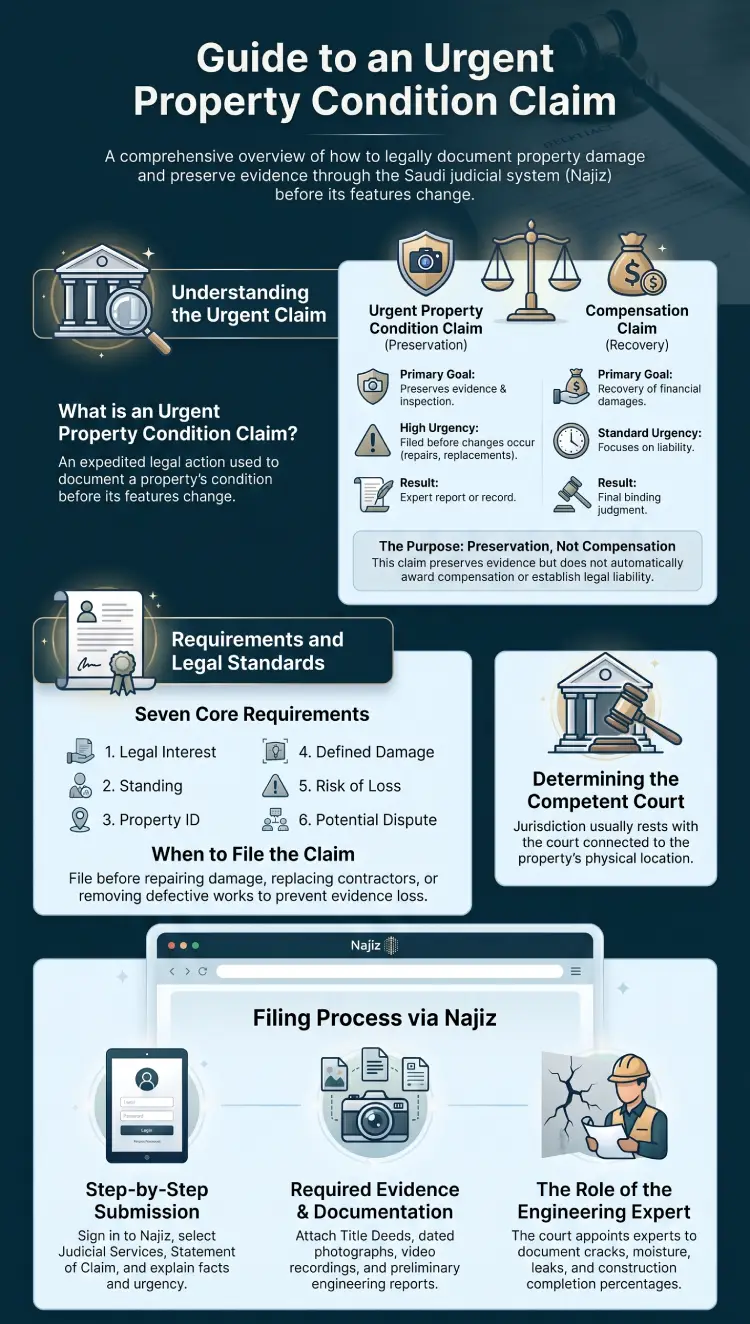
Urgent Property Condition Claim: A Direct Answer
An urgent property condition claim is an expedited evidentiary action used to inspect and document a physical condition that may change or disappear. It may be relevant to structural cracks, water leaks, damage caused by neighbouring excavation, contractor defects, tenant damage, or a suspended construction project.
The Saudi Law of Evidence permits an interested party to request an inspection when there is a reasonable concern that the features of a potential dispute may be lost. The purpose is to preserve evidence rather than decide the final liability of another party.
Acceptance of the claim does not automatically establish that the contractor, neighbour, developer, or tenant caused the damage. Likewise, an inspection report does not result in compensation by itself.
After the inspection, the report may be used with contracts, correspondence, photographs, and other evidence in a subsequent substantive claim.
What Is a Property Condition Evidence Claim and When Is It Filed?
A property condition evidence claim documents the existing physical condition of a property at a specific point in time. The inspection may record the location of cracks, the course of water leakage, visible construction defects, completed works, or the percentage of progress in a project.
The claim is based on Article 109 of the Saudi Law of Evidence, which regulates inspection requests when the features of a matter that may become disputed are at risk of being lost.
The court may conduct the inspection directly or appoint a technical expert when engineering knowledge is required. The procedure remains focused on recording physical and technical matters without finally determining ownership, contractual liability, or compensation.
The claim should generally be considered before:
- Repairing damage whose features may disappear.
- Continuing a suspended construction project.
- Replacing the original contractor.
- Covering defective work with finishing materials.
- Repairing tenant damage before re-letting the property.
- Removing a structure that presents an immediate risk.
- Completing works that may conceal the original condition.
Urgency may be weakened when the condition has already disappeared or when the request is limited to a financial demand that does not require an immediate inspection.
7 Requirements for an Urgent Property Condition Claim
The requirements for accepting an urgent property condition claim focus on legal interest, standing, urgency, the inspection location, and the scope of the requested relief.
Photographs and technical reports may support the request, but they do not replace a clear explanation of the applicant’s relationship with the property.
| Requirement | What Should Be Explained |
|---|---|
| Legal interest | How the request relates to an existing or potential right |
| Standing | Ownership, tenancy, investment, or contractual relationship |
| Property identification | Location and information distinguishing the property |
| Defined condition | Type, location, and date of the damage |
| Risk of losing evidence | Why the condition may change or disappear |
| Potential dispute | Relationship between the condition and the expected claim |
| Limited relief | Inspection, evidence preservation, and necessary expert work |
The claimant may be an owner, tenant, contractor, investor, or another party with a relevant legal relationship. The exact status depends on the documents and the nature of the condition to be inspected.
Where the property is financed or connected to several contracts and parties, consulting a real estate lawyer in Jeddah may help identify the appropriate claimant, respondents, court, and relief before filing.
Which Court Has Jurisdiction Over the Claim?
Territorial jurisdiction is generally connected to the location of the property or the place where the inspection must occur. This allows the court to manage a site visit or appoint an expert who can inspect the relevant location.
Subject-matter jurisdiction depends on the original legal relationship and the status of the parties. It does not depend solely on the fact that the dispute involves real estate.
The general court may hear civil and real estate matters falling within its jurisdiction. A commercial court may have jurisdiction when the underlying dispute is commercial and falls within the scope of the Commercial Courts Law.
The presence of a contractor or construction project does not automatically make the case commercial. The contract, parties, business activity, and underlying dispute should be reviewed before selecting the court.
How to File an Urgent Property Condition Claim Through Najiz
Filing through Najiz begins by signing in through the national access service, opening the judicial services section, and selecting the statement of claim service.
Choose a new application, review the available classifications, and select the category that corresponds to the nature of the inspection request. Classification labels may change, so rely on the options displayed at the time of filing.
Enter the parties’ details and explain the capacity in which each party is involved. You should also identify the property and describe the physical condition that needs to be documented.
The facts should be presented chronologically. State when the damage appeared, what work preceded it, and what may happen if the inspection is delayed.
| Stage | Required Action | Common Error |
|---|---|---|
| Classification | Select the appropriate available route | Selecting a category unrelated to the dispute |
| Property details | Provide an accurate location and description | Using a broad or incomplete address |
| Facts | Present events in chronological order | Giving a narrative without dates |
| Urgency | Explain what may change or disappear | Merely stating that the matter is urgent |
| Relief | Request inspection and necessary expertise | Adding compensation or termination requests |
| Attachments | Submit clear supporting evidence | Uploading unexplained photographs |
After submitting the statement of claim, monitor the application through Najiz and complete any missing information requested by the competent authority.
Documents Required to Document the Property’s Condition
The required documents depend on the cause of the damage and the applicant’s relationship with the property. The attachments should establish standing and help the court understand the condition and the need for an urgent inspection.
Relevant documents may include:
- The property title deed.
- A registered lease agreement.
- A construction or development contract.
- Property handover and delivery records.
- Dated photographs and video recordings.
- A preliminary engineering report.
- Plans and technical specifications.
- Construction progress statements.
- Notices sent to the other party.
- Repair quotations and invoices.
- Emails and written correspondence.
Photographs should clearly show the location and nature of the damage. Add a short explanation of when each photograph was taken and what it is intended to establish.
Where the title deed or ownership information is unclear, consider verifying property ownership documents before preparing the attachments to the claim.
A privately commissioned engineering report is not a mandatory requirement in every case. However, it may help define the technical issues and assist with drafting the proposed scope of the court-appointed expert’s task.
Template for an Urgent Property Condition Claim
The claim template must be adapted to the claimant’s standing, the competent court, the source of the damage, and the required technical work.
Using a generic template without modification may omit the urgency requirement or include substantive requests that do not belong in an urgent evidentiary claim.
Sample Property Condition Statement of Claim
To the competent court in: [City]
Claimant: [Name, identification number, address, and legal capacity]
Respondent: [Name or company and available identification details]
Subject: Urgent request to inspect and document the condition of a property.
I own or lawfully occupy the property located at [location and property details]. On [date], damage appeared in the form of [accurate description of the damage].
The damage appeared following or in connection with [relevant work or event], as supported by the attached documents, photographs, and correspondence.
The existing condition may change because of [repairs, continuing works, replacement of the contractor, or another relevant reason]. Delaying the inspection may therefore result in the loss of material features that may become relevant to a contractual, liability, or compensation dispute.
Requested relief: Conduct an urgent inspection of the property and appoint a qualified expert where necessary to document the condition, damage locations, and percentage of completed works.
I also request that the report be placed in the case file while reserving my right to bring the appropriate substantive claim.
This template is for general guidance only. The facts, parties, jurisdiction, and relief should be adapted to each case before submission.
The Expert’s Role and Practical Applications
The court may appoint an expert when documenting the condition requires engineering or technical knowledge. This may include evaluating cracks, describing construction defects, examining visible works, or recording the progress of a suspended project.
The court determines the scope of the assignment because the expert addresses technical matters rather than deciding legal liability.
The expert’s report records the inspection, procedures followed, and findings within the assigned scope. The parties may submit comments, while the court may question the expert, request a supplementary report, or appoint another expert where necessary.
Expert evidence is particularly relevant in cases involving:
- Excavation damage from neighbouring land.
- Water leakage and moisture.
- Structural or finishing defects.
- Contractor non-performance.
- Suspended construction projects.
- Damage found after a tenant leaves.
- Disagreement over completed works.
For tenant-related damage, a property handover form for the owner may help compare the condition at the beginning of the tenancy with the condition at the end.
The expert’s report may preserve important evidence, but it does not independently establish legal liability or determine the final amount of compensation.
Judicial Costs and Expected Duration
The estimated judicial costs for urgent claims are SAR 3,000, subject to applicable exemptions and the detailed provisions of the Judicial Costs Law and its Implementing Regulations.
Expert fees may be added where the court appoints a technical expert. The amount may depend on the property’s size, location, required specialisation, and the scope of the assignment.
There is no single duration that applies to every urgent property condition claim. Timing may be affected by:
- Completion of the statement of claim.
- Service on the parties.
- The need for expert evidence.
- Expert appointment procedures.
- Payment of the required expert deposit.
- Availability of the property for inspection.
- Preparation of the report.
- Comments submitted by the parties.
The claim should therefore be considered before important physical features are removed or concealed by major repair works.
Reasons an Urgent Property Condition Claim May Be Weakened
The request may be weakened when the statement of claim does not identify the exact condition to be inspected or explain why its features may disappear.
The case may also become more difficult when repairs have already removed the damage, the photographs are unclear, or the claimant’s relationship with the property is not established.
Common mistakes include:
- Filing before a court without proper jurisdiction.
- Naming a party without explaining its connection to the condition.
- Requesting compensation or contract termination within the urgent claim.
- Providing photographs without dates or location details.
- Failing to explain the risk created by delay.
- Asking the expert to decide legal liability.
- Using a general template that does not reflect the actual facts.
Clear standing, defined facts, a genuine urgency basis, and focused relief make the request easier to understand and evaluate.
Property Condition Evidence Claim vs Property Damage Compensation Claim
A property condition claim documents the state of the property before its features change. A compensation claim seeks financial redress after liability and the relevant elements of damage are established.
| Element | Property Condition Claim | Compensation Claim |
|---|---|---|
| Purpose | Preserve the condition and evidence | Obtain compensation for proven damage |
| Nature | Urgent and evidentiary | Substantive |
| Result | Inspection record or expert report | Judgment where requirements are established |
| Timing | Before the physical features change | After the claim elements are sufficiently developed |
After the inspection report is issued, it may support negotiation, a repair request, a construction dispute, or a subsequent compensation action.
Where the objective becomes establishing liability and obtaining compensation, review the requirements for filing a property damage claim, including damage, causation, and the responsible party.
Frequently Asked Questions About Property Condition Claims
Is a property condition evidence claim urgent?
Yes. It may be filed urgently where the physical features of a potential dispute are at risk of changing or disappearing.
Can the claim be filed through Najiz?
Yes. It is submitted through the statement of claim service using the appropriate classification and supporting documents.
Is an engineering report required?
It is not a fixed requirement in every case, but it may help describe the damage and identify the required technical issues.
Can compensation be requested in the same claim?
The urgent claim should generally focus on inspection and evidence preservation. Compensation is usually pursued through the appropriate substantive route.
Who pays the expert’s fees?
The court determines which party must initially deposit the required amount. Costs may later be addressed according to the circumstances of the case.
What should I do before repairing the property?
Document the condition, collect contracts and correspondence, and assess whether an urgent inspection is required before removing the damage.
Can the claim be filed before the full extent of the damage appears?
Yes, where visible features already exist and may change or disappear before the dispute or repair process is completed.
Does the expert’s report prove the contractor’s or neighbour’s liability?
Not by itself. It documents technical findings that the court evaluates with contracts, correspondence, and other evidence.
Can the claim be filed after the property has been repaired?
It may become more difficult if the relevant features have disappeared. Existing photographs, reports, invoices, and other records may still be assessed.
I am about to repair the property. Should I file before or after?
Assess the need to document the condition before repairs, especially where cracks or leakage marks will disappear. Immediate safety work should not be unnecessarily delayed.
Urgent Property Condition Claim: 7 Requirements in KSA provides a practical route for preserving evidence before damage disappears or the site changes.
The correct starting point is to review standing, documents, urgency, jurisdiction, requested relief, and the proposed expert assignment before filing the statement of claim.
Where repairs are about to begin, the contractor will be replaced, or neighbouring works are affecting the property, do not delay assessing whether an inspection is necessary.
When you need contracts, reports, photographs, and the proposed legal route reviewed before the condition changes, you may consult a law firm in Jeddah to assess standing, urgency, and the required documents.
Official Sources: