
Reasons for acquittal in drug cases in Saudi Arabia depend on the facts, the available evidence, and the legality of the procedures followed before trial. Finding a prohibited substance or formally accusing someone does not establish criminal responsibility without proving the required elements of the alleged offense.
A legal review usually begins with the exact charge, the place where the substance was found, and its connection to the accused. It then examines the arrest, search, seizure, laboratory analysis, and interrogation procedures documented in the case file.
The documents may reveal insufficient evidence linking the seized substance to the accused, a lack of knowledge, or a material inconsistency between the official records and the forensic report. Each issue must be assessed within the complete evidentiary context.
The existence of a legal defense does not guarantee acquittal. A court may consider one procedural error minor while finding another defect significant enough to affect the legality or reliability of the principal evidence.
Understanding the elements of drug cases under Saudi law helps identify which element of the charge remains unsupported and where the defense should focus its review.
Seven Grounds That May Support Acquittal in a Drug Case
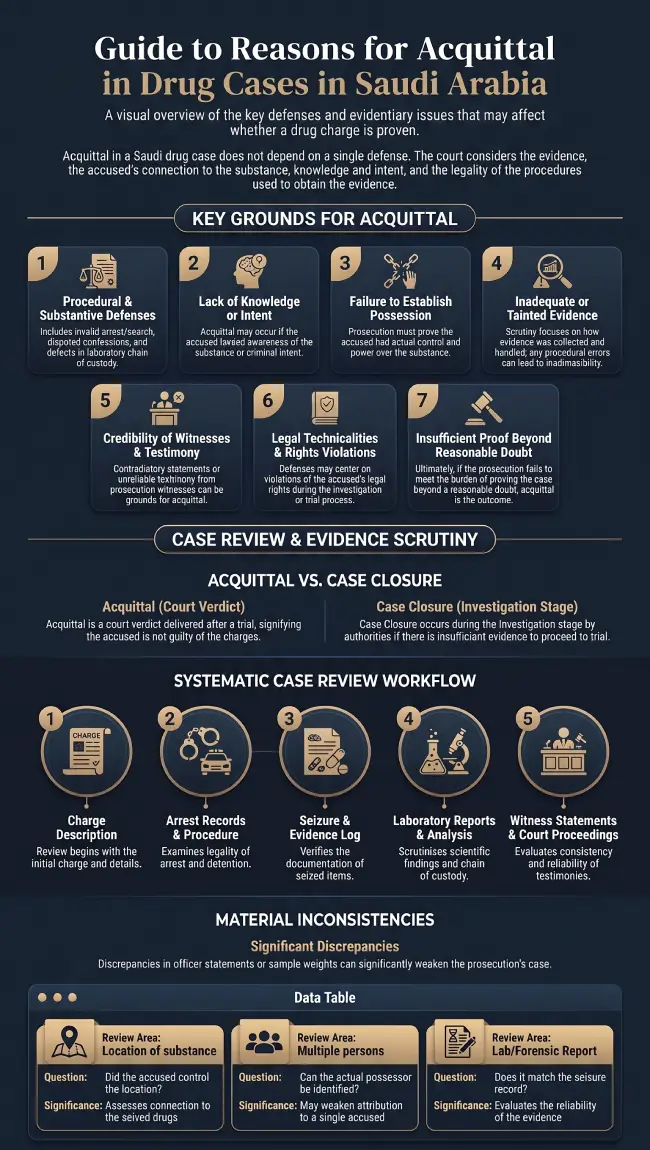
The main reasons for acquittal in drug cases generally fall within seven areas: insufficient evidence, failure to establish possession, lack of knowledge, absence of criminal intent, an unlawful arrest or search, an unreliable confession, and a material defect in laboratory analysis or evidence handling.
These defenses are not a standard checklist that can be applied identically to every case. Each defense must be connected to a particular fact, document, or piece of evidence contained in the file.
A defense based on lack of knowledge requires an examination of where the substance was found and who controlled that location. A challenge to a search requires a review of the legal basis, timing, location, and permitted scope of the procedure.
The practical question is not simply which defense appears strongest. The relevant question is which defense is supported by the case documents and affects an element of the charge or the evidence relied upon by the prosecution.
A proper review therefore begins with the indictment, arrest and search records, seizure report, forensic findings, evidence-sealing documents, and interrogation record.
What Does Acquittal Mean in a Saudi Drug Case?
An acquittal is a court judgment issued when the charge has not been established by sufficient evidence or when a required element of the alleged offense remains unproven. It may result from a failure to connect the accused to the substance, establish knowledge, or rely on legally sound evidence.
An acquittal differs from a decision to close the case during the investigation stage. The Public Prosecution may close a case when the evidence does not justify referral or when there is no basis to proceed with the criminal action.
An acquittal, by contrast, is issued by the competent court after it considers the allegation, reviews the evidence, and hears the parties’ defenses and requests.
The appropriate legal request therefore depends on the stages of a criminal case in Saudi Arabia. Case closure relates to the investigation stage, whereas acquittal follows the court’s consideration of the criminal action.
Not every procedural or evidentiary defense automatically leads to acquittal. A court may accept that an error occurred but conclude that it did not affect separate and independently obtained evidence.
The defense must therefore explain the connection between the procedural defect, the resulting evidence, and the extent to which the prosecution relies upon that evidence.
Insufficient Evidence in a Drug Case
Insufficient evidence means that the evidence presented does not establish the alleged offense or connect it to the accused to the degree required for conviction. A prohibited substance may have been found without a clear link to a particular individual or a specific criminal purpose.
Evidence may be weak when the allegation relies mainly on the accused being near the substance, without proving control over it or knowledge of its presence. The same concern may arise when criminal investigation officers give conflicting accounts about where the substance was found, when the seizure occurred, or who was present.
An inconsistency becomes more important when it concerns a central fact, such as the location of the substance, the person who recovered it, or the evidence seal number. Minor differences that do not alter the substance of the incident may carry less significance when they can be reasonably explained.
The assessment should focus on whether the evidence forms a coherent account of possession, knowledge, and intent rather than relying on isolated assumptions.
| Area Reviewed | Main Question | Possible Significance |
|---|---|---|
| Location of the substance | Did the accused control the location? | Assesses the connection to the seized evidence |
| Multiple persons present | Can the actual possessor be identified? | May weaken the attribution of possession |
| Officers’ statements | Are their accounts consistent? | Assesses the reliability of the incident narrative |
| Forensic report | Does it match the record and sample? | Assesses the integrity of the technical evidence |
| Digital evidence | Is it linked to the accused and incident? | Assesses knowledge or alleged intent |
Failure to Establish Drug Possession
Drug possession cannot be established solely by identifying where the substance was found. It also requires examining whether the accused knew about the substance and exercised actual control over it or the location where it was discovered.
Possession may be direct when the substance is physically found on the person. It may also be inferred where the evidence establishes that the accused had exclusive control over the relevant location, container, or property.
When drugs are found inside a vehicle used by several people, ownership of the vehicle does not automatically establish knowledge of everything inside it. The review should consider the driver, passengers, period of use, location of the substance, and each person’s ability to access it.
Similar distinctions apply to shared homes. A private bedroom differs from a shared reception area, while a locked cabinet differs from a location available to everyone. Evidence concerning who held the key or regularly used the room may affect the attribution of possession.
Simply stating that the drugs belonged to someone else does not establish a defense. The explanation must be consistent with the surrounding circumstances, including the number of users, the method of concealment, the location of the substance, and any evidence connecting or distancing the accused from it.
Where possession is established rather than disproved, the legal assessment shifts to the penalty for drug possession in Saudi Arabia, the applicable classification, the alleged purpose, and the evidence supporting that purpose.
Invalid Arrest, Search, and Seizure Procedures
The Saudi Criminal Procedure Law regulates the circumstances in which arrest and search procedures may be conducted. The importance of challenging such procedures lies in determining whether the disputed evidence resulted directly from an unlawful measure.
It is not enough to state that a search occurred without a warrant. Some circumstances may permit a search where a legally recognised state of flagrante delicto or another lawful basis exists.
The case file should therefore be reviewed to identify the recorded reason for the procedure, its timing, the location searched, the scope of any authorisation, and whether the officer remained within that scope.
An overreach may occur when authorisation covers a named person or specific location but the search extends to another property or place. The circumstances relied upon to establish flagrante delicto should also be compared with the officers’ statements and other documents.
If a procedural defect is established, the next question concerns the evidence produced by that procedure and how heavily the prosecution relies upon it. Invalidating one procedure does not necessarily invalidate every other step in the case.
A minor formal error may not exclude the entire file. The defense should identify the precise defect, the evidence derived from it, and the effect of that evidence on the alleged offense.
Lack of Knowledge and Criminal Intent
A drug charge requires proof of the physical elements of the alleged act and the necessary mental element. Knowledge concerns awareness of the substance and its prohibited nature, while intent concerns the accused’s will in relation to the alleged possession, use, delivery, or promotion.
A person may have a physical connection to a location without knowing that drugs were present there. Lack of knowledge is therefore assessed through objective circumstances rather than the accused’s denial alone.
Relevant factors may include ownership of the bag or vehicle, the number of people using the location, whether the substance was visible, how it was concealed, and how long the accused controlled the property.
Possession also differs from possession for personal use or promotion. The review may examine quantity, packaging, communications, financial transfers, associated tools, and any alleged delivery or offer.
No single indicator should be considered without the wider circumstances. A message, transfer, or item may carry a different meaning when reviewed in context and linked to a particular person and incident.
A prior dispute or hostility involving the person who made the report may require examination, but it does not prove fabrication by itself. A malicious-report defense should be connected to inconsistencies, documents, or facts supporting the possibility of planting evidence or making a false allegation.
Invalid Confessions and Withdrawal of Earlier Statements
A confession is evidence that the court evaluates alongside the remaining evidence. Its existence does not prevent the defense from challenging the circumstances in which it was made or its consistency with the seizure and forensic findings.
An interrogation should not involve methods that affect the accused’s free will or cause statements to be given involuntarily. A claim of coercion should therefore identify the type of pressure, when it occurred, the circumstances surrounding it, and any documents or reports supporting the allegation.
An accused person may dispute or withdraw earlier statements before the court. However, withdrawing a confession does not automatically erase it from consideration.
The court may examine why the statement was withdrawn, how it was recorded, and whether independent evidence supports or contradicts its contents.
The challenge becomes clearer when the defense compares the statement with the physical and technical evidence and identifies specific inconsistencies. A general claim of coercion or withdrawal may be less effective when it does not explain how the disputed statement affected the case.
Reviewing the rights of the accused during investigation in Saudi Arabia becomes particularly important when examining interrogation conditions or an allegation that pressure affected the person’s free will.
Challenging Laboratory Analysis and Evidence Handling
A forensic report is important in identifying the substance or recording the result of a biological sample. However, it must be reviewed together with the other case documents.
The review begins by checking whether the sample details match the accused’s information, the seizure record, evidence seal numbers, and the dates of delivery and examination.
Evidence sealing refers to the measures used to preserve and identify seized items while they move from the place of seizure to the competent laboratory. A minor clerical omission does not necessarily invalidate the evidence.
A material defect may, however, raise questions about the identity of the sample or its connection to the case. Possible issues include a different evidence seal number, inconsistent substance description, unexplained weight difference, differing sample count, or conflicting receipt date.
Before relying on such an inconsistency, it is necessary to determine whether a technical explanation exists. A weight difference may result from sending only part of the seized material for testing rather than testing the full quantity.
| Item | What Should Be Checked? |
|---|---|
| Evidence seal number | Whether it matches the seizure record and forensic report |
| Description of the substance | Whether the form, quantity, and packaging correspond |
| Weight | Difference between total weight and tested portion |
| Dates | Continuity between seizure, delivery, and examination |
| Accused’s details | Whether the name, identification, and sample match |
How Is a Defense Memorandum Prepared?
A defense memorandum should begin with the alleged offense and the evidence supporting it, rather than collecting the largest possible number of general defenses. Each argument should be connected to a fact or document and should explain its effect on a particular element or item of evidence.
The memorandum usually presents a concise statement of the facts, identifies the charge and its elements, and then addresses the relevant procedures and evidence.
Procedural defenses should be presented according to the chronological sequence of arrest, search, and seizure. They can then be followed by substantive defenses concerning possession, knowledge, intent, confession, and forensic evidence.
Contradictory defenses should not be used without explaining whether they are submitted as primary and alternative arguments. Generic templates should also be avoided because possession, personal use, and promotion cases differ in their facts, evidence, and legal classification.
Understanding criminal defenses in Saudi Arabia helps distinguish between procedural and substantive arguments and clarifies the potential effect of each defense.
Core documents for legal review include:
- The criminal indictment.
- Arrest, search, and seizure records.
- The interrogation record and the accused’s statements.
- The forensic report and sample details.
- Evidence-sealing and delivery records.
- Statements from witnesses and criminal investigation officers.
- The judgment, once issued.
- The appeal memorandum and hearing records.
The Lawyer’s Role in Reviewing the Case
A lawyer begins by identifying the exact charge and comparing it with the facts and evidence contained in the file. The lawyer then reviews the procedures chronologically and separates issues concerning the legality of the arrest and search from those concerning possession, knowledge, or criminal intent.
The lawyer analyses the official records and compares them with witness statements, forensic findings, and digital evidence. This process helps identify material inconsistencies while avoiding arguments based on minor differences that do not affect the incident or the accused’s connection to the seized substance.
During the investigation stage, the defense may submit observations concerning the sufficiency of the evidence and legality of the procedures. Before the court, the lawyer presents the relevant defenses and requests and later reviews the judgment to determine whether grounds for appeal exist.
BMS Legal reviews criminal case files according to the available facts and documents. Acquittal cannot be guaranteed or predicted before the file is examined because the outcome depends on the evidence, legal defenses, and the court’s assessment.
If the case remains under investigation or has reached the court, a drug crime lawyer in Jeddah can begin by identifying the charge and reviewing the records, evidence, and documents requiring closer examination.
Frequently Asked Questions About Acquittal in Drug Cases
Can a drug case end in acquittal in Saudi Arabia?
Yes. A drug case may end in acquittal when the evidence is insufficient, possession or knowledge is not established, or a material defect affects the reliability of the evidence.
When may a court acquit an accused person in a drug case?
A court may issue an acquittal when the charge is not proven by sufficient evidence, a required element of the offense is missing, or key evidence cannot be reliably relied upon.
Does an unlawful search automatically lead to acquittal?
Not necessarily. Its effect depends on the nature of the violation, the evidence obtained through the search, and whether separate evidence independently supports the charge.
Does finding no drugs directly on the accused disprove possession?
It is an important factor, but it does not decide the case by itself. Possession may also be inferred from control over the location, statements, communications, or other evidence.
Does finding drugs in a shared vehicle establish possession?
Not by itself. The review should consider who used the vehicle, where the substance was found, who could access it, and whether the accused knew it was there.
Can lack of knowledge support acquittal?
Yes, when it is supported by consistent facts and evidence, such as several people using the location or the substance being found inside another person’s belongings.
Is a confession alone sufficient for conviction?
A confession is assessed alongside the other evidence. The court may examine how it was obtained and whether it is consistent with the seizure records and forensic findings.
Can an accused person withdraw a confession before the court?
Yes. However, withdrawing a confession does not automatically remove it from consideration. The court reviews the reasons for withdrawal and any independent evidence supporting or contradicting it.
Does a difference in the sample weight lead to acquittal?
Not automatically. The difference must be examined through the seizure, evidence-handling, delivery, and laboratory records to determine whether it has a technical explanation.
.
Which documents does a lawyer need to review a drug case?
The main documents usually include the indictment, arrest and search records, seizure report, interrogation record, forensic report, evidence-handling documents, and the judgment if one has been issued
Reasons for Acquittal in Drug Cases: 7 Defenses begin with one central question: what do the case documents actually prove?
A judgment does not rest solely on the existence of a prohibited substance. The court also considers its connection to the accused, the accused’s knowledge and intent, and the legality and reliability of the procedures and evidence.
The review begins with the indictment, official records, and forensic report. The defense arguments are then selected according to the facts rather than presented as broad or generic claims.
A clear memorandum supported by specific documents is better positioned to address the allegation, explain evidentiary weaknesses, and distinguish material defects from minor procedural differences.
This article provides general legal information and does not constitute individual legal advice or guarantee a particular outcome. Results vary according to the facts, evidence, procedures, and applicable laws in each case.
BMS Legal Law Firm and Legal Consultations provides its services as a licensed law firm in Jeddah. Its approach begins with understanding the facts and reviewing the documents before explaining the available legal options without making advance promises about the result.
Legal Source: