
Elements of drug offences under Saudi law cannot be understood by looking at the potential penalty alone. The starting point is the alleged conduct, the defendant’s connection to the controlled substance, knowledge of its presence, and the intent associated with the facts.
Two cases may appear similar at the point of seizure, yet their legal classification may differ depending on whether the conduct involves possession, control, personal use, or promotion and trafficking.
The quantity of a substance or the place where it was found does not, by itself, determine the legal classification. Likewise, establishing possession does not automatically establish an intent to use or promote the substance.
A proper assessment therefore requires the seizure report, laboratory findings, statements, and surrounding evidence to be considered together. Each piece of evidence may address a different part of the case, including conduct, knowledge, intent, and the resulting legal classification.
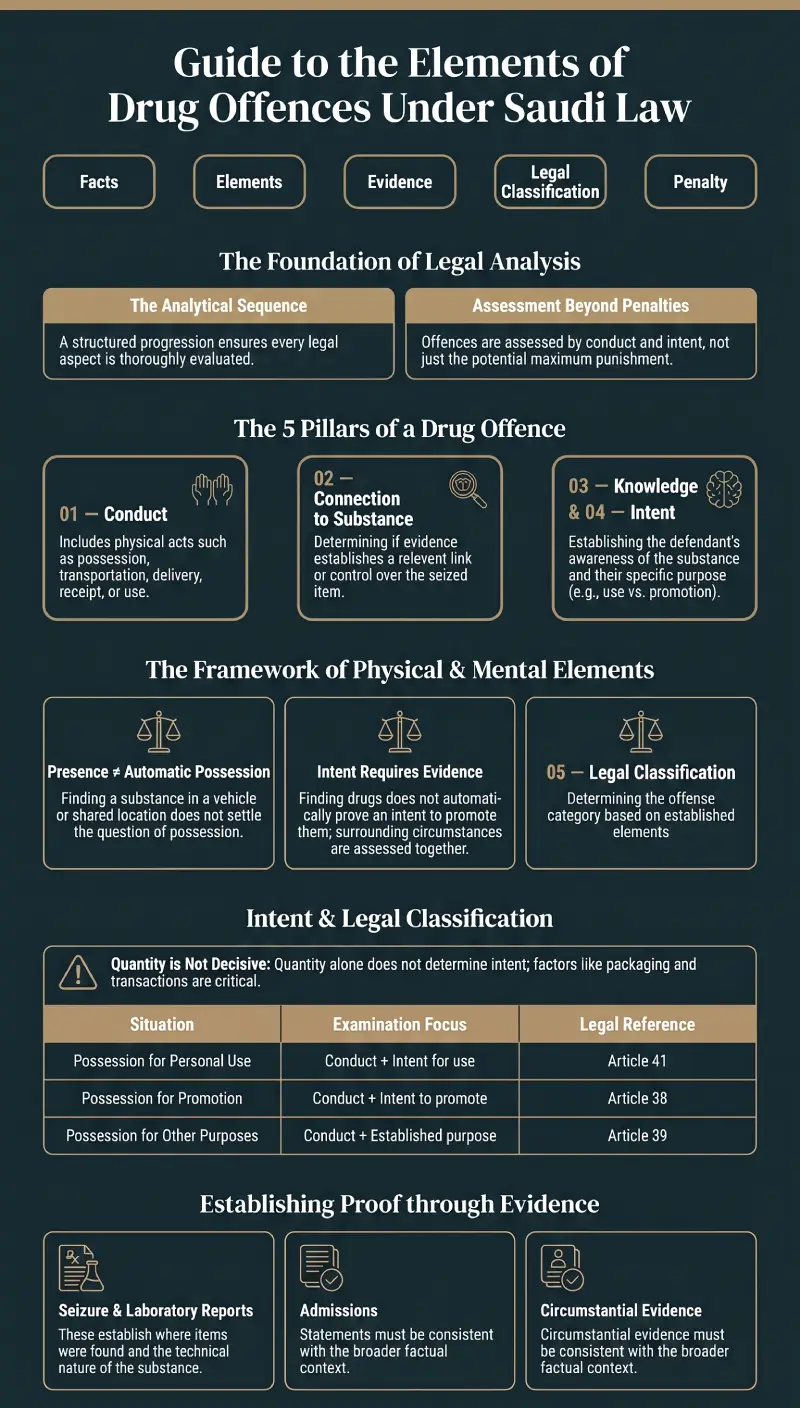
5 Elements for Understanding Drug Offences Under Saudi Law
The elements of drug offences in Saudi Arabia can be examined through five practical components that should be considered before reaching a final legal classification.
The first is the conduct itself, which may involve possession, control, transportation, delivery, receipt, or use. The second is the defendant’s connection to the substance, including whether control or a relevant degree of possession can be established.
The third element is knowledge of the existence and nature of the substance. The fourth concerns intent, including whether the alleged purpose was personal use, promotion, or another purpose.
The fifth element is evidence supporting those matters. This may include the seizure report, laboratory report, statements made during the proceedings, and other relevant circumstances.
This framework helps explain the requirements for proving a drug offence without relying on general assumptions. Proving possession also does not automatically establish a particular purpose, because the intended purpose must be assessed separately from the fact of possession itself.
What Is the Physical Element of a Drug Offence?
The physical element concerns the external conduct attributed to the defendant and whether that conduct can be connected to a narcotic drug or psychotropic substance.
Saudi law covers several forms of conduct, including possession, control, transportation, delivery, receipt, sale, purchase, and acting as an intermediary, depending on the legal description applicable to the facts.
The law defines possession in terms of having the substance under one’s control for ownership or exclusive possession. The concept of control is also connected to having the substance for ownership or exclusive possession for a particular purpose.
Accordingly, the difference between possession and control in drug cases should not be reduced to the idea that one means ownership while the other simply means briefly holding an item.
Finding drugs in a vehicle or shared residence also does not, by itself, resolve whether drug possession has been established. The defendant’s connection to the location, where the substance was found, whether others had access, and other circumstances relating to knowledge and control all require consideration.
For that reason, drugs found in a vehicle without the owner’s knowledge may require examination of both the physical and mental elements of the alleged offence.
Where the dispute concerns whether possession itself has been established, the penalty for drug possession for personal use or promotion will depend on the classification supported by the facts and the intent established in the case.
What Is the Mental Element and Criminal Intent?
The mental element concerns the state of mind accompanying the alleged conduct, particularly knowledge, intention, and the form of criminal intent required by the alleged offence.
This element becomes particularly important when the dispute involves a lack of knowledge that drugs were present, or disagreement over the actual purpose behind possession or control.
The mere presence of a controlled substance does not necessarily establish an intent to use or promote it. Equally, a simple denial of knowledge does not determine the issue without considering the other facts and evidence.
Criminal intent in drug cases is assessed through evidence and surrounding circumstances, including how the substance was found, where it was located, the nature of the dealings involved, and the broader facts of the case.
A failure to establish the required criminal intent may affect the classification when the prosecution cannot prove the specific purpose required for the alleged offence.
Likewise, failure to establish knowledge of the substance may affect the mental element depending on the circumstances and the overall evidence. There is no single rule that can be applied to every drug case.
How Does Intent Change the Classification of a Drug Case?
Intent is one of the most important factors distinguishing different drug offences. It should therefore be identified before estimating a penalty or characterising conduct as personal use or promotion.
Article 38 addresses various forms of conduct when associated with an intent to trade in or promote controlled substances. Article 41 addresses cases involving an intent to use the substance personally.
Where the dispute specifically concerns the purpose of possession, possession of cannabis for personal use requires the alleged intent to be assessed separately from the mere presence or quantity of the substance.
Article 39 addresses specified forms of possession, control, transportation, delivery, or receipt where the purpose is neither trafficking or promotion nor personal use.
The distinction between possession for personal use and possession for promotion therefore does not depend on quantity alone. It turns on the totality of facts and circumstances capable of indicating the purpose of the conduct.
Packaging, communications, transactions, or relevant equipment may form part of the evidence considered when assessing an alleged intent to promote. No single circumstance should automatically be treated as conclusive in every case.
| Situation | What Needs to Be Established | Main Legal Reference |
|---|---|---|
| Possession for personal use | Conduct, connection, and intent for personal use | Article 41 |
| Possession for promotion | Conduct, connection, and intent to promote | Article 38 |
| Possession for another purpose | Conduct, connection, and the established purpose | Article 39 |
How Are the Elements of a Drug Case Proven?
Evidence in drug cases in Saudi Arabia varies according to the particular element that needs to be established. A single piece of evidence should not automatically be treated as proving every aspect of the allegation.
A seizure report may record where the substance was found, the circumstances of the seizure, and the items recovered. A laboratory report, by contrast, addresses the technical nature of the substance or the result of a sample tested under the applicable procedures.
The Implementing Regulations require testing to be conducted through approved laboratories and provide for the result to be approved by two qualified experts, whether the analysis concerns the seized substance or samples obtained from a defendant.
A drug analysis report is therefore an important form of technical evidence. However, by itself, it does not establish the defendant’s connection to the substance or the purpose for which possession occurred.
An admission may also be relevant evidence, but its significance depends on its content, the circumstances in which it was made, and how it relates to the remaining evidence.
When assessing the proof required in a drug case, each document or circumstance should therefore be linked to the particular element it is capable of supporting rather than treating all evidence as interchangeable.
The circumstances surrounding an admission may also need to be considered together with the defendant’s legal rights during the investigation and the other procedural and evidential circumstances in the case.
When Are the Elements of a Drug Case Not Established?
A dispute over the physical element may arise where the evidence does not sufficiently establish the defendant’s connection to the substance or the conduct alleged.
A dispute over the mental element may arise where knowledge or the intent required for the proposed classification has not been sufficiently established. This is different from simply denying the alleged conduct.
Insufficient evidence in a drug case may arise where the available material does not support an element required for the alleged legal description, or where a gap remains between the seized substance and the attribution of the conduct to the defendant.
Questions concerning the validity of arrest or search procedures are different from the absence of the physical element itself. Procedural irregularities may affect the validity of a procedure or evidence arising from it, depending on the nature of the issue and its connection to the rest of the case.
Where the dispute concerns the legality of evidence or procedure, criminal defence arguments depend on the particular irregularity, the elements of the allegation, and the other material contained in the case file.
There is therefore no fixed list of “strongest defences” in Saudi drug cases. The appropriate legal position depends on reviewing the seizure report, investigation records, technical reports, evidence, and the classification alleged against the defendant.
How Does Legal Classification Affect the Penalty?
A drug penalty in Saudi Arabia cannot be assessed properly until the applicable legal classification has been identified. The law links penalties to the conduct, intent, and circumstances established in each case.
Article 41 provides for imprisonment from six months to two years where the relevant conduct falls within the provision concerning personal use, subject to its legal requirements.
Article 38 provides, in its basic form, imprisonment from five to fifteen years for conduct falling within the provision where an intent to trade or promote has been established, together with the other penalties and consequences prescribed by law.
If this is the defendant’s first drug offence in Saudi Arabia, the expected judgment should not be assessed before considering the legal classification, procedural stage, and circumstances that may affect the case.
Article 39 provides a different framework for possession, control, transportation, delivery, or receipt where the conduct falls within the particular circumstances regulated by that provision.
Where the case concerns a first drug offence in Saudi Arabia, the classification, procedural stage, and circumstances affecting the case should be examined before forming expectations about the possible judgment.
Saudi law also regulates more serious circumstances separately. A penalty applicable to one form of promotion or possession should therefore not be assumed to apply automatically to every other drug case.
If the case is under investigation or before the court, consulting a drug offences lawyer in Jeddah should begin with reviewing the seizure report, technical report, and alleged legal classification, then identifying the next appropriate procedural step rather than focusing solely on the potential penalty.
Frequently Asked Questions About Drug Offences
What are the main elements of a drug offence in Saudi Arabia?
The assessment generally focuses on the conduct, the defendant’s connection to the substance, knowledge, intent, and the evidence supporting those elements.
What is the physical element of a drug offence?
It is the external conduct attributed to the defendant, such as possession, control, transportation, or delivery, according to the applicable legal description.
What is the mental element of a drug offence?
It concerns knowledge, intention, and the criminal intent required for the particular classification alleged in the case.
When is drug possession established?
Possession is assessed through evidence connecting the defendant to the substance and supporting the required level of control or exclusive possession.
Is finding drugs with a defendant enough for conviction?
Not necessarily in every case. The defendant’s connection to the substance, knowledge, intent, and the remaining evidence must also be considered.
How is criminal intent proven in a drug case?
Intent may be inferred from the overall facts, evidence, and circumstances showing the purpose associated with the alleged conduct.
What is the difference between possession for personal use and promotion?
The central distinction is the intent supported by the evidence. Personal use and promotion are treated under different legal provisions.
Does the quantity of drugs alone prove an intent to promote?
No. Quantity may be relevant, but it should be assessed alongside other evidence and circumstances rather than treated as automatically conclusive.
Do drugs found in a vehicle automatically establish possession?
Not by themselves. The location of the substance, the defendant’s connection to the vehicle, knowledge, access by others, and other evidence may require assessment.
I have been arrested in a drug case in Saudi Arabia. What should I do first?
Start by identifying the current stage of the case, the allegation against you, and the available seizure and technical reports. Early legal review can help identify which elements and procedures need closer examination.
Elements of Drug Offences Under Saudi Law: 5 Key Factors is more than a summary of legal concepts. The practical assessment begins with the conduct, connection to the substance, knowledge, intent, and evidence before the legal classification and potential penalty can be identified.
If a case is already pending, begin with the procedural stage, the key document, and the legal description alleged rather than focusing on the penalty alone. Those points provide a clearer basis for understanding what the case file actually requires.
When a case requires a broader review of the criminal proceedings and the related documents, you can start with a Jeddah law firm by identifying the current stage of the case and the key elements that need to be examined before taking the next step.
Official Sources: