
Employee drug testing in Saudi Arabia is primarily connected to occupational fitness and workplace safety, rather than automatically proving a criminal offence. Testing may be requested before employment, during service, following a workplace incident, or when indicators raise concerns about safe performance.
The need for testing depends on the employee’s duties, the level of occupational risk, and the employer’s approved internal policy. A role involving public transport, heavy machinery, or hazardous operations may require stricter fitness controls than an ordinary office position.
A positive result does not automatically justify dismissal. A laboratory result is different from an occupational fitness decision, while both are separate from a disciplinary investigation or criminal liability. The type of test, testing provider, prescribed medication, notification date, and nature of the employee’s duties must therefore be reviewed before any decision is made.
Employee Drug Testing in Saudi Arabia: The Short Answer
Drug testing is not a standard mandatory test for every employee and every occupation in Saudi Arabia. However, it may form part of an occupational fitness examination when justified by the nature of the role, its safety risks, or an approved workplace policy.
Testing may take place before employment, periodically during service, or exceptionally after an incident or a noticeable change in performance. An employer may also introduce a workplace drug-testing policy when it is proportionate, clearly communicated, and applied without selective or arbitrary treatment.
A positive test result is not sufficient on its own to establish misconduct requiring dismissal. The result should first receive professional medical interpretation, followed by an occupational fitness decision. The employer may then consider whether a separate workplace violation exists and whether disciplinary procedures are required.
An employee or job candidate may challenge an occupational fitness decision within 30 days of formal notification. Medical details must also remain protected from access by individuals who are not professionally authorised to review them.
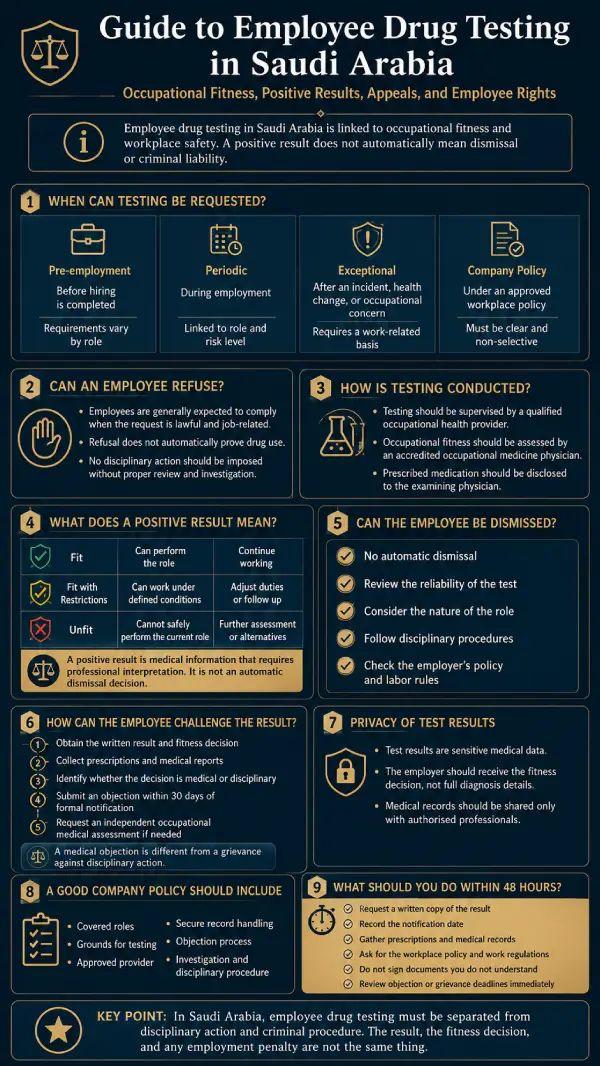
When May an Employer Request a Drug Test?
A pre-employment occupational fitness examination assesses whether a candidate can perform the proposed duties without creating an unacceptable risk to themselves or others. This does not mean that every candidate must undergo the same drug test, because examination requirements vary according to the job description and occupational risks.
Periodic testing may apply to roles involving higher safety responsibilities. These may include driving vehicles, operating industrial equipment, working at heights, or performing duties where reduced concentration could endanger colleagues or members of the public.
Exceptional testing may also be requested after a workplace incident, a significant health change, or reasonable concerns connected to safe job performance.
| Type of examination | When it may occur | Key consideration |
|---|---|---|
| Pre-employment | Before completing recruitment | Requirements vary by occupation |
| Periodic | During employment | Linked to role and risk level |
| Exceptional | After an incident, health change, or occupational concern | Requires a work-related basis |
| Under company policy | When an approved policy applies | Must be clear and non-selective |
Unexpected or unannounced testing is not an unlimited employer power. It should be supported by a communicated policy, a legitimate occupational purpose, and balanced implementation that avoids discrimination or arbitrary selection.
Can an Employee Refuse a Drug Test?
An employee is generally expected to comply with occupational fitness examinations when the request is consistent with the job, the employer’s approved policy, and the applicable regulations. However, refusing a test does not automatically prove drug use or justify immediate dismissal.
An employee may have a medical reason for delaying the examination, concerns about the sample collection process, or legitimate questions regarding medical confidentiality. The employer should therefore explain why the test is required, who will conduct it, and how the employee may raise an objection.
When the request is lawful and directly connected to the occupation, an unjustified refusal may lead to an administrative investigation. The employer should still follow the relevant administrative investigation procedures in Saudi Arabia before imposing any disciplinary measure.
The employee must be informed of the alleged violation, allowed to present a response, and given an opportunity to explain the reason for refusing. The investigation and the employee’s defence should be recorded in a clear written report.
How Is Workplace Drug Testing Conducted?
The examination should be supervised by a qualified occupational health provider, while the occupational fitness assessment should be issued by an accredited occupational medicine physician. Human resources personnel should not independently interpret medical findings or replace the physician’s assessment with an internal administrative opinion.
A urine drug test may be used for employment purposes, but the required sample and the time needed to issue a result depend on the applicable protocol. There is no single statutory period that applies to every employee, test, or laboratory.
Employees should disclose prescribed medication to the examining physician and provide a prescription or medical report when necessary. A valid prescription does not automatically make a result negative, but it helps the physician interpret the finding and assess whether the medication affects safe performance.
A distinction must be made between:
- A valid positive result caused by prescribed medication.
- A preliminary result that requires further confirmation.
- A result affected by analytical interference.
- Use outside the terms of a valid prescription.
- Medication that may affect fitness for a safety-sensitive position.
Whether pregabalin, tramadol, cannabis, or Captagon appears in a test depends on the substance, testing method, and laboratory protocol. If a cannabis result develops into an independent criminal allegation, the penalties for cannabis use in Saudi Arabia depend on the evidence, legal classification, and criminal procedures, rather than the workplace test alone.
What Does a Positive Result Mean?
A positive result is medical information requiring professional interpretation; it is not itself a dismissal decision. The occupational physician may classify the employee as fit, fit with restrictions, or unfit for the current role for a specified period.
| Fitness decision | Meaning | Possible action |
|---|---|---|
| Fit | The employee can perform the role | Continue normal duties |
| Fit with restrictions | The employee can work under defined conditions | Adjust duties or conduct follow-up |
| Unfit | The employee cannot safely perform the current role | Additional assessment or consideration of alternatives |
Where occupational fitness is not established, the employer may consider modifying duties or transferring the employee to a suitable position when reasonably possible. If the employer believes that a disciplinary violation has occurred, a separate investigation should take place independently from the medical assessment.
A workplace test does not by itself establish criminal responsibility. A criminal allegation requires separate evidence and procedures. The defences leading to acquittal in Saudi drug cases may involve the reliability of evidence, legality of the procedure, and whether the substance can properly be attributed to the accused person.
Can an Employee Be Dismissed After a Positive Drug Test?
Dismissal for a positive drug test should not be treated as an automatic consequence. Its legality depends on the reliability of the examination, the nature of the occupation, the connection between the incident and the workplace, the employer’s policy, the disciplinary investigation, and the provisions of Saudi Labor Law.
In the private sector, the employer should notify the employee in writing of the alleged violation, question the employee, consider their defence, and document the investigation. Dismissal may be unlawful when it is based only on an initial result, disregards relevant medical evidence, occurs without an investigation, or conflicts with the employer’s work regulations.
A positive result also does not automatically deprive the employee of their end-of-service benefits. The position depends on the legal basis for termination, the type of employment contract, the applicable statutory provision, and whether the required procedures were followed correctly.
Where the matter concerns government employment, disciplinary consequences may follow different regulations and procedures. The occupational fitness rules may still apply medically, but the administrative employment framework must be considered separately.
How Can an Employee Challenge the Result or Disciplinary Action?
An employee or job candidate may challenge an occupational fitness decision within 30 days of formal notification. The objection should normally include the examination report, relevant prescriptions, medical records, job description, reasons for the challenge, and correspondence concerning the result.
The employee may also seek an assessment from an independent occupational medicine physician. A medical objection is different from a grievance against disciplinary action, so the employee should identify precisely which decision is being challenged.
| Decision being challenged | Appropriate route |
|---|---|
| Occupational fitness decision | Objection before the competent body |
| Disciplinary penalty | Internal grievance to the employer |
| Rejected or unanswered grievance | Labor Court proceedings |
| Criminal allegation | Separate criminal procedure |
If a private-sector employer imposes a disciplinary penalty, the employee may submit a grievance within 30 days of notification. If the grievance is rejected or remains unanswered within the applicable period, the employee may proceed through the relevant labor dispute route.
Documents should be preserved from the moment the result is issued. These may include the testing request, written result, occupational fitness decision, prescriptions, job description, workplace policy, investigation record, disciplinary decision, and related correspondence.
Privacy of Employee Drug Test Results
A drug test result and occupational health record are sensitive medical data. The employer should not have access to the employee’s full diagnosis, medication details, or complete medical history. The employer generally needs the fitness decision and any necessary occupational restrictions, rather than the underlying private medical information.
Prescriptions and medical reports should be provided to the examining physician, not circulated among managers or unrelated members of the human resources team. Access to occupational health records should remain restricted, while reports should not be shared through unsecured communication channels.
Where a test result includes prescribed medication or a private diagnosis, the occupational physician may communicate the required workplace restriction without disclosing the condition or medication itself.
If an employer discloses a test result, diagnosis, or medication without a lawful basis, the employee may have grounds to object or submit a complaint to the competent authority, depending on the nature and circumstances of the disclosure.
Drug-Testing Policies for Saudi Companies
A workplace drug-testing policy should identify the roles covered by testing, the circumstances permitting an examination, the approved occupational health provider, notification procedures, confidentiality safeguards, and the objection process.
The policy should also explain how prescribed medication will be handled and how disciplinary procedures connect with the company’s work regulations. Selective or retaliatory application should be expressly prohibited.
A sound policy should cover:
- Roles involving elevated health or safety risks.
- Circumstances that justify requesting a test.
- Appointment of a qualified occupational health provider.
- Secure retention of medical data and test results.
- Notification and reassessment procedures.
- Investigation and disciplinary processes.
- Periodic review when workplace risks or duties change.
Employers should avoid wording that appears to give unrestricted authority to test any employee for any reason. The policy should instead show the occupational basis for testing and the safeguards protecting employees from arbitrary action.
What Should You Do Within 48 Hours of Receiving the Result?
Request a written copy of the result and the occupational fitness decision, then record the date on which you received formal notification. Gather your prescriptions and medical reports, and request copies of the employer’s testing policy and work regulations.
Do not sign a statement whose legal effect you do not understand. Identify whether the document issued against you is a medical fitness decision, a disciplinary notice, an investigation request, or a termination decision.
If an investigation has started or a penalty has been issued, retain the investigation record, decision, emails, and other correspondence. Review the applicable objection or grievance period immediately, because delay may affect whether your challenge is accepted.
If the result is followed by a summons from the police or Public Prosecution, the matter should not be treated as an employment investigation alone. The rights of the accused during investigation in Saudi Arabia include understanding the reason for the summons, seeking legal assistance, and avoiding inaccurate statements made under pressure.
When the result is connected to a criminal referral or formal investigation, a drug crime lawyer in Jeddah can review the criminal process separately from the labor dispute and occupational fitness procedure.
Frequently Asked Questions About Employee Drug Testing
No. The requirement depends on the nature of the position, its occupational risks, and the employer’s approved workplace policy. It may do so under a clear workplace policy and for a legitimate occupational purpose, provided testing is not selective or arbitrary and employee privacy is protected. No. The result must first receive medical interpretation, followed by an occupational fitness decision and, where necessary, a separate disciplinary investigation. Yes. The employee may challenge the occupational fitness decision and request an independent medical assessment or additional examinations where appropriate. Yes. Certain prescribed medicines may affect how the result is interpreted. The employee should provide the examining physician with a valid prescription and relevant medical reports. Generally, no. The employer should receive only the occupational fitness decision and any necessary workplace restrictions, not the employee’s diagnosis or detailed medication information. The objection period begins on the date the employee or job candidate is formally notified of the occupational fitness decision. No. A workplace test does not establish criminal liability by itself. Criminal proceedings require separate evidence and procedures. Dismissal may be unlawful if it occurs without an investigation, relies on incomplete evidence, disregards relevant medical documentation, or breaches the employer’s work regulations and required procedures. The employee should retain the test result, occupational fitness decision, prescriptions, medical reports, employment contract, workplace policy, investigation record, disciplinary decision, and related correspondence.Is drug testing mandatory for all employees in Saudi Arabia?
Can a company conduct an unannounced drug test?
Does a positive drug test result lead to automatic dismissal?
Can an employee request a reassessment?
Can prescribed medication affect a drug test result?
Is the employer entitled to know the name of the medication?
When does the objection period begin?
Does a workplace drug test result prove a criminal offence?
When may dismissal based on a drug test be unlawful?
What documents should the employee keep?
Employee Drug Testing in Saudi Arabia: 7 Key Rights begins with understanding the difference between a laboratory result, an occupational fitness decision, and a disciplinary penalty. A positive result should not lead to a rushed decision, while employers also retain the right to implement proportionate safety policies.
The seven key protections concern formal notification, the right to object, independent medical assessment, medical privacy, the opportunity to respond, review of the disciplinary basis, and access to the appropriate legal procedure.
When an occupational fitness decision overlaps with disciplinary action or a criminal allegation, a law firm in Jeddah can review the available documents and identify the appropriate route before the objection or grievance period expires.
Sources: