
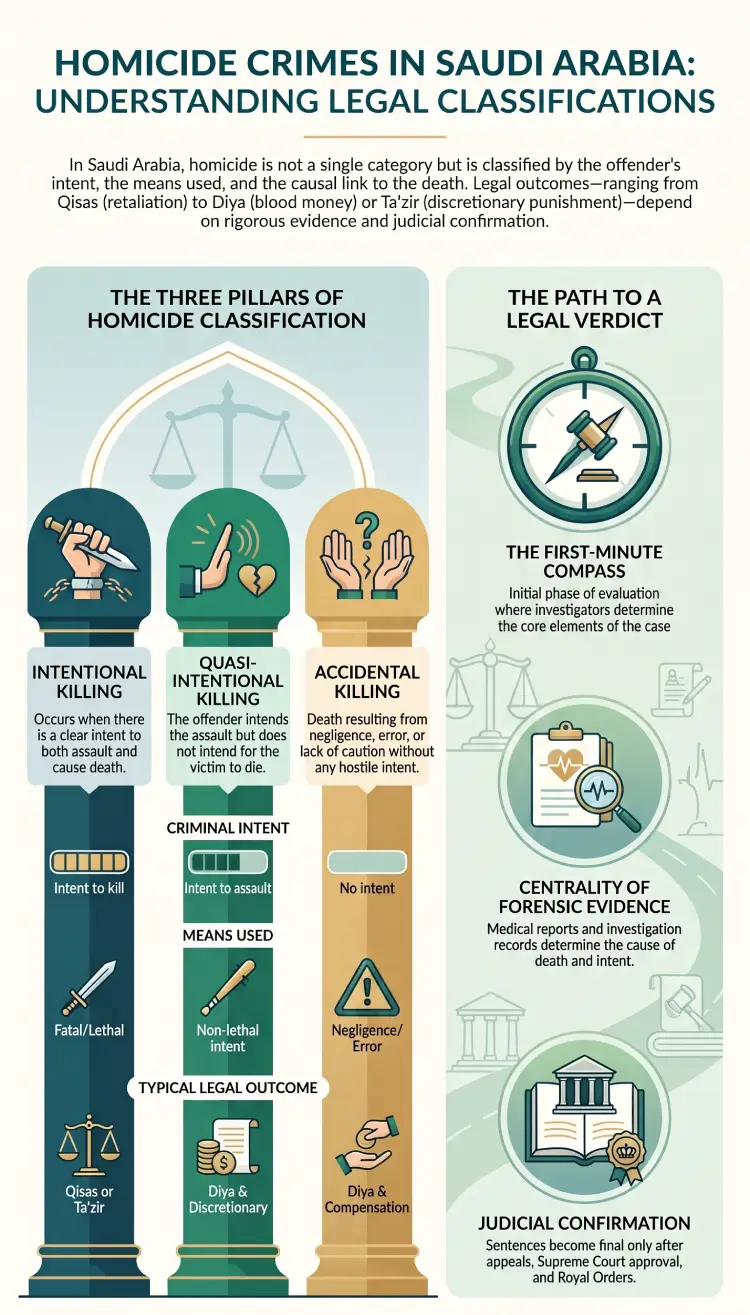
Homicide crimes in Saudi Arabia are not treated as one single legal category. A case may involve intentional killing, quasi-intentional killing, or accidental killing. The difference does not depend on the death alone, but on the offender’s intent, the act itself, the means used, and the causal link between the act and the result.
Legal classification is critical because it can change the entire direction of the case. Intentional killing may raise the issue of qisas when its requirements are met, while diya and discretionary liability may arise in other situations, especially in accidental or quasi-intentional killing.
In homicide cases, proper legal assessment starts with documents, not impressions. These documents may include investigation records, forensic medical reports, witness statements, technical evidence, recordings, and any material connected to the incident.
Legal review through a criminal case lawyer consultation in Jeddah may help assess how investigation records and forensic findings affect the classification before any step is taken.
The First-Minute Compass: What Determines the Direction of a Homicide Case?
Homicide crimes in Saudi Arabia are usually assessed through three initial questions. Was there an intent to kill? Was the means used usually capable of causing death? Is there a direct causal link between the act and the death?
If the offender intended both the act and the fatal result, the case may be closer to intentional killing. If the offender intended the assault but not the death, the classification may be closer to quasi-intentional killing. If there was no intent to assault or kill, and the death resulted from negligence or error, the case may be closer to accidental killing.
This assessment is not based on one party’s version. A case may appear to be intentional killing at first, then reports, witness statements, or the context of a fight may reveal a significant doubt regarding intent. A case may also appear to be an ordinary accident, then later evidence may show negligence or a regulatory breach that affects liability.
What Are Homicide Crimes in Saudi Arabia?
Homicide crimes in Saudi Arabia are incidents where a human life is lost and the death is linked to an act attributed to another person. The mere occurrence of death is not enough to determine the legal classification. The court examines the act, intent, means, circumstances, and causal link.
Causation means that the death must be the result of the act attributed to the accused. If an independent cause intervenes and breaks that link, the classification or liability may change. Forensic medical reports are therefore central in homicide cases because they help determine the cause of death and the nature of the injury.
Criminal intent refers to the direction of the offender’s will toward the act or the result. A person may intend only to assault, and death may occur without being intended. Another person may intend to kill from the beginning. This distinction is one of the key elements in understanding the elements of criminal cases in Saudi Arabia before deciding the final legal classification.
Types of Homicide Under Saudi Law
The main types of homicide crimes in the Saudi legal and judicial context are intentional killing, quasi-intentional killing, and accidental killing. Special classifications may arise in some cases if the incident involves treachery, public danger, or circumstances that require a different legal assessment.
Intentional killing is the most serious form. It usually involves both intent to commit the act and intent to cause death. This intent may appear from the weapon used, the method of assault, the location of the injury, the surrounding circumstances, and what happened before or after the act.
Quasi-intentional killing occurs when the offender intends the assault, but not the death. This form often appears in incidents that begin as a fight or beating and then end with a more serious result than the offender intended.
Accidental killing occurs when death results from error, negligence, or lack of caution, without intent to assault or take life. This may arise in certain traffic accidents, professional errors, or incidents where hostile intent is absent.
The Difference Between Intentional, Quasi-Intentional, and Accidental Killing
The main difference between the types of homicide is intent. Intentional killing involves intent to commit the act and intent to cause the result. Quasi-intentional killing involves intent to assault without proven intent to kill. Accidental killing involves no intent to assault or kill.
Legal classification does not depend on the accused person’s statement alone. A person may deny intent to kill, while the weapon, injury location, or repeated acts may indicate otherwise. A person may also admit a specific act, but that admission alone may not settle the classification if a relevant doubt exists.
| Type of Homicide | Intent | Approximate Example | Possible Legal Effect |
|---|---|---|---|
| Intentional killing | Intent to act and cause death | Using a deadly means on a dangerous body area | Qisas and public-right liability may be examined |
| Quasi-intentional killing | Intent to assault without intent to kill | A fight or beating ending in death | Diya and discretionary liability, depending on the judgment |
| Accidental killing | No intent to assault or kill | An accident or negligence causing death | Diya and liability based on the cause of error |
| Special incidents | Depending on deception or public danger | Treachery, ambush, or public-security risk | Special classification decided by the court |
This table explains general distinctions only. Facts are not assessed by their title, but by their details and what is proven before the court.
Punishment, Qisas, and Diya in Homicide Cases
Punishment for killing in Saudi Arabia depends on legal classification. There is no single penalty for all homicide crimes in Saudi Arabia, because qisas, diya, and discretionary punishment do not apply in the same way to every case.
In intentional killing, qisas may be considered when the crime is proven, the conditions are met, and no legal impediment exists. Forgiveness or settlement by the victim’s heirs may affect the private right, but this does not necessarily end every public-right consequence.
In quasi-intentional killing, the key issue is usually whether intent to kill is absent while intent to assault is proven. If the court accepts this classification, the case differs from intentional killing, and diya or discretionary liability may become relevant depending on the circumstances.
In accidental killing, death results from error, negligence, or lack of caution. Diya, expiation, and regulatory liability may become relevant, especially in accidents or professional incidents.
The amount of diya or the term of imprisonment should not be treated as fixed in every case. These issues depend on the type of crime, private right, legal classification, timing of the incident, and the decision of the competent court.
Qisas Crimes in Saudi Arabia: When Does Qisas Arise or Fall?
Qisas in homicide crimes in Saudi Arabia is usually connected to intentional killing when its requirements and conditions are met. It is not imposed merely because death occurred. The court examines evidence, defenses, and legal classification before reaching such a judgment.
Before qisas is ruled, the court examines several elements, including proof of the act, proof of intent, causation, a valid claim by the right holders, and the absence of legal impediments that may prevent qisas.
Qisas may fall or become unenforceable in certain cases, such as forgiveness, settlement, a significant doubt, or a recognized impediment. However, the fall of qisas does not automatically mean the fall of the public right, because the state has an independent interest in public security and deterrence.
Qisas should not be confused with diya. Qisas is a private-right consequence connected to intentional killing when its requirements are met. Diya is financial compensation that may arise in accidental killing, quasi-intentional killing, or in some cases of forgiveness and settlement.
Public Right and Private Right in Homicide Cases
The private right is the right of the victim’s heirs to claim what is recognized under Sharia and law, such as qisas, diya, or forgiveness. This right requires identifying the rightful parties, because disagreement among heirs or incomplete representation may affect waiver or claim procedures.
The public right relates to the state’s interest in deterrence and public security. Therefore, a waiver by the victim’s heirs does not necessarily end the criminal case or remove every consequence connected to the incident.
| Element | Practical Meaning | Effect of Waiver |
|---|---|---|
| Private right | Right of the heirs to claim qisas, diya, or forgiveness | May be waived under applicable rules |
| Public right | State’s right to deterrence and public security | Does not automatically fall |
| Diya | Financial compensation when due | May fall through forgiveness or settlement |
| Settlement | Documented agreement between parties | Its effect depends on its wording |
A waiver must be understood before it is signed or documented. It may cover qisas only, include diya, or be connected to a settlement with specific terms. Any ambiguity may later create a dispute between the parties.
Homicide Investigation in Saudi Arabia
A homicide investigation usually begins with a report and evidence-gathering, then moves to examination of evidence and statements within the broader path of criminal investigation in Saudi Arabia and its procedural safeguards.
The competent authorities may preserve the scene as far as possible, document traces, and hear those connected to the incident. Technical reports may also be requested, including forensic medical reports, criminal evidence reports, or surveillance recordings.
The Public Prosecution plays an important role by hearing the accused and witnesses, confronting parties with available evidence, and requesting necessary reports. Early statements may later affect how the court understands the incident.
The duration of investigation and detention cannot be fixed by one number for every case. The duration of investigation before the Public Prosecution may differ depending on the number of accused persons, complexity of evidence, and pending technical reports.
Evidence in Homicide Cases
Evidence in homicide cases should not be read in isolation. A confession may be important, but its effect depends on the circumstances in which it was made, its voluntariness, and its connection with the rights of the accused during investigation and the remaining evidence.
The forensic medical report is one of the most important pieces of evidence in homicide cases. It helps identify the cause of death, type of injury, approximate timing, and connection between the injury and the act attributed to the accused. It may change the direction of the case if it reveals a different cause of death.
Witness testimony and technical indications also require careful review. A witness may have seen only part of the incident, a camera may not show every angle, and a fingerprint may prove presence without proving killing by itself.
Contradictory evidence, weak causation, or doubt around a confession may affect legal classification. The discussion may move from intentional killing to quasi-intentional or accidental killing, depending on what is proven judicially.
The Competent Court and Objection Stages
Homicide cases are heard before the competent criminal judiciary. Serious judgments usually pass through more intensive review stages than ordinary cases. The path depends on the type of judgment, the charge, and whether a private right exists.
After investigation and referral, the case moves to one of the criminal lawsuit stages before the criminal court, including presentation of the claim, hearing the parties, and examining the evidence.
When a judgment is issued in a homicide or qisas case, objection becomes very important. This stage is not based on repeating the facts, but on identifying errors in classification, weak reasoning, contradictory evidence, or failure to address key defenses.
Judicial review is especially important in judgments connected to homicide and qisas. Therefore, objections must be drafted in precise legal language that connects facts with evidence and procedure, not general denial or emotional argument.
Key Legal Defenses in Homicide Cases
Defenses in homicide cases are not built on general denial. They require careful analysis of what is proven in the file. This is why defenses in criminal cases can directly affect classification and the direction of judgment.
One key defense is absence of intent to kill. If intent to take life is not proven, the classification may change from intentional killing to quasi-intentional killing or another classification. This may appear from the nature of the tool, injury location, number of acts, and context of the fight.
Self-defense may also be a relevant defense if its conditions and limits are proven. It is not enough for the accused to say he acted in self-defense. The facts must show an immediate danger and proportionality between the defensive act and the threat.
Interruption of causation is another important defense. If death was not the direct result of the attributed act, or if an independent cause intervened, the effect on liability may change. In this area, the forensic medical report is often central.
What Documents Should You Prepare Before Requesting a Consultation?
Before requesting a consultation in a homicide case or a death incident under investigation, prepare the available documents without alteration or deletion. Accurate legal review requires a clear picture of the facts, not a brief description only.
- Case number or report number, if available.
- Copy of the arrest or incident report, or the relevant notice.
- Medical reports or death report, if available.
- Names and contact details of witnesses.
- Any recordings, photos, or messages related to the incident.
- Details of the accused, victim, and the requester’s capacity.
- Any power of attorney or document proving heirship or legal capacity.
If the incident took place in Jeddah, Makkah, Taif, Madinah, or nearby areas, the case can be presented confidentially to BMS Legal for review of the documents and assessment of the closest lawful step.
When Do You Need a Lawyer in a Homicide Case?
You need a lawyer in a homicide case from the suspicion or investigation stage, because the role of a lawyer in a criminal case starts with reading procedures and statements, not with waiting for a judgment.
If the person is accused or detained, the lawyer’s role begins with reviewing procedures, explaining rights, and understanding the contents of reports and technical documents. The purpose is not to invent a version, but to organize the defense according to what the evidence allows.
If you are one of the victim’s heirs, you may need a lawyer to understand the private right, diya, waiver, settlement, and the effect of each option. Decisions in such cases should not be made under pressure or based on incomplete information.
Frequently Asked Questions About Homicide Crimes in Saudi Arabia
What are homicide crimes in Saudi Arabia?
They are incidents that result in the loss of human life, with classification depending on intent, means, and causation.
What are the main types of killing under Saudi law?
The main types are intentional killing, quasi-intentional killing, and accidental killing, each with different legal effects.
What is the difference between intentional and quasi-intentional killing?
Intentional killing involves intent to kill, while quasi-intentional killing involves intent to assault without intent to cause death.
What is the difference between quasi-intentional and accidental killing?
Quasi-intentional killing involves assault, while accidental killing occurs without intent to assault or take life.
Does accidental killing involve qisas?
As a general rule, qisas is connected to intentional killing when its conditions are met, not merely to accidental death.
When is qisas ordered in Saudi Arabia?
Qisas may be ordered when its basis is proven, its conditions are met, and no impediment exists, according to the competent court.
Does waiver by the victim’s heirs remove the public right?
No. Waiver usually relates to the private right and does not automatically remove the public right.
What is the role of the forensic medical report?
It helps identify the cause of death, type of injury, and connection between the injury and the act attributed to the accused.
Is confession enough in a homicide case?
A confession is important, but it is read with the remaining evidence and procedures, not in isolation.
When do I need a lawyer in a homicide case?
You need a lawyer from the suspicion, investigation, or detention stage, and also when qisas or diya is being claimed.
Homicide Crimes in Saudi Arabia: 3 Types That Shape Qisas and Diya is not only a search title. It reflects the legal path that begins with classification and ends with different consequences for punishment, private right, and public right. The difference between intentional, quasi-intentional, and accidental killing may change the entire case.
If the incident is under investigation, detention, or a claim for qisas or diya, do not begin with the question: what is the punishment? Start with the more accurate question: what does the evidence prove? In homicide cases, the real answer does not appear from the general description, but from investigation records, forensic reports, technical indications, and how the facts are presented before the court.
If the incident is in Jeddah or nearby areas, presenting the documents to a Jeddah law firm may be a practical step to understand the classification, the impact of investigation, and the available legal options before making a decision related to qisas, diya, or objection.
Official Sources: