
Article 60 of Saudi Labor Law regulates when an employer may assign an employee work that differs from the duties originally agreed upon in the employment contract. As a general rule, a substantial change cannot be imposed solely by the employer and requires the employee’s written consent, subject to a limited exception for temporary necessity arising from exceptional circumstances.
This does not mean that every new or additional task constitutes a violation. Some duties may reasonably fall within the employee’s existing role and normal responsibilities. Assessing a change in job duties therefore requires comparing the agreed work with the new assignment, including its nature, duration, and purpose.
This distinction becomes particularly important when an employer changes a job title or job description, assigns a non-Saudi employee to a different occupation, or when the employee is considering refusing an assignment and relying on Article 81. In these situations, the employment contract, assignment decision, and written communications can help clarify the employee’s legal position before any further action is taken.
Article 60 of Saudi Labor Law in Brief
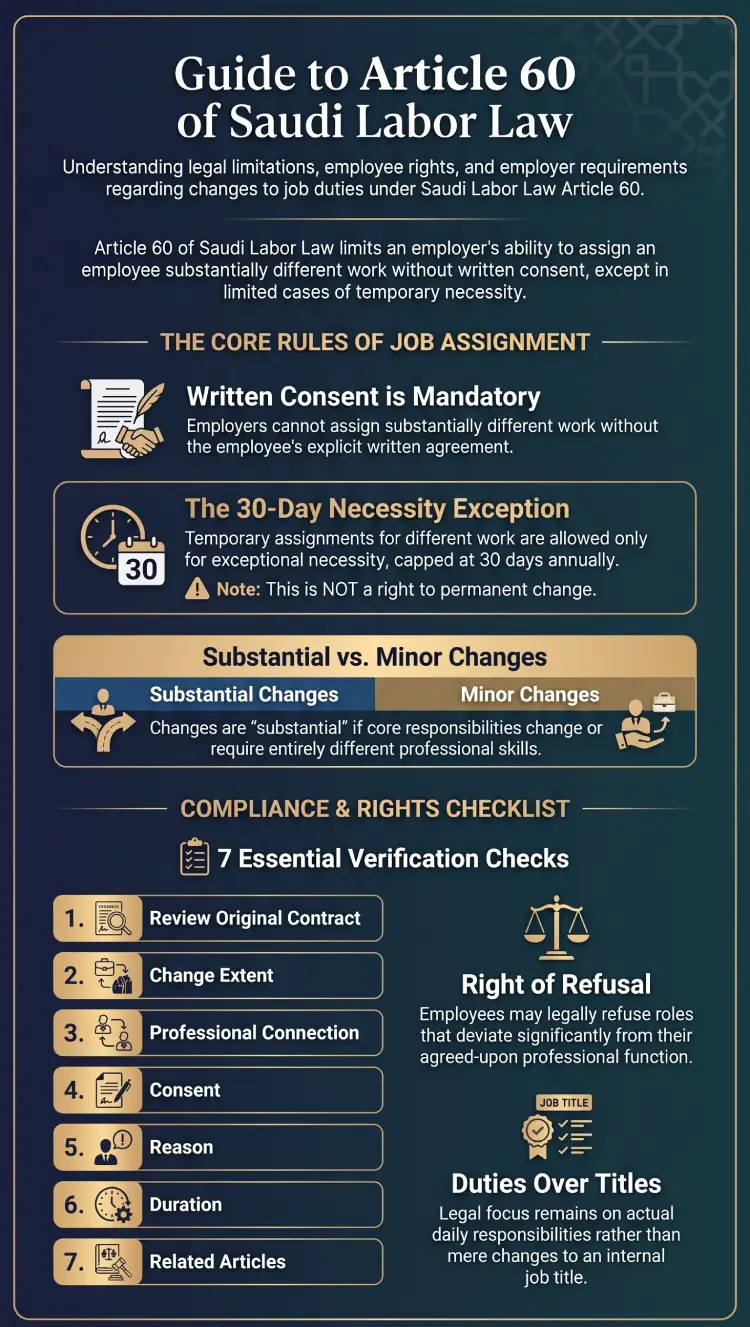
Under Article 60 of Saudi Labor Law, an employee generally may not be assigned work that is substantially different from the work agreed upon without the employee’s written consent. An exception applies when temporary necessity arises from exceptional circumstances, provided that the assignment does not exceed 30 days in one year.
A practical assessment usually involves seven factors: the work originally agreed upon, the extent of the change, whether the new duties remain connected to the employee’s professional role, whether written consent exists, the reason for any temporary assignment, its duration, and the relevance of related provisions such as Articles 38 and 81.
| Situation | Initial Assessment | What to Review |
|---|---|---|
| Duties related to the existing role | May be an organizational change | Contract and nature of the task |
| Actual move to another professional field | May be substantial | Written consent |
| Job title change only | Does not determine a violation | Actual duties performed |
| Assignment due to exceptional necessity | Permitted subject to conditions | Reason and duration |
| Long-term continuation of different duties | Requires review | Legal basis and consent |
| Non-Saudi employee | Additional rules apply | Occupation on the work permit |
| Considering leaving employment | Requires careful assessment | Article 81 and supporting evidence |
Understanding Article 60 and a Substantial Change in Work
The wording of Saudi Labor Law Article 60 distinguishes between adjusting duties within an existing role and changing the nature of the employee’s work itself. An employer may organize operations and distribute responsibilities within reasonable limits, but this managerial authority does not allow an employee to be transferred to substantially different work without observing the legal requirements.
A change is more likely to be substantial when it alters the employee’s core professional activity, field of work, principal responsibilities, or the skills for which the employee was originally hired. For example, assigning an engineer to a field sales role is materially different from requiring the same engineer to prepare an additional technical report.
Assigning an employee additional duties does not, by itself, violate Article 60. The key question is whether those duties remain reasonably connected to the employee’s existing position or effectively transform the role into different work.
For this reason, interpreting Article 60 of Saudi Labor Law requires the employment contract, job description, and actual working arrangements to be considered together rather than relying on the job title alone.
Can an Employer Change an Employee’s Job Duties?
An employer may organize work, add duties, or redistribute responsibilities where those changes remain within the reasonable scope of the employee’s role. However, assigning an employee work that is substantially different from what was agreed may fall within Article 60 and require written consent.
The outcome depends on the facts of each case. A new responsibility may simply be a natural extension of the employee’s position, while another assignment could replace the employee’s professional function or core responsibilities altogether. This is why there is no single answer to whether an employer can change an employee’s duties in Saudi Arabia.
Broad contractual wording, such as requiring an employee to perform “other duties as needed,” should also be read in the context of the agreed role. Such wording does not automatically create unlimited authority to replace the employee’s original occupation with entirely different work.
An employer’s authority to reorganize duties should therefore be understood within the wider framework of the Saudi Labor Law, which regulates the rights and obligations of both parties throughout the employment relationship.
Can an Employee Refuse a Different Work Assignment?
The right to refuse a work assignment depends on the nature of the new duties rather than the employee’s preference alone. If the assignment falls naturally within the existing position, refusing it may raise different issues from refusing work that substantially changes the employee’s agreed role.
An employee’s position becomes clearer when the difference between the original job and the new assignment can be demonstrated through the employment contract, job description, assignment letter, and relevant correspondence. For this reason, refusing an assignment before determining whether the change is genuinely substantial may create an avoidable employment dispute.
Likewise, refusing duties outside a job description requires distinguishing between an ancillary task reasonably connected to the position and a genuine change in the nature of the work. Written documentation becomes especially important once a disagreement develops over the scope of the assignment.
If the dispute eventually results in termination by the employer, it is important to distinguish an alleged Article 60 violation from the specific grounds for dismissal under Article 80 and the conditions governing their application.
When Can an Employee Be Assigned Different Work for 30 Days?
An employee may be assigned substantially different work without written consent when necessity arising from exceptional circumstances requires it, provided the assignment does not exceed 30 days in one year.
The 30-day rule under Article 60 is therefore not a general right allowing an employer to change an employee’s position whenever operational needs arise. The temporary assignment must be connected to circumstances capable of bringing it within the statutory exception.
Simply describing an assignment as temporary does not determine its legal character if, in practice, the employee continues performing the different work indefinitely. Where the assignment extends beyond the statutory period, the basis for its continuation and the existence of employee consent should be reviewed.
Article 60 does not provide a closed list of every circumstance that constitutes necessity. The assessment therefore depends on the facts surrounding the assignment and the reason it was introduced.
The Article also does not establish a rule converting every eight hours of different work into one day of the 30-day period. The safer approach is to apply the statutory wording without introducing a calculation method that the provision itself does not specify.
Does Changing a Job Title Violate Article 60?
Changing a job title without employee consent does not, by itself, establish a violation of Article 60 of Saudi Labor Law. The provision focuses primarily on the work actually performed and whether it is substantially different from the work agreed upon.
A job title may change while the employee continues performing essentially the same duties and responsibilities. Conversely, the original title may remain unchanged while the employee is effectively transferred to an entirely different role.
Working outside a stated job title or changing a job description should therefore be assessed by comparing the substance of the employee’s position before and after the change. The practical effect of the change is more important than the label used internally by the employer.
This distinction is also relevant when considering whether an employer may change a job title. The answer depends substantially on what the change means in practice rather than the title appearing in an internal organizational structure.
Additional restrictions apply to non-Saudi employees because Article 60 expressly refers to Article 38, which addresses the occupation recorded on the employee’s work permit.
Article 60 and Article 38 for Non-Saudi Employees
Article 60 expressly preserves the requirements of Article 38, making the two provisions particularly relevant when a non-Saudi employee is assigned different work.
Article 38 addresses employment in an occupation other than the occupation recorded on the employee’s work permit. Consequently, assigning a non-Saudi employee to different duties may raise two separate questions: whether the new work is substantially different from the agreed work, and whether it remains consistent with the employee’s officially registered occupation.
Written consent to a substantial job change does not, by itself, replace any regulatory procedures required where the new work amounts to a different occupation. Employers should therefore consider both the employment contract and the regulatory status of the employee’s occupation before implementing such a change.
For non-Saudi employees, the internal job title used by the company should not be considered in isolation from the occupation officially recorded for employment purposes.
What Is the Relationship Between Article 60 and Article 81?
The connection becomes particularly important where an employee is assigned, without consent, work that is substantially different from the agreed work in violation of Article 60. Article 81 includes such a situation among the circumstances in which an employee may, when its requirements are satisfied, leave employment without notice while retaining statutory rights.
However, the relationship between Article 60 and Article 81 of Saudi Labor Law does not mean that every disagreement about a new duty automatically gives an employee the right to leave immediately. The employee must first consider whether the work is genuinely substantially different, whether consent was absent, and whether the facts fall within the situation contemplated by the law.
Leaving employment because of changed job duties therefore requires careful review of the contract, assignment decision, and correspondence. If a dispute arises later, evidence concerning the actual nature of the duties and the employee’s position on the change may become central.
Where an employee has been assigned substantially different work without consent, Article 81 of Saudi Labor Law becomes relevant when assessing whether employment may be left without notice and what statutory rights may follow.
How Can an Employee Prove a Violation of Article 60?
Proving an alleged violation generally requires showing the difference between the work originally agreed upon and the duties the employee was subsequently required to perform. Documents should therefore help establish the employee’s original role, what changed, when the change began, and how long it continued.
Relevant evidence may include:
- The documented or signed employment contract.
- The original job description and employment offer.
- An assignment decision or written instruction.
- Emails and professional correspondence.
- Messages identifying the employee’s new duties.
- A written objection submitted to the employer.
- Records showing the employee’s actual duties before and after the change.
- Occupational information relating to a non-Saudi employee.
No single document necessarily determines the outcome of every dispute. The strength of a case may instead come from several pieces of evidence that collectively demonstrate that the employee’s actual work became substantially different from the work originally agreed upon.
What Should You Do If Your Duties Change Without Your Consent?
If your job duties change without your consent, begin by reviewing your employment contract and job description, then compare your previous responsibilities with the new ones. You should also ask Human Resources to clarify the reason for the assignment and its expected duration, particularly where the decision has not been clearly documented.
Any professional objection should be recorded in writing, and relevant communications and assignment decisions should be retained. Relying solely on verbal conversations can make it more difficult to establish what occurred if the disagreement later develops into a formal employment dispute.
If the matter is not resolved internally, an employment dispute may proceed through the amicable settlement process before moving to the Labor Court where settlement is unsuccessful and the applicable procedures permit escalation.
Where the dispute involves refusing an assignment, continuing in the new role, or ending the employment relationship, consulting an employment lawyer in Jeddah can help assess the contract, assignment, and available evidence before further action is taken.
Frequently Asked Questions About Article 60 of Saudi Labor Law
1. What is Article 60 of Saudi Labor Law?
It regulates assigning an employee work that is substantially different from the agreed role and sets conditions for such changes.
2. Can an employer change an employee’s job duties?
Yes, if the changes remain within the reasonable scope of the role. Substantial changes generally require written consent.
3. What is a substantial change in work?
It is a change that materially alters the employee’s core duties, professional field, responsibilities, or agreed role.
4. Can an employee refuse a different work assignment?
Potentially, if the assignment substantially differs from the agreed work and does not fall within a lawful exception.
5. Does changing a job title violate Article 60?
Not necessarily. The key issue is whether the employee’s actual duties have substantially changed, not the title alone.
6. When can an employee be assigned different work for 30 days?
When necessity arises from exceptional circumstances, provided the temporary assignment does not exceed 30 days in one year.
7. What is the relationship between Article 60 and Article 81?
Article 81 may become relevant when an employee is assigned substantially different work without consent in violation of Article 60.
8. How can an employee prove a violation of Article 60?
Relevant evidence may include the employment contract, job description, assignment letter, emails, written objections, and records of actual duties.
Article 60 of Saudi Labor Law: 7 Rules on Job Changes can be understood through seven practical considerations: the agreed work, the extent of the change, the nature of the new duties, written consent, necessity, duration, and the evidence and related legal provisions applicable to the case.
If your duties have changed, do not rely on the new job title alone or assume that every additional responsibility amounts to a violation. Compare your actual work with the employment contract, document relevant decisions and communications, and determine whether the change is substantial, temporary, or effectively permanent.
Where the situation requires a broader review of the employment contract, correspondence, and potential consequences of the dispute, a law firm in Jeddah can help assess the available legal route before escalation.
Official Legal Source: