
Saudi Labor Law Article 81 allows an employee to leave work without notice while retaining statutory rights, but only when specific legal grounds apply to the employment relationship. A disagreement with an employer alone is not sufficient, and Article 81 should not be treated as an automatic alternative to resignation.
The key issue is identifying the legal ground, connecting it to the employment contract and actual working conditions, and preserving evidence before ending the employment relationship. This becomes particularly important when the dispute involves unpaid or delayed wages, a substantial change in job duties, insult or assault, or a serious workplace hazard.
Article 81 forms part of the wider rules governing the relationship between employers and employees under the Saudi Labor Law. Understanding it therefore requires considering the broader framework of contractual rights, obligations, and procedures governing employment in Saudi Arabia.
Quick Answer: When Does Saudi Labor Law Article 81 Protect an Employee?
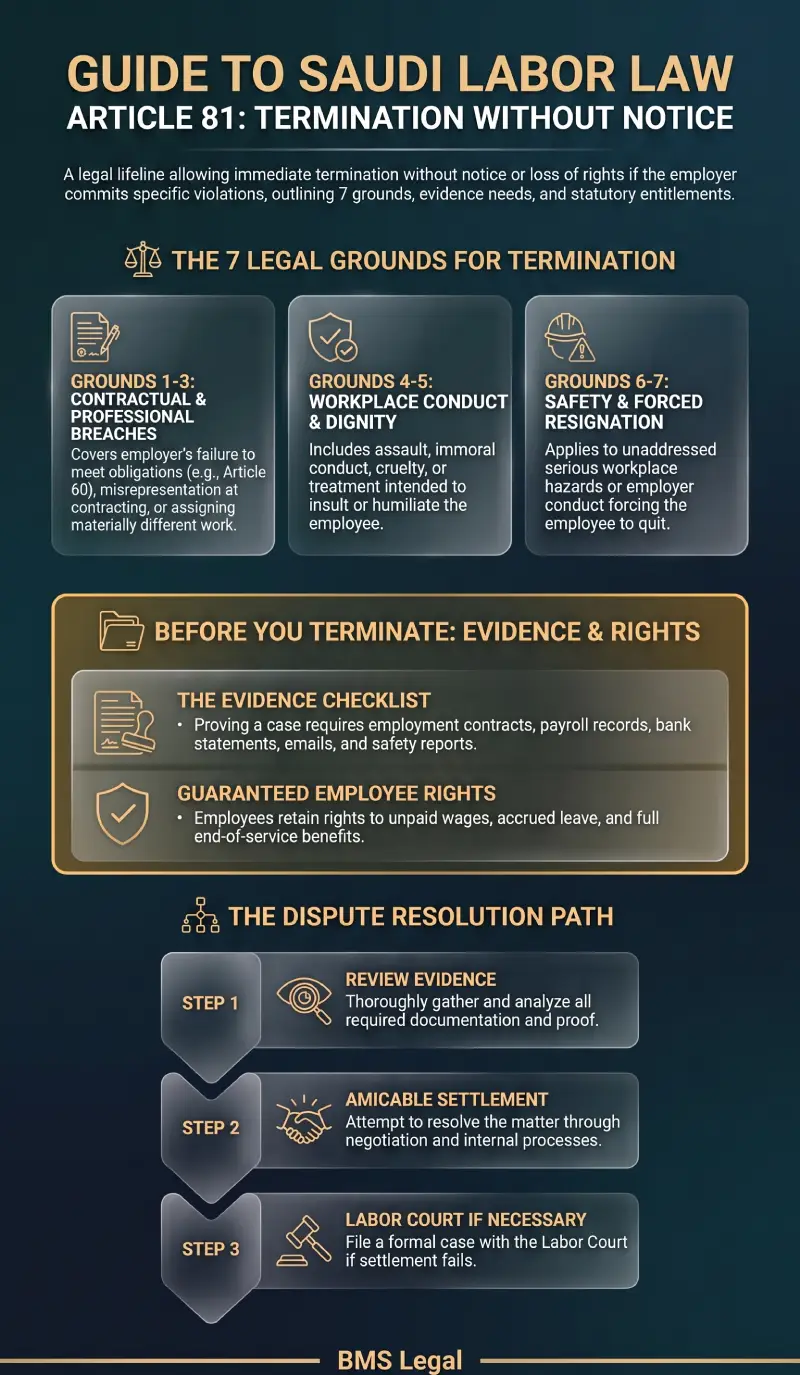
Saudi Labor Law Article 81 applies when one of the seven statutory situations is established. These include a substantial breach of the employer’s contractual or statutory obligations, misrepresentation at the time of contracting, assigning materially different work without the employee’s consent, assault, or treatment involving cruelty, injustice, or insult.
The provision also covers a serious workplace hazard where the employer knew of the danger but failed to remove it, as well as situations where the employer’s conduct effectively forces the employee to appear as though they voluntarily ended the contract.
Where one of these grounds is established, the employee may leave without notice while retaining statutory rights. In practice, however, the main dispute often shifts from whether misconduct occurred to whether the employee can prove it. The employment contract, correspondence, payroll records, and other relevant documents should therefore be reviewed before taking an irreversible step.
If you are considering ending your employment because of an employer breach, assess both the legal ground and the available evidence before submitting a resignation. BMS Legal can review the relevant documents and explain the appropriate legal route before action is taken.
What Is Article 81 of the Saudi Labor Law?
Saudi Labor Law Article 81 governs exceptional circumstances in which an employee may end the employment relationship without serving the usual notice period while retaining statutory rights. This distinguishes Article 81 termination from an ordinary resignation, which generally results from the employee’s own decision and does not necessarily involve misconduct or breach by the employer.
The legal classification of the termination therefore depends on what actually caused the employment relationship to end, rather than solely on the label used by either party.
The wording and structure of Article 81 do not give employees an unrestricted right to leave employment without notice. Instead, the Article identifies seven specific situations. The actual circumstances must correspond to one of those grounds, and the evidence should support the reason relied upon.
If an employee terminates the contract but cannot establish the alleged ground, a dispute may arise over whether the termination was legally justified and what financial consequences follow.
In practical terms, the conditions of Article 81 under Saudi Labor Law require three elements to be considered together: a legally recognised ground, identifiable facts supporting that ground, and evidence capable of establishing those facts.
What Are the 7 Cases Under Saudi Labor Law Article 81?
The law identifies seven circumstances in which an employee may leave work without notice. Article 81 should not be reduced to salary delays or disputes with a manager alone.
| Case | Practical Meaning |
|---|---|
| Employer breaches its obligations | Failure to meet a substantial contractual or statutory obligation owed to the employee |
| Misrepresentation when contracting | Misleading the employee about the terms or conditions of employment when the contract was concluded |
| Materially different work | Assigning work that is substantially different from the agreed role without the employee’s consent, subject to Article 60 |
| Assault or immoral conduct | Violent assault or conduct contrary to morality involving the employee or a member of the employee’s family |
| Cruelty, injustice, or insult | Treatment by the employer or responsible manager that involves cruelty, injustice, or humiliation |
| Serious workplace hazard | A danger threatening the employee’s health or safety that the employer knew about but failed to remove |
| Employer causes the employee to terminate | Conduct by the employer that makes the employee appear to have voluntarily ended the contract when the real cause lies with the employer |
These grounds do not mean that every minor breach automatically triggers Article 81. For example, where wages are delayed, the circumstances, frequency, affected obligation, and supporting evidence should be examined rather than relying on a fixed number of days that Article 81 itself does not prescribe as a general threshold.
The same approach applies to changes in job duties. Article 60 concerns work that differs substantially from the work originally agreed upon, while allowing a limited exception for temporary necessity subject to the conditions prescribed by law.
Where the dispute involves an employer breach or uncertainty over whether Article 81 applies, having the file reviewed by a labor lawyer in Jeddah can help clarify the available legal options before the employee takes action.
When Can an Employee Leave Work Without Notice in Saudi Arabia?
An employee may leave work without notice when the facts fall within one of the statutory grounds under Article 81 and are genuinely connected to the employment relationship.
It is therefore important to distinguish dissatisfaction with a job from a contractual or statutory breach that may justify immediate termination. A disagreement with management, failure to receive a promotion, or changes to minor aspects of the job do not automatically establish an Article 81 case.
Before leaving employment, consider four practical questions. What obligation did the employer allegedly breach? Where is that obligation found in the contract or applicable law? When did the breach begin and how did it develop? What evidence is available to demonstrate it?
Answering these questions helps determine whether the case is supported by identifiable facts or is primarily a workplace disagreement that may be difficult to establish legally.
An employee should also avoid automatically describing the termination as a “resignation” when relying on Article 81. The classification and stated reason for ending the contract may later become part of the dispute. Any written communication concerning termination should therefore identify the relevant facts accurately without adding allegations that cannot be supported.
How Do You Prove a Saudi Labor Law Article 81 Case?
Evidence is one of the most important elements in applying Saudi Labor Law Article 81 because an employer may dispute whether the alleged breach occurred, whether it was sufficiently serious, or whether it actually caused the employee to end the contract.
Employees should therefore preserve relevant evidence before losing access to workplace email, internal systems, or employment-related documents.
Depending on the dispute, relevant evidence may include the employment contract and job offer, bank statements showing salary payments, payroll records, emails and workplace correspondence, decisions concerning changes in duties, previous complaints, workplace safety reports, and other legally admissible material supporting the underlying facts.
A single document does not automatically prove that Article 81 applies. Evidence becomes more persuasive when it corresponds with the alleged events and establishes a consistent timeline.
If the dispute concerns insulting treatment, pressure to terminate employment, or changes in duties, the events should be documented in an organised manner. Where delayed wages are involved, records should show both the contractual payment dates and the dates on which salary payments were actually made.
Having the file organised before termination allows the employee’s legal position to be assessed more accurately and reduces the risk of relying on facts that cannot later be demonstrated.
If you already have an employment contract, correspondence, or other documents and are unsure whether they support an Article 81 claim, BMS Legal can review the material and identify the legal strengths and potential risks before further action.
What Rights Does an Employee Keep After Applying Article 81?
Article 81 provides that an employee retains statutory rights when one of the prescribed grounds is established. However, the exact amounts due depend on the employment contract, length of service, wage, and rights accrued up to the date the employment relationship ends.
Potential entitlements that may need to be reviewed include unpaid wages, contractual or statutory allowances, payment for accrued unused annual leave where applicable, and end-of-service benefits in accordance with the rules governing entitlement and calculation.
The employer must also comply with the Labor Law requirements applicable when the employment relationship ends, including those relating to the employee’s service certificate and return of documents.
Compensation under Article 77 is a separate legal issue from the rights preserved under Article 81. Article 77 addresses compensation for termination without a legitimate reason where the employment contract does not specify particular compensation.
Accordingly, Article 77 compensation should not be presented as an automatic consequence of every Article 81 termination. Whether a separate compensation claim exists, and how it may be calculated, requires examination of the reason for termination, the terms of the contract, the alleged loss, and the specific circumstances of the case.
How Is Article 81 Applied When an Employment Dispute Arises?
Start by reviewing the employment contract and identifying which Article 81 ground could correspond to the facts. Relevant evidence should then be collected, and copies of documents the employee is legally entitled to retain should be preserved.
Any notice, communication, or step associated with ending the employment relationship should accurately reflect the genuine reason for termination. Incorrect or exaggerated statements may later weaken the employee’s position.
Where a dispute arises regarding the validity of the termination or the employee’s financial entitlements, amicable settlement of labor disputes is generally the first stage for labor claims through the Saudi Ministry of Human Resources and Social Development. The process seeks to resolve the dispute by settlement. If no settlement is reached, the case may proceed before the competent Labor Court in accordance with the applicable procedures.
Employees who are not Saudi nationals should not assume that Article 81 automatically creates a separate right to transfer employment services. Employment mobility and transfer procedures are governed by their own rules and requirements.
If a case involves both contract termination and residency or service-transfer issues, the two matters should be evaluated together rather than treating one as an automatic consequence of the other.
What Is the Difference Between Articles 77, 80, and 81?
Articles 77, 80, and 81 address different aspects of termination under Saudi employment law. Confusing them can lead to incorrect assumptions about the rights and obligations of both parties.
| Article | Main Subject | Party Primarily Associated With the Provision |
|---|---|---|
| Article 80 | Cases in which an employer may terminate the contract subject to specific conditions | Employer |
| Article 81 | Cases in which an employee may leave without notice while retaining statutory rights | Employee |
| Article 77 | Compensation for termination without a legitimate reason, subject to its conditions | Injured party |
Article 80 is not simply the mathematical opposite of Article 81, and Article 77 is not an automatic penalty whenever an employment contract ends.
Each provision has its own conditions and legal consequences. The correct approach is to identify what actually happened, determine who ended the employment relationship, establish why it ended, and assess what evidence supports that explanation.
The relevant question is therefore not “Which Article should I choose?” but rather: “What happened, who terminated the relationship, why did it end, and what can be proved?”
Frequently Asked Questions About Saudi Labor Law Article 81
What is Saudi Labor Law Article 81?
It allows an employee to leave work without notice while retaining statutory rights when one of the specified legal grounds applies.
2. Is Article 81 considered a resignation?
No. It is different from an ordinary resignation because it is based on a statutory ground for ending the employment relationship.
3. When can an employee leave work without notice?
An employee may do so when one of the seven Article 81 cases applies and the underlying facts can be supported by evidence.
4. Can delayed salary payments fall under Article 81?
They may amount to an employer breach, depending on the facts, the seriousness of the delay, and the available evidence.
5. How can an employee prove an Article 81 case?
Evidence may include the employment contract, payroll records, bank statements, emails, workplace messages, and relevant administrative documents.
6. Does an employee keep end-of-service benefits under Article 81?
Article 81 preserves statutory rights, while the actual entitlement depends on the employee’s service period and applicable end-of-service rules.
7. What is the difference between Article 80 and Article 81?
Article 80 concerns certain cases where the employer may terminate the contract, while Article 81 gives the employee the right to leave in specified situations.
8. Where does an employee file an Article 81 labor dispute?
Labor disputes generally begin through amicable settlement procedures and may proceed to the competent Labor Court if no settlement is reached.
Saudi Labor Law Article 81: 7 Cases to Leave Without Notice summarises an important protection that employees should understand before deciding to terminate an employment contract.
Where there is a substantial employer breach, misrepresentation, a material change in the agreed work, assault, degrading treatment, a serious workplace hazard, or employer conduct that effectively causes the employee to terminate the contract, Article 81 may provide a legal route to leave without notice while retaining statutory rights.
The strength of the employee’s position, however, begins before termination. The correct ground should be identified, evidence should be preserved, and the financial and procedural consequences should be understood in advance.
If your decision involves Saudi Labor Law Article 81, reviewing the file before taking action can reduce the risk of incorrectly characterising the termination or losing evidence that may later become important.
If you have a labor dispute that requires legal assessment, the team at our law firm in Jeddah can review the circumstances and explain the available legal route under Saudi law.
Legal Sources: