
A commercial concealment report may be filed in Saudi Arabia when facts or indicators justify Ministry of Commerce verification of a business establishment or individuals connected with its activities. Individuals and consumers may report suspected commercial concealment through the Commercial Report app or the unified number 1900, while a separate electronic service is available for commercial establishments reporting suspected concealment in other establishments.
Filing a report does not establish that commercial concealment has occurred or that the reported person is guilty. A report initiates verification, detection, and evidence-gathering procedures. Depending on the findings, the matter may subsequently be referred to the Public Prosecution and, where criminal proceedings are brought, to the competent criminal court.
The Anti-Commercial Concealment Law also provides safeguards for the informant’s identity and permits a reward of up to 30% of the collected fine, subject to the statutory requirements.
Commercial Concealment Report in One Minute: What Should You Know?
If your question is how to report commercial concealment in Saudi Arabia, first identify the capacity in which you are reporting and gather information that clearly identifies the establishment and the relevant facts.
You do not need to make a final legal determination that an offence has been committed. Instead, distinguish between facts you personally know and assumptions or suspicions that still require verification.
Key points to consider before submitting a report include:
- Individuals and consumers: Reports may be submitted through the Commercial Report app or by calling 1900.
- Commercial establishments: A separate online service is available for establishments reporting suspected concealment in other businesses.
- Information: Clearly identify the establishment, its location, the type of business activity, and the conduct that raised the suspicion.
- Supporting documents: Attach lawfully obtained information or documents where available. The establishment reporting service requires supporting documents.
- Confidentiality: The informant’s identity is kept in a confidential record and is not ordinarily included in the case file.
- Reward: The reward may reach 30% of the collected fine, but it is not automatically payable for every report.
- Outcome: Filing a report does not amount to a finding of guilt. It allows the competent authorities to verify the circumstances through the applicable procedures.
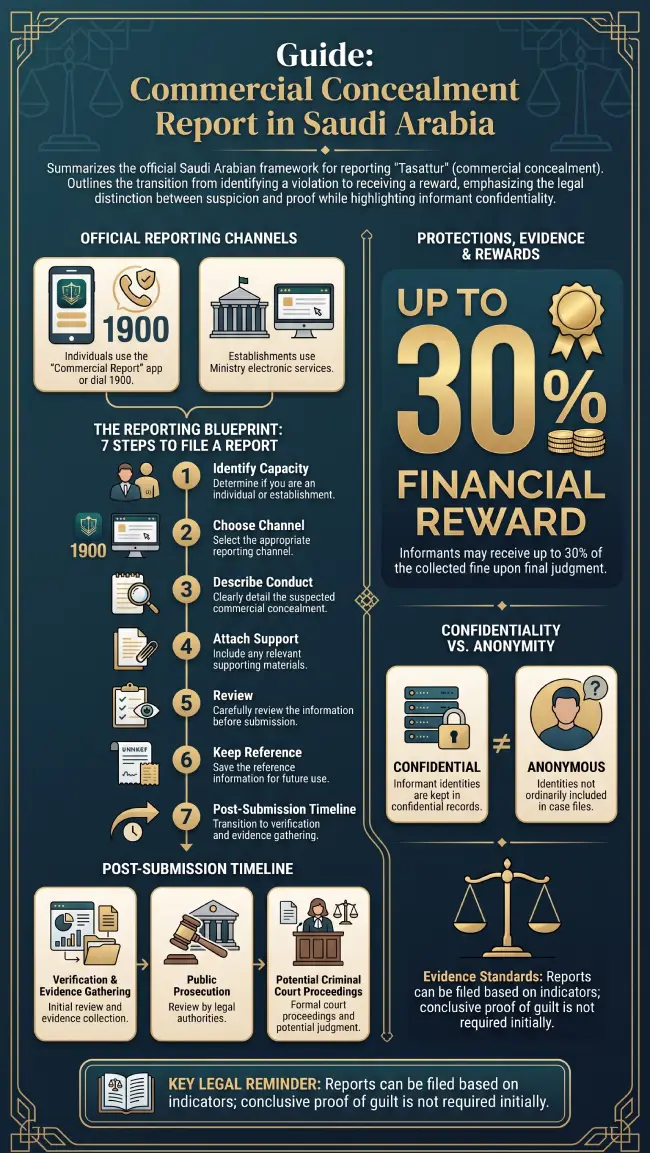
How Do You File a Commercial Concealment Report in Saudi Arabia?
The method for filing a commercial concealment report depends on who is submitting it. Individuals and consumers may use the Commercial Report app or call 1900. A commercial establishment reporting another establishment may use the dedicated electronic service provided by the Ministry of Commerce.
The reporting process can be organised into seven practical steps:
- Identify whether you are reporting as an individual, consumer, or representative of a commercial establishment.
- Select the official reporting channel that corresponds to your capacity.
- Identify the reported establishment, its available business details, and the location of its activities.
- Describe the facts clearly and explain the conduct that gave rise to suspected commercial concealment.
- Attach any supporting documents, images, or information that you lawfully possess.
- Review the information before submission and avoid adding unverified allegations or unsupported legal characterisations.
- Retain the report details or reference number for any available follow-up through the relevant channel.
When submitting a commercial concealment report in Saudi Arabia, focus on facts connected with the economic activity itself. Personal or commercial disputes that do not assist the authorities in verifying the suspected conduct should not replace a clear description of the relevant facts.
Where Can Commercial Concealment Be Reported?
The Ministry of Commerce provides different reporting channels depending on the person submitting the report. This is particularly relevant for searches such as the commercial concealment reporting number or how to report suspected concealment without visiting a Ministry branch.
| Point of Comparison | Individuals and Consumers | Commercial Establishments |
|---|---|---|
| Reporting channel | Commercial Report app or 1900 | Dedicated electronic service |
| Main information | Establishment, incident, and location | Informant and reported establishment details |
| Attachments | Depending on the report | Supporting documents |
| Follow-up | Report status may be viewed | According to the electronic service process |
| Published service period | Depends on the service | 20 business days for the service |
The Commercial Report app enables users to submit reports, attach images, identify the relevant location, and review the status of their submissions. The establishment service requires information about the person making the report, the establishment being reported, and supporting documentation.
Only official channels should be used. Passwords, banking credentials, verification codes, or other sensitive access information should not be shared with websites or persons claiming to file a Ministry of Commerce report on your behalf.
Can You File a Commercial Concealment Report Without Evidence?
A person submitting a commercial concealment report is not required to establish the offence personally because the final determination of liability does not belong to the informant. However, supporting-document requirements vary according to the reporting channel, and the service for establishments requires supporting documentation.
There is an important distinction between suspicion and proof. Certain conduct may justify verification without being sufficient, on its own, to establish commercial concealment. It is therefore preferable to describe the conduct you observed or the document you possess rather than state conclusively that a particular person committed an offence.
Relevant information may include the way the establishment is managed, financial authority, contracts, correspondence, business documents, or transactions directly connected with the suspected conduct. Any information submitted should have been obtained lawfully.
The Anti-Commercial Concealment Law permits offences and violations to be established through different forms of evidence, including electronic evidence. A single message or financial transfer, however, does not automatically establish commercial concealment. Evidence and indicators must be assessed within the wider factual context.
Is a Commercial Concealment Report Confidential?
Yes. Saudi law provides specific protection for the identity of a person making a commercial concealment report, although describing that protection as absolute confidentiality would not be accurate.
Under the Anti-Commercial Concealment Law, the informant’s identity is maintained in a confidential record and is not included in the case file.
The Public Prosecution may request disclosure of the informant’s identity where the investigation requires it, provided that the necessary measures are taken to maintain confidentiality. Therefore, confidentiality means that the identity is legally protected rather than that disclosure is impossible under every circumstance.
A confidential commercial concealment report should also be distinguished from an anonymous report. An official reporting channel may require the informant to identify themselves before applying the statutory confidentiality protections to that information.
These protections may be particularly relevant where the informant is an employee, business partner, or person dealing with the reported establishment. Where an employment or commercial dispute already exists between the parties, the suspected concealment facts should be distinguished carefully from the separate dispute.
How Much Is the Commercial Concealment Reporting Reward?
A qualifying informant may receive a reward of up to 30% of the collected fine imposed in connection with the reported offence or violation.
The 30% figure is a maximum rather than an automatic entitlement. Filing a report alone does not guarantee payment of the reward.
Key eligibility requirements include:
- The informant must provide information that can be relied upon to initiate an investigation.
- The offence must be established by a final judgment, or the violation by a final decision.
- The informant must not have been convicted of the same offence or violation being reported.
- A fine must actually have been collected before the reward can be calculated from it.
The reward is granted through the applicable statutory mechanism. It therefore does not become payable merely because a commercial concealment report has been submitted or the file has been referred to the Public Prosecution.
Where several informants are involved, the Executive Regulations govern the rules for payment and division of the reward. There is no general rule under which the entire reward automatically belongs to the first person who submits a report.
What Happens After a Commercial Concealment Report?
Once a report is received, the competent authorities begin verifying the information according to the circumstances of the case. The Ministry of Commerce is responsible for receiving reports, conducting regulatory oversight, and detecting offences and violations falling within the Anti-Commercial Concealment Law.
Authorised criminal investigation officers may exercise powers that include entering a suspected establishment, examining records, data, and documents, reviewing surveillance recordings, requesting information, and summoning persons who may hold information relevant to the matter.
Where the detection procedures reveal circumstances that justify a criminal investigation, the file may be referred to the Public Prosecution, which is responsible for investigating and prosecuting commercial concealment crimes.
Following the investigation, the criminal court considers the case if the Public Prosecution brings criminal proceedings before it.
Submitting a report therefore does not itself result in imprisonment, a fine, or a conviction. Such consequences depend on proving the offence through the relevant investigation and judicial process. For a detailed explanation, see the commercial concealment penalty for a first offence in Saudi Arabia.
How Do You Follow Up a Commercial Concealment Report?
Users of the Commercial Report app can review their submitted reports and status electronically. Reports submitted by commercial establishments follow the process provided through the dedicated electronic service.
The Ministry of Commerce publishes a service completion period of 20 business days for the service allowing commercial establishments to report suspected concealment in other establishments.
This should not be interpreted as a 20-business-day deadline for completing an entire commercial concealment case. The administrative service period is different from the time required for detection procedures, a Public Prosecution investigation, or court proceedings.
Similarly, the fact that suspected concealment is not ultimately established does not automatically mean that the original report was malicious. The information provided may have been accurate while remaining insufficient to prove an offence.
If the report arises from a shareholder dispute, partnership disagreement, or overlapping financial and managerial authority within an establishment, reviewing the relevant documents with a commercial lawyer in Jeddah may help distinguish the underlying commercial dispute from the suspected concealment issue before a legal position is taken.
Frequently Asked Questions About Commercial Concealment Reports
1. How do I file a commercial concealment report in Saudi Arabia?
Individuals can use the Commercial Report app or call 1900. Commercial establishments may use the dedicated electronic reporting service.
2. Is a commercial concealment report confidential?
Yes. The informant’s identity is kept in a confidential record and is not ordinarily included in the case file.
3. Can I file a commercial concealment report without evidence?
Yes. You may report facts or indicators that justify verification, although supporting documents can strengthen the report.
4. Can electronic evidence be used in commercial concealment cases?
Yes. Electronic evidence may be considered together with other relevant evidence and circumstances.
5. How much is the commercial concealment reporting reward?
The reward may reach 30% of the collected fine, subject to the statutory conditions.
6. Does every informant receive 30% of the fine?
No. The 30% figure is a maximum, and the reward is not automatically granted for every report.
7. What happens after a commercial concealment report is filed?
The authorities verify the information and may proceed with detection, investigation, Public Prosecution referral, and court proceedings where required.
8. Does filing a report mean that commercial concealment has been proven?
No. Filing a report only starts the verification process and does not itself establish guilt.
Commercial Concealment Report: 7 Steps & Up to 30% Reward describes a process that starts with clear information but may progress to detection, investigation, and court proceedings depending on what the authorities establish.
Use the official reporting channels and distinguish facts you know from suspicions that still require verification. You should also avoid assuming that a reward is guaranteed or that filing a report establishes the offence, because each stage has its own statutory requirements and procedures.
Where the matter involves a partnership, overlapping financial authority, transfers or documents requiring interpretation, or you have received a summons following a commercial concealment report, early legal review may help clarify your position before the next procedural step.
Where the circumstances require the facts and documents to be reviewed before action is taken, BMS Legal Law Firm and Legal Consultations begins by assessing the position of the file and then explaining the available options and appropriate legal route without guaranteeing the outcome.
Official Sources: