
The commercial concealment penalty is not limited to a fine or a prison sentence. Its consequences may extend to the offender’s assets, the business establishment, commercial activity, and the residency status of a non-Saudi party.
Commercial concealment, commonly referred to in Saudi Arabia as tasattur, generally involves enabling a non-Saudi person to carry out an economic activity that they are not licensed to conduct for their own account, using another person’s license, approval, commercial registration, or business identity.
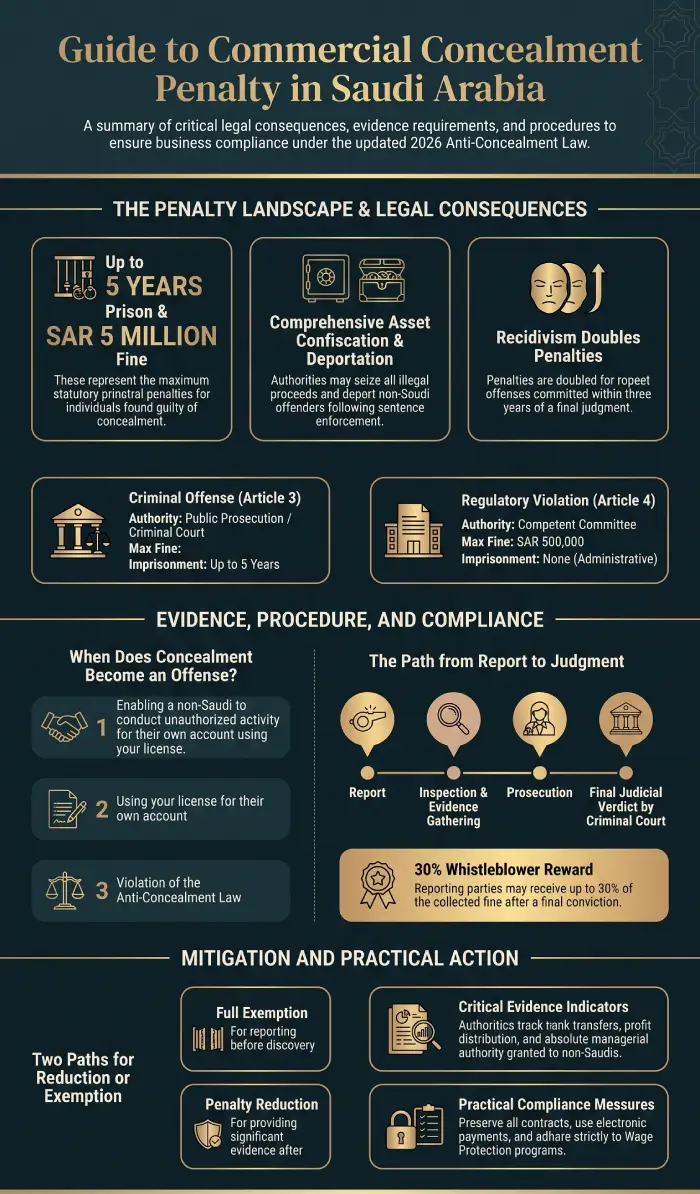
The penalty may reach five years’ imprisonment and a fine of up to SAR 5 million, or either of these penalties. A conviction may also result in confiscation, deportation of a non-Saudi offender, restrictions on commercial activity, and consequences affecting the establishment itself.
However, the presence of a non-Saudi manager or employee does not, by itself, establish commercial concealment. The legal assessment depends on the true nature of the relationship, who controls the business, how revenue and authority are managed, and what the available evidence actually proves.
Commercial Concealment Penalty in Saudi Arabia: Imprisonment and Fines
The commercial concealment penalty in Saudi Arabia may include imprisonment for up to five years and a fine of up to SAR 5 million, or either penalty.
When determining the appropriate sentence, the court may consider factors such as the size of the economic activity, its revenue, the duration of the unlawful conduct, and the consequences resulting from the offense.
For this reason, questions such as “how much is the commercial concealment fine?” or “how long is the prison sentence for commercial concealment?” do not have one fixed answer. Five years and SAR 5 million represent the statutory maximums rather than mandatory sentences in every case.
A conviction may also lead to confiscation of criminal proceeds, publication of a summary of the final judgment, deportation of a non-Saudi offender under the applicable rules, and consequences affecting the business establishment.
These criminal penalties should also be distinguished from violations under Article 4 of the Anti-Concealment Law, which are subject to a different framework and may result in a fine of up to SAR 500,000 and closure of the establishment for up to 90 days.
| Consequence | Maximum or Legal Effect |
|---|---|
| Imprisonment | Up to 5 years |
| Fine | Up to SAR 5 million |
| Confiscation | Proceeds of the offense, subject to the law |
| Commercial restriction | May extend to 5 years |
| Non-Saudi offender | Deportation after enforcement of the judgment and obligations |
What Is Commercial Concealment in Saudi Arabia?
Under the Saudi Anti-Concealment Law, concealment involves an agreement or arrangement enabling a non-Saudi person to conduct an economic activity in the Kingdom that they are not licensed to undertake, using the concealing party’s license or approval.
The offense arises when a person enables the non-Saudi party to conduct the activity for their own account, or when the non-Saudi person actually carries out that activity through the person who enabled them.
Criminal liability may also extend to a person who knowingly participates through incitement, assistance, or advice where the offense is committed or continues as a result.
A lawful foreign investment arrangement, however, is not commercial concealment merely because a foreign investor or non-Saudi manager is involved.
A foreign investor must be registered with the Ministry of Investment before carrying out investment activities and must then complete the required commercial registration, licenses, and approvals applicable to the activity.
Likewise, appointing a non-Saudi manager or granting ordinary operational authority does not automatically establish concealment. What matters is the actual structure of the activity, the parties’ legal status, the authority exercised, the destination of the profits, and compliance with the required registrations and licenses.
Commercial Concealment Offense vs. Anti-Concealment Violation
Saudi law distinguishes between criminal offenses under Article 3 and regulatory violations under Article 4 of the Anti-Concealment Law.
A commercial concealment offense primarily concerns enabling a non-Saudi person to conduct an unauthorized economic activity for their own account, or the non-Saudi person actually conducting that activity.
Regulatory violations cover other conduct, such as unlawfully giving a non-Saudi person tools or powers that allow unrestricted control over the establishment, unlawfully possessing such powers, or using a bank account that does not belong to the establishment for its business transactions.
| Comparison | Criminal Offense | Regulatory Violation |
|---|---|---|
| Legal basis | Article 3 | Article 4 |
| Investigation / decision | Public Prosecution and Criminal Court | Competent committee |
| Maximum penalty | 5 years and SAR 5 million | SAR 500,000 and closure up to 90 days |
| Challenge | Applicable judicial procedures | Administrative Court within 60 days |
This distinction is important when assessing commercial concealment indicators. A regulatory breach or poorly controlled managerial authority does not automatically establish the criminal offense.
The facts may ultimately reveal a criminal offense, but they may also remain within the scope of a regulatory violation. The conduct must therefore be classified correctly before determining the applicable penalty or legal response.
Elements of a Commercial Concealment Offense
The elements of commercial concealment begin with the act of enabling a non-Saudi person to undertake an economic activity that they are not licensed to conduct for their own account.
Enabling may involve the use of a name, commercial registration, license, approval, or another arrangement that produces the same practical result.
The other central element is the actual conduct of the activity by the non-Saudi person for their own account.
Liability may also extend to participation through incitement, assistance, or advice where the applicable statutory conditions, including knowledge, are established.
When assessing whether the elements are proven, the authorities may examine:
- The actual management structure.
- The source of business funding.
- Revenue flows and bank transactions.
- Financial and administrative authority.
- Contracts and commercial documents.
- Licenses and registrations.
- Correspondence between the parties.
- How profits are distributed.
A worker managing ordinary daily operations does not alone prove commercial concealment. Similarly, one bank transfer or a documented employment contract does not independently establish or disprove the offense.
The overall relationship and evidence must be considered together.
First-Time Commercial Concealment and Repeat Offenses
Saudi law does not prescribe a separate fixed sentence specifically described as a commercial concealment penalty for a first offense.
Instead, the general statutory limits apply according to the facts, the size and revenue of the activity, the duration of the conduct, and its consequences. It would therefore be inaccurate to assume that a first offense always results only in a fine or can never result in imprisonment.
A repeat offense is treated differently.
A person is considered a repeat offender when the statutory conditions for recidivism are satisfied, including committing an offense for which a final judgment is issued within three years from the previous final judgment.
When recidivism applies, the prescribed penalties may be doubled.
There is also no separate penalty simply because a person is the commercial registration holder or establishment owner. Liability depends on the conduct attributed to that person and whether their role in the offense is established.
Likewise, the commercial concealment penalty for a Saudi party depends on their proven role. A non-Saudi party may face the criminal penalties applicable to the offense, together with an additional consequence of deportation after enforcement of the judgment and satisfaction of the relevant fees, taxes, and obligations ordered by the court.
Confiscation and Consequences for the Establishment
A commercial concealment penalty may extend beyond imprisonment and fines to significant financial and business consequences.
Where a conviction concerns the principal concealment offenses involving enabling and unauthorized practice, the proceeds of the offense may be confiscated by judicial order, including where they are held by another person, subject to the protection of bona fide third-party rights.
If direct confiscation is not possible, or the criminal proceeds have been mixed with legitimate funds, other assets of equivalent value may be subject to confiscation under the applicable legal conditions.
A conviction for the relevant enabling offense may also result in dissolution of the establishment involved, cancellation of licenses and approvals, and cancellation of the convicted person’s commercial registration unless the Criminal Court decides otherwise.
The convicted person may also be prohibited from conducting the activity involved in the offense and from undertaking other commercial activities for five years from the date the judgment becomes final.
For a non-Saudi offender convicted of an Article 3 offense, deportation may follow after enforcement of the judgment and satisfaction of the relevant obligations.
Accordingly, the question of whether a foreign national is deported in a commercial concealment case depends on a conviction, not merely on a complaint or initial investigation.
How Is Commercial Concealment Proven?
Commercial concealment may be established using all legally recognized methods of proof, including electronic evidence.
Commercial concealment evidence may include bank statements, transfers, contracts, correspondence, commercial records, digital data, and evidence showing how the establishment is actually managed.
The implementing regulations also identify certain forms of unrestricted control that may require examination. These may include business revenue or profits being transferred to the non-Saudi person’s account, the non-Saudi party financing the establishment, exercising powers normally reserved for owners or partners, or holding signed blank documents in certain circumstances.
| Situation | Does It Alone Prove Concealment? |
|---|---|
| Appointing a non-Saudi manager | No |
| Granting defined operational authority | No |
| Business profits transferred to the person for their own account | Strong indicator requiring examination |
| Using another person’s registration to operate for one’s own account | May fall within the core offense if all elements exist |
| Properly registered foreign investment | Not concealment by itself |
The question of how commercial concealment is proven cannot therefore be answered by referring to a single indicator.
Bank transfers may have a legitimate documented explanation. Managerial authority may also be consistent with the person’s position.
By contrast, several financial and managerial indicators taken together may demonstrate actual control and operation of the business for the non-Saudi person’s own account.
The ultimate assessment depends on the complete evidence and legal characterization of the facts.
Commercial Concealment Case Procedures: From Report to Judgment
A commercial concealment case may begin with a report or with suspected conduct identified during regulatory inspections.
The Ministry of Commerce and other authorized authorities may then verify the facts and gather relevant information. The Public Prosecution is responsible for investigating and prosecuting criminal offenses, while the Criminal Court has jurisdiction to hear and decide those cases.
The Ministry may also request that the Public Prosecution impose a travel ban on a person suspected of committing an offense, subject to the statutory requirements.
A precautionary seizure may also be imposed over assets that could later become subject to confiscation for up to 60 days, with any extension requiring a judicial order.
| Stage | Main Authority | What Happens |
|---|---|---|
| Report and inspection | Ministry of Commerce | Verification and enforcement |
| Investigation | Public Prosecution | Evidence review, questioning and prosecution |
| Trial | Criminal Court | Determination of the offense |
| Article 4 violations | Competent committee | Administrative penalties |
| Challenge to violation decision | Administrative Court | Review within the statutory period |
An eligible whistleblower may receive a reward of up to 30% of the collected fine where the statutory requirements are satisfied and a final judgment or decision is issued.
A report itself does not establish guilt. It initiates verification, while a criminal conviction requires investigation and consideration of the evidence before the competent judicial authority.
Acquittal, Exemption and Reduction of the Commercial Concealment Penalty
Acquittal in a commercial concealment case depends on whether the elements of the offense are proven against the accused through sufficient evidence.
Relevant defenses may concern the absence of enabling conduct, the absence of activity carried out for the non-Saudi person’s own account, the existence of a lawful investment structure, weak connections between the evidence and the accused, or a legitimate explanation for financial and administrative transactions.
An employment contract or nominal supervision does not automatically establish a defense. Likewise, a single financial indicator should be examined within its factual context and alongside the rest of the evidence.
Legal defenses in commercial concealment cases should therefore be built on the actual documents and facts rather than general assumptions.
An exemption from the commercial concealment penalty is different from a reduction of the penalty.
The court may exempt a person who reports the offense or its perpetrators before the authorities discover it where the applicable conditions are met and the report contributes to identifying the offenders, funds, or proceeds.
A reduction may apply where, after the Ministry has become aware of the offense, the accused provides evidence or information that could not otherwise have been obtained and that is relied upon in proving the offense.
These routes should not be confused with the previous corrective period for commercial concealment cases. That program related to a transitional period and is not an open corrective route today.
What Should You Do If You Receive a Report or Summons?
If you receive a summons or become aware of a commercial concealment report, first identify your legal capacity and the current stage of the case before giving an unstructured explanation of the facts.
Preserve contracts, bank statements, correspondence, commercial records, authority documents, and any records explaining transfers or the relationship between the parties. Do not alter or dispose of relevant data, because the integrity of the records may become important during the investigation.
You should also review who actually managed the activity, who controlled contracting and transfers, how profits were distributed, and whether any foreign investment or licensing requirements were properly completed.
Where the matter concerns a business or commercial activity, consulting a commercial lawyer in Jeddah may help clarify the documents, procedural stage, and available legal options before the next step is taken.
Frequently Asked Questions About Commercial Concealment Penalties
What is the commercial concealment penalty in Saudi Arabia?
It may reach five years’ imprisonment and a SAR 5 million fine, or either penalty, with additional consequences depending on the judgment.
How much is the commercial concealment fine?
The maximum fine for the criminal offense is SAR 5 million. The court determines the actual amount based on the circumstances.
How long is the prison sentence for commercial concealment?
The statutory maximum is five years. This does not mean every convicted person receives the maximum sentence.
What is the commercial concealment penalty for a first offense?
There is no separate fixed penalty for a first offense. The general statutory limits apply according to the facts and judicial assessment.
What is the penalty for a Saudi concealing party?
The prescribed penalties apply where enabling or participation in the offense is established under the Anti-Concealment Law.
What is the penalty for a non-Saudi concealed party?
Criminal penalties may apply upon conviction, together with deportation in accordance with the applicable legal requirements.
Is a foreign national deported in a commercial concealment case?
Deportation follows a qualifying conviction, not merely a report, suspicion, or initial investigation.
Do bank transfers prove commercial concealment?
They may constitute evidence or an indicator, but they must be assessed with the remaining facts and do not automatically establish the offense alone.
When can the commercial concealment penalty be doubled?
The penalty may be doubled where the legal conditions for a repeat offense are satisfied.
Can a person be exempted from the penalty?
An exemption may be available where the statutory reporting, cooperation, timing, and evidentiary requirements are satisfied.
Commercial Concealment Penalty: 5 Saudi Consequences captures the seriousness of the offense, but the outcome of any case depends on more than the statutory maximum sentence.
The legal assessment turns on whether enabling and unauthorized practice are established, the role of each party, the financial and electronic evidence, and whether that evidence satisfies the elements of the offense. A conviction may lead to imprisonment, fines, confiscation, deportation of a non-Saudi offender, commercial restrictions, and direct consequences for the establishment.
For business owners, clearly documented authority, banking arrangements, contracts, and investment registrations can reduce uncertainty and make the true nature of the business relationship easier to demonstrate. Where a report or investigation already exists, early review of the documents may help identify the relevant evidence and available legal options without making assumptions about the outcome.
BMS Legal operates as a law firm in Jeddah with an approach centered on understanding the facts first, then explaining the available legal route, options, and procedural steps before action is taken.
Legal Sources: