
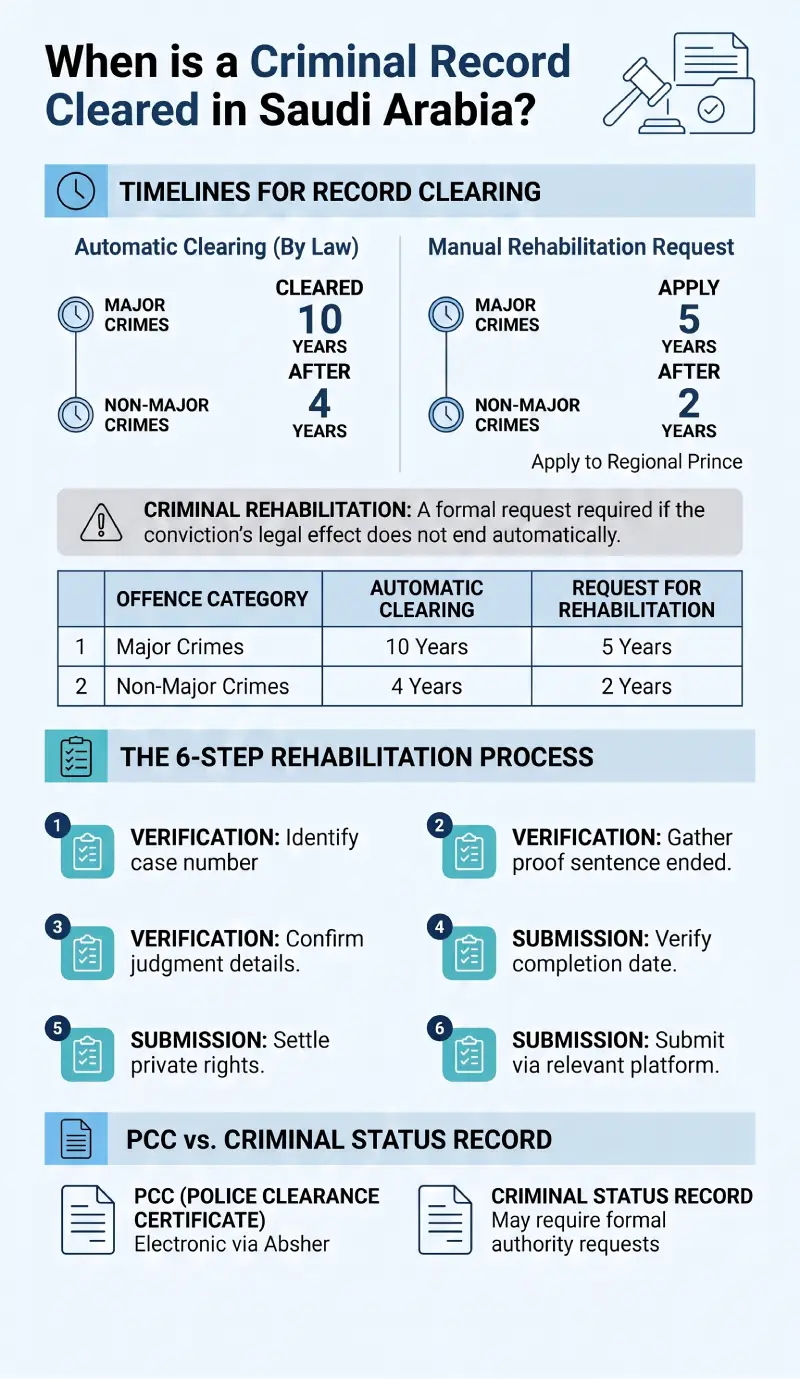
A common question is: when is a criminal record cleared in Saudi Arabia? Legally, however, the more precise questions are when the effects of a criminal conviction cease and when criminal rehabilitation is required.
If you are searching for criminal record clearance in Saudi Arabia, you are probably looking for a practical answer. Has the effect of a previous conviction actually ended? Do you need to apply for criminal rehabilitation? And can you obtain a police clearance certificate?
That distinction matters because completing a sentence does not necessarily mean that every legal or practical consequence of the conviction disappears immediately.
Quick Answer: When Is a Criminal Record Cleared in Saudi Arabia?
There is no single period that applies to criminal record clearance in Saudi Arabia in every case. In some circumstances, the legal effect may cease after the applicable period has passed. In others, the person may need to apply formally for criminal rehabilitation.
| Situation | Practical Result |
|---|---|
| Effect ceases after the applicable statutory period | A separate procedure may not be necessary if all relevant conditions have been met |
| Rehabilitation requires a formal application | A criminal rehabilitation application must be submitted |
| A document is required to prove current status | First determine whether you need a police clearance certificate or a criminal status record |
For that reason, asking only “how many years until a criminal record is cleared?” is not enough.
You should first determine:
- Whether a final conviction exists.
- When the sentence was fully executed or otherwise ended.
- What type of offence was involved.
- Whether you currently need proof of status, criminal rehabilitation, or a document for employment or licensing purposes.
What Is Meant by a Criminal Record?
When asking about criminal record clearance in Saudi Arabia, people are usually not referring merely to the fact that an old criminal case once existed. They are concerned about a continuing practical consequence that still appears on a record or may affect employment, licensing, or another legal matter.
It is therefore important to distinguish between:
- The criminal case.
- The judgment or conviction.
- The practical consequences arising after the judgment.
In practice, the criminal record that usually causes concern is linked to a final criminal conviction and its continuing effects.
An investigation, summons, or decision to close a case does not automatically produce the same result. It is therefore incorrect to treat “I once had a criminal case” as equivalent to “I currently have an active criminal conviction affecting my record.”
The role of a lawyer in criminal cases becomes particularly important when reviewing the judgment and determining whether the current issue arises from the conviction itself or from an earlier procedural stage.
When Is a Criminal Record Registered and When Is It Not?
Not every old criminal file means that a criminal record continues to have legal consequences today. Similarly, not every old judgment produces the same result before every government authority, employer, or licensing body.
It is therefore important to distinguish between different types of criminal cases from the outset. The nature of the offence and its final legal classification may affect both the consequences of the judgment and the correct assessment of whether those consequences remain in effect.
If a case ends in acquittal or is closed without a conviction, it should not be treated as equivalent to a final judgment of conviction.
Where a final conviction exists, the next question should not simply be whether several years have passed. Instead, the relevant questions are whether the legal effect has ended in the particular circumstances and whether an application for criminal rehabilitation is required.
Key Factors That Can Change the Outcome
The practical outcome depends on several factors, particularly the classification of the offence in the final judgment, the circumstances of the case, the date on which the sentence was completed, and whether any private rights or civil obligations remain unresolved.
In some cases, the general description of the offence is not enough. A more detailed review by a criminal lawyer may be necessary to connect the wording of the judgment with its current legal and practical consequences.
The most important factors include:
- The classification of the offence in the final judgment.
- Whether the particular case falls within a category carrying lighter or more serious continuing consequences.
- The date on which the sentence was completed or otherwise ceased to be enforceable in the applicable circumstances.
- Whether private rights or civil obligations remain outstanding.
- Whether a special law applies to a particular occupation, licence, profession, or sensitive position.
Two individuals may therefore describe their cases using the same general term, while the legal result is substantially different once the judgment, enforcement history, and required document are examined.
When Does the Effect of a Criminal Record Actually End?
The more precise question is not simply when a criminal record is deleted, but when the legal effect of a criminal record actually ceases.
In some cases, the effect may cease after the applicable period has passed. In others, a formal application for criminal rehabilitation may be necessary.
Understanding where the judgment falls within the overall criminal process also helps distinguish between the end of criminal proceedings and the end of the judgment’s continuing consequences. This distinction is easier to understand when reviewing the stages of a criminal case before the Criminal Court, from the initial report through to the final judgment.
The following table illustrates the distinction:
| Question | General Answer |
|---|---|
| The sentence has ended. Has every consequence ended? | Not necessarily |
| Is the passage of time alone sufficient? | In some cases |
| Do I need criminal rehabilitation? | In some cases, yes |
| Do all authorities treat the result in the same way? | No |
Criminal Rehabilitation in Saudi Arabia: The Practical Route to Removing the Effect of a Conviction
Understanding criminal record clearance in Saudi Arabia also requires understanding criminal rehabilitation.
Criminal rehabilitation is not merely an ordinary letter or the automatic consequence of time passing. It is a formal legal process in which matters such as the judgment, execution of the sentence, subsequent conduct, and outstanding civil obligations may need to be considered.
Before submitting an application, the following issues should be reviewed carefully:
- Has the required period applicable to your case passed?
- Do you have evidence showing that the sentence has been fully executed or otherwise completed?
- Does any private right or civil obligation remain outstanding?
- Has another offence been committed after the previous conviction?
- Is the offence governed by a special legal regime?
Consulting a criminal lawyer may also be relevant when examining the requirements for a valid confession in criminal cases if the previous conviction was materially affected by this type of evidence.
Infographic: Criminal Record Clearance in Saudi Arabia
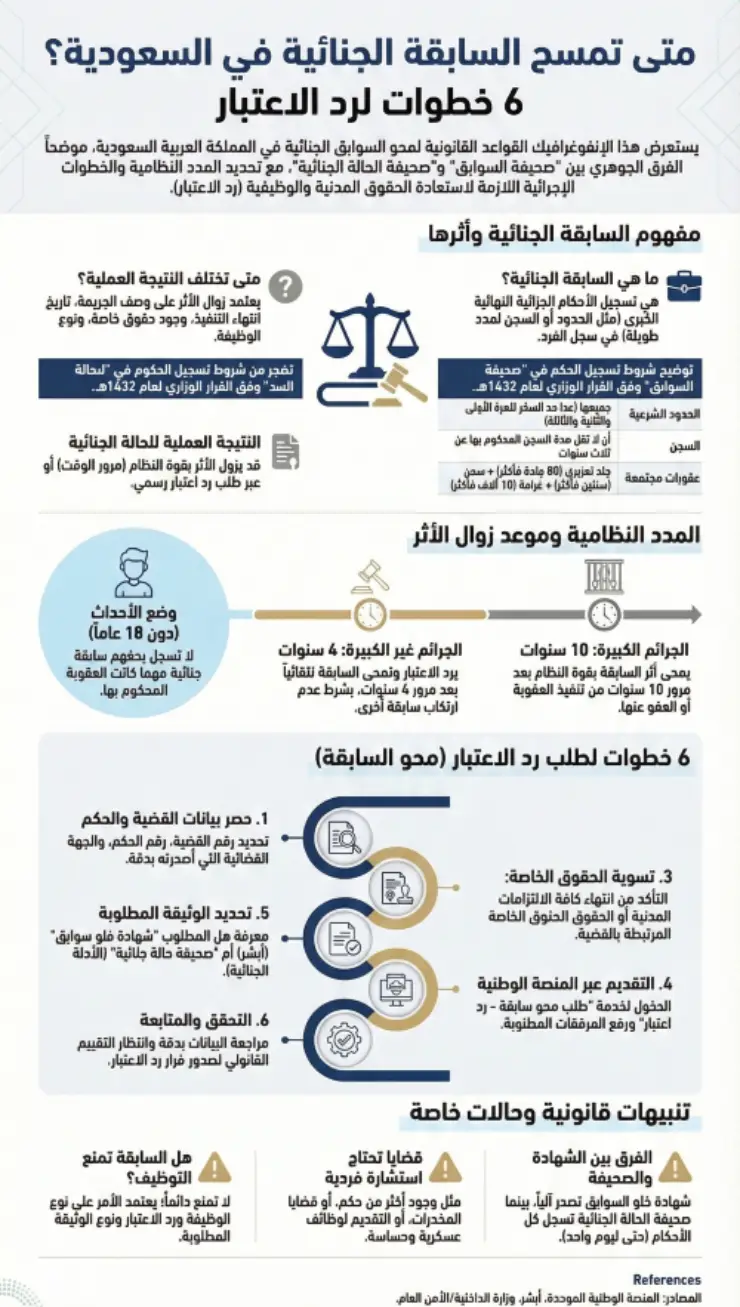
How to Apply for Criminal Rehabilitation Step by Step
If your circumstances require a formal application for criminal rehabilitation, the following sequence provides a practical starting point:
- Identify the criminal case number and judgment number.
- Identify the court or authority that issued the judgment.
- Gather evidence showing that the sentence was executed or completed.
- Confirm the exact date on which execution of the sentence ended.
- Review whether any private right or civil obligation connected to the judgment remains outstanding.
- Access the relevant criminal record clearance or rehabilitation service through the Saudi National Platform and verify the information and supporting documents required.
These steps become particularly important where the judgment is still subject to legal review or where a previous or existing remedy may be connected to an appeal against a Criminal Court judgment.
What Is the Difference Between a Police Clearance Certificate and a Criminal Status Record?
This distinction is particularly important because many questions about criminal record clearance in Saudi Arabia are actually questions about which document is required.
A police clearance certificate can be issued electronically through Absher. The service allows eligible users to issue, view, and print the certificate.
A criminal status record request follows a different procedure and may require a letter from the requesting authority, attendance at the relevant police department, and procedures involving criminal evidence authorities.
The two documents should therefore not be confused:
- Police clearance certificate: issued through Absher.
- Criminal status record: generally requires documentation from the requesting authority.
- The specific document requested determines the next procedural step.
If an employer asks you for a criminal-record-related document, first determine whether the requirement is a Saudi police clearance certificate or a criminal status record.
People also sometimes confuse the end of the criminal case itself with the end of the consequences of a conviction, although these are separate issues.
A criminal case may terminate for a legal or procedural reason that is entirely different from a final conviction. This is why it is important to distinguish criminal records from issues involving the limitation or expiry of criminal proceedings, which may bring proceedings to an end before the case reaches the outcome commonly assumed by the public.
Does a Criminal Record Prevent Employment in Saudi Arabia?
There is no single answer that applies to every job in Saudi Arabia.
Some civilian employers focus on the specific document required and conditions relating to good conduct. Military, security, regulated, and other sensitive positions may apply stricter requirements.
You should therefore avoid relying on a broad statement such as “a criminal record always prevents employment” or “a conviction no longer matters after a certain number of years.”
Instead, review:
- The type of employment, profession, or licence.
- The legal classification of the offence.
- Whether criminal rehabilitation has been granted or otherwise applies.
- The document requested by the employer or authority.
- Whether a special law or regulation governs that position.
In some sectors, eligibility requirements include good conduct and the absence of convictions for offences involving dishonesty, honour, or trust, while certain regulatory frameworks may expressly take criminal rehabilitation into account.
If you have an existing criminal case or a previous conviction and need to assess its impact on employment or licensing, you may consult a Jeddah lawyer experienced in criminal matters.
Special Cases Requiring Additional Attention
Some cases cannot be assessed reliably through a short general answer. These include:
- Drug offences: Certain laws and regulations may impose specific consequences in relation to licences, admission, employment, or eligibility, while criminal rehabilitation may be recognised in particular circumstances. Cases in this category often require a more detailed review by a drug crimes lawyer who can assess the precise legal classification of the offence and its practical consequences rather than relying on general information.
- Juvenile cases: Cases involving juveniles are governed by a specific legal framework and should not automatically be assessed in the same way as cases involving adults.
- Offences involving honour, integrity, or trust: This classification may materially affect employment, professional memberships, appointments, or licensing.
- Non-criminal matters: Not every dispute, violation, administrative penalty, or regulatory procedure constitutes a criminal record.
When Do You Need an Individual Legal Assessment?
A case-specific legal assessment may be appropriate where:
- You have more than one criminal judgment.
- You do not know the exact date on which the sentence was completed.
- A private right remains unresolved or its settlement has not been formally documented.
- The case affects military employment or a sensitive professional licence.
- The requesting authority requires a criminal status record rather than a police clearance certificate.
- The incident occurred before you turned 18.
- The current legal classification of the offence is unclear to you.
These issues are different from the existence of the conviction itself. This distinction can also be seen when considering personal appearance bail in criminal cases and the limits of its effect compared with a final criminal judgment.
What Should You Do Now?
If you need a practical answer regarding criminal record clearance in Saudi Arabia, start with the following:
- Confirm whether a final criminal conviction exists.
- Determine the exact date on which the sentence was completed.
- Check whether any private right remains unresolved.
- Identify the exact document being requested from you.
- Determine whether your case requires waiting for an applicable period or submitting an application for criminal rehabilitation.
Frequently Asked Questions About Criminal Record Clearance in Saudi Arabia
1. When is a criminal record cleared in Saudi Arabia?
There is no single period for every case. The outcome depends on the final judgment, the offence, sentence completion, and whether criminal rehabilitation is required.
2. Does completing a sentence automatically clear a criminal record?
Not always. Completing the sentence does not necessarily end every legal or practical effect of the conviction.
3. What is criminal rehabilitation in Saudi Arabia?
Criminal rehabilitation is a formal legal process that may remove or limit the continuing effects of a previous conviction when the applicable conditions are met.
4. How do I apply for criminal rehabilitation?
You generally need the case and judgment details, proof that the sentence ended, the completion date, and information about any outstanding private rights or obligations.
5. What is the difference between a police clearance certificate and a criminal status record?
A police clearance certificate can generally be issued electronically through Absher, while a criminal status record follows a different procedure and may require a request from the relevant authority.
6. Does a criminal record prevent employment in Saudi Arabia?
Not in every case. The effect depends on the job, offence, required document, rehabilitation status, and any special rules governing the position.
7. Does an acquittal create a criminal record?
An acquittal should not be treated in the same way as a final criminal conviction when assessing the effects of a criminal record.
8. Can a previous criminal record affect professional licences?
Yes, in some sectors. The effect depends on the type of licence, the offence, applicable regulations, and whether criminal rehabilitation has been granted.
This guide has provided a practical answer to the question: When is a criminal record cleared in Saudi Arabia? 6 steps to criminal rehabilitation. It has also explained how to determine whether a previous conviction may still affect a police clearance certificate, employment opportunity, licence, or other legal requirement.
You may contact a law office or a licensed law firm in Jeddah and provide the type of case and the date on which the sentence was completed so the circumstances can be reviewed in relation to criminal rehabilitation or obtaining the relevant clearance document.
Official References: