
Article 84 of Saudi Labor Law establishes the basic formula for calculating an employee’s end-of-service benefit when the employment relationship ends in Saudi Arabia. The calculation depends primarily on the employee’s length of service and final wage, while the reason for termination may affect the amount ultimately payable.
Knowing the employee’s salary and years of service alone is therefore not always enough to determine the correct entitlement. The wage components, complete service period, manner in which employment ended, and any provisions governing resignation or dismissal must also be considered.
This guide explains the calculation method, the wage used for the calculation, the effect of resignation and dismissal, payment deadlines, and the available route when a dispute arises.
Article 84 of Saudi Labor Law in Brief: How Is the Benefit Calculated?
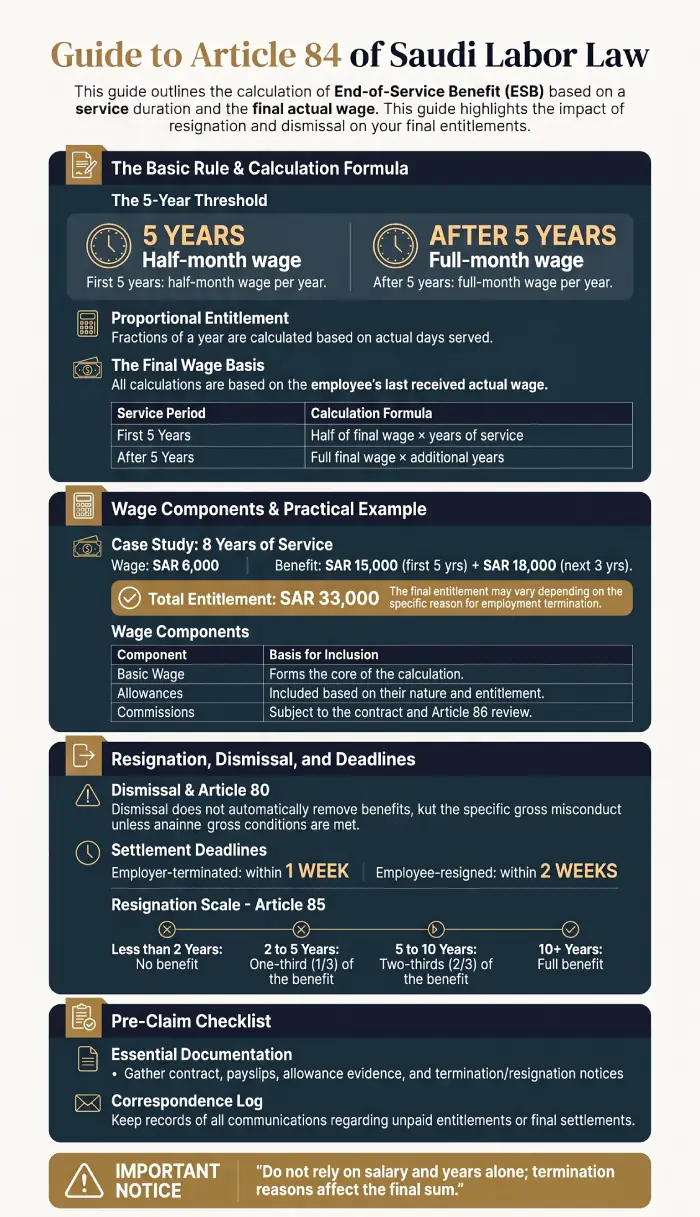
Quick answer: An employee’s end-of-service benefit is calculated at half a month’s wage for each of the first five years of service. For every subsequent year, the calculation increases to one full month’s wage, using the employee’s final wage as the basis.
An employee is also entitled to a proportionate benefit for any fraction of a year worked. The calculation is therefore not limited to completed years of service.
Article 84 determines the basic value of the benefit, but other provisions may affect the employee’s final entitlement depending on how the employment relationship ended.
For resignation, Article 85 provides specific entitlement percentages based on length of service. Dismissal may require consideration of Article 80 and its conditions, while Article 88 governs the period within which the employer must settle wages and other employment rights.
What Does Article 84 of Saudi Labor Law Provide?
The rule under Article 84 of Saudi Labor Law is built around three main elements: the employee’s length of service, final wage, and any fraction of a year worked.
Together, these elements determine the initial formula used to calculate the end-of-service benefit when the employment relationship comes to an end.
What Does Article 84 Mean in Practice?
For the first five years of service, the employee receives an amount equivalent to half a month’s wage for each qualifying year.
For every year after the first five years, the calculation increases to one full month’s wage for each additional year of service.
Fractions of a year are also included proportionately. For example, if an employee has worked for seven years and six months, the additional six months are not disregarded simply because another full year was not completed.
However, the calculation under Article 84 should be distinguished from the percentage of that benefit which may ultimately be payable after considering the reason employment ended.
The provision therefore operates alongside other Saudi Labor Law provisions, particularly Articles 80, 81, 85, 86, 87, and 88.
These rules form part of the wider framework governing employment termination, wages, and employee entitlements under the Saudi Labor Law.
How to Calculate End-of-Service Benefits Under Article 84
An end-of-service benefit calculation starts by identifying the employee’s final wage and complete period of service. The service period is then divided into two stages under Article 84.
The first five years are calculated separately, after which the value of any subsequent years and fractions of a year is added.
Calculation for the First Five Years and Beyond
For the first five years, the basic formula is:
Half of the final monthly wage × number of years of service within the first five years
If the employee’s final wage is SAR 6,000 and the employee has completed four years of service:
SAR 3,000 × 4 = SAR 12,000
If the same employee instead completed eight years of service, the calculation would be divided into two stages:
- First five years: SAR 3,000 × 5 = SAR 15,000
- Following three years: SAR 6,000 × 3 = SAR 18,000
- Calculated benefit: SAR 33,000
This amount represents the basic benefit calculated under Article 84 before examining whether the reason for termination affects the employee’s final entitlement.
Calculating Months and Fractions of a Year
Fractions of a year are included proportionately when calculating end-of-service benefits in Saudi Arabia.
If an employee has completed seven years and six months of service, the calculation does not stop at the end of the seventh year.
For example, where the final wage is SAR 8,000 and the employee worked for seven years and six months:
- First five years: SAR 20,000
- Following two years: SAR 16,000
- Additional six months: SAR 4,000
- Total calculated benefit: SAR 40,000
An end-of-service benefit calculator may provide an initial estimate, but a dispute may require closer examination of the wage, length of service, and reason employment ended.
Is the Benefit Calculated on Basic Salary or Actual Wage?
Whether the benefit is calculated on basic salary or a broader wage amount depends on the components that legally form part of the employee’s wage.
Article 84 uses the employee’s final wage as the basis for calculation, while the Saudi Labor Law separately defines basic wage and actual wage.
Are Allowances and Commissions Included?
Actual wage includes basic wage together with other increases that satisfy the applicable statutory or contractual conditions.
Accordingly, relying automatically on basic salary alone may not produce the correct result in every end-of-service benefit calculation.
At the same time, the appearance of an amount on a payslip does not necessarily mean that it must always be included. Its nature, source, and entitlement conditions should first be reviewed.
Article 86 also allows the parties to agree that some or all commissions, percentages, and wage components that are inherently variable may be excluded from the basis used to settle the benefit.
| Wage component | What should be reviewed? |
|---|---|
| Basic wage | Forms the core of the wage |
| Allowances | Nature and basis of entitlement |
| Commission | Employment contract and Article 86 |
| Bonuses | Conditions and regularity of entitlement |
| Benefits in kind | Contract and nature of the benefit |
If the employer has calculated the benefit using an amount different from the employee’s actual remuneration, the employment contract, payslips, and relevant wage components should be reviewed before challenging the calculation.
When Is an Employee Entitled to an End-of-Service Benefit?
An end-of-service benefit is connected to the termination of the employment relationship, but the way employment ends may affect the final amount payable after the Article 84 formula has been applied.
It is therefore necessary to determine whether the contract expired, was not renewed, ended through resignation, or was terminated by the employer.
Non-renewal of an employment contract is not automatically treated as resignation. Likewise, the fact that a contract is indefinite does not by itself remove the employee’s entitlement to an end-of-service benefit.
Each situation should be classified according to the actual reason the employment relationship ended before applying provisions concerning benefits or possible compensation.
For further details on terminating indefinite-term employment contracts, see Article 75 of Saudi Labor Law.
Article 84 and Resignation: How Does Article 85 Differ?
Article 84 determines the basic value of the benefit. Article 85, by contrast, determines the percentage payable where the employment relationship ends because the employee resigns.
Accordingly, calculating an end-of-service benefit following resignation generally starts with the Article 84 formula before applying the relevant percentage under Article 85.
| Length of service at resignation | Entitlement |
|---|---|
| Less than two years | The one-third entitlement threshold is not met |
| Two to five years | One-third of the benefit |
| More than five but less than ten years | Two-thirds of the benefit |
| Ten years or more | Full benefit |
There are statutory exceptions to these percentages in specific circumstances governed by Article 87, so Article 85 should not be applied in isolation.
The Saudi Labor Law also regulates the submission and acceptance of resignation requests, the relevant response period, and continuation of the employment contract during that process.
Does a Dismissed Employee Receive an End-of-Service Benefit?
The fact that employment ended through dismissal does not automatically mean that the employee loses the end-of-service benefit.
The legal result depends on the reason for termination and the statutory basis relied upon by the employer. This distinction is particularly important when Article 80 of Saudi Labor Law is invoked.
Article 80 permits termination without an end-of-service benefit, notice, or compensation in specifically defined circumstances, subject to the statutory conditions being satisfied.
The employee must also be given an opportunity to state the reasons for objecting to the termination. The facts and supporting documents should therefore be reviewed before concluding that Article 80 validly applies.
Conversely, Article 81 of Saudi Labor Law allows an employee to leave employment without notice while retaining statutory rights in certain specified situations.
Application of Article 81 does not automatically establish unfair termination or a separate compensation claim. Each claimed right must have its own legal and factual basis.
When Must the End-of-Service Benefit Be Paid?
Article 88 governs the deadline for settling wages and employment rights after the employment relationship ends.
If the employer terminates the employment relationship, the employee’s wages and entitlements must be settled within no more than one week from the termination date.
If the employee is the party ending the contract, the employer must settle the employee’s entitlements within no more than two weeks.
The employer may deduct a debt owed by the employee arising from employment from the employee’s final entitlements, subject to the applicable rules.
Missing these deadlines does not automatically create a separate entitlement to additional compensation. It may, however, lead to a dispute concerning unpaid employment entitlements.
What If the Employer Does Not Pay the Benefit?
Before making a claim, review the end-of-service entitlement calculation and the documents affecting the amount claimed.
The employee should confirm the length of service, wage used in the calculation, reason employment ended, and any applicable percentage where resignation is involved.
Relevant documents may include:
- Employment contract and amendments.
- Payslips.
- Evidence of allowances and commissions.
- Termination or non-renewal notice.
- Resignation request, where applicable.
- Proposed final settlement or release.
- Correspondence concerning unpaid entitlements.
Employment disputes generally begin through the amicable settlement process, where the parties are given an opportunity to resolve the dispute before litigation proceeds.
If settlement is unsuccessful, the dispute may proceed before the Saudi labor court in accordance with the applicable procedures.
Where the dispute concerns the amount of the benefit, the reason employment ended, or the wage used in the calculation, consulting an employment lawyer in Jeddah may help identify the relevant claim elements and supporting documents before proceedings begin.
Common Mistakes When Applying Article 84
Errors often arise when the Article 84 formula is used without considering the reason employment ended, the wage components, or the employee’s complete service period.
Common mistakes include:
- Calculating one full month’s wage for every year from the start of employment.
- Ignoring months and other fractions of a year.
- Automatically relying on basic salary without reviewing wage components.
- Automatically including every allowance or commission without examination.
- Applying Article 85 to situations that are not resignations.
- Assuming every dismissal automatically removes the employee’s benefit.
- Confusing end-of-service benefits with compensation for termination.
- Signing a final settlement before reviewing the amounts and rights covered.
Frequently Asked Questions About Article 84 of Saudi Labor Law
ماذا تنص المادة 84 من نظام العمل السعودي؟
تحدد طريقة حساب مكافأة نهاية الخدمة وفق مدة العمل والأجر الأخير، مع احتساب أجزاء السنة بنسبة المدة الفعلية.
كيف تحسب مكافأة نهاية الخدمة؟
يحسب نصف أجر شهر عن كل سنة من أول خمس سنوات، ثم أجر شهر كامل عن كل سنة تالية.
هل تحسب المكافأة على الراتب الأساسي فقط؟
ليس دائماً؛ يجب تحديد الأجر وعناصره وفق النظام والعقد وطبيعة البدلات والعمولات المستحقة في حالة العامل.
هل الأشهر تدخل في حساب نهاية الخدمة؟
نعم، يستحق العامل عن أجزاء السنة بنسبة المدة التي قضاها في العمل وفق القاعدة المقررة بالمادة 84.
هل المستقيل يستحق مكافأة نهاية الخدمة؟
نعم وفق نسب المادة 85 المرتبطة بمدة الخدمة، مع مراعاة الحالات والاستثناءات الأخرى التي يقررها نظام العمل.
ما الفرق بين المادة 84 والمادة 85؟
المادة 84 تحدد معادلة المكافأة، بينما تحدد المادة 85 نسبة استحقاق العامل عندما تنتهي العلاقة بسبب الاستقالة.
هل الفصل بالمادة 80 يسقط المكافأة؟
تجيز المادة 80 الفسخ دون مكافأة في الحالات المحددة نظاماً، بشرط تحقق الحالة والشروط المرتبطة بتطبيقها.
هل عدم تجديد العقد يعتبر استقالة؟
لا يعد عدم التجديد استقالة تلقائياً، ويجب تحديد نوع العقد وسبب الانتهاء قبل حساب المستحقات النهائية للعامل.
كم مدة صرف مكافأة نهاية الخدمة؟
أسبوع إذا أنهى صاحب العمل العلاقة، وبحد أقصى أسبوعين إذا كان العامل هو الطرف الذي أنهى العقد.
ماذا أفعل إذا لم تدفع الشركة المكافأة؟
راجع الحساب والمستندات أولًا، ثم يمكن بدء المطالبة عبر التسوية الودية واستكمالها أمام المحكمة العمالية عند تعذر الصلح.
Article 84 of Saudi Labor Law: 7 Rules for Calculating End-of-Service Benefits is more than a mathematical formula. The correct result depends on seven connected factors: length of service, the first five years, subsequent years, fractions of a year, final wage, reason for termination, and the applicable settlement deadline.
The employment contract, wage records, and supporting documents should therefore be reviewed before accepting a final calculation or signing a release concerning end-of-service benefits.
Where a dispute arises over the applicable wage, service period, or reason for termination, the circumstances can be assessed before a claim or court proceeding is initiated.
At a law firm in Jeddah such as BMS Legal, employment disputes are assessed by reviewing the facts, documents, and available legal options before selecting the appropriate course of action.
Legal Sources: