
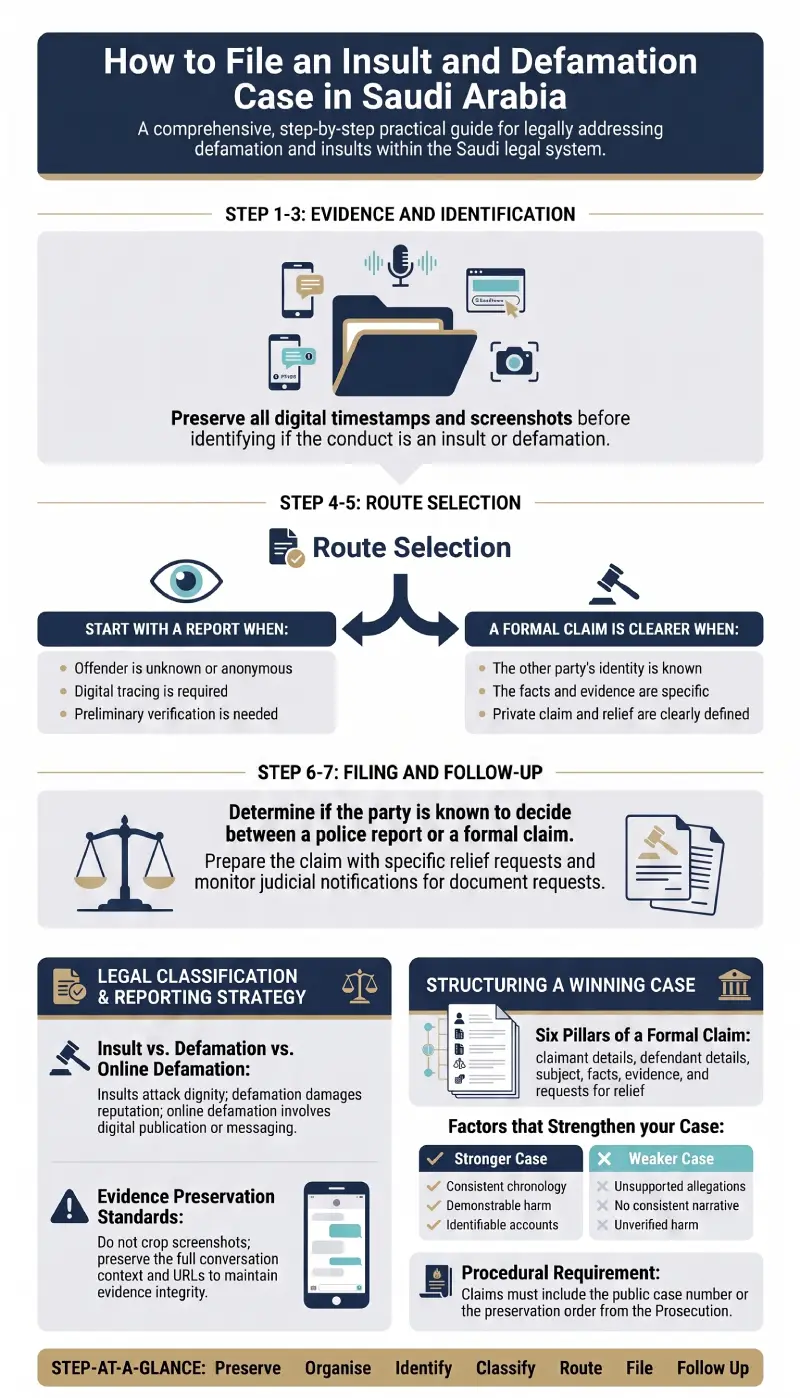
How to File an Insult and Defamation Case in Saudi Arabia starts with preserving the evidence, understanding the nature of the offending conduct, and choosing the appropriate legal route for the circumstances.
Some cases may begin with a report to the competent authority, while others may be more appropriately presented through a formal claim. In certain situations, an initial legal assessment is necessary to determine whether the conduct involves a direct insult, a defamatory accusation, or conduct falling within cybercrime and online defamation because it was committed through a digital platform or electronic means.
A strong case therefore depends on more than the offensive nature of the statement. The facts should be presented clearly, connected to supporting evidence, and accompanied by appropriate legal requests in an organised manner.
Quick Answer: How to File an Insult and Defamation Case
If you need to know How to File an Insult and Defamation Case, the practical process generally begins with preserving the evidence, identifying the nature of the offending conduct, arranging the facts chronologically, and determining the appropriate legal route.
Following this order can strengthen the presentation of the case and reduce avoidable procedural mistakes.
The main practical steps are:
- Preserve messages, recordings, screenshots, images, and links immediately.
- Determine whether the conduct involves an insult, defamatory accusation, or online defamation.
- Arrange the events chronologically, including dates, platforms, and surrounding context.
- Determine whether the other party is known or using an anonymous account.
- Assess whether the matter should begin with a report or a formal claim.
- Present the facts, evidence, and requested relief clearly.
- Follow all notifications and requests for additional documents.
| Step | What Should You Do? | Why Does It Matter? |
|---|---|---|
| Preserve the evidence | Save screenshots, recordings, links, and account details | Content may later be deleted or altered |
| Identify the conduct | Distinguish between insult, defamation, and online publication | Classification may affect the legal route |
| Organise the facts | Record when, where, how, and by whom | A clear chronology makes the case easier to assess |
| Identify the person | Determine whether the person is known or anonymous | This may change the appropriate starting point |
| Choose the route | Report or formal claim | Helps reduce procedural mistakes |
| Draft clearly | Present the facts, evidence, and requests | Clear drafting strengthens the presentation |
- Explains the difference between insult, defamation, and online defamation.
- Highlights the practical importance of preserving complete evidence.
- Clarifies when a case may start with a report and when a formal claim may be more suitable.
- Presents the topic in a structured and reader-friendly legal format.
When Is Conduct an Insult, Defamation, or Online Defamation?
Before deciding How to File an Insult and Defamation Case, it is important to understand the nature of the conduct involved. Not every offensive statement has the same legal character, and different forms of harmful speech may require different treatment.
An insult generally involves language directed at a person’s dignity, personal respect, or standing. A defamatory accusation may involve attributing serious conduct or allegations to another person in a manner capable of harming reputation, honour, or social standing.
Where the statement is communicated through messaging applications, social media, websites, or digital accounts, additional issues may arise concerning electronic publication, reputational harm, and whether the material was made available to third parties.
The practical assessment should therefore consider:
- What exactly was said or published?
- Where did the statement appear?
- How was it communicated?
- Was it private or accessible to others?
- Was the content circulated or shared?
- Did identifiable harm result?
Where the material was published to third parties or circulated more widely, reviewing the steps for filing a defamation claim in Saudi Arabia may help clarify the procedure for that form of dispute.
Electronic publication can also affect how the conduct is assessed. A statement published publicly, circulated through a digital platform, or shared with other users may raise considerations that differ from a private exchange.
For additional context, see the penalties for defamation in Saudi Arabia and how electronic publication may affect the legal assessment of the incident.
Why Does the Legal Classification Matter?
Correct classification helps determine how the case should be presented from the outset.
If the conduct is described inaccurately, the requested relief may become unclear, the evidence may be presented in the wrong context, or the claimant may begin through a less appropriate procedural route.
The important question is therefore not simply whether the statement caused offence. The issue is which legal description most closely corresponds to what actually occurred.
What Makes an Insult or Defamation Claim Stronger?
A successful claim is not based on anger or personal distress alone. It depends on whether the underlying facts can be identified, supported, and presented coherently.
Important practical factors may include:
- A specific and identifiable incident.
- A known individual or reliable indications linking an account to its operator.
- One or more pieces of supporting evidence.
- A consistent description of the conduct.
- An identifiable effect on reputation, employment, family relationships, social standing, or other interests.
- Requests that reasonably correspond to the facts and available evidence.
A case may become more difficult where the evidence is incomplete, screenshots have been heavily cropped, the claimant responded with similar abusive language, or substantial relief is requested without evidence supporting the alleged harm.
Early assessment is particularly important where the incident occurred online, involved an anonymous account, or resulted in wider publication beyond a private communication.
When Is a Claim Stronger, and When Can It Become Weaker?
A claim is generally stronger where there is:
- A clear and specific incident.
- A known party or strong evidence identifying the account owner.
- Consistent supporting evidence.
- An appropriate legal description.
- Reasonable requests directly connected to what occurred.
A claim may become weaker where there are:
- Incomplete or unclear screenshots.
- Confusion between insult, defamatory statements, and public defamation.
- Reciprocal abusive statements.
- Lengthy allegations without precise facts.
- Significant compensation requests without clear evidence of harm.
Evidence: How Do You Prove Insult and Defamation?
Evidence is central when determining How to File an Insult and Defamation Case effectively.
The practical issue is not simply whether you believe you were insulted or defamed. The question is whether the conduct can be demonstrated through reliable and organised evidence.
Common forms of evidence may include:
- Text conversations.
- Voice messages or recordings.
- Screenshots.
- Links to published content.
- Images.
- Account names and usernames.
- Telephone numbers.
- Dates and timestamps.
- Other material supporting the identity of the person involved and the context of the communication.
WhatsApp messages, for example, may be useful where the conversation is preserved clearly and shows the relevant number or account together with the surrounding context.
Recordings may also be relevant where they are clear, directly connected to the incident, and capable of being linked to the other party or supported by additional evidence.
Depending on the circumstances, related evidentiary questions may also arise concerning the requirements for a valid confession in criminal cases.
Witness evidence may assist in verbal or public incidents, although witnesses will not necessarily be required in every case involving electronic communications.
How Should You Preserve the Evidence?
The following practical steps can help preserve evidence more effectively:
- Capture the complete conversation rather than an isolated sentence.
- Show the telephone number, username, account name, or link where possible.
- Preserve the date, time, and surrounding context.
- Keep the original material on the device where possible.
- For published content, preserve both the link and a screenshot.
- Do not delay preservation if the content may later be deleted or edited.
| Type of Evidence | When Can It Help? | Practical Point |
|---|---|---|
| Text conversation | Where the exchange is clear and complete | Preserve the surrounding context, not only one sentence |
| Voice recording | Where it is clear and directly connected to the incident | Identification of the speaker should be supportable |
| Screenshot | Where it shows the account, date, and context | Cropped screenshots may remove important information |
| Published link | Where the statement appeared publicly | Preserve both the URL and an image of the content |
| Account information | Where identity is disputed | Particularly important for anonymous accounts |
Report or Formal Claim: Which Route Is More Appropriate?
One of the key issues in understanding How to File an Insult and Defamation Case is determining whether the matter should begin with a report to the competent authority or through a formal claim.
There is no single route that applies to every situation. The appropriate starting point depends on the nature of the conduct, whether the responsible person is known, the available evidence, and the type of legal relief sought.
For a broader understanding of the procedural sequence that may follow in a criminal matter, see the stages of a criminal case under Saudi law.
If the offending material originates from an anonymous or fictitious account, or if identification, tracing, or preliminary verification is necessary, reporting the incident may be the more appropriate starting point.
Where the facts are clear, the other party is known, the evidence has been organised, and there is a clearly defined private claim, presenting a formal claim may provide a clearer procedural structure.
The practical distinction is that a report generally focuses on bringing the incident before the competent authority and initiating the relevant process. A formal claim focuses more directly on the claimant’s facts, evidence, and requested relief.
A common mistake is drafting a lengthy claim before determining whether the matter first requires reporting, identification, or another preliminary procedural step.
If the matter later results in a first-instance criminal judgment and there are grounds for challenging it, the subsequent stage may involve appealing a criminal judgment in Saudi Arabia in accordance with the applicable procedures.
When Should You Start With a Report?
A report may generally be more appropriate where:
- The person’s identity is unknown.
- The conduct occurred electronically and tracing may be required.
- The identity behind an account needs to be established.
- Initial verification of the incident is necessary.
A formal claim may be clearer where:
- The facts are specific.
- The other party is known.
- The evidence is organised.
- The private claim and requested relief are clear.
| Comparison | Report | Formal Claim |
|---|---|---|
| Primary purpose | Bring the incident before the competent authority | Present an organised legal claim |
| Often more useful | Where identity is unknown or tracing is required | Where the facts and parties are clear |
| Main focus | Verification, investigation, or identification | Facts, evidence, and requested relief |
How Do You Draft an Insult and Defamation Claim Clearly?
A well-drafted claim does not require aggressive or unnecessarily technical language. It requires clarity, chronology, and a direct connection between the facts, evidence, and requests.
Where the facts are complicated or several forms of evidence are involved, understanding when to consider instructing a lawyer experienced in criminal cases may be useful.
A clear claim should identify the parties, explain the facts chronologically, connect each relevant allegation to its supporting evidence, and conclude with specific requests.
It should answer five basic questions:
- What happened?
- When did it happen?
- How did it happen?
- What evidence supports it?
- What relief are you requesting?
Avoid:
- Unnecessary length.
- Repeating the same account in different wording.
- Mixing unrelated incidents without a clear chronology.
- Requesting relief that is not supported by the facts or evidence.
Short Sample Insult and Defamation Claim
First: Claimant Details
Name: __________
National ID / Iqama No.: __________
Address: __________
Mobile Number: __________
Second: Defendant Details
Name: __________
National ID or available identifying information: __________
Mobile number / account / URL: __________
Third: Subject of the Claim
Claim concerning insult and defamation, or electronic defamation, depending on the nature and legal assessment of the incident.
Fourth: Facts
On __________, the defendant used __________ to communicate or publish statements containing __________.
The statements appeared in __________ and were directed at / concerned __________.
As a result, I suffered harm consisting of __________.
Fifth: Evidence
- A dated copy of the relevant conversation.
- Recording / URL / screenshot / account information.
- Any additional supporting documents.
Sixth: Requests
I respectfully request that the conduct attributed to the defendant be considered on the basis of the submitted facts and evidence, that my private right arising from the incident be addressed, and that compensation be considered where its legal requirements are established.
This sample is provided only as a general drafting guide. It does not replace an assessment of the particular facts, evidence, and procedural position of an individual case.
What Should You Do Now, and When May You Need a Lawyer?
Not every incident requires full legal representation from the outset. However, early legal assessment may become particularly important where:
- The offending account is anonymous.
- The content has been published or circulated widely.
- Several platforms or accounts are involved.
- The evidence is extensive or disputed.
- The incident has caused identifiable employment, family, social, or reputational consequences.
- There is uncertainty over whether the matter should begin with a report or a formal claim.
In these circumstances, consulting a criminal lawyer can help assess the evidence and determine How to File an Insult and Defamation Case through the route most appropriate to the circumstances.
Frequently Asked Questions About Insult and Defamation Cases
1. How do I file an insult and defamation case in Saudi Arabia?
Preserve the evidence, identify the person involved, organise the facts, and determine whether the matter should begin with a report or a formal claim.
2. Can WhatsApp messages be used as evidence?
Yes. Complete WhatsApp conversations may support the case when they clearly show the sender, date, context, and relevant statements.
3. What if the insulting account is anonymous?
A report may be the appropriate starting point where the account owner is unknown and identification or tracing is required.
4. What evidence should I preserve in an insult or defamation case?
Keep screenshots, messages, recordings, links, usernames, account details, dates, timestamps, and the original content whenever possible.
5. What is the difference between insult and defamation?
An insult generally attacks a person's dignity, while defamation may involve statements or accusations capable of harming reputation or honour.
6. Can I claim compensation for insult or defamation?
Compensation may be considered where legally recoverable harm can be established and supported by the facts and evidence of the case.
How to File an Insult and Defamation Case in Saudi Arabia begins with preserving the evidence, organising the facts chronologically, and determining whether the person responsible is known or anonymous before choosing the appropriate legal route.
Do not respond with similar abusive language. Preserve the original material and its context, identify the relevant account or person where possible, and ensure that the facts and requested relief are supported by clear evidence.
For other legal services and specialised practice areas, you can visit the homepage of our Jeddah law firm.
Official References: