
Article 111 of Saudi Labor Law protects an employee’s right to payment for accrued annual leave that remains unused when the employment relationship ends. It becomes particularly relevant after resignation, contract expiry, or dismissal, especially where the employee and employer disagree over the number of leave days or the amount payable.
A correct calculation does not depend solely on the leave balance shown in an HR system. It also requires reviewing the employee’s length of service, annual leave already taken, proportional entitlement for part of a year, and the wage components used in the calculation. The provision also interacts with the rules governing annual leave, postponement of leave, settlement of employment entitlements, and the time limits for bringing a labor claim.
This guide explains Article 111 of Saudi Labor Law, its practical application, and its legal effects so you can understand your leave entitlement, review the calculation, and identify the appropriate next step if unused leave was not included in your final settlement.
Article 111 of Saudi Labor Law in 60 Seconds
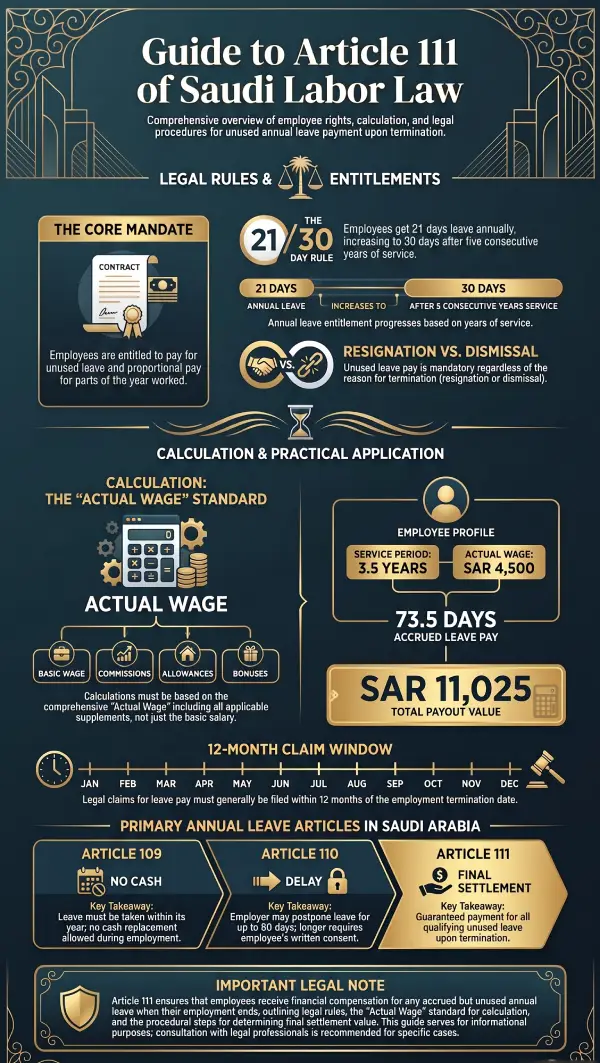
Under Article 111 of Saudi Labor Law, an employee who leaves employment before using accrued annual leave is entitled to payment for the unused leave days. The employee is also entitled to proportional leave pay for any part of a year worked. The final amount depends on the accrued balance, leave already taken, and the wage used for calculation.
Several connected rules should be considered together so that annual leave during employment is not confused with payment for unused leave after employment ends:
| Rule | Practical Effect |
|---|---|
| Annual leave | At least 21 days, increasing to 30 days after five consecutive years |
| During employment | The general rule is to take annual leave rather than replace it with cash |
| Postponing leave | Governed by Article 110 |
| Leaving employment | Payment becomes due for qualifying unused leave |
| Part of a year | Leave accrues proportionately to the period worked |
| Settlement of entitlements | One week where the employer ends employment; two weeks where the employee ends it |
| Labor claims | The general limitation period is 12 months from the end of employment |
What Does Article 111 of Saudi Labor Law Cover?
Article 111 deals with what happens to accrued annual leave when employment ends before the employee has used it. It does not turn annual leave into a cash benefit that employees may request whenever they choose while employment continues. The general rule is that annual leave should actually be taken.
The financial entitlement arises when the employment relationship ends and qualifying leave remains unused. Article 111 therefore operates alongside other provisions of the New Saudi Labor Law governing annual leave, postponement, and the financial rights arising when employment ends.
What Article 111 Means in Practice
The rule under Article 111 of Saudi Labor Law gives an employee the right to receive payment for accrued leave days that were not used before employment ended. It also provides for proportional leave entitlement for fractions of a year based on the period actually worked.
This means that a final settlement is not limited to completed years of service. An employee may also have a leave entitlement for the months worked during the final incomplete year.
It is also important to distinguish between annual leave pay received while the employee is actually on leave and payment for an unused annual leave balance after employment ends. The two arise at different stages of the employment relationship and should not be treated as the same entitlement.
How Is Leave Calculated for Part of a Year?
A practical reading of Article 111 requires proportional calculation for the part of the year actually worked.
If an employee is entitled to 21 days of annual leave and works six months of a new leave year, the proportional entitlement is 10.5 days before deducting any annual leave already taken during that period.
If the employee has completed five consecutive years and the annual entitlement has increased to 30 days, the calculation changes accordingly.
For this reason, calculating an annual leave balance should begin with the employment start and end dates, the applicable annual leave entitlement during each period of service, and the leave days actually used. This becomes particularly important where employment ends part-way through a year or where older accrued leave remains in dispute.
When Is an Employee Entitled to Payment for Unused Leave?
Payment for unused annual leave becomes relevant when the employment relationship ends and the employee still has accrued leave that was not taken.
This may arise following resignation, expiry of a fixed-term contract, dismissal, or another form of termination. However, payment for unused leave should be separated from other employment rights whose treatment may depend on the reason employment ended.
For example, an end-of-service benefit and compensation for termination are governed by different statutory provisions. Article 111 specifically deals with accrued annual leave that has not been used.
A leave balance should therefore be reviewed particularly where:
- An employee resigns with unused annual leave.
- A fixed-term contract expires before the full balance is used.
- An employee is dismissed with accrued leave remaining.
- Employment ends during part of a leave year.
- The employee’s records differ from the employer’s recorded balance.
Article 88 also regulates the deadline for settling employment rights after termination. Where the employer ends the employment relationship, entitlements must generally be settled within no more than one week. Where the employee ends the contract, the settlement period is generally no more than two weeks.
Payment for unused annual leave must also be distinguished from the end-of-service benefit governed by Article 84 of Saudi Labor Law, because each entitlement has its own legal basis and calculation method.
How Is an Annual Leave Balance Calculated?
Calculating unused annual leave starts with determining the correct number of accrued days before assigning a monetary value to them.
An employee is entitled to annual leave of at least 21 days. The entitlement increases to at least 30 days after completing five consecutive years with the employer. Once the applicable annual entitlement has been identified, the proportional entitlement for the final part of a year is added and leave already taken is deducted.
Where employment has lasted several years or earlier leave records are disputed, a year-by-year calculation may be more reliable than relying on one cumulative figure shown in an HR system.
The calculation can be approached in six steps:
- Identify the employment start date and final working day.
- Determine the annual leave entitlement for each stage of service.
- Calculate proportional leave for the final part of a year.
- Deduct annual leave actually taken.
- Determine the wage used for the calculation.
- Compare the result with the final settlement statement.
Practical Example of an Unused Leave Calculation
Assume an employee worked for three years and six months, was entitled to 21 days of annual leave each year, and did not take any annual leave.
The first three completed years produce an entitlement of 63 days. The additional six months produce another 10.5 days, bringing the total leave balance to 73.5 days.
If the monthly wage used in this example is SAR 4,500 and the daily wage is SAR 150, the resulting value is SAR 11,025.
This example illustrates the method used to calculate an unused annual leave balance. It does not determine the amount payable in an actual case until the employee’s wage components, leave records, and employment contract have been reviewed.
| Item | Calculation | Result |
|---|---|---|
| Leave for 3 years | 21 × 3 | 63 days |
| Leave for 6 months | 21 ÷ 12 × 6 | 10.5 days |
| Total leave balance | 63 + 10.5 | 73.5 days |
| Daily wage in the example | 4,500 ÷ 30 | SAR 150 |
| Value of unused leave | 73.5 × 150 | SAR 11,025 |
If your calculation differs from the employer’s final settlement, review the number of leave days, the wage used, and the termination date before signing a release.
Is Unused Leave Calculated on Basic or Actual Wage?
Saudi Labor Law distinguishes between basic wage and actual wage. It is therefore not enough to rely automatically on either the basic salary or a general figure described as the “total salary” when calculating annual leave pay.
Actual wage is connected to the employee’s basic wage together with other qualifying elements that may form part of remuneration depending on their nature and basis of entitlement.
Certain commissions, allowances, bonuses, and benefits may form part of the wage where the relevant statutory or contractual conditions are met. At the same time, not every payment appearing on a payslip automatically becomes part of the wage used for every calculation.
Whether allowances are included therefore requires reviewing the employment contract, workplace regulations, payslips, and the nature of each payment.
| Wage Component | What Should Be Reviewed? |
|---|---|
| Basic wage | Forms the core of the wage |
| Commissions and percentages | Nature and entitlement conditions |
| Allowances | Purpose, contract, and workplace regulations |
| Grants and bonuses | Whether they satisfy the conditions for forming part of wage |
| Benefits in kind | Their nature and conditions of entitlement |
| Expense reimbursements | Not automatically treated as wage |
Where the dispute concerns the value of the leave balance rather than the number of days, the issue often begins with identifying the correct wage components.
Annual Leave Balance After Resignation or Dismissal
Resignation does not mean that accrued annual leave earned before the employee’s final working day should simply be disregarded.
Calculating an annual leave balance after resignation requires identifying the leave accrued and used up to the termination date, then including the remaining qualifying balance in the final settlement. This entitlement should be distinguished from the end-of-service benefit because each right has a separate statutory basis.
Similarly, the expression “payment of leave balance after resignation” does not mean the employee should accept the figure shown in the employer’s statement without reviewing how it was calculated.
Where dismissal is based on Article 80 of Saudi Labor Law, the consequences of Article 80 should be distinguished from the employee’s entitlement to payment for unused annual leave. The leave balance should therefore be assessed separately from the other consequences of dismissal.
Does Accrued Annual Leave Expire?
The question of whether an accrued annual leave balance has been lost cannot be answered solely by looking at whether the employer’s internal HR system shows a zero balance.
The first step is to establish the leave the employee actually accrued, the leave used, and any leave that was postponed or carried forward according to the available records.
Articles 109, 110, and 111 deal with different stages of the same subject:
| Article | Subject | Practical Effect |
|---|---|---|
| 109 | Annual leave | Taking annual leave during employment |
| 110 | Postponement of leave | Rules governing postponement and carry-forward |
| 111 | Balance when employment ends | Payment for qualifying unused accrued leave |
The existence of a leave entitlement should also be distinguished from the time limit for bringing a labor claim.
Article 234 generally provides that a claim arising from Saudi Labor Law or an employment contract will not be accepted after 12 months have passed from the end of the employment relationship, subject to the statutory exceptions.
For that reason, a dispute over unused annual leave should not be left unresolved indefinitely after employment has ended.
What If the Employer Does Not Pay the Leave Balance?
If payment for unused annual leave is missing from the final settlement, identify the source of the discrepancy before submitting a claim.
Review the employment contract, payslips, annual leave records, leave requests and approvals, the resignation letter or termination decision, and the final settlement statement. Then determine whether the dispute concerns the number of leave days, wage components, leave the employer says was already taken, or non-payment of an agreed amount.
Relevant documents may include:
- The employment contract and evidence of the service period.
- Annual leave balance records.
- Leave requests and approvals.
- Payslips or other wage records.
- Resignation notice or termination decision.
- The final settlement or release.
If the dispute continues, labor disputes generally begin through the amicable settlement process, where the employee and employer are given an opportunity to resolve the matter before litigation.
If no settlement is reached, the dispute may proceed before the labor court in accordance with the applicable procedures. A claim should clearly identify the number of disputed days, the amount claimed, and the basis of the calculation rather than relying on a general objection.
Where the dispute concerns the number of days, the wage used, or the supporting records, reviewing the matter with a labor lawyer in Jeddah can help identify the amount in dispute and the appropriate legal route.
Common Mistakes When Applying Article 111
Errors often occur when payment for unused annual leave in Saudi Arabia is treated as a simple arithmetic exercise without first establishing how the leave balance arose.
Common mistakes include relying automatically on basic salary, assuming that resignation or dismissal removes the leave entitlement, and ignoring proportional entitlement for the employee’s final part of a year.
Another common mistake is confusing annual leave pay during employment with payment for accrued unused leave after employment ends. Relying on one figure from an HR system may also be insufficient where leave was postponed, records differ, or previous leave requests are disputed.
Before signing a final settlement, review five points: length of service, annual entitlement, leave already used, wage components, and the date employment ended.
Once those elements are clear, any remaining dispute over the leave balance or calculation can be identified more precisely.
Article 111 of Saudi Labor Law: 7 Leave Balance Rules brings together the main points that should be checked before accepting a final employment settlement: the underlying entitlement, number of days, proportional leave for part of a year, wage basis, resignation or dismissal, accrued leave, and the available claim route.
A correct result cannot be reached by relying only on the balance shown in an internal HR system or by automatically using basic salary without reviewing the other relevant information.
If a dispute arises over payment for unused annual leave, start with the employment contract, leave records, payslips, and the date employment ended, then compare those records with the final settlement.
Where the matter goes beyond a straightforward calculation and becomes a dispute over the leave balance, wage, or evidence, a law firm in Jeddah such as BMS Legal can review the documents and identify the legal options available before further action is taken.
Official Sources: