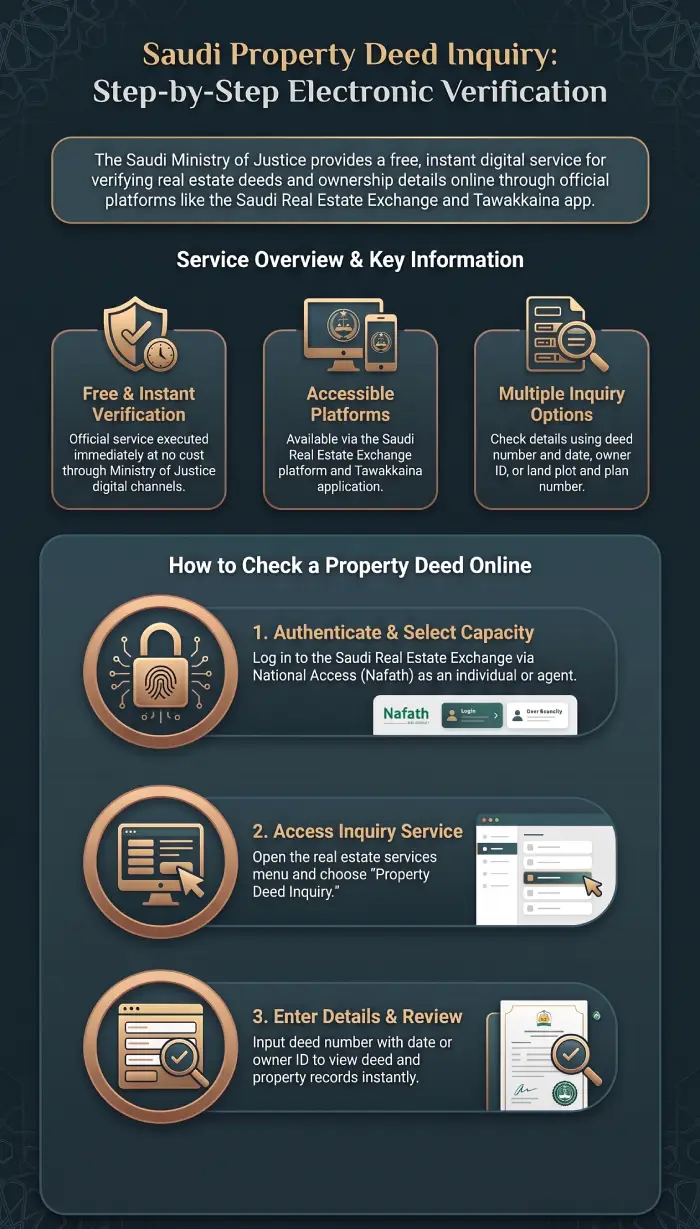
According to the Saudi Ministry of Justice’s property ownership document inquiry service, users can access the Real Estate Exchange platform, select the property deed inquiry service, and review the available document and property details.
However, finding a deed electronically does not automatically establish that a property transaction is free from legal risks. An outdated deed, differences in recorded land area, or ownership involving heirs or co-owners may require additional examination by a real estate lawyer in Jeddah.
This guide explains how to check a Saudi property deed online, verify ownership information, distinguish between electronic and paper deeds, and identify circumstances in which legal review may be necessary before buying, selling, or transferring property.
Saudi Property Deed Inquiry: What Should You Know Before a Transaction?
A Saudi property deed inquiry is an electronic process used to check registered property ownership information before a sale, purchase, ownership review, or other real estate transaction.
The process generally involves accessing the appropriate official service and entering the required document information.
However, an electronically available deed does not necessarily mean that the proposed transaction is legally secure. An outdated title deed, inherited property, discrepancies in recorded land measurements or boundaries, or a deed that cannot be found through Najiz may require further investigation before signing a contract, paying a deposit, or initiating an ownership transfer.
The following table helps identify the appropriate procedure.
| Your situation | Recommended procedure |
|---|---|
| You have the deed number and date | Property Ownership Document Inquiry |
| You want to identify properties registered in your name | Owned Properties Inquiry |
| Your deed does not appear electronically | Verify its information and determine whether an update is required |
| You have an old paper deed | Apply for a Property Deed Update, where applicable |
| The deed is registered in a deceased owner’s name | Deceased Owner’s Property Inquiry |
| You intend to purchase property | Review the deed before paying a deposit |
The appropriate service depends on the applicant’s legal capacity, the document’s condition, and the purpose of the inquiry.
What Is a Saudi Property Deed Inquiry?
A Saudi property deed inquiry involves checking information contained in a property ownership document registered with the competent Saudi authorities.
Its purpose is to identify the deed, the property to which it relates, and the available ownership information, while confirming whether the document appears in the relevant official electronic records.
A Saudi property title deed, commonly known as a Sak, is an official document evidencing ownership of real estate.
Information available through the inquiry may include:
- The deed or document number.
- The registered owner’s name.
- The property’s location.
- Its recorded area.
- Property boundaries or description.
- Available information concerning the document’s status.
A property owner may possess a copy of a deed but still need to compare its details with official electronic records before entering into a significant transaction.
When Is an Online Inquiry Sufficient?
An online inquiry may be sufficient when the purpose is simply to view information about an existing, updated property deed.
However, if the inquiry is connected with a purchase, inherited property, an old paper deed, or inconsistent information, the electronic search should be regarded as the beginning of a more comprehensive verification process.
Important: Do not rely exclusively on an electronic inquiry when the property is registered in a deceased owner’s name, the deed is outdated, recorded measurements differ from the actual property, or there are indications of an ownership dispute.
How to Conduct a Saudi Property Deed Inquiry Through Najiz
A Saudi property deed inquiry can be completed through the relevant real estate services associated with the Saudi Ministry of Justice.
The official process involves the Saudi Real Estate Exchange platform and the electronic deed inquiry service.
Step-by-Step Property Deed Inquiry Process
- Sign in to the Saudi Real Estate Exchange property deed inquiry service using the National Single Sign-On system (Nafath), where required.
- Select your capacity as an individual applicant or authorized representative.
- Open the platform’s navigation menu.
- Select the property title deed inquiry service.
- Enter the deed number and its date, or the deed number and identification number of one of the owners, as requested.
- Submit the inquiry through the platform.
- Review the available deed information and property details.
The required information may differ depending on the service and the applicant’s circumstances.
If an agent submits the inquiry, the power of attorney must be valid and contain the relevant authority for the real estate matter.
What Information Can You Obtain?
| Available information | Practical purpose |
|---|---|
| Document number | Match the deed against the electronic record |
| Property details | Identify the property’s location, area, and description |
| Owner information | Examine the registered owner’s identity and legal capacity |
| Document status | Understand the available recorded status |
| Additional property information | Compare the electronic record with supporting documents |
An electronic inquiry provides useful information but does not independently establish that every legal risk associated with the property has been eliminated.
The result should therefore be assessed according to the intended purpose: viewing ownership information, purchasing real estate, updating a deed, or dealing with inherited property.
Property Deed Lookup by Deed Number or National ID
The appropriate electronic inquiry depends on whether the applicant wants to examine a particular deed or identify properties registered in their own name.
If you have a specific title deed number, the property ownership document inquiry service is generally the appropriate route.
If you want to view properties registered under your identity, the owned properties inquiry service is more relevant.
Checking a Property Deed by Number
A deed-number inquiry is useful before purchasing real estate or when examining a specific ownership document.
The deed number and date must be entered accurately.
An incorrect digit or date may prevent the document from appearing in the search results, even if the deed exists in the official records.
Checking Property Ownership Using National ID
Identification-based property inquiries generally concern real estate associated with the authenticated beneficiary’s account.
According to the Ministry of Justice, the Owned Properties Inquiry service allows eligible beneficiaries to access their registered properties, select a property, and review its document and real estate details.
| Comparison | Specific deed inquiry | Owned properties inquiry |
|---|---|---|
| Purpose | Examine a particular ownership document | View properties associated with the beneficiary |
| Required information | Deed number and date, or other required identifiers | Authenticated beneficiary account |
| Typical use | Purchase, verification, or deed review | Identifying owned properties and documents |
| Eligible applicant | Owner, authorized representative, or other eligible applicant | Owner or legally authorized person |
These services have different purposes and should not be treated as interchangeable.
How to Verify a Saudi Property Deed and Ownership Details
Property deed verification involves more than confirming that a document exists in an electronic system.
A meaningful review compares the ownership information recorded in the deed with the registered owner’s identity, the property’s location, its area and boundaries, and the purpose of the proposed transaction.
Essential Ownership Verification Checks
Before relying on a property deed, review the following information:
- Registered owner: Confirm the name and legal capacity of the person recorded as the owner.
- Identification information: Compare the owner’s identification or registration details.
- Deed information: Verify the document number and date.
- Property location: Confirm that the recorded location corresponds to the actual property.
- Area and boundaries: Compare measurements and property descriptions with supporting documents.
- Other interested parties: Identify any heirs, co-owners, or representatives whose legal rights may be relevant.
- Deed status: Determine whether the document has been updated or requires correction.
These checks are especially important when the property consists of vacant land, an older building, or an asset forming part of a deceased person’s estate.
When Is Legal Verification Necessary?
A legal review may be appropriate where:
- The deed is outdated.
- The recorded area differs from actual measurements.
- The property belongs to multiple owners.
- The registered owner has died.
- The deed conflicts with other documents.
- The document cannot be found through the relevant government service.
- The seller’s authority to complete the transaction is unclear.
Electronic vs. Paper Property Deeds in Saudi Arabia
The principal difference between electronic and paper property deeds concerns access to ownership information and compatibility with modern government real estate services.
An updated electronic deed is generally available through the relevant digital systems.
An older paper deed, however, may need to be updated before certain transactions, including a property sale, mortgage, or ownership transfer, can be completed.
Possessing a paper deed does not automatically mean that the underlying ownership is invalid.
Nevertheless, an outdated document may result in delays or additional requirements, particularly where recorded information is incomplete or does not correspond with the owner’s current identification details.
| Comparison | Electronic deed | Paper deed |
|---|---|---|
| Access | Through official digital services | Through the physical document or an update process |
| Transactions | Generally easier to use in modern electronic procedures | May require updating before use |
| Information review | Electronic information is more readily accessible | Older information may require further examination |
| Possible procedure | Inquiry or digital use | Update or correction before a transaction |
When Should a Paper Deed Be Updated?
A property deed may require updating when:
- It exists only as an old paper document.
- It cannot be located through the electronic service.
- Its ownership information is incomplete.
- It is needed for a sale or mortgage.
- It must be used in an electronic real estate transaction.
The Saudi Ministry of Justice’s property deed update and amendment service provides a route for submitting eligible update and amendment applications.
Why Is a Property Deed Not Showing in Najiz?
A title deed may fail to appear in Najiz or the relevant electronic real estate service for several reasons.
Possible explanations include incorrect information, an outdated paper document, incomplete identification records, or the use of an inquiry service that does not match the applicant’s purpose.
A missing electronic result does not necessarily indicate an ownership dispute.
However, the reason should be investigated before entering into a significant property transaction.
Common Reasons a Deed Cannot Be Found
- An incorrect deed number.
- An inaccurate document date.
- A paper deed that has not been updated.
- Missing identification details in an older deed.
- An incomplete deed update request.
- Registration under a deceased or previous owner.
- Selection of an unsuitable inquiry service.
The situation becomes particularly important where the property is being sold, divided among heirs, or used in a financing transaction.
It may also raise concerns if the seller insists on completing the transaction without explaining why the ownership document is unavailable.
What Should You Do If the Deed Is Missing?
Start by checking the deed number and date.
Next, determine whether the title document needs to be updated or whether its recorded information requires correction.
If the problem remains unresolved, establish its cause before paying a deposit or signing a binding property sale agreement.
Where the issue involves conflicting ownership information or uncertain legal authority, obtaining a professional review may help prevent avoidable complications.
Updating or Correcting a Saudi Property Deed
A Saudi property deed inquiry may reveal that an ownership document must be updated or amended before it can be used for a proposed transaction.
Although these procedures are connected, they serve different purposes.
Updating a Property Deed
Updating a property deed generally involves bringing an older document into the relevant electronic system.
This may be necessary when the deed is paper-based, not available electronically, or otherwise requires processing through the official service.
Correcting a Property Deed
Correcting a property deed involves addressing inaccurate information already recorded in the ownership document.
Examples include errors involving the registered owner’s name, property area, or boundaries.
The Ministry of Justice provides an official property deed update or amendment application service.
The available application categories may include a new deed update, an update involving a lost deed, or an amendment to an electronic title deed.
| Comparison | Deed update | Deed correction |
|---|---|---|
| Main purpose | Bring an existing document into the electronic system | Correct inaccurate recorded information |
| Typical situation | Old paper deed, missing document, or unavailable electronic record | Error involving the name, area, or boundaries |
| Expected function | Facilitate electronic use of the deed | Improve the accuracy of ownership information |
| Legal implications | Often procedural | May involve substantive legal issues where ownership rights are affected |
What If the Deed Update Application Is Rejected?
If a deed update application is rejected or the competent authority identifies problems with the information provided, repeating the same application without understanding the reason may not resolve the issue.
The appropriate response may involve:
- Correcting the submitted information.
- Providing additional supporting documents.
- Submitting a revised electronic application.
- Taking a separate legal step if the issue affects ownership rights.
Legal advice can help distinguish between an administrative problem and a dispute requiring a more extensive procedure.
Saudi Property Deed Inquiry for Heirs
A Saudi property deed inquiry for heirs differs from a standard ownership search because the title document may remain registered in the deceased owner’s name.
The heirs may need to identify real estate belonging to the estate before agreeing on its distribution or sale.
The Saudi Ministry of Justice provides an official deceased owner’s property inquiry service, allowing eligible beneficiaries to examine property information associated with a deceased person.
How to Check Property Registered to a Deceased Owner
The relevant inquiry service allows eligible users to access the Real Estate Exchange platform, select the deceased owner’s property inquiry, choose the relevant property, and review the available deed and real estate details.
The service is subject to the official eligibility and document requirements.
However, identifying property registered to a deceased person does not automatically transfer ownership to the heirs.
A transfer or division is a separate legal matter involving the heirs’ status, the available documents, and the circumstances of the estate.
For a broader explanation, see our guide to inheritance and estate procedures in Saudi Arabia.
Documents and Legal Issues Affecting Inherited Property
Depending on the case, the required documents may include:
- An official heirship determination.
- Documents establishing the deceased person’s ownership.
- Relevant powers of attorney.
- A property division agreement.
- Documents concerning any disagreement between the heirs.
Knowing a title deed number does not independently authorize one heir to dispose of the entire inherited property without regard to the rights of the other heirs.
Further legal examination may be necessary when beneficiaries disagree, an authorized representative acts on their behalf, the deed is outdated, or a sale is being considered.
In these situations, an inheritance and estates lawyer in Jeddah can review the legal capacity of the parties and relevant documentation before a transaction proceeds.
Where a representative intends to sell inherited property, the scope of authorization is particularly important. Our guide to powers of attorney for heirs in Saudi Arabia explains why authority to sell or transfer ownership should be examined carefully.
How to Check a Property Deed Before Buying Real Estate
Checking a property deed before purchasing real estate is an important preliminary safeguard.
An electronic record does not necessarily reveal every issue that could affect the transaction.
A property purchase may involve heirs, co-owners, powers of attorney, disputed boundaries, or inconsistent ownership information.
What Should Property Buyers Verify?
Before purchasing property, review:
- The seller’s name and identity.
- Whether the seller is the registered owner.
- The seller’s authority to complete the transaction.
- The type of title deed.
- Whether the document has been updated.
- The property’s recorded area and boundaries.
- Whether heirs or co-owners have relevant ownership rights.
- The validity and scope of any power of attorney.
- Whether the property can proceed through the applicable ownership transfer process.
- Any recorded issue that could affect the proposed transaction.
These checks help distinguish a straightforward documentation review from a situation requiring additional investigation.
Risks of Buying Property With an Old Deed
Purchasing property supported by an outdated deed may delay ownership transfer or require the deed to be updated before the transaction can proceed.
Additional concerns may arise concerning the recorded land area, boundaries, or the seller’s legal capacity.
Before paying a deposit or entering into a binding agreement, buyers should establish why the deed has not been updated and whether the issue could affect the proposed transfer.
Property Transaction Checkpoint: Is an Electronic Deed Enough Before Buying?
Finding a deed electronically is an important preliminary step, but it does not necessarily disclose every issue relevant to a property purchase.
An outdated deed, inherited property, boundary discrepancies, or unclear seller authority may justify further review before paying a deposit or entering into a binding contract.
1. Match the ownership document
Compare the deed number, owner’s name, land area, location, and recorded boundaries with the supporting documents.
2. Identify the source of legal risk
Examine whether the property involves an old paper deed, heirs, co-owners, powers of attorney, or inconsistencies between the ownership record and the actual property.
3. Determine the appropriate procedure
Depending on the findings, the next step may involve updating the deed, correcting its information, reviewing supporting documents, or addressing an existing property dispute.
At BMS Legal Law Firm, a property deed review begins with identifying the client’s objective, whether the matter involves a purchase, sale, inheritance, document update, or ownership discrepancy.
Relevant documents can then be assessed to determine an appropriate legal course without guaranteeing any particular outcome.
Common Saudi Property Deed Problems That May Require a Lawyer
Some property deed issues begin as relatively straightforward administrative errors but may develop into ownership disputes if they affect the registered owner, land area, or property boundaries.
Not every property deed problem requires litigation.
However, early legal examination may be appropriate where a discrepancy could affect ownership rights or prevent a transaction from being completed.
When Should You Consult a Real Estate Lawyer?
Professional legal assistance may be particularly relevant when:
- There is a significant error in the owner’s name or identification information.
- The recorded area or boundaries differ from the available supporting documents.
- A deed update request has been rejected or delayed.
- An old title deed is discovered shortly before a proposed purchase.
- Ownership involves heirs or multiple co-owners.
- The deed information conflicts with the actual property.
- An ownership dispute already exists.
If the title deed contains unclear information or requires review before a purchase, you can contact BMS Legal’s real estate lawyers in Jeddah with a brief summary of the circumstances.
The legal team can then determine which documents are relevant to identifying an appropriate next step.
Legal Information You Can Rely On
This guide is based on official Saudi Ministry of Justice services and explains practical steps for verifying property deed information before a real estate transaction.
BMS Legal Law Firm
Saudi Licensed Law Firm · Jeddah, Saudi Arabia
Commercial Registration No. 7053637679
This content is for general legal information and does not replace advice based on your specific circumstances.
Frequently Asked Questions About Saudi Property Deed Inquiry
1. How can I check a property deed online in Saudi Arabia?
You can conduct a Saudi Property Deed Inquiry through the official Real Estate Exchange platform. Enter the deed number and date, or the required owner's identification details, then review the available property and ownership information.
2. Can I verify a Saudi property deed using a national ID number?
Yes, eligible users can access the Owned Properties Inquiry service through their authenticated account to view properties registered in their name. Checking another person's deed may require additional document information or appropriate legal authorization.
3. Why is my property deed not showing in Najiz?
A property deed may not appear because of incorrect document details, an outdated paper deed, incomplete ownership information, or an unfinished update request. Verify the information and determine whether the deed requires updating before proceeding with a transaction.
4. Is checking a property deed online enough before buying property?
No. An online inquiry confirms available recorded information but does not guarantee that a transaction is free from legal risks. Buyers should also verify ownership, property boundaries, potential disputes, and the seller's authority before signing a contract or paying a deposit.
A Saudi property deed inquiry is more than an electronic search for title document information. It provides an initial opportunity to examine recorded ownership details before entering into a financial commitment or undertaking a real estate transaction.
However, the inquiry result should not be treated as conclusive legal clearance when the deed is outdated, the property forms part of an inheritance, recorded measurements or boundaries are inconsistent, or important ownership information is unavailable.
Begin with the relevant official service, then compare the document number, registered owner, and property description with the supporting records and actual circumstances.
If inconsistencies arise or the deed cannot be found, further examination can help determine whether an update, correction, or legal procedure is appropriate.
Some real estate matters may also overlap with inheritance, contractual obligations, or commercial disputes. In these situations, consulting a licensed lawyer in Jeddah may help identify the relevant legal specialization and the appropriate next step.