
If you are searching for how long a Khula case takes in Saudi Arabia, you are probably not looking for a general explanation of Khula. You want to know how much time your own case may realistically take.
You may want to know whether the matter can be completed quickly when both spouses agree, whether the husband’s refusal can extend the process, when the judgment actually becomes final, and whether the case will end through documentation or proceed as a judicial dispute before the Personal Status Court.
For that reason, asking only “how long does a Khula case take?” is not enough. The realistic timeline depends on the legal route, the level of agreement between the spouses, whether the compensation is clearly determined, whether the required information is complete, and whether the judgment is challenged.
These factors determine the practical duration of the case more accurately than the name of the proceeding itself.
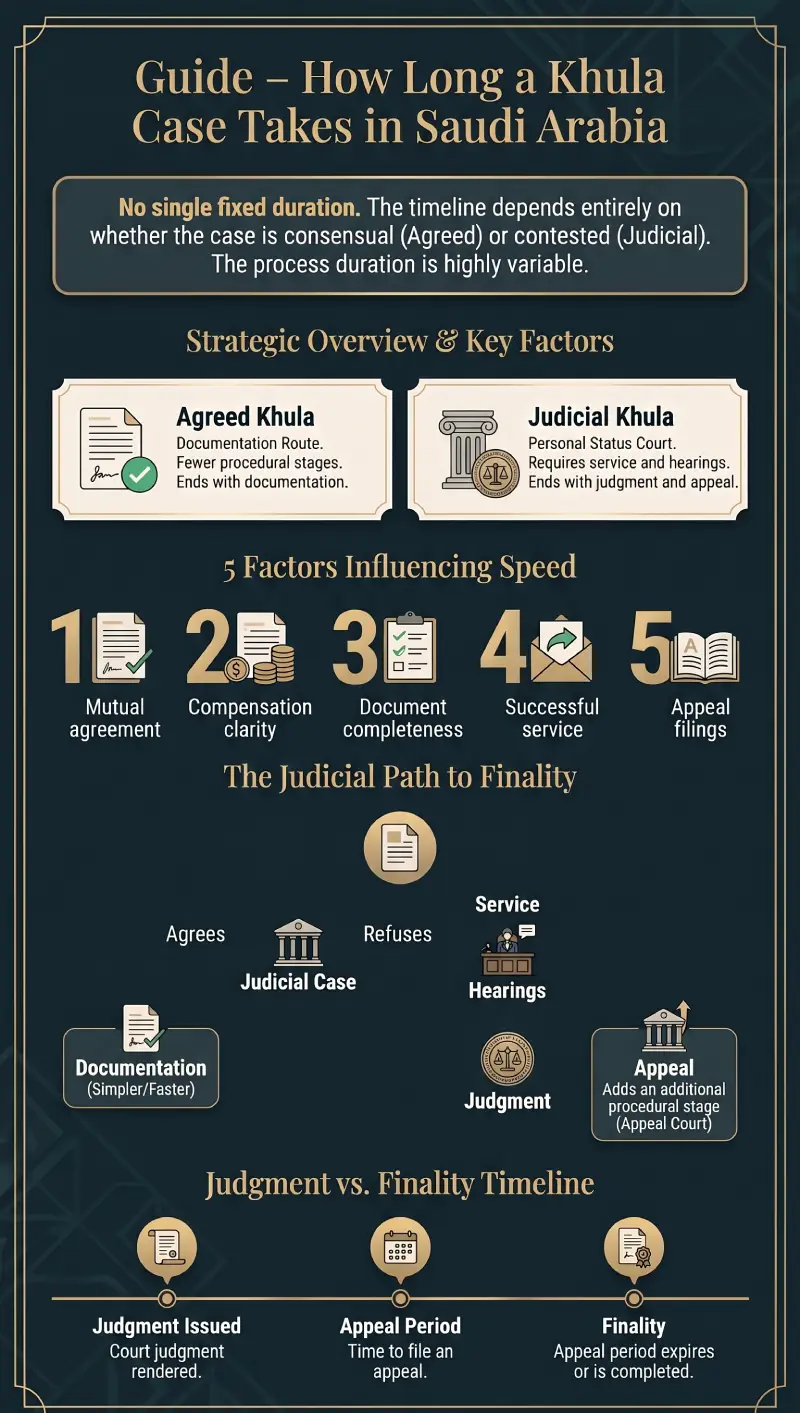
In Saudi Arabia, Khula does not always follow one procedural route. It may be based on an agreement between the spouses and proceed through documentation, or it may become a disputed case before the Personal Status Court requiring service of notice, hearings, judicial consideration, and potentially an appeal.
Because understanding the procedural route comes before estimating the timeline, it is useful to first review the Khula procedure in Saudi Arabia before assessing how long your particular case may take.
How Long a Khula Case Take in? The Quick Answer
There is no single fixed period that applies to every Khula case in Saudi Arabia.
When both spouses agree on the Khula and the compensation, the matter is generally closer to a documentation process and may therefore move more quickly than a contested court case.
However, if the husband refuses the Khula, the parties disagree over compensation, service of notice is delayed, or the case proceeds to an appeal against the Khula judgment, the overall timeline may become longer depending on the circumstances.
For a quick practical assessment, focus on five main factors:
- Whether there is full agreement between the spouses.
- Whether the compensation is clear and undisputed.
- Whether all required information and documents are complete.
- How quickly service and procedural notifications are completed.
- Whether the judgment is challenged after it is issued.
Accordingly, how long a Khula case takes in Saudi Arabia varies from one case to another depending on agreement, proper service, the stage of the proceedings, and whether an appeal is filed.
For this reason, any timeline you find online should not be treated as a guaranteed period.
The more useful question is whether your case is closer to documenting a mutual agreement or to litigating a disputed Khula claim, and whether any procedural or substantive issue could delay the case.
Agreed vs. Judicial Khula: Which Takes Longer?
The main difference is that an agreed Khula is based on mutual consent, while a judicial Khula involves a dispute that requires examination and resolution.
If both spouses agree on the Khula itself and on the compensation, the process is generally closer to formal documentation. If no agreement exists, or one of the spouses refuses to proceed, the matter may become a case before the Personal Status Court.
This distinction should be considered before estimating the duration because the expected timeline changes according to the procedural path followed.
The two routes should not be treated as identical simply because both concern Khula.
In a documentation-based route, the focus is on completing the agreement and satisfying the documentation requirements. In a judicial route, the matter becomes litigation involving service, hearings, responses, and judicial consideration of the compensation and any related issues.
Therefore, when asking how long does a Khula case take in Saudi Arabia, the first step is to identify the procedural route.
The following table compares the two main Khula routes in Saudi Arabia:
| Comparison | Agreed Khula | Judicial Khula |
|---|---|---|
| Nature of the process | Documentation of an agreement | Contested court case |
| Main route | Documentation procedure | Personal Status Court |
| Main reason for speed or delay | Completion of the agreement | Litigation and procedural steps |
| What may delay it | Missing information or requirements | Service, hearings, and disputes over compensation |
| When it ends | Once documentation is completed | After judgment and the appeal stage is completed or expires |
Accordingly, it is difficult to estimate the duration of a Khula case accurately before determining whether the matter will proceed through documentation or judicial litigation.
If the Husband Refuses Khula, Will the Case Take Longer?
The husband’s refusal does not necessarily mean that the legal route has ended. It does, however, usually mean that the matter will no longer follow the shorter route associated with mutual agreement.
Instead, the case may move from documenting an agreement to a judicial dispute requiring court consideration.
The practical question is therefore not simply whether refusal prevents Khula, but how that refusal affects the timeline.
In many cases, refusal introduces disputed issues concerning compensation, service of process, attendance at hearings, and whether either party will challenge the judgment after it is issued.
For a more detailed explanation of the legal basis of Khula, you can review the Khula requirements under Saudi law to understand when refusal affects the procedure and when it does not prevent Khula from proceeding.
In practice, refusal itself is not always the main reason for delay. The issues resulting from that refusal may be more significant.
The spouses may disagree over the amount of the dowry, the nature of the compensation, procedural notices may be delayed, adjournments may be requested, or additional claims may distract from the main Khula dispute.
For this reason, a clearly defined claim, properly organized documents, and a clear position on compensation may reduce avoidable procedural delays.
Common factors that may extend the case when Khula is disputed include:
- Disagreement over the compensation or dowry.
- Incomplete information about the other party.
- Delayed service or poor procedural follow-up.
- Adding multiple unrelated claims to the same case.
- Appealing the judgment after it is issued.
How Many Hearings Does a Khula Case Need?
There is no fixed number of hearings that applies to every Khula case.
Some cases may be relatively clear from the beginning, while others may become more complicated because of disagreement over compensation, incomplete documentation, or the need to clarify the claims.
It is therefore inaccurate to assume that every Khula case will require one, two, or three hearings. The number of hearings depends on the nature of the dispute rather than the title of the case.
The timing of the first hearing after filing also depends on the registration of the case, the accuracy of the information submitted, and successful service on the other party.
The practical sequence generally involves filing the request, registering the case, serving the other party, scheduling the first hearing, examining the dispute, and then issuing a judgment.
The clearer and more complete the case is from the beginning, the lower the likelihood of avoidable procedural delay.
After a Khula case is filed, it may generally pass through the following stages:
- Registration of the application or claim.
- Service on the other party.
- Scheduling of the first hearing.
- Consideration of the dispute over compensation and related issues.
- Issuance of the judgment and commencement of the applicable appeal period.
If you have not yet started the procedure, reviewing how to file a Khula case in Saudi Arabia can help you understand the filing steps, the claim format, and the electronic procedure before estimating the likely duration of your case.
When Is the Khula Judgment Issued?
It is important to distinguish between the issuance of the judgment, the availability of the electronic judgment document, and the judgment becoming final.
A judgment may first be issued and later become available electronically, while the case may still not be legally final if the appeal period remains open.
This distinction is important because the issuance of a judgment does not necessarily mean that the entire case has been conclusively completed.
Therefore, the question should not only be when the Khula document becomes available.
You should also ask whether the appeal period has expired and whether an appeal has been filed.
If the Khula is completed through a documentation route based on mutual agreement, the conclusion of the process is linked to completing that documentation.
If the matter proceeds through judicial Khula, the case moves through the judgment stage, followed by the appeal period or the resolution of any appeal, before reaching finality.
Appealing a Khula Judgment: How Does It Affect the Timeline?
An appeal against a Khula judgment may add an additional stage to the overall duration of the case.
Challenging a first-instance judgment is not merely a secondary procedural issue. It can materially affect when the dispute is finally concluded.
A judgment may therefore be issued but remain non-final while the appeal period is still open or while an appeal is being considered.
If you want to determine when the case is truly concluded, you should not look only at the date on which the judgment was issued.
You must also consider what happens after that date.
An appeal should be treated as a factor that can extend the proceedings when it occurs, rather than as an automatic stage in every case.
If the appeal period expires without a challenge, the judgment moves closer to finality. If an appeal is filed within the applicable period, the case enters an additional procedural stage.
A Khula judgment generally moves closer to finality when:
- The appeal period expires without an appeal being filed.
- An appeal is filed and subsequently resolved.
- The matter was originally completed through an agreed and documented Khula route.
When Does a Khula Case End in Court?
A judicial Khula case is effectively concluded when there is no remaining dispute or open appeal period affecting the legal position of the parties.
In a court-based Khula, this is generally connected to the expiry of the appeal period or the resolution of an appeal.
In a documentation-based process, the matter concludes when the documentation procedure is completed and the relevant document is issued.
For that reason, saying that a judgment has been issued does not always mean the case has become final.
A useful way to assess the position is to ask three questions:
Was the process based on documentation or litigation? Was a judgment issued or was the Khula formally documented? Is an appeal period still open?
These questions provide a clearer picture of whether the case has actually ended.
This article has been reviewed to ensure that its explanation of the Khula process, court proceedings, appeal stage, and judgment finality is presented clearly and consistently with the applicable Saudi legal framework.
The actual duration of a Khula case may vary depending on the procedural route, service of notice, disputes over compensation, hearings, and whether an appeal is filed.
Last reviewed: September 2026
Khula Case Costs
The cost of a Khula case is a separate issue from the duration of the proceedings.
There may be costs associated with the procedure, compensation, legal advice, or representation, but those costs do not by themselves determine how long a Khula case takes in Saudi Arabia.
A relatively low-cost case may still take longer if it is heavily disputed, while a clearer case may move more quickly even if professional legal services are involved.
When estimating the timeline, focus first on the procedural route and the issues in dispute. When assessing cost, consider that issue separately according to the specific circumstances of the case.
Reasons a Khula Case May Be Rejected or Delayed
If your goal is to reduce avoidable delays, this is one of the most important areas to address from the beginning.
Some Khula claims are weakened or delayed because the application starts with unclear wording or incomplete information.
Common issues include an unclear request, failure to define the compensation properly, incomplete information about one of the spouses, combining too many claims in one case, or failing to prepare essential documents in advance.
The case should therefore be clearly structured from the first step.
The requested relief should be defined precisely, the position on compensation should be clear, and the necessary supporting documents should be prepared.
Avoid adding unrelated claims that may distract from the central Khula dispute.
Common issues that may delay or weaken a Khula case include:
- Incomplete information about one of the spouses.
- An unclear claim or unclear compensation.
- Combining multiple claims in a single statement of claim.
- Missing essential documents.
- Poor follow-up after filing.
Special Circumstances That May Affect How Long a Khula Case Takes
The timeline may also change when the case involves circumstances requiring additional procedural attention.
The existence of children, the husband’s absence, his residence outside Saudi Arabia, or a significant dispute over compensation may make the process less straightforward than a case in which both spouses agree from the beginning.
This does not mean that every case involving one of these factors will take the same amount of time.
Rather, how long a Khula case takes in Saudi Arabia should be assessed according to the facts of the individual case instead of relying on a general estimate found online.
If your circumstances fall somewhere between a documentation process and a contested court claim, or if there is a dispute concerning compensation or the finality of the judgment, it may be better to assess the legal route before taking an unnecessary procedural step.
An early legal assessment may help identify the most appropriate route, the documents that may be required, and whether the case requires immediate action or better preparation before filing.
If your case may proceed either through documentation or litigation, or there is an existing dispute over compensation or the finality of a judgment, consulting a Khula lawyer in Jeddah may help you assess the appropriate procedural route before proceeding.
Frequently Asked Questions About How Long a Khula Case Takes in Saudi Arabia
1. How long does a Khula case take in Saudi Arabia?
There is no fixed duration. It depends on the route, service, hearings, and whether an appeal is filed.
2. Does the husband’s refusal delay a Khula case?
It can. Refusal may move the case from documentation to judicial proceedings.
3. How many hearings does a Khula case require?
There is no fixed number. It depends on the complexity of the dispute and the issues raised.
4. When does a Khula judgment become final?
It becomes final after the applicable appeal period expires or any filed appeal is resolved.
If you are asking how long a Khula case takes in Saudi Arabia, begin by identifying the procedural route.
When there is a clear agreement between the spouses, the matter is generally closer to documentation. When the husband refuses, or there is a dispute over compensation, the case may move into judicial proceedings and may take longer depending on the facts and procedural developments.
If a judgment has already been issued, you should also consider the appeal period and the possibility of an appeal before treating the matter as conclusively finished.
The clearer the information, claims, and supporting documents are from the beginning, the lower the risk of avoidable procedural delay.
You may contact BMS Legal for Law and Legal Consultations for an initial and confidential assessment of the procedural step that may be appropriate to your circumstances.
Official Sources: