
How to Get Khula in Saudi Arabia does not always begin with the same step. The first question is not simply how to submit the request, but whether the spouses have reached an agreement.
When considering Khula in Saudi Arabia, understanding the general procedure alone is not enough. It is also necessary to understand the applicable Khula requirements and determine whether the correct route is Khula documentation through Najiz or a Khula case before the Personal Status Court.
This distinction determines the procedure that follows, the financial consideration involved, the rights that remain separate from Khula, and the likely timeframe.
Where the spouses agree on Khula and its consideration, the appropriate route will generally be to document the Khula through Najiz. If there is no agreement, or the required approval cannot be completed, the matter may instead proceed through a statement of claim before the competent court.
A common source of confusion is the difference between documentation and litigation, between Khula and judicial dissolution of the marriage contract, and between Khula consideration and children’s rights. Starting under the wrong procedure may make the case unnecessarily complicated from the outset.
This guide explains How to Get Khula in Saudi Arabia, what Khula means under Saudi law, the main requirements, when Najiz documentation may be appropriate, when a Khula case may be required, how consideration is treated, and how the procedure can affect rights and timing.
Quick Answer: How to Get Khula in Saudi Arabia
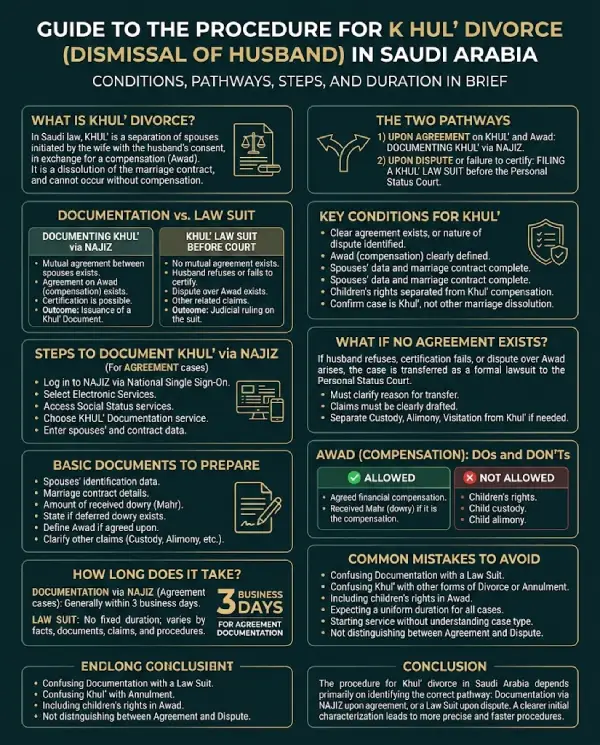
In practical terms, How to Get Khula in Saudi Arabia depends on two main routes:
- If the spouses agree on Khula and the consideration: document the Khula through Najiz.
- If there is a dispute or approval cannot be completed: file a claim before the Personal Status Court.
- Financial consideration is an essential element of Khula.
- Children’s rights cannot form part of the Khula consideration.
What Does Khula Mean Under Saudi Law?
Under Saudi law, Khula is a separation between spouses initiated by the wife and agreed to by the husband in exchange for consideration provided by the wife or another person.
The Saudi Personal Status Law further provides that Khula cannot take place without consideration. It may be expressed by any wording that clearly indicates separation, whether verbally or in writing. It is treated as dissolution of the marriage contract even if the word “divorce” is used, and it results in a minor irrevocable separation. Khula may also take place regardless of the wife’s condition at the time.
These points are important because Khula is often confused with divorce and judicial dissolution of marriage. They also help determine whether a particular dispute is properly treated as Khula or whether advice from a Divorce Lawyer in Jeddah may be more appropriate where the dispute concerns divorce and its legal consequences rather than Khula consideration alone.
Khula should also not be treated as a single procedure that applies identically in every case. It may be based on a documented agreement, or it may develop into a judicial dispute.
For that reason, the more useful question is not merely, “Can I obtain Khula from my husband?” It is: Which legal route applies, what consideration is involved, and are there additional claims that should be dealt with separately?
When Is Khula More Appropriate Than Judicial Dissolution of Marriage?
Not every request to end a marriage is necessarily a Khula case.
Khula is principally based on ending the marriage in exchange for consideration. Where the facts instead involve independent harm or another ground that may justify ending the marriage without structuring the case around consideration, judicial dissolution of the marriage contract may be the more appropriate route depending on the circumstances.
The Implementing Regulations of the Personal Status Law also provide that, after reviewing the arbitrators’ report, the court may dissolve the marriage contract and determine what it considers appropriate regarding compensation.
Accordingly, a wife should not only ask: “How can I obtain Khula?”
The more important preliminary question is whether the circumstances support Khula in exchange for consideration or whether there are stronger grounds for judicial dissolution of the marriage.
That distinction affects the way the case should be structured, the consideration involved, the relief requested, and the documents that should be prepared from the outset.
How Do You Know Whether to Use Documentation or File a Court Case?
The distinction can be simplified as follows.
If the spouses clearly agree on both Khula and the consideration, and the required approval can be completed, the appropriate route is generally Khula documentation.
If there is no agreement, the request stops at the approval stage, a genuine dispute arises over the consideration, or other claims become intertwined with the Khula itself, the more appropriate route may be a Khula case filed through a statement of claim before the Personal Status Court.
This reflects the practical distinction made by the Saudi Ministry of Justice between the documentation service and the statement-of-claim service.
Khula Requirements in Saudi Arabia
Before beginning the procedure, Khula consideration should not be viewed simply as an amount of money or a waiver.
The Khula Requirements in Saudi Arabia begin with more fundamental questions: Is there a genuine agreement? Is the consideration clearly defined? Is the matter suitable for documentation, or does it require court proceedings?
Answering these questions correctly can prevent the matter from being started under an unsuitable procedure.
Understanding the requirements from the outset can therefore save time, reduce procedural mistakes, and make the legal file clearer.
Legal Capacity and Mutual Agreement
Under the consensual route, Khula is based on a clear agreement between the spouses regarding both the Khula itself and its consideration.
A general desire to separate is therefore not sufficient. The spouses’ details, marriage contract information, amount or form of consideration, and the method for completing the procedure should all be clear.
The Khula documentation service and its guidance also indicate that the request proceeds through submission of the required information, approval, final confirmation, and issuance of the document.
Accurate information is therefore an integral part of completing the procedure correctly.
Khula Consideration and What Cannot Be Included
Consideration is a fundamental element of Khula because it distinguishes Khula from other forms of marital separation.
The law provides that anything legally capable of being treated as property may serve as consideration for Khula. However, it expressly prevents the consideration from consisting of the waiver of any of the children’s rights or their custody.
The law also provides that where the consideration for Khula is the mahr, it is limited to the amount of the mahr already received, while any outstanding amount is waived even if payment had been deferred.
For this reason, incorrectly defining the consideration or combining it with children’s rights can create significant confusion in the case.
Key Practical Requirements
The main practical requirements can be summarised as follows:
- Determine whether the matter is based on agreement or dispute.
- Define the Khula consideration clearly and accurately.
- Ensure that the spouses’ details and marriage contract information are complete.
- Keep children’s rights separate from the Khula consideration.
- Determine whether the circumstances are more appropriately treated as Khula or judicial dissolution of marriage.
Khula Documentation vs a Court Claim
The distinction between the two routes begins with one question: Is there a complete agreement?
Where the spouses agree on Khula and the consideration, documentation will generally be the appropriate route.
Where there is no agreement, approval cannot be completed, or a dispute arises regarding the consideration, the matter may proceed through court proceedings.
The Ministry of Justice has explained that Khula may proceed through documentation where the husband agrees because a judicial judgment is not required in that situation.
| Issue | Khula Documentation | Court Claim |
|---|---|---|
| Situation | Agreement on Khula and consideration | No agreement or approval cannot be completed |
| Procedure | Khula documentation service through Najiz | Statement of claim before the Personal Status Court |
| Nature | Documentation of an agreement | Resolution of a dispute |
| Main requirements | Accurate information and approval | Clear facts, properly framed claims and supporting documents |
| Outcome | Issuance of a Khula document | Judicial consideration of the case |
How to Get Khula Through Najiz When There Is an Agreement
Where an agreement exists, How to Get Khula in Saudi Arabia generally begins through the Khula documentation service available on the Najiz portal.
This route will usually be quicker where the spouses fully agree on the Khula and its consideration and are able to complete the required approval process.
The Saudi Unified National Platform states that the service execution time is three working days.
What Do You Usually Need Before Documentation?
You will generally need:
- Details of both spouses.
- Marriage contract or marriage document details.
- A clearly defined Khula consideration.
- Active National Single Sign-On accounts.
- The ability to complete the required approval process.
Practical Steps
- Log in to Najiz through the National Single Sign-On service.
- Select all electronic services.
- Open the Social Cases package.
- Select the Khula Documentation service.
- Enter the spouses’, marriage contract, and Khula details.
- Enter the Khula consideration clearly.
- Complete the approval process.
- Approve and download the issued document.
The Khula documentation form also contains important fields such as the marriage or reconciliation document number, Khula details, date, status, consideration, and whether the consideration has been delivered.
Accuracy in these details is therefore not merely administrative; it forms part of completing the request correctly.
What Happens If There Is No Agreement?
If the spouses do not agree, the husband refuses, or the transaction cannot proceed because approval is not completed, this does not necessarily mean that all legal options have ended.
It does mean, however, that the documentation route alone may no longer be sufficient.
Depending on the circumstances and the claims involved, the matter may proceed as a Khula case before the Personal Status Court.
The Saudi Ministry of Justice provides the statement-of-claim service electronically through Najiz.
At this stage, simply stating “I want Khula” is not enough. The practical issue becomes how to follow the correct procedure for filing a Khula case in a way that clearly explains the matter to the court.
Why did the case move from documentation to litigation? Where does the dispute lie? Is the disagreement about the Khula itself, the consideration, or related issues such as custody, maintenance, or visitation?
Where documentation stops because the husband refuses or approval cannot be completed, the key issue is choosing the correct legal route and presenting the claims clearly.
What Documents Are Required Before Starting?
Before using Najiz or filing a statement of claim, it is generally useful to prepare the basic information needed to identify the appropriate procedure and avoid unnecessary delay.
Relevant information may include:
- Details of both spouses.
- Marriage certificate or marriage contract details.
- The amount of mahr already received and whether any deferred mahr remains outstanding.
- The agreed consideration, if an agreement exists.
- Information affecting the legal classification of the matter: Is it an agreement or a dispute? Are there additional claims concerning maintenance, custody, or visitation?
Preparation is particularly important because the Khula documentation service itself requires detailed information, while a court claim requires the relevant claim information and supporting documents to be submitted.
The Competent Court and Rights Connected to Khula
The Personal Status Court has jurisdiction over matters including Khula, judicial dissolution of marriage, divorce, custody, maintenance, and visitation.
Some cases may therefore require a broader assessment than the Khula itself, particularly where several family-law claims overlap.
It is also important to separate Khula consideration from children’s rights.
Saudi law prevents the consideration for Khula from consisting of the waiver of any right belonging to the children or their custody. Custody, child maintenance, and visitation should therefore not be incorporated into the Khula consideration itself.
| Item | Can It Form Part of Khula Consideration? |
|---|---|
| Financial consideration agreed between the parties | Yes |
| Mahr already received, if used as the consideration | Yes |
| Children’s rights | No |
| Custody | No |
| Child maintenance | No |
Khula Rulings in Saudi Courts
Khula cases in Saudi courts are based on two important distinctions.
First, Khula under Saudi law is based on consideration.
Second, where a case reaches court, the court does not treat the request as a general statement alone. It considers the nature of the dispute, the clarity of the facts, the nature of the consideration, and whether other related claims exist, such as custody, maintenance, or visitation.
Where judicial proceedings become necessary, the Personal Status Court therefore considers the proper legal route.
Is the case more appropriately treated as Khula in exchange for consideration? Does it instead involve grounds for judicial dissolution of the marriage contract? Is the dispute about the separation itself, the amount of consideration, or other related claims?
The regulations also indicate that, after reviewing the arbitrators’ report, the court may dissolve the marriage contract and determine what it considers appropriate concerning compensation based on the circumstances of the case.
What Happens After a Khula Document or Court Judgment Is Issued?
The consequences of the case do not end merely because the Khula document or court judgment has been issued.
Practical issues may still need to be addressed, including updating the relevant legal status, identifying any separate claims relating to custody, maintenance, or visitation, and ensuring that the financial effect of the Khula consideration is clear.
The Implementing Regulations of the Law of Civil Procedure also provide that, when establishing divorce, Khula, or dissolution, the court states the relevant waiting period and its type where applicable.
In practice, this stage may also be appropriate for separating related claims from the Khula itself where doing so creates a clearer legal structure, particularly when children’s rights or other independent disputes are involved.
Where the facts overlap with other family-law issues, legal advice from a Family Lawyer in Jeddah may assist in identifying which claims should be dealt with separately.
How Long Does Khula Take in Saudi Arabia?
There is no single timeframe that applies to every Khula case.
This distinction is particularly important when explaining How to Get Khula in Saudi Arabia.
For consensual documentation, the Unified National Platform lists a service execution period of three working days.
There is no equivalent fixed period that applies to every judicial Khula case. Court proceedings may be affected by the drafting and filing of the claim, service of process, supporting documents, related claims, and the stages through which the proceedings must pass.
Consensual Khula documentation will therefore generally be faster than contested litigation, but the overall timeframe depends on the nature of the matter, the completeness of the information, the ability to complete approval, and any related claims.
Are There Fees for a Khula Case or Khula Documentation?
The official Ministry of Justice Khula documentation service states that there are no service fees.
Official information concerning the Saudi Judicial Costs Law also indicates that personal status claims are exempt from judicial costs, while specific fees may apply to certain applications such as cassation and petitions for reconsideration under the applicable law and its implementing regulations.
3 Common Scenarios When Seeking Khula in Saudi Arabia
The following three scenarios illustrate How to Get Khula in Saudi Arabia in different circumstances:
- The spouses fully agree: Where there is complete agreement on both Khula and the consideration, documentation through Najiz will generally be the appropriate route because the Ministry of Justice permits Khula to proceed through documentation when the husband agrees.
- The husband refuses or does not approve the request: The documentation procedure alone will not be sufficient. The matter may proceed through a statement of claim before the competent court, making it important to present the facts and requested relief clearly from the outset.
- There is a dispute over the consideration or children’s rights are involved: Careful legal classification becomes particularly important because Saudi law does not allow the Khula consideration to consist of waiving children’s rights or custody.
Common Mistakes When Seeking Khula
Common mistakes include:
- Confusing Khula documentation with a court claim.
- Confusing Khula with divorce or judicial dissolution of marriage.
- Including children’s rights within the Khula consideration.
- Assuming that every Khula case has the same timeframe.
- Starting an electronic service before identifying the correct legal route.
- Failing to distinguish between consensual and disputed cases.
When Should You Obtain a Legal Assessment Before Starting?
A legal assessment may be particularly useful where:
- The husband refuses the Khula.
- There is a dispute over the consideration.
- Related claims involve custody, maintenance, or visitation.
- It is unclear whether documentation or litigation is the correct route.
- The facts may support judicial dissolution of the marriage rather than Khula.
In these circumstances, general information about How to Get Khula in Saudi Arabia may not be sufficient on its own.
The important issue is how the matter is structured from the beginning, what the next procedural step should be, which documents need to be prepared, and which related claims should remain separate from the Khula itself.
In Khula matters, starting quickly is not the only consideration. Choosing the correct route from the outset is equally important. You can contact us for an initial confidential explanation of the procedure that may be appropriate to the circumstances of your case.
Frequently Asked Questions About How to Get Khula in Saudi Arabia
1. How do I get Khula in Saudi Arabia?
If both spouses agree, Khula can be documented through Najiz. If there is a dispute, the matter may proceed before the Personal Status Court.
2. Can a wife get Khula if the husband refuses?
Yes. If the husband refuses or does not approve the documentation request, the matter may move to court proceedings.
3. Is compensation required for Khula in Saudi Arabia?
Yes. Khula is generally based on consideration provided by the wife or another person.
4. Can child custody or maintenance be waived as Khula consideration?
No. Children’s rights, including custody and maintenance, cannot be included in the Khula consideration.
5. How long does Khula take in Saudi Arabia?
Consensual documentation may take about three working days, while court proceedings vary depending on the case.
How to Get Khula in Saudi Arabia: 7 Steps and Requirements can only be understood properly after distinguishing between a consensual case and a dispute.
Where the spouses agree on both Khula and the consideration, the appropriate route will generally be Khula documentation through Najiz.
Where there is no agreement or the required approval cannot be completed, the matter may proceed as a Khula case before the Personal Status Court.
The Ministry of Justice reflects this distinction through its documentation and statement-of-claim services, while the Saudi Personal Status Law governs the nature and effect of Khula, the consideration involved, and the rights that cannot form part of that consideration.
The applicable requirements, rights, and timeframe should therefore be assessed according to the correct legal classification of the matter. The clearer the route is from the outset, the easier it becomes to organise the next steps, structure the claims correctly, and reduce avoidable procedural delay.
Official References: