
To understand How to File a Khula Case in Saudi Arabia, the first step is to identify the correct legal route before drafting or submitting any application. The key question is whether both spouses agree on the Khula and the compensation, or whether there is a dispute or refusal by the husband. This distinction determines whether the appropriate route is Khula documentation or filing a Khula case through a Statement of Claim before the competent court.
If you want to understand the overall process before going into the electronic filing details, review our guide to the Khula procedure in Saudi Arabia for a broader overview.
Najiz provides a separate electronic service for documenting Khula, while the Saudi Ministry of Justice provides the Statement of Claim service for filing cases before the courts. Saudi Family Law also regulates Khula in a dedicated chapter and defines it as separation between spouses at the request of the wife and with the consent of the husband in return for compensation paid by the wife or another person.
Understanding Khula procedures in Saudi Arabia therefore does not begin with the online platform alone. It begins with identifying the correct legal classification before filing.
Quick Answer: How to File a Khula Case in Saudi Arabia
The short answer is that filing for Khula in Saudi Arabia generally follows one of two routes. If the spouses agree on the Khula itself and the compensation, the closest route is usually Khula documentation through Najiz. If there is no agreement, the husband refuses, or there is a dispute over the compensation, the practical route is generally to file through the Statement of Claim service.
If Both Spouses Agree
Where there is full agreement, an electronic Khula application through the documentation route is generally the most appropriate option.
This route suits cases where both the termination of the marriage and the compensation have been clearly agreed upon, meaning that there is no need to begin with a judicial dispute.
If There Is No Agreement
If an agreement cannot be reached, the husband refuses, or the amount of compensation remains disputed, documentation alone will not be sufficient.
In this situation, the wife generally moves to the judicial route and files the relevant claim through the Statement of Claim service, after which the case follows the appropriate court procedure according to its circumstances.
The Ministry of Justice also indicates that Khula-related proceedings fall within the jurisdiction of the Family Court and that witnesses are not initially required. Since Khula falls within family disputes, it may also be useful to understand the role of a Family Lawyer in Jeddah in organizing the applications and documents connected with the case.
Can Khula Be Requested After Divorce?
This is a common search query, but the more legally accurate question is whether a valid marriage contract still exists when Khula is requested.
Khula concerns the termination of an existing marriage. If the marital relationship has already ended through an irrevocable divorce or a final judgment, the legal question changes, and Khula may no longer be the appropriate classification.
When Should You Document Khula and When Should You File a Khula Case?
Distinguishing between the two routes is more important than simply memorizing the steps.
Many women search for how to submit a Khula application, while the real issue is not which button to click but which legal route should be selected from the outset. Choosing the wrong route can waste time and may later require moving to a different procedure.
| Situation | Closest Route | When Is It Used? |
|---|---|---|
| Agreement on Khula and compensation | Khula documentation | When both spouses fully agree |
| No agreement | Statement of Claim | When judicial consideration is required |
| Husband refuses | Khula case | When documentation cannot be completed |
| Dispute over compensation | Khula case | When the compensation has not been settled |
| Uncertainty over legal classification | Initial legal assessment | Before starting the service |
This distinction is not merely editorial. It reflects the structure of the official services themselves: Najiz provides a Khula documentation service, while the Ministry of Justice separately provides the Statement of Claim service within its judicial services.
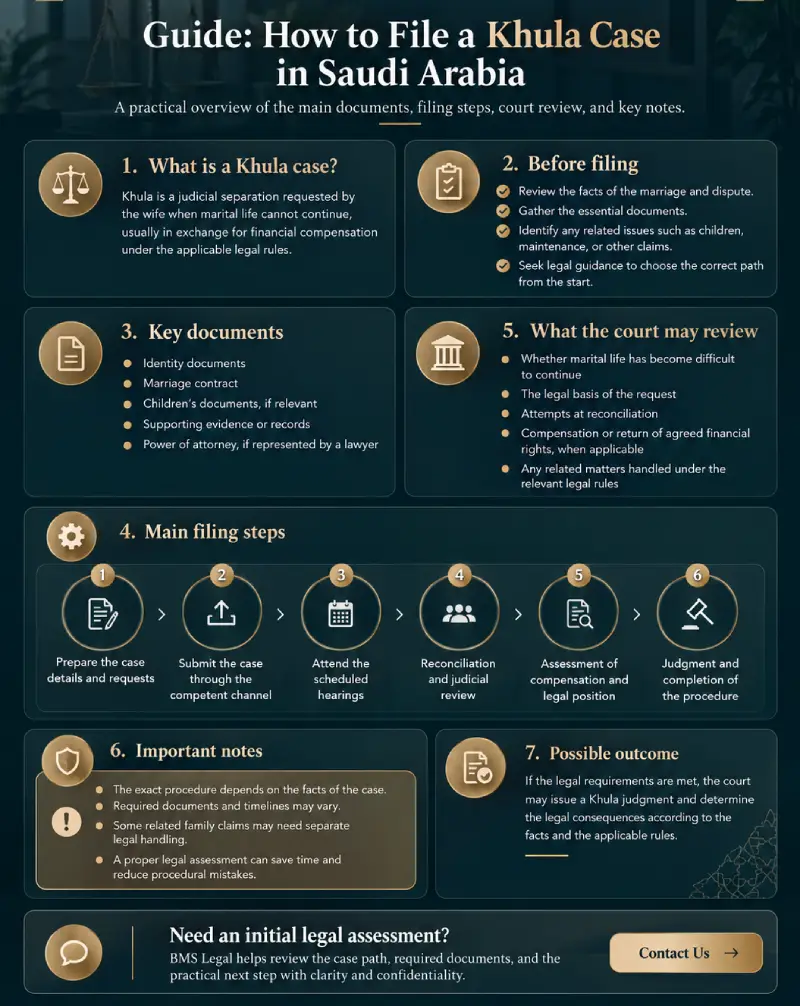
How to File a Khula Case in Saudi Arabia Step by Step
If the case is not suitable for documentation, the practical process of filing a Khula claim begins.
The Ministry of Justice explains that submitting a Statement of Claim involves several steps, including accessing the service, entering the applicant’s and parties’ information, completing the claim details, attaching the required documents, submitting the application, and then following it using the application number.
The Ministry also states that if information or documents are missing, the applicant will receive a notification requesting completion of the missing requirements.
The main steps are:
- Access the appropriate service: Log in to Najiz through the National Single Sign-On system. If the matter is disputed, select the Statement of Claim service. If there is already an agreement on the Khula and compensation, review the Khula documentation service instead of filing a court case that may not be necessary.
- Identify the correct type of application: This is where the distinction between a Khula case and other forms of marital separation becomes important. The application should be clear from the outset: is the request for Khula in return for compensation, or do the facts point to a different legal route? Khula has its own definition and legal consequences and should not be treated as a general term for every method of ending a marriage.
- Enter the parties’ details and the facts: After selecting the service, complete the applicant’s details, the other party’s details, and the facts and details of the claim. The relevant supporting documents should then be attached.
- Upload the supporting documents: It is practical to prepare the marriage contract or its details, information showing the amount of the dowry and what has actually been received, and any information concerning children where relevant to the facts. Compensation is a fundamental element of Khula because Saudi Family Law provides that Khula may not take effect without compensation.
- Follow up on the application: Submission is not the final step. Monitor the status of the application and respond to any requests for completion or further information. Many procedural difficulties do not arise from the underlying claim itself but from missing information or unclear drafting.
Before submitting, review the following:
- Have you selected documentation or a court claim?
- Are the marriage contract details clear?
- Is the compensation, or your willingness to provide it, stated clearly?
- Is the requested relief concise and specific?
- Are the essential supporting documents ready?
A clear desire to end the marriage is not sufficient on its own. Understanding the requirements for Khula in Saudi Arabia helps determine whether the case genuinely belongs under the Khula route or whether the facts are closer to dissolution of marriage, divorce, or another family-law claim.
What Should You Prepare Before Filing?
A successful Khula application often begins before you even open the Najiz platform.
The most important preparation is gathering enough information to make the application clear from the beginning. According to the Ministry of Justice, essential requirements for filing a Statement of Claim include the parties’ identification details, national address, and supporting documents where required.
Useful basic information includes:
- Basic details of both spouses.
- Marriage contract details.
- The amount of the dowry and the portion actually received.
- Information concerning children where related matters are relevant.
- Any facts that may affect the legal classification of the dispute.
Useful supporting documents may include:
- A copy of the marriage contract or its details.
- Evidence showing the dowry or the amount actually received.
- Documents relating to children where connected issues arise.
- Any documents that assist in understanding the relevant facts.
If some information is incomplete, avoid filling gaps with inaccurate estimates.
It is generally better to complete the essential information first and then prepare the application based on clear facts. Where the situation is complicated, an initial assessment may be more useful than filing prematurely.
Khula Application Template and Statement of Claim Sample
Many women search for a Khula application template in Saudi Arabia because they are looking not only for an explanation of the procedure but also for a practical example of how the request may be written.
The application does not require unnecessarily complex legal language. It should, however, clearly identify the parties, confirm the existence of the marriage, state the request for Khula, and address the compensation.
Short Khula Application Template
I submit this application in my capacity as the wife of the respondent under an existing marriage contract. As continuation of the marital relationship has become impossible, I request termination of the marriage through Khula in return for the appropriate legal compensation as established according to the circumstances of the case.
Clearer Khula Application Template in Saudi Arabia
I, the claimant (…), am the wife of the respondent (…) under an existing marriage contract. Due to the inability to continue the marital relationship and my firm desire to separate, I request a judgment terminating the marriage through Khula in return for the appropriate legal compensation, while preserving any rights that may not legally constitute compensation for Khula.
Sample Statement of Claim for Khula
To the Honorable Competent Court,
Peace be upon you,
I, the claimant (…), submit this claim against the respondent (…). I am his wife under an existing marriage contract. Continuation of the marital relationship between us has become impossible, and it is no longer possible for the marriage to continue in a manner that achieves its intended purpose.
I therefore request termination of the marriage through Khula in return for the appropriate legal compensation as established in the case, while preserving any rights that may not legally constitute compensation for Khula.
May Allah grant success.
Grounds for a Khula Claim
When discussing the grounds for a Khula claim, this refers to the factual and legal basis upon which the application is built.
Important elements include:
- An existing marriage contract.
- A clear request for Khula.
- Inability to continue the marital relationship.
- The existence of compensation or willingness to provide it.
- Avoiding confusion between Khula and a different legal route.
Common Drafting Mistakes
The most frequent mistakes in a Khula Statement of Claim include:
- Drafting the request in overly general terms.
- Failing to address compensation.
- Confusing Khula with divorce or dissolution of marriage.
- Combining numerous unrelated requests in a single, unstructured claim.
Compensation, Return of the Dowry, and Children’s Rights in Khula
This is one of the most important sections for anyone asking how to file a Khula case or what the Khula procedure involves.
In practice, much of the confusion does not concern the application itself, but rather the compensation, the dowry, and the rights of children.
Saudi Family Law provides that anything deemed property may be used as compensation for Khula. However, it imposes an important restriction: waiving any of the children’s rights or relinquishing their custody may not constitute compensation.
The law also provides that where the compensation for Khula is the dowry, the compensation is limited to the portion of the dowry actually received, while the remainder is forfeited even if it had been deferred.
Khula therefore does not automatically erase every right or obligation connected with the marriage. Compensation has a defined scope, children’s rights are independently protected, and some financial consequences must be considered separately.
This is why understanding the wife’s rights after Khula requires attention to the details: what may form part of the compensation, what cannot legally be waived, and what remains connected to children, documents, or the final judgment.
In practical terms:
- Compensation is a fundamental element of Khula.
- The portion of the dowry actually received is particularly relevant when the dowry itself is the compensation.
- Children’s rights cannot form part of the compensation.
- A dispute over compensation may make the case more complex.
What If the Husband Refuses Khula?
Many women search for the court procedure for Khula when the husband refuses because they assume that refusal closes the matter entirely.
However, refusal does not necessarily mean that all procedural options have ended. It generally means that the consensual documentation route cannot be completed and that the matter may need to move to the judicial route.
In such a situation, filing through the appropriate judicial procedure becomes the practical next step, with particular importance placed on preparing a clear and specific Statement of Claim.
The Ministry of Justice provides the Statement of Claim service within its judicial services for this purpose.
Where the husband refuses or the dispute over compensation is complicated, consulting a Khula Lawyer in Jeddah may help determine the most suitable route before filing.
How Long Does a Khula Case Take?
There is no single fixed duration that applies to every Khula case.
The timeframe varies depending on whether the spouses agree, whether the required information is complete, whether compensation is disputed, and the nature of the facts involved.
As a practical matter, the documentation route is naturally faster than a disputed court proceeding because documentation is based on agreement, whereas litigation involves a dispute requiring judicial consideration.
What Is the Difference Between Khula, Divorce, and Dissolution of Marriage?
Understanding this distinction is essential because many procedural mistakes begin when these terms are treated as though they were interchangeable.
Khula has its own legal definition and rules. Divorce is governed by separate provisions, while dissolution of marriage has its own grounds and legal effects.
Saudi Family Law provides that Khula results in dissolution of the marriage contract even if it is expressed using the wording of divorce. It is treated as a minor irrevocable separation and does not take effect without compensation.
If you are still deciding between Khula and divorce, reviewing the role of a Divorce Lawyer in Jeddah may help clarify the practical differences between the available routes according to the circumstances of your case.
When Can a Lawyer Be Helpful?
Not every electronic Khula application involves the same level of complexity.
Legal assistance may be particularly useful where the facts overlap, compensation is disputed, there are related issues involving children, or there is uncertainty over whether Khula or another legal route is appropriate.
In such cases, the value of legal assistance is not merely in escalating the dispute. It can also help identify the correct procedural route before the case begins.
Frequently Asked Questions About How to File a Khula Case in Saudi Arabia
1. How do I file a Khula case in Saudi Arabia?
Use Najiz. If both spouses agree, Khula can usually be documented electronically; if there is a dispute, file a Statement of Claim.
2. What if the husband refuses Khula?
The wife may proceed through the judicial route by filing a Khula claim before the competent Family Court.
3. Is compensation required for Khula?
Yes. Khula requires compensation, which is often linked to the dowry or another agreed lawful amount.
4. Do I need witnesses to file a Khula case?
Generally, witnesses are not required at the initial filing stage of a Khula claim.
5. How long does a Khula case take in Saudi Arabia?
There is no fixed duration. It depends on whether there is agreement, the completeness of documents, and any dispute over compensation.
How to File a Khula Case in Saudi Arabia: 5 Steps starts with identifying the correct route: Khula documentation when both spouses agree, or a judicial claim when there is a dispute.
You should then prepare the essential information and documents, draft the request clearly, and pay particular attention to compensation and children’s rights, as these are among the issues most likely to affect the process.
Where the circumstances are unclear, the husband refuses, or compensation is disputed, an early legal assessment may help reduce unnecessary procedural steps.
If the facts are unclear, the husband refuses, or there is a dispute over the compensation, contact us for initial guidance on the next step that may be appropriate for your situation.
Official References: