
Article 83 of the Saudi Labor Law regulates contractual restrictions intended to protect an employer after the employment relationship ends, particularly non-compete obligations and the non-disclosure of business secrets. A written clause in an employment contract does not, by itself, mean that the restriction will apply in every situation. The law sets requirements relating to the employee’s role, the wording of the clause, its duration, geographic scope, and the type of work covered.
Article 83 becomes particularly relevant when an employee moves to another business, starts a competing venture after resignation, or has had access to client information or the employer’s confidential business information. The clause should therefore be read together with the employment contract, the employee’s actual duties, and the surrounding facts, rather than in isolation from the wider provisions of the Saudi Labor Law.
What Does Article 83 of the Saudi Labor Law Cover?
Article 83 deals with two distinct situations after an employment relationship ends: competition that may affect the employer’s client relationships and disclosure of business secrets that the employee learned through their work.
The distinction is important because the conditions governing a non-compete obligation should not automatically be treated as identical to those governing confidentiality and non-disclosure obligations.
Non-Compete Clause
Where an employee’s work allows them to become acquainted with the employer’s clients, Article 83 permits the parties to agree that the employee will not compete with the employer after the employment relationship ends.
This protection is connected to a legitimate business interest. It should not be treated as an unlimited prohibition preventing the employee from working or making use of their professional experience in every field.
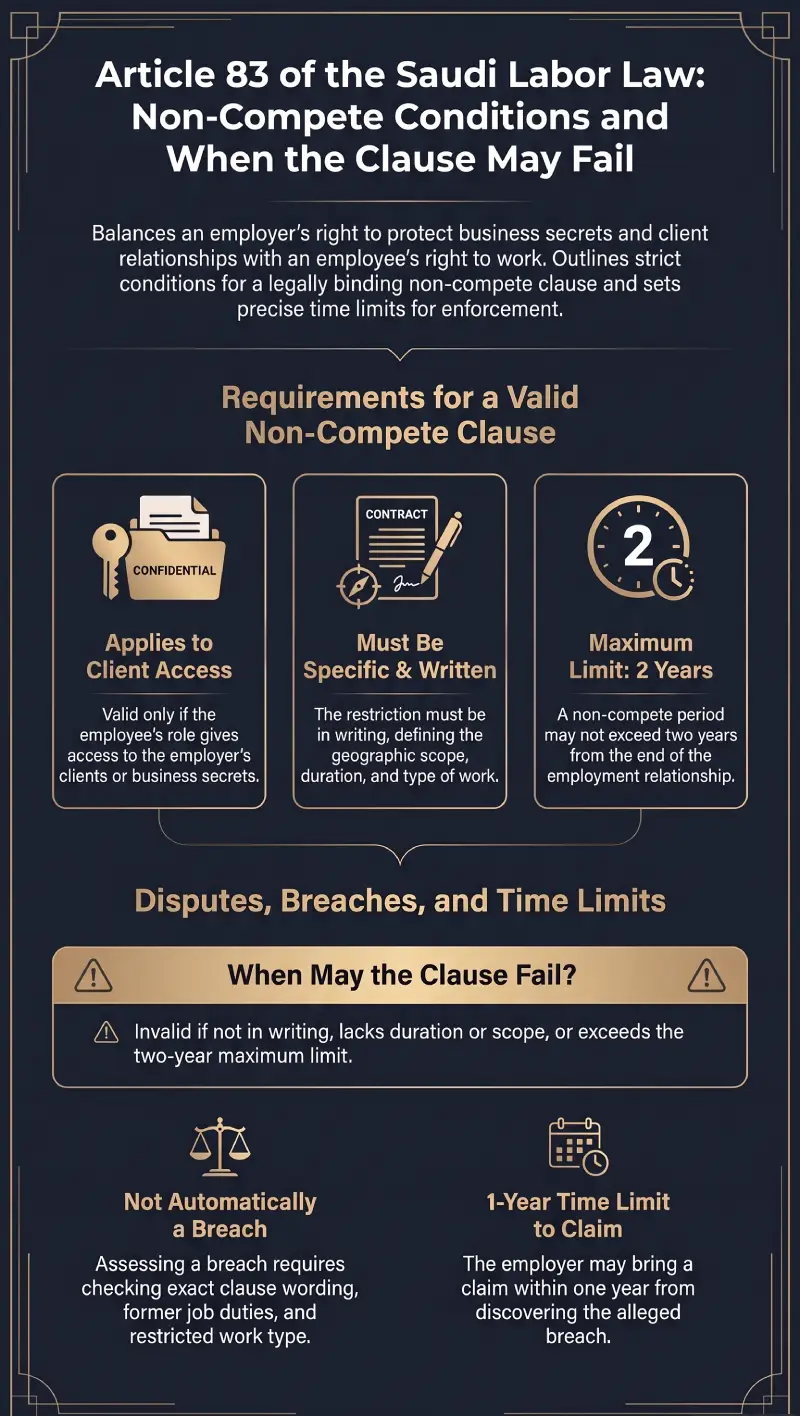
A non-compete clause in an employment contract must be in writing and must define three core elements: the period of restriction, its geographic scope, and the type of work covered. The law also provides that the non-compete period may not exceed two years from the date the employment relationship ends. (Ministry of Human Resources and Social Development)
Assessing the clause therefore begins with the employee’s actual position. A role that gives an employee meaningful knowledge of the employer’s clients is different from a position that provides no such access.
Non-Disclosure of Business Secrets
The second situation concerns an employee whose role gives them access to the employer’s business secrets. The parties may agree that those secrets must not be disclosed after the employment relationship ends, provided the restriction is written and specifies its duration, geographic scope, and type of work.
The paragraph governing business secrets does not state the same two-year maximum that appears expressly in the provision dealing with non-compete restrictions. The two-year limit should therefore not automatically be applied to every confidentiality obligation. Each restriction must be considered according to its wording and the facts surrounding the employment relationship. (Ministry of Human Resources and Social Development)
What Are the Requirements for a Valid Non-Compete Clause?
The requirements governing a non-compete clause are not merely drafting details. They determine the scope of the agreed restriction. The broader or less specific the wording is, the more closely the clause needs to be examined against the requirements of Article 83.
| Requirement | What Should Be Checked? |
|---|---|
| Written form | Is the restriction recorded in the employment contract or a related written agreement? |
| Duration | Does the clause specify a period that does not exceed two years? |
| Geographic scope | Does it identify the area in which the restriction applies? |
| Type of work | Does it identify the activity or work covered by the restriction? |
| Nature of the role | Did the employee’s position allow access to the employer’s clients? |
Written Form and Duration
The restriction must be in writing. A purely verbal understanding is therefore insufficient to establish the type of post-employment non-compete obligation regulated by Article 83.
The clause must also specify its duration. The maximum period stated by the law is two years from the end of the employment relationship.
When considering how long a non-compete clause can last in Saudi Arabia, two years is the statutory maximum rather than a mandatory period for every agreement. A shorter period may be used depending on the nature of the business and the interest being protected.
Geographic Scope and Type of Work
The clause should also identify where the restriction applies and the type of activity covered.
A provision that broadly prevents an employee from carrying out any work is materially different from a clause that identifies a particular activity within a specific geographic area.
A geographic restriction covering “the entire Kingdom of Saudi Arabia” cannot be classified as valid or invalid solely because of that wording. The employer’s business operations, the employee’s duties, the interest being protected, and the remaining terms of the clause should all be considered.
When Can a Non-Compete Clause Be Invalid or Disputed?
Determining when a non-compete clause may fail begins with the requirements set out in Article 83 itself. If the clause is not in writing, or does not adequately specify its duration, place, or type of work, a direct issue arises as to whether it satisfies the statutory requirements.
A dispute over the clause should not be confused with a predetermined court outcome. Depending on the case, the disagreement may concern the meaning of the restricted activity, the employee’s access to clients, the geographic limits of the clause, or the date from which the restriction began to run.
A Non-Compete Period Exceeding Two Years
Article 83 provides that a non-compete restriction may not exceed two years from the end of the employment relationship.
A clause drafted for a longer period therefore raises an issue regarding its consistency with the statutory limit. The legal effect should be assessed in light of the complete wording of the agreement and the relief being sought in the dispute. (Ministry of Human Resources and Social Development)
The employee or employer should not base a decision on one sentence taken from the contract. The agreement should be reviewed as a whole, particularly where it contains separate provisions governing confidentiality, client dealings, or the use of information after termination.
Can an Employer Prevent an Employee from Working for a Competitor?
The existence of a non-compete clause does not automatically mean that every move to another company constitutes a breach.
Article 83 deals with an agreement preventing an employee from competing with the employer after the employment relationship ends. Applying the clause therefore requires an examination of its wording, the employee’s former position, the new role, and the nature of the competing activity.
When an employee joins another company operating in the same industry, relevant questions may include: Did the employee know the former employer’s clients? Does the new role fall within the type of work identified in the clause? Is the agreed restriction still within its stated period? Is the new activity taking place within the agreed geographic area?
Working for a Competitor After Resignation
Resignation does not, by itself, make a non-compete clause enforceable or unenforceable.
The central questions are whether a restriction satisfying Article 83 exists and whether it applies to the employee’s circumstances after the employment relationship has ended.
Before accepting a role with a competitor, the employee should compare the proposed position with the activity identified in the clause. The analysis may differ where the employee is moving to a different market, carrying out different duties, or working in a substantially different part of the industry.
Starting a Competing Business
The issue may become more direct where a former employee establishes a business that carries out the activity expressly identified in the non-compete clause during the agreed period and within the specified geographic area.
This may be particularly relevant where the employee’s former role gave them access to the employer’s clients.
Even in this situation, however, the wording of the clause remains important. Merely starting a business in the same industry does not remove the need to examine the requirements of Article 83 and the limits of the parties’ agreement.
What Is the Difference Between Non-Compete and Protection of Business Secrets?
A non-compete obligation and a confidentiality obligation serve different purposes.
A non-compete clause restricts specified competitive activity after the employment relationship ends. A confidentiality obligation focuses on protecting information and business secrets that the employee learned through their work.
The obligation to preserve certain business secrets also applies during employment. The Saudi Labor Law requires employees to preserve technical, commercial, industrial, and professional secrets where disclosure could harm the employer’s interests. In addition, Article 80 of the Saudi Labor Law addresses disclosure of industrial or commercial secrets in the context of an ongoing employment relationship.
After the contract ends, Article 83 regulates agreements restricting disclosure of business secrets through written terms defining the relevant duration, place, and type of work.
The rules governing competition and confidentiality should therefore not be merged into a single rule, and the two-year maximum applicable to non-compete restrictions should not automatically be assumed to govern both.
| Issue | Non-Compete | Non-Disclosure of Business Secrets |
|---|---|---|
| Interest protected | Competition connected with clients | Employer’s business secrets |
| Basis under Article 83 | Employee’s role allows access to clients | Employee’s role allows access to business secrets |
| Written agreement | Required | Required |
| Duration, place and type of work | Must be specified | Must be specified |
| Two-year maximum | Expressly stated | No equivalent maximum stated in the second paragraph |
What Happens If a Non-Compete Clause Is Breached?
Article 83 does not impose a fixed monetary penalty merely because a non-compete clause has been breached.
It does, however, allow the employer to bring a claim after discovering a breach of one of the obligations regulated by the Article. The wording of the clause, the facts of the case, and the available evidence therefore become central to the dispute.
Depending on the circumstances, relevant documents may include the employment contract and its amendments, the job description, evidence showing the employee’s access to clients or business secrets, documents concerning termination of employment, evidence of the later activity being challenged, and communications associated with the alleged breach.
A specific amount of compensation cannot be assumed from Article 83 alone because the Article does not establish a fixed compensation figure. Any financial claim will depend on the legal basis relied upon, the evidence, the alleged loss, and what can be established before the competent authority.
A non-compete dispute also does not automatically cancel the employee’s financial entitlements. Final settlement of employment rights is governed by separate provisions, including Article 88 of the Saudi Labor Law, while a non-compete dispute must be considered according to Article 83, the contractual terms, and the relevant facts and documents.
The employer should also document the date on which the alleged breach was discovered because that date is directly relevant to the time limit for bringing a claim.
How Is a Claim for Breach of a Non-Compete Clause Filed?
The duration of the non-compete obligation must be distinguished from the time limit for bringing a claim.
The non-compete restriction itself may not exceed two years. By contrast, the third paragraph of Article 83 allows the employer to bring a claim within one year from the date the employer discovers the employee’s breach of an obligation regulated by the Article. (Ministry of Human Resources and Social Development)
Time Limit for Filing a Non-Compete Claim
Under the wording of Article 83, the one-year period begins from the date the breach is discovered, rather than simply from the date the employment contract ends.
Evidence establishing when the employer became aware of the alleged competing activity or disclosure may therefore be important where the filing period itself becomes disputed.
Relevant evidence may include correspondence, documents, or other facts relied upon to establish when the employer first discovered the alleged breach.
Amicable Settlement and the Labor Court
The Ministry of Human Resources and Social Development describes amicable settlement of labor disputes as the first stage for considering disputes between employers and employees.
If settlement cannot be reached, a record of unsuccessful settlement is issued, after which the claimant may proceed before the competent Labor Court in accordance with the applicable procedures. (Ministry of Human Resources and Social Development)
The Ministry also identifies a service period of 21 business days and lists basic supporting documents, including the employment contract where available, evidence of the contractual relationship, and documents relevant to the type of claim.
How Should You Review a Non-Compete Clause Before Signing or Before a Dispute?
Reviewing the clause early can help both employees and employers understand its limits before the issue develops into a dispute.
The review should not begin and end with the heading “non-compete.” It should consider the employee’s actual position, the wording of the agreement, and the specific business interest the restriction is intended to protect.
Where the clause affects a new job offer, reviewing the employment agreement and related documents with a labor lawyer in Jeddah can help clarify the scope of the obligation, its connection to the employee’s role, and the appropriate legal step before action is taken.
For an employee, the review should focus on the duration, geographic scope, and activity identified in the clause and compare them with future career plans.
For an employer, the review should consider whether the restriction is actually connected to positions that involve knowledge of clients or access to business secrets, and whether the wording is specific rather than excessively general.
Where a dispute already exists, useful documents include:
- The employment contract and any amendments.
- The non-compete clause or confidentiality agreement.
- The employee’s job description.
- The date and method by which employment ended.
- Documents showing the nature of the clients or business secrets connected with the role.
- Evidence concerning the alleged breach.
- Evidence showing when the breach was discovered, where the employer intends to bring the claim.
Practical Examples Under Article 83 of the Saudi Labor Law
Practical scenarios help illustrate the difference between merely having a clause in an employment contract and establishing that the restriction applies to a particular situation.
The examples below do not determine the legal outcome of an individual case because the result depends on the agreement and supporting documents.
- Sales employee with access to clients: If the employee’s contract contains a defined non-compete restriction and the employee later carries out competing activity within the agreed period and geographic area, their knowledge of clients and the nature of the new activity may be important in assessing the dispute.
- Employee with no client contact: If the employee’s position did not allow them to become acquainted with the employer’s clients, that fact may be directly relevant when examining the basis for a non-compete restriction under the first paragraph of Article 83.
- Employee with access to technical secrets: The dispute may not be limited to competition. A separate non-disclosure obligation may become the central issue and should be assessed independently under the requirements applicable to business secrets.
Frequently Asked Questions About Article 83 of the Saudi Labor Law
What is Article 83 of the Saudi Labor Law?
Article 83 regulates post-employment non-compete restrictions and agreements concerning non-disclosure of business secrets. It sets specific requirements for the circumstances in which those restrictions may be agreed.
When is a non-compete clause valid in Saudi Arabia?
The clause must be in writing and specify its duration, geographic scope, and type of work. The employee’s role must also allow them to become acquainted with the employer’s clients, and the non-compete period may not exceed two years.
Does simply working for a competitor amount to a breach?
Not necessarily. The answer depends on the wording of the non-compete clause, the former and new roles, the restricted activity, the applicable period, the geographic scope, and the employee’s connection with the former employer’s clients.
Does the two-year limit apply to a confidentiality clause?
The two-year maximum is expressly stated for non-compete restrictions. The paragraph governing non-disclosure of business secrets requires the restriction to be written and defined by duration, place, and type of work, but does not state the same two-year maximum.
Does breaching a non-compete clause cancel an employee’s final entitlements?
Article 83 does not itself provide that a non-compete dispute automatically cancels an employee’s financial entitlements. Final settlement is governed by separate provisions of the Saudi Labor Law.
How long does an employer have to bring a claim under Article 83?
Article 83 allows the employer to bring a claim within one year from the date the employer discovers the employee’s breach of an obligation governed by the Article.
Article 83 of the Saudi Labor Law: Non-Compete Limits is ultimately applied by examining the wording of the restriction together with the employee’s role and the surrounding facts, rather than relying solely on the presence of the words “non-compete” in an employment contract.
Written form, duration, geographic scope, type of work, and the employee’s access to clients are central to assessing a non-compete restriction. Protection of business secrets, meanwhile, should be considered under its own requirements.
If an employee is considering a move to a new role or business, or an employer has discovered activity that may breach an existing restriction, the practical starting point is to gather the employment contract, amendments, job description, and documents connected with the relevant conduct. Those materials help identify whether the dispute concerns the validity of the clause, its scope, an alleged breach, or the procedure that should follow.
Where an employee or employer needs a review of an existing restriction or documents relating to an active dispute, a law firm in Jeddah can review the agreement and relevant facts and help identify the appropriate legal route before the next step is taken.