
The penalty for assaulting a teacher in Saudi Arabia is not the same in every case. It depends on the nature of the assault, the legal status of the parties, the purpose behind the act, the resulting harm, and the available evidence.
An assault may be physical, such as hitting or pushing a teacher; verbal, such as insults or threats; or digital, such as defamation or misuse of recording and publishing tools.
Legal classification becomes particularly important when the teacher qualifies as a public employee or when force, violence, or threats are used to prevent the teacher from carrying out a legally assigned duty.
The applicable procedure may also differ depending on whether the alleged offender is a minor student or an adult parent. For that reason, the facts of the incident must be reviewed before determining the potential penalty or any private-right claim.
Not every assault on a teacher is punishable by
ten years’ imprisonment and a SAR 1 million fine.
The penalty may reach that level only when the
conditions of Article 7 of the Saudi Anti-Bribery Law
are met, including the use of force, violence, or threats against a public employee
to obtain an unlawful act or to cause the employee to refrain from performing a legally assigned duty.
What Is the Penalty for Assaulting a Teacher in Saudi Arabia?
Determining the penalty begins with identifying the nature of the incident. Physical assault is not treated in exactly the same way as threats, and online defamation raises different issues from a verbal confrontation.
Similarly, the use of force to prevent a public employee from performing an official duty may have a different legal classification from an assault that does not contain those elements.
The main issues can be summarized as follows:
| Type of incident | Main legal issue to examine |
|---|---|
| Hitting a teacher | Injury, nature of the act, and evidence |
| Force or threats connected with official duties | Whether Article 7 of the Anti-Bribery Law applies |
| Insulting or verbally abusing a teacher | Words used, context, and proof |
| Assault by a student | Student’s age, school procedures, and Juvenile Law |
| Recording or online defamation | Privacy, publication method, and resulting harm |
| Compensation claim | Proven damage and its connection to the act |
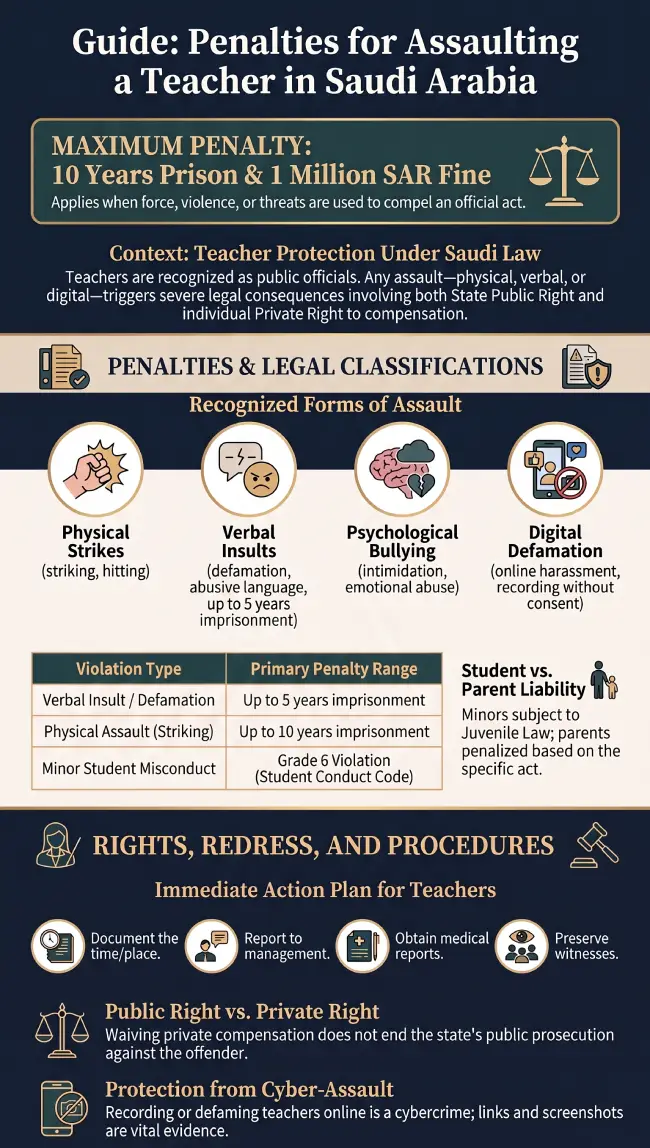
Penalty for Physically Assaulting a Teacher
The penalty for physically assaulting a teacher depends on the circumstances of the case and the injury or harm caused.
Hitting, pushing, or using an object against a teacher generally requires proof that the act occurred, that it can be attributed to the alleged offender, and that the claimed injury resulted from the incident.
A medical report can be important evidence of the nature and extent of an injury. However, it does not necessarily establish by itself who caused that injury. Witness testimony, recordings, incident reports, and other evidence may therefore be relevant.
Rules on evidence and private-right claims vary according to the facts, as explained in the rules governing the penalty for assault and battery under Saudi law, including proof of harm and the process for pursuing individual rights.
Verbal Assault or Threats Against a Teacher
The legal consequences of verbally assaulting or threatening a teacher depend on what was said or done, the context in which it occurred, the method used, and whether the conduct satisfies the elements of a particular offence.
Insults, verbal abuse, and threats do not automatically carry the same legal classification. The actual words or conduct must be identified, together with the person to whom they were directed and the available evidence.
If violence or threats are directed at a public employee for the purpose of making that employee refrain from performing an assigned duty, or to obtain an unlawful act, Article 7 of the Anti-Bribery Law may become relevant if all statutory elements are satisfied. (Saudi Anti-Bribery Law)
Can the Penalty Reach 10 Years in Prison and SAR 1 Million?
Yes, in specific circumstances the maximum penalty may reach imprisonment for up to ten years and a fine of up to SAR 1 million, or either penalty.
This is not, however, the automatic penalty for assaulting a teacher in Saudi Arabia in every physical or verbal assault case.
Article 7 of the Anti-Bribery Law refers to the penalty prescribed in Article 1 when force, violence, or threats are used in the manner and for the purpose specified by the Law. (Saudi Anti-Bribery Law)
Accordingly, the ten-year imprisonment term and SAR 1 million fine do not apply merely because a teacher was hit. The legal status of the teacher, the purpose of the force or threat, and the other elements of the incident must first be established.
When Does Article 7 of the Anti-Bribery Law Apply?
Article 7 requires two central elements.
First, force, violence, or threats must be used against a public employee.
Second, the conduct must be intended either to obtain an unlawful act from that employee or to cause the employee to refrain from performing a duty assigned by law.
For example, force used to compel a teacher who qualifies as a public employee to unlawfully change an official decision may raise Article 7 issues. The same may apply to threats intended to prevent that teacher from carrying out an official responsibility.
A disagreement, argument, or assault by itself is not sufficient to conclude automatically that Article 7 applies.
Is Every Teacher Considered a Public Employee?
Teachers should not automatically be given the same legal status without considering their employer and legal position.
Article 8 of the Saudi Anti-Bribery Law identifies the categories treated as public employees for the purposes of the Law. These include individuals working for the State or entities with public legal personality, along with other categories expressly identified by the legislation.
The status of a government-school teacher or an employee of a public entity is therefore generally clearer when considering Article 7.
By contrast, a teacher working for a private educational institution should not automatically be treated as having the same status without examining the nature of the employer and whether it falls within a category covered by Article 8.
What Is the Penalty When a Student Assaults a Teacher?
When the alleged offender is a student, a distinction should be made between disciplinary measures taken within the school and any separate legal liability arising from the conduct.
The student’s age is particularly important because Saudi law distinguishes between juveniles and adults.
The Rules of Conduct and Attendance for General Education Students regulate school disciplinary procedures relating to student misconduct, while students who qualify as juveniles are subject to the specific legal rules applicable to that age group.
Penalty for a Student Hitting a Teacher
A student who hits a teacher may face disciplinary action under the applicable school conduct rules, in addition to any other legal process required by the nature of the incident.
Where the student is at least seven but under eighteen years of age, the student falls within the definition of a juvenile under the Saudi Juvenile Law.
The procedures, safeguards, and measures applicable to juveniles therefore apply instead of automatically treating the student in the same way as an adult offender.
The student’s age, the nature of the assault, the resulting harm, and the surrounding circumstances may all affect the handling of the case.
A Student Insulting or Threatening a Teacher
Insults and threats are not automatically treated in the same way as physical assault.
The actual statement, message, or conduct must be examined, together with whether it occurred in person or through a digital platform and what evidence is available.
Evidence may include testimony from students or staff members, messages, recordings, or other relevant material.
Where a conversation or recording is relevant, preserving the complete context is generally important because an isolated excerpt may not accurately reflect what occurred before, during, and after the incident.
What Is the Penalty if a Parent Assaults a Teacher?
The penalty for a parent assaulting a teacher is determined by the conduct itself. There is no single penalty that applies merely because the alleged offender is the parent of a student.
The incident may involve hitting, threats, verbal abuse, or online defamation, and each form of conduct has its own legal elements and evidentiary issues.
Article 7 of the Anti-Bribery Law may apply in some cases if the teacher qualifies as a public employee and force or threats were used for the specific purpose required by the Law.
A teacher who suffers harm may document the incident, pursue the appropriate legal procedure, and assert a private-right claim where the relevant requirements are met.
Can a Teacher Bring a Claim Against a Parent?
A person who suffers harm as a result of an offence may pursue a private-right claim during the investigation or before the court hearing the public criminal action.
The Saudi Criminal Procedure Law provides for private-right claims during the investigation and before the court hearing the public criminal case.
The fact that the alleged offender is a student’s parent does not prevent a teacher from seeking a remedy where harm can be proven and connected to the incident.
Proof of the assault and determination of the amount of compensation are separate issues, each of which depends on the evidence and circumstances of the case.
What Should a Teacher Do After an Assault?
Taking appropriate steps early can help preserve evidence and reduce the risk that important information is lost.
A teacher does not need to use complicated legal terminology when documenting the incident. The important point is to record what happened in chronological order, identify the people who were present, note the resulting harm, and preserve relevant documents or recordings.
Initial practical steps may include:
- Record the date, location, and sequence of events.
- Document the incident with the employer where appropriate.
- Obtain a medical report where an injury requires examination or treatment.
- Identify witnesses and any relevant CCTV cameras or recordings.
- Preserve messages, videos, links, and digital files in their original form.
How Can a Teacher Prove the Assault?
There is no single form of evidence that applies to every assault case.
Evidence may include medical reports, witness testimony, CCTV footage, recordings, incident reports, messages, admissions, and digital evidence.
A medical report can establish the nature and medical effects of an injury. Attribution of the act to a particular person may, however, depend on other evidence and surrounding circumstances.
Relevant original documents and files should therefore be preserved and not altered or deleted while they may still be required.
What Should Be Done During the First 24 Hours?
If the incident has just occurred, preserve complete messages, conversations, and recordings. Record the time of the incident and the names of those present, and identify any surveillance cameras that may have captured what happened.
Where an injury occurred, early medical examination can help document the condition close in time to the incident.
For online incidents, the steps for reporting cybercrimes in Saudi Arabia include documenting accounts, links, and conversations and preserving digital evidence before completing the reporting process.
What Is the Private Right in a Teacher Assault Case?
The private right in a teacher assault case relates to the harm personally suffered by the teacher as a result of the incident.
It is distinct from the public criminal action handled by the competent authorities.
An injured party may assert a private-right claim during the investigation or before the court hearing the public criminal case, provided the applicable procedural requirements are satisfied.
A private-right claim should not be confused with the penalty imposed under the public right, because the two have different legal foundations and procedures.
Can a Teacher Claim Compensation?
A teacher may seek compensation where the wrongful act, the damage, and the causal connection between them can be established.
The Saudi Civil Transactions Law provides that a person whose wrongful act causes damage to another may be liable to compensate that damage.
Compensation is intended to restore the loss suffered and may include losses incurred and gains lost where they are a natural consequence of the harmful act.
Saudi law also recognizes compensation for non-material harm.
Examples may include physical or psychological harm resulting from interference with a person’s body, liberty, honour, reputation, or social standing.
The amount of compensation ultimately depends on the nature of the damage and what can be established in the particular case.
Does the Public Right End if the Teacher Waives the Private Right?
Giving up a private-right claim does not by itself mean that the public criminal action automatically ends.
The Criminal Procedure Law recognizes the distinction between the two proceedings and provides that abandonment of a private-right claim does not affect the public criminal action.
Before signing a waiver, it is therefore important to understand exactly which right is being waived and whether a public criminal case, compensation claim, or other related right remains outstanding.
What Is the Effect of Waiving the Private Right?
A waiver concerns the right held by the injured party within the limits permitted by law.
It should not be assumed that every legal consequence of the incident disappears merely because a waiver has been signed.
Its effect may depend on the stage of the proceedings, the legal classification of the incident, and the claims pending before the investigating authority or court.
Before executing a written waiver, the teacher should understand whether it also covers compensation or any other claim the teacher intends to preserve.
What Is the Penalty for Recording or Defaming a Teacher Online?
Recording a teacher does not automatically constitute a cybercrime merely because a recording was made.
Certain forms of recording, publication, or online conduct may, however, fall within the Saudi Anti-Cyber Crime Law if the required legal elements are present.
Article 3 of the Saudi Anti-Cyber Crime Law addresses certain invasions of privacy through misuse of camera-equipped mobile devices or similar technology, as well as defamation and harming others through information-technology methods.
The maximum penalty under Article 3 may reach imprisonment for one year and a fine of SAR 500,000, or either penalty.
Whether Article 3 applies depends on the method of recording or publication, the surrounding context, the harm caused, and whether all elements of the offence are established.
What Digital Evidence Should Be Preserved?
Relevant evidence may include the original URL, account or username, publication date, screenshots, the complete conversation, and original media files.
The original recording should not be altered or deleted before it has been properly preserved because the complete version may help establish context, timing, and source.
Article 3 of the Anti-Cyber Crime Law regulates specific situations involving invasion of privacy, defamation, and harm caused through information technology where the statutory requirements are met.
When Should a Teacher Seek Legal Assistance?
Legal review may be particularly useful where the incident involves a significant injury, continuing threats, an active investigation, disagreement over the legal classification of the conduct, online publication, or a private-right and compensation claim.
Review may also be appropriate before submitting a waiver or an important statement where the consequences could affect the course of the case or financial claims.
If the incident occurred in Jeddah, a criminal lawyer in Jeddah can assist in organizing the facts and evidence and identifying the appropriate legal route according to the current stage of the case.
This content has been reviewed based on the Saudi Anti-Bribery Law, the Criminal Procedure Law, the Juvenile Law,
the Anti-Cyber Crime Law, the Civil Transactions Law, and the Rules of Conduct and Attendance issued by the Ministry of Education.
The final legal classification, penalty, and compensation remain dependent on the facts and evidence of each case.
Frequently Asked Questions About the Penalty for Assaulting a Teacher
1. What is the penalty for assaulting a teacher in Saudi Arabia?
There is no single fixed penalty. It depends on the conduct, harm caused, legal status of the parties, and purpose of the assault. In specific cases, the penalty may reach 10 years’ imprisonment and a SAR 1 million fine.
2. Does everyone who hits a teacher face 10 years in prison?
No. The maximum penalty applies only when the legal requirements of Article 7 of the Saudi Anti-Bribery Law are satisfied.
3. What is the penalty for a student who hits a teacher?
It depends on the student’s age and the circumstances. Juvenile students are subject to the Saudi Juvenile Law in addition to applicable school disciplinary procedures.
4. What is the penalty if a parent assaults a teacher?
The penalty depends on whether the conduct involves physical assault, threats, verbal abuse, or another offence. Article 7 may apply in certain cases involving a teacher who qualifies as a public employee.
5. Can a teacher claim compensation after an assault?
Yes. A teacher may seek compensation where the harm and its connection to the wrongful act can be proven. Compensation may cover both material and non-material damage.
6. Does the public criminal action end if the teacher waives the private right?
Not automatically. Waiving the private-right claim does not by itself terminate the public criminal action under Saudi criminal procedure rules.
Penalty for Assaulting a Teacher in Saudi Arabia: 10 Years? The answer depends on the legal elements of the incident, the status of the parties, and the purpose behind the force or threat. The maximum penalty under the Anti-Bribery Law applies only when its statutory requirements are met, while other forms of assault, threats, or online abuse may fall under different legal rules.
Protecting legal rights begins with documenting the incident, preserving the evidence, understanding the distinction between the public and private rights, and then selecting the appropriate procedure without assuming a particular penalty before the legal elements of the case are established.
BMS Legal for Law Firm and Legal Consultations begins by understanding the facts, identifying the relevant documents, and clarifying the available legal options and scope of service. BMS Legal, a law firm in Jeddah, provides access to the firm’s communication channels and relevant legal practice areas.