
How to Get a Child Custody Document is a practical question that involves more than simply issuing an electronic record through Najiz. The correct procedure depends on whether custody is undisputed and can be documented electronically, or whether an existing dispute requires a custody claim, enforcement proceedings, or an objection to a court judgment.
Families sometimes use the term “custody deed” to describe official proof of custody. In Saudi judicial services, however, the process is generally referred to as custody documentation, with a custody document issued as formal proof. The key issue is therefore not the terminology, but whether the circumstances qualify for electronic documentation through Najiz.
When custody is already established and neither parent disputes it, Najiz documentation may be sufficient. If the father objects, refuses to hand over the children, or fails to comply with an existing custody judgment, the matter may instead require judicial proceedings or enforcement.
This guide covers the Najiz documentation process, its requirements and supporting documents, and the distinction between documentation and a custody claim. It also explains what to do when a request is rejected, when enforcement is required, and when an objection to a custody judgment may be appropriate.
Quick Answer: How Do I Get a Child Custody Document Through Najiz?
You can request a Child Custody Document in Saudi Arabia through the Custody Documentation service available on the Najiz platform.
The service allows a female custodian or her authorized representative to submit a request to document custody of children under 18 in specified circumstances, including divorce, the father’s absence or imprisonment, or certain circumstances affecting his legal capacity, provided that there is no existing custody dispute.
9 Steps to Obtain a Child Custody Document
To request the document through Najiz:
- Sign in to Najiz using National Unified Access.
- Select all electronic services.
- Open the Social Cases services package.
- Select the Custody Documentation service.
- Enter the custodian’s or representative’s information.
- Enter the father’s and children’s information.
- Specify the reason for requesting custody documentation.
- Add the witnesses and required supporting documents.
- Submit the application and monitor the notifications.
After submission, you should receive a notification containing the application number and submission date. Once the application has been reviewed, the witnesses are notified to complete their electronic confirmation. The applicant should therefore verify the information and ensure that the witnesses are ready before submitting the request.
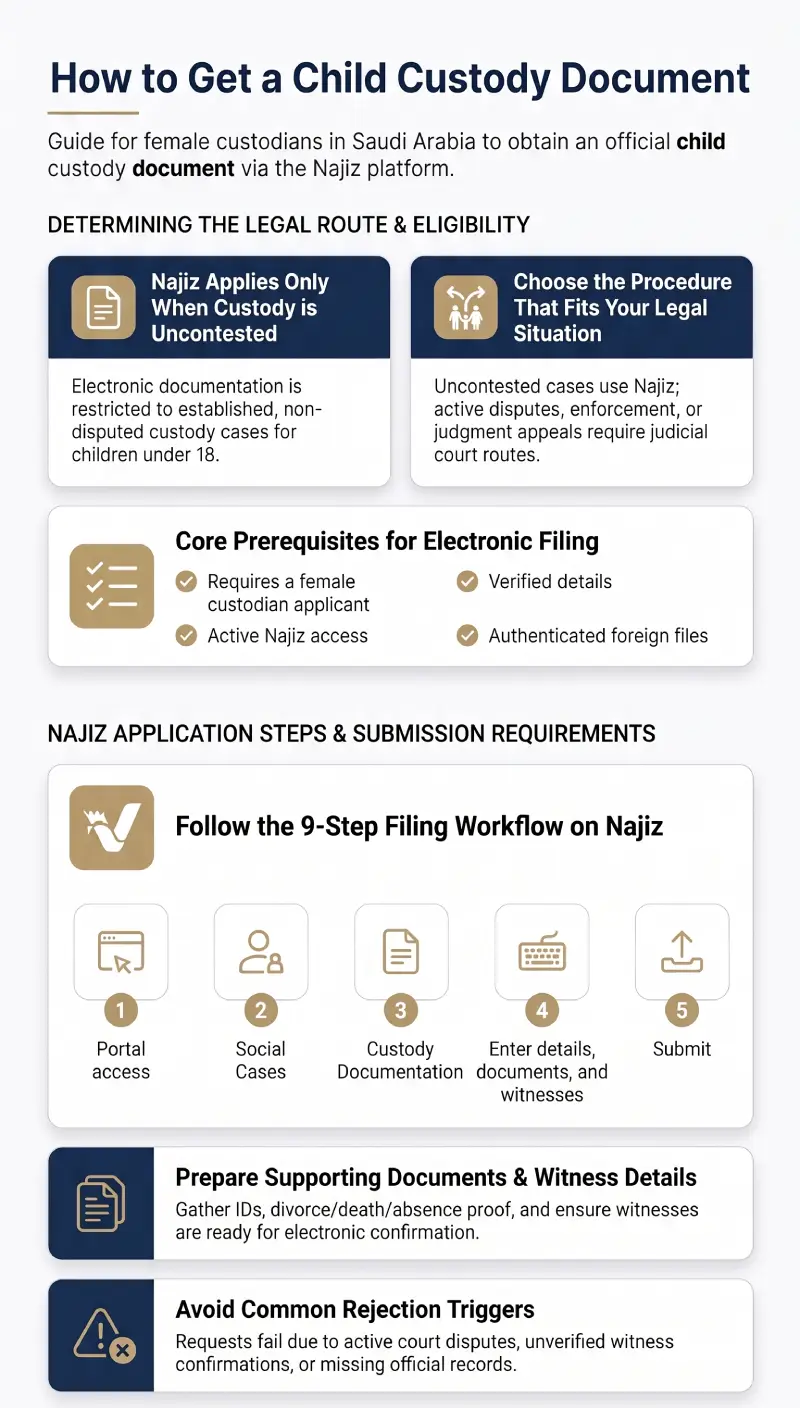
How to Document Child Custody Through Najiz
The process begins through the beneficiary’s Najiz account using National Unified Access. A court visit is generally unnecessary where the case qualifies for electronic custody documentation and no custody dispute is pending.
After signing in, select the electronic services section, open the Social Cases package, and choose the Custody Documentation service.
You will then need to specify the applicant’s capacity and enter the details of the custodian, the father of the child, and the children. You must also state the reason for requesting the document, upload the required supporting records, and enter the witnesses’ information.
Review all information carefully before submitting the application. Once submitted, the applicant receives the application number and date, after which the review and witness-confirmation stage begins.
The application status should be monitored through Najiz. If the reviewing authority identifies missing information or another procedural issue, it should be addressed before resubmitting the request or moving to another legal procedure.
When Is Custody Documentation Enough, and When Is a Custody Claim Required?
Custody documentation through Najiz may be sufficient when custody already exists in practice and there is no dispute between the parents.
If the other parent objects, refuses to hand over the children, or disputes who is legally entitled to custody, electronic documentation alone is generally not the appropriate route. The matter may instead require a custody claim before the competent court because the issue is no longer merely documenting an existing status; it involves resolving a judicial dispute concerning the child’s interests.
A distinction must also be made between litigation, enforcement, and objection. If you already have a custody judgment that has not been complied with, the appropriate route may be enforcement rather than filing a new custody claim. If a custody judgment has been issued and there are grounds to challenge it, an objection may need to be filed within the applicable statutory period.
For a broader explanation of custody requirements, court proceedings, and enforcement, see our guide to child custody rules in Saudi Arabia before deciding which procedure applies.
| Situation | Appropriate Route | Why? |
|---|---|---|
| Custody exists and there is no dispute | Custody documentation through Najiz | The purpose is to formally document the custodian’s status |
| The father or another party objects | Custody claim | The dispute requires a judicial determination |
| A child is not handed over despite an existing right or judgment | Enforcement of the custody judgment | The objective is to compel compliance |
| An unfavorable custody judgment has been issued | Objection to the custody judgment | The challenge concerns an existing judicial judgment |
| Documentation is rejected because information is incomplete | Correct and resubmit the application | The problem may be procedural rather than a custody dispute |
Before searching for a generic custody claim template or statement of claim, determine whether your situation actually requires documentation, litigation, enforcement, or an objection.
Requirements for a Child Custody Document in Saudi Arabia
Knowing the Najiz procedure is only part of obtaining a Child Custody Document in Saudi Arabia. You must first determine whether the case qualifies for electronic documentation rather than requiring a custody claim before the court.
The principal requirements can generally be summarized as follows:
- The applicant must be the female custodian or her legally authorized representative.
- The beneficiary must have access to the Najiz platform.
- A valid power of attorney is required where an authorized representative submits the application.
- The mother’s and children’s information must be accurate and verifiable.
- The children must be under 18 years of age.
- There must be no pending case or existing dispute concerning custody.
- The circumstances must fall within those accepted by the Custody Documentation service.
- Foreign documents must be duly authenticated when submitted as supporting evidence.
Accordingly, applicants should not focus exclusively on how to submit the electronic request. The first question is whether the custody situation itself qualifies for Najiz documentation or instead requires litigation, enforcement, or an objection.
Documents Required for Custody Documentation
The required supporting records vary according to the reason for requesting custody documentation. In many cases, the applicant will need evidence establishing the underlying event, such as a divorce, khula, marriage annulment, death, or the father’s absence.
| Requirement | When Is It Needed? | Important Note |
|---|---|---|
| Identification information | All applications | Details should correspond with official records |
| Children’s information | When submitting the request | Review it before submission to avoid delays |
| Divorce, khula, or annulment document | Following termination of the marriage | Establishes the circumstances supporting the request |
| Father’s death certificate | Where custody is requested following his death | The document must be legally acceptable |
| Evidence of the father’s absence or imprisonment | Where relied upon as the basis of the request | Submit it only when relevant to the stated reason |
| Witness information | During custody documentation | Delayed confirmation may delay processing |
| Power of attorney | Where a representative submits the application | It must contain the appropriate authority |
Are Witnesses Required for a Custody Document?
Yes. The Najiz Custody Documentation service requires witness information to be entered as part of the electronic application. Following the initial review, the witnesses are notified to complete the required electronic confirmation.
Applicants should therefore avoid listing witnesses who are unavailable or unwilling to complete the confirmation process. Identification numbers, dates of birth, and other required details should also be checked carefully before submission to reduce the risk of processing delays.
Obtaining a Custody Document for a Mother After Divorce
Mothers frequently seek a custody document after divorce because they need formal evidence of their legal status as the child’s custodian. The document may be required when dealing with schools, hospitals, or certain administrative bodies handling matters related to children.
Saudi Personal Status Law regulates custody as a responsibility connected to the care and interests of the child. Where a dispute exists, the court considers the circumstances affecting the child’s interests rather than relying solely on the preference of either parent.
When Should a Mother Request a Custody Document?
A mother may request custody documentation where the children are already in her custody and there is no actual dispute over that arrangement. This commonly arises following divorce, khula, or annulment of the marriage when official evidence of custody is required.
If the father does not object and no custody case is pending, documentation through Najiz may be sufficient. If a dispute develops over entitlement to custody, visitation, or guardianship, judicial proceedings may become necessary.
The Saudi child custody law sets out the rules governing custody as a responsibility linked to the child’s interests, including provisions relevant when entitlement to custody or the custodian’s eligibility is disputed.
Can a Custody Document Be Obtained Without the Father’s Consent?
The answer depends primarily on whether an actual custody dispute exists.
If custody is already established, no custody proceedings are pending, and the father has not raised an active objection, a request for a Child Custody Document in Saudi Arabia may proceed through Najiz when the relevant requirements, information, and supporting documents are complete.
If the father expressly disputes or objects to custody, electronic documentation alone will generally not resolve the matter. The relevant facts may need to be presented to the court so that entitlement to custody can be determined judicially.
In disputed cases, consulting a child custody lawyer in Jeddah may help determine the appropriate claims, supporting documents, and evidence relevant to the child’s interests.
Custody Documentation Request Rejected: Reasons and Next Steps
Rejection of a custody documentation request does not, by itself, mean that the applicant has lost the right to custody. The rejection may result from incomplete information or supporting documents, or because the circumstances involve a custody dispute requiring judicial proceedings rather than electronic documentation.
Common reasons for rejection include:
- A custody case is already pending.
- The other party disputes the custody arrangement.
- A supporting document establishing the reason for the request is missing.
- Information is incorrect or does not match official records.
- Witnesses have not completed the required confirmation.
- Foreign documents have not been properly authenticated.
- The applicant used the documentation service for a situation requiring a court claim.
After rejection, first review the reason shown through Najiz. Check the information, attachments, and witness details. If the issue is procedural, it may be possible to correct the application and submit it again.
Where rejection results from an actual dispute, the next step may instead involve filing a custody claim, objecting to an existing judgment, or seeking enforcement, depending on the procedural stage of the case.
If a custody documentation request is rejected, BMS Legal can review the stated reason and determine the appropriate procedural route before resubmission or commencement of court proceedings.
Objecting to a Custody Document or Custody Judgment
A rejected documentation request must be distinguished from an objection to a custody judgment issued by a court.
Rejection of electronic documentation is generally addressed by correcting the application or, where necessary, moving to a custody claim. It does not automatically mean that an appeal should be filed.
Where a court has issued a custody judgment, however, an objection may be available within the applicable statutory time limits. The grounds and strength of the objection depend on the facts, supporting documents, and their relevance to the child’s interests.
When May an Objection Be Appropriate?
An objection may arise where a custody judgment does not adequately reflect facts affecting the interests of the child. Depending on the circumstances, the issue may involve the assessment of evidence, omission of a material fact, or relevant new information.
Simply downloading and copying a generic objection template is not sufficient. A properly prepared objection should identify specific grounds, state the relief requested, and establish the legal connection between the facts relied upon and the requested outcome.
Difference Between Rejection of Documentation and Objection to a Judgment
Rejection of documentation means that the electronic application did not satisfy the service requirements or that the circumstances require a judicial custody claim.
An objection to a judgment, by contrast, is a judicial procedure available after a court has issued a judgment concerning custody.
Searches sometimes refer to an “objection to a custody deed,” but the first practical question should be whether the document involved is an electronic custody document, a judicial custody judgment, or simply a rejected administrative request.
Where the dispute concerns a court judgment, the matter may proceed through the applicable appellate process in custody cases. The objection should address the specific judgment and circumstances rather than rely on a generic template.
What Happens After a Custody Document or Judgment Is Issued?
Once a Child Custody Document in Saudi Arabia has been issued through Najiz, it can be used to establish the custodian’s status before authorities or organizations that require proof, including schools, hospitals, and certain administrative bodies. Keeping an accessible and up-to-date copy can simplify later administrative procedures.
A custody document does not, however, automatically resolve every issue involving the child. Travel, guardianship, visitation, and maintenance may involve separate legal rules and procedures.
Where a dispute concerns the children’s expenses, see our guide to child maintenance after divorce under Saudi law for an explanation of how maintenance may be assessed and which expenses may be included.
If a court has issued a custody judgment but the other party does not comply with it, enforcement may be the appropriate next step rather than filing a new custody claim. If the issue concerns the judgment itself, an objection may need to be filed within the applicable statutory period.
Frequently Asked Questions About Child Custody Documents in Saudi Arabia
1. How do I get a child custody document through Najiz?
Sign in to Najiz through National Unified Access, select Social Cases, choose Custody Documentation, enter the required information and witnesses, attach the documents, and submit the request.
2. Can I get a child custody document without the father’s consent?
It may be possible when custody is already established and there is no active dispute. If the father contests custody, a court claim may be required instead.
3. Are witnesses required for custody documentation?
Yes. The Najiz custody documentation process requires witness information, and witnesses may be asked to complete electronic confirmation after the application is reviewed.
4. Why can a custody documentation request be rejected?
Common reasons include incomplete documents, incorrect information, pending custody proceedings, an existing dispute, incomplete witness confirmation, or a case that requires a judicial custody claim rather than documentation.
If you are searching for How to Get a Child Custody Document: 9 Najiz Steps, the process begins by determining whether your case requires custody documentation, a court claim, enforcement, or an objection. If there is no custody dispute, documenting custody through Najiz may be the appropriate route for formally establishing the custodian’s legal status.
If another party objects, refuses to hand over the child, or a custody case is already pending, a judicial custody claim may be required. Where a judgment has already been issued but has not been complied with, enforcement proceedings may instead be the appropriate procedure.
If the matter involves rejection of a documentation request, an active custody dispute, an objection, or enforcement of an existing judgment, legal assessment may be necessary before choosing the next procedural step. You can contact our legal team to provide a summary of the case and the principal documents for an initial assessment of the appropriate route.
Official Sources: