
The verbal assault penalty in Saudi Arabia depends on what was said, how the statement was made, the medium used, the circumstances surrounding the incident, and the evidence available to prove it. There is no single penalty that automatically applies to every insult or verbally abusive statement, because the legal characterization may differ between direct verbal abuse, online defamation, qadhf, threats, and verbal harassment.
Correct legal characterization determines the applicable law, potential penalty, appropriate procedure, and the evidence that should be preserved before filing a complaint. A sound legal approach therefore begins by establishing what happened, preserving the evidence, and identifying the applicable legal characterization before taking action that could affect either the complainant or the accused.
There is no uniform verbal assault penalty in Saudi Arabia. The legal consequences depend on the words used, the medium, context, and legal characterization of the conduct. Online abuse may fall under the Saudi Anti-Cyber Crime Law when its statutory elements are met, while other forms may be governed differently. Preserving evidence is therefore essential before determining liability or potential penalties.
What Is the Verbal Assault Penalty in Saudi Arabia?
The verbal assault penalty in Saudi Arabia can only be assessed after the conduct has been legally characterized, because “verbal assault” is a broad expression covering incidents with materially different facts and consequences. An incident may involve a direct insult between two people, a statement made publicly before others, an electronic message containing defamation or harm, a threat, or language carrying a sexual connotation.
For this reason, not every verbal dispute can be treated as the same offense with a fixed penalty. Likewise, the consequences of insulting another person cannot be determined without examining the actual words, their context, the communication method, and the supporting evidence.
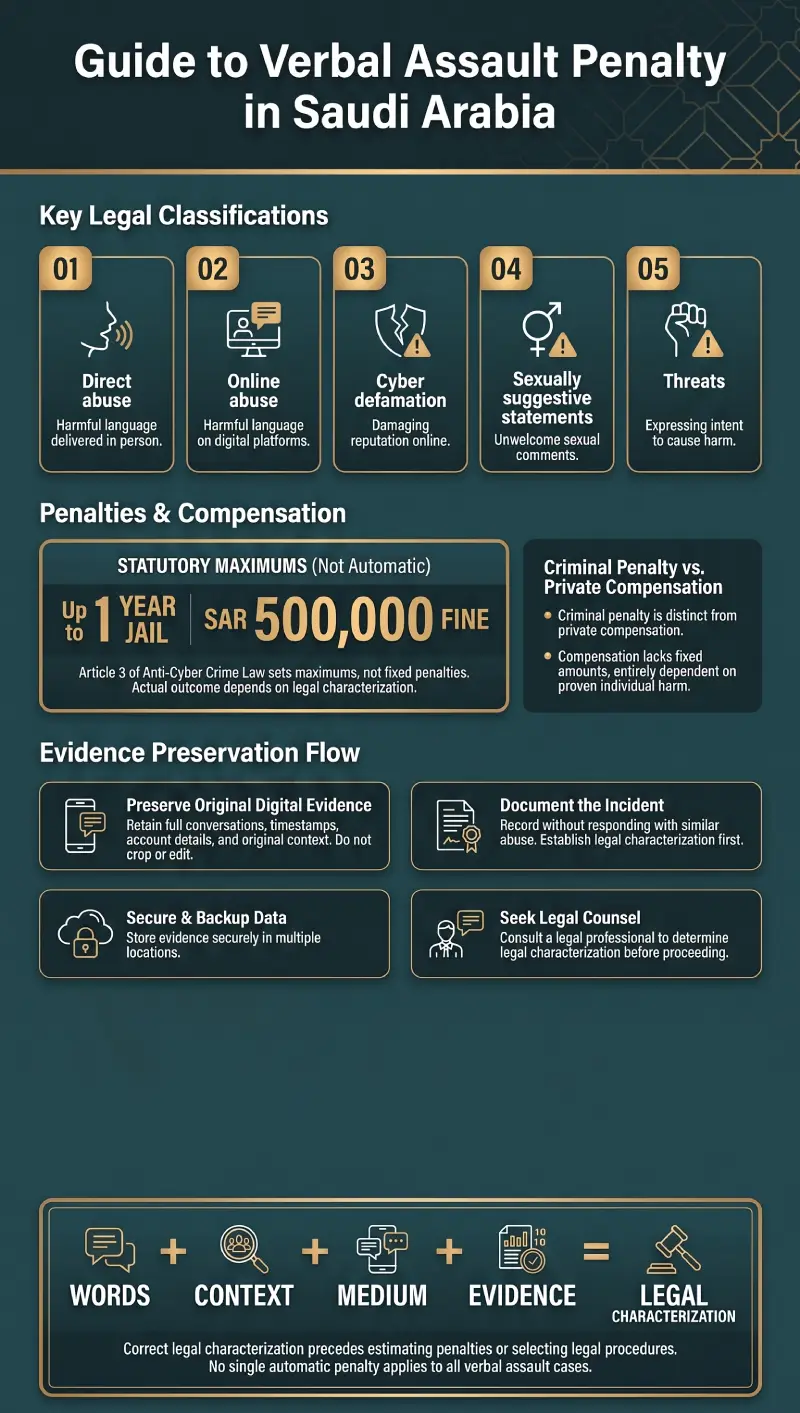
This distinction is particularly important in digital communications. Article 3 of the Saudi Anti-Cyber Crime Law criminalizes defaming others and inflicting damage upon them through information technology. Where the statutory elements of that offense are established, the prescribed maximum penalty may reach imprisonment for one year, a fine of SAR 500,000, or either penalty.
This does not mean that every offensive WhatsApp message automatically constitutes that offense. The statutory elements must first apply to the particular facts. Determining the verbal assault penalty in Saudi Arabia therefore begins with legal characterization rather than selecting the highest possible penalty before examining the incident.
The following five situations illustrate the principal distinctions:
| Type of Incident | What Must Be Examined | Potential Legal Effect |
|---|---|---|
| Direct verbal abuse | Words, context, and evidence | Depends on legal characterization |
| Online verbal abuse | Content, medium, and harm | Saudi Anti-Cyber Crime Law may apply |
| Online defamation | Defamation or harm through technology | Article 3 penalty may apply |
| Sexually suggestive statement | Content and surrounding circumstances | Anti-Harassment Law may apply |
| Threat accompanying abuse | Nature of the threat and circumstances | Depends on the applicable legal characterization |
Can Verbal Assault Lead to Imprisonment or a Fine?
Some forms of verbal assault may result in imprisonment or a fine when the elements of an offense carrying such a penalty are established. However, the mere use of offensive language does not automatically result in either sanction. This is particularly clear in digital cases, where Article 3 of the Saudi Anti-Cyber Crime Law provides a maximum penalty of one year’s imprisonment and a SAR 500,000 fine, or either penalty, when defamation or harm to others through information technology is established
These figures represent the statutory maximum for the specified offense, not an automatic sentence for every offensive message or social-media post. Whether imprisonment or a fine may apply therefore depends on the wording, medium, context, evidence, and whether the statutory elements of the relevant offense are actually established.
Using WhatsApp or a social-media platform is also insufficient by itself to classify an incident as a cybercrime. The characterization depends on the conduct and whether the elements required by law are satisfied.
The types of cybercrimes in Saudi Arabia differ according to the nature of the conduct, the technology used, and the statutory elements involved. The correct legal characterization should therefore be established before estimating any potential penalty.
When Does Verbal Assault Become a Crime in Saudi Arabia?
Not every hurtful statement or verbal disagreement automatically constitutes a criminal offense. The actual words, surrounding circumstances, and potentially applicable legal characterization must first be examined. This distinction is particularly important when considering the penalty for insulting someone in Saudi Arabia, because everyday use of the word “insult” covers a much wider range of conduct than any single legal characterization.
The conduct may involve a private insult between two individuals, public defamation, online harm, a threat, sexually suggestive language, or an accusation affecting a person’s honor that may raise a different legal characterization. The practical question is therefore not merely whether an insult can constitute an offense, but which characterization is supported by the words, context, and available evidence.
Verbal assault also differs from physical assault, which involves the use of force or the infliction of bodily injury. The assault and battery penalty in Saudi Arabia depends on the circumstances of the incident, its consequences, and the applicable legal characterization.
Verbal assault should likewise not be treated as interchangeable with insult, abusive language, qadhf, or threats. These terms do not necessarily produce the same legal consequences. Incorrect characterization can create inaccurate expectations about penalties or procedures, while identifying the facts first helps determine the appropriate route and preserve relevant evidence.
What Is the Difference Between Verbal Assault, Insults, Abusive Language, and Qadhf?
“Verbal assault” is commonly used as a broad description for abuse committed through spoken or written words. Determining legal responsibility, however, requires moving beyond that broad label and examining the actual statement. Verbal assault may encompass several forms of misconduct, while insults and abusive language generally refer to words involving humiliation or disparagement, whose legal effect remains dependent on context and characterization.
Qadhf should not be used as a synonym for every insult. It carries a distinct legal meaning associated with a specific accusation affecting honor when its required conditions are satisfied. A threat is also different because it involves a warning of intended harm, while verbal harassment may arise where the words carry a sexual connotation and the remaining statutory requirements are fulfilled.
These distinctions prevent an incident from being assigned a more serious characterization than its facts support, while also preventing conduct involving additional elements from being understated. The full statement, its context, the communication method, its recipient, and the available evidence should therefore be examined before determining the applicable verbal assault penalty in Saudi Arabia.
How Can You Prove Verbal Assault in Saudi Arabia?
Proving verbal assault depends partly on how the abuse occurred. A face-to-face incident may rely on witnesses and circumstantial evidence, whereas online abuse may generate messages and digital data capable of examination. Under the Saudi Evidence Law, Article 53 defines digital evidence as evidence derived from data created, issued, received, stored, or communicated through digital means. Article 54 includes digital correspondence, communication methods, and digital media among its recognized forms
Article 55 provides that digital evidence is subject to the rules governing written evidence, while Article 60 addresses presenting digital evidence in its original form or through another digital medium.
Accordingly, asking whether WhatsApp messages can constitute evidence does not mean that a screenshot automatically proves an allegation. Rather, digital correspondence falls within the evidentiary framework, while the integrity, attribution, and context of the material remain relevant to its assessment. Where possible, retain the original conversation, account details, dates, and timestamps, and avoid editing messages or extracting them in a way that alters their meaning.
Can an Audio Recording Prove Verbal Assault?
An audio recording cannot be treated as conclusive evidence merely because it exists. Its evidentiary value may depend on its source, integrity, content, the circumstances in which it was obtained, and how it is used. Saudi evidence rules regulate evidence derived from digital data and media, while the court assesses its probative value in accordance with the applicable evidentiary requirements.
It is therefore preferable to preserve the original audio file without editing or trimming it and to retain information showing the incident’s date, context, and relevant parties. A distinction should also be maintained between submitting a recording to a competent authority and publishing it on social media. The need to prove an incident does not automatically make public dissemination of another person’s content lawful in every circumstance.
Where the evidentiary value of a recording or messages is unclear, reviewing the material before filing a complaint may help identify what supports the case and reduce the risk of handling digital evidence in a manner that affects its value or creates an additional dispute.
How Do You File a Verbal Assault Complaint in Saudi Arabia?
A verbal assault complaint should begin with preserving the available evidence and organizing the facts before determining the appropriate procedural route. The competent authority needs to understand what occurred, how it occurred, and what evidence supports the allegation. Preserve original messages and recordings, document the date and place of the incident, retain the other party’s identifying information where available, record witness details, and keep documents demonstrating any resulting harm.
Responding with similar abuse or publishing a private conversation to expose the other person may introduce additional conduct into the dispute and complicate its assessment. Under Article 29 of the Saudi Law of Criminal Procedure, a complaint submitted by a person harmed by an offense is regarded as a claim for a private right unless that person expressly waives it in accordance with the applicable procedure.
Article 69 also allows a person who has suffered harm to assert a private-right claim during the investigation, while Article 147 permits such a claim before the criminal court hearing the public criminal action. The correct procedure for complaining about an insult therefore depends on the nature and procedural stage of the particular incident.
Private Right and Compensation for Verbal Assault
There is no fixed amount of compensation for verbal assault. Entitlement to compensation and the amount awarded depend on proving the harm, its causal relationship to the conduct, and the circumstances of the case. Under Article 138 of the Saudi Civil Transactions Law, compensation for a harmful act includes moral damage, including physical or psychological harm resulting from infringement of honor, reputation, or social standing.
Article 136 provides for compensation sufficient to fully redress the harm, while Article 138 addresses the court’s assessment of moral damage by considering its type, nature, and the injured person.
Accordingly, a private-right claim arising from verbal assault should not be tied to an assumed amount or a percentage of any criminal fine. Criminal punishment and compensation serve different purposes and rest on different legal foundations.
Where the abuse occurred through technology and caused harm, the affected person may have a compensation claim depending on the circumstances and available evidence. The rules associated with such claims are discussed further in private rights in cybercrime cases.
What Should You Do If You Are Verbally Assaulted?
Begin by preserving the facts rather than focusing immediately on the highest possible penalty. Keep the original evidence, document when and where the incident occurred, identify the communication method and any witnesses, and avoid deleting, modifying, or publicly sharing relevant messages.
Next, determine whether the abuse was direct or electronic and whether it involved defamation, threats, or another element capable of changing its legal characterization. If the incident occurred digitally, consulting a cybercrime lawyer in Jeddah may help clarify the evidentiary issues and the appropriate procedural route before action is taken.
The same caution applies if a verbal assault complaint has been filed against you. Deleting conversations or sending new messages to the complainant may remove important evidence of the full context. BMS Legal approaches these matters by first reviewing the incident, available evidence, and procedural stage, then explaining the available options and next step without guaranteeing a particular outcome.
Frequently Asked Questions About the Verbal Assault Penalty
What is the verbal assault penalty in Saudi Arabia?
There is no single penalty for every case. The verbal assault penalty in Saudi Arabia depends on the words used, their context, the communication method, and the applicable legal characterization. A specific statutory penalty may apply when the conduct satisfies the elements of a defined offense, including certain forms of online defamation or harm.
Can verbal assault result in imprisonment in Saudi Arabia?
Yes, some forms of verbal misconduct may result in imprisonment when the elements of an offense carrying imprisonment are established. A hurtful or offensive statement does not automatically result in jail. The facts, evidence, context, communication method, and the requirements of the applicable legal provision must first be assessed.
How can I prove that someone verbally abused me?
Preserve original messages, conversations, recordings, and other available evidence. Document the time and place of the incident and retain witness details where relevant. Avoid editing or selectively extracting evidence in a way that changes its context, because integrity, attribution, and connection to the incident can affect its evidentiary assessment.
Can WhatsApp messages be used as evidence of verbal assault?
Digital correspondence and communication methods are recognized forms of digital evidence under the Saudi Evidence Law. However, a screenshot alone does not automatically establish the allegation. The integrity of the evidence, attribution to the relevant parties, full conversational context, and ability to verify the material may affect its evidentiary value.
Can I claim compensation for verbal assault?
Compensation may be claimed where harm and the requirements for liability can be established. Saudi civil law recognizes moral damage resulting from infringement of honor, reputation, or social standing. The amount is not fixed in advance; it is assessed according to the nature of the proven harm and the circumstances of the individual case.
What should I do if a verbal assault complaint is filed against me?
Preserve the complete conversations and evidence without deleting or modifying them. Avoid further communications that could introduce new issues into the dispute. Review the exact allegation, the complete context of the statements, and the available evidence before submitting a response or taking any step that could affect your legal position.
Verbal Assault Penalty in Saudi Arabia: 5 Key Cases covers direct verbal abuse, online verbal abuse, online defamation, sexually suggestive statements, and threats accompanying abusive language. These situations do not carry one automatic penalty because the legal outcome depends on the applicable characterization, supporting evidence, and circumstances of each incident.
A single statement or item of digital evidence may materially affect the assessment of a case. Legal characterization should therefore be established before filing a complaint or responding to one. BMS Legal can review the incident and available evidence and explain the relevant options and next legal step before proceedings begin.