
When Can a Father Get Child Custody in Saudi Arabia? The answer does not depend solely on the father’s wishes, nor does custody automatically transfer because the mother loses a particular advantage. Under Saudi Personal Status Law, custody decisions revolve around the child’s best interests, the custodian’s legal conditions, and the specific facts presented before the court.
Following divorce, custody may remain with the mother according to the applicable statutory order. This does not prevent custody from transferring to the father where a material reason exists. If the evidence shows that living with the father would better protect the child’s care, education, health, or stability, the court may consider transferring custody.
Custody is neither a reward for one parent nor a punishment for the other. It involves daily responsibility for housing, schooling, medical treatment, psychological welfare, supervision, and general care. A father should therefore ask more than whether he has a right to custody. The more important question is what evidence demonstrates that the child’s interests would be better served in his care.
This guide explains when a father can get child custody in Saudi Arabia, when the mother’s custody may be affected, and what evidence may support a transfer request. For a broader explanation of eligibility, proceedings, enforcement, and documentation, see custody rules under Saudi law.
In 60 Seconds: When Can a Father Get Child Custody in Saudi Arabia?
Custody may transfer to the father where living with him better serves the child’s interests, a material custody requirement is no longer satisfied by the mother, or a court has ordered the transfer. The father’s position may also be strengthened by serious neglect, repeated interference with visitation that harms the parent-child relationship, or the child reaching an age at which their preference may be considered.
| Situation | Does Custody Transfer Automatically? | What May the Father Need? |
|---|---|---|
| Mother remarries | Not necessarily | Evidence showing how the marriage affects the child’s interests |
| Educational or medical neglect | It may affect custody | Reports, messages, records, or other clear evidence |
| Repeated denial of visitation | It may support the application | Evidence of denial or existing visitation orders |
| Mother relocates far away | Depends on the resulting harm | Evidence showing the effect on the child and visitation |
| Child reaches an age where preference is considered | May support the father’s request | Evidence concerning the child’s welfare and living arrangements |
| Existing custody judgment for the father | Matter proceeds to enforcement | Enforceable judgment and appropriate enforcement request |
Saudi Personal Status Law regulates custody by examining the custodian’s conditions, the statutory order of entitlement, and the child’s best interests. Personal preference alone is therefore insufficient. The father should demonstrate how the relevant circumstances materially affect the child’s welfare and stability.
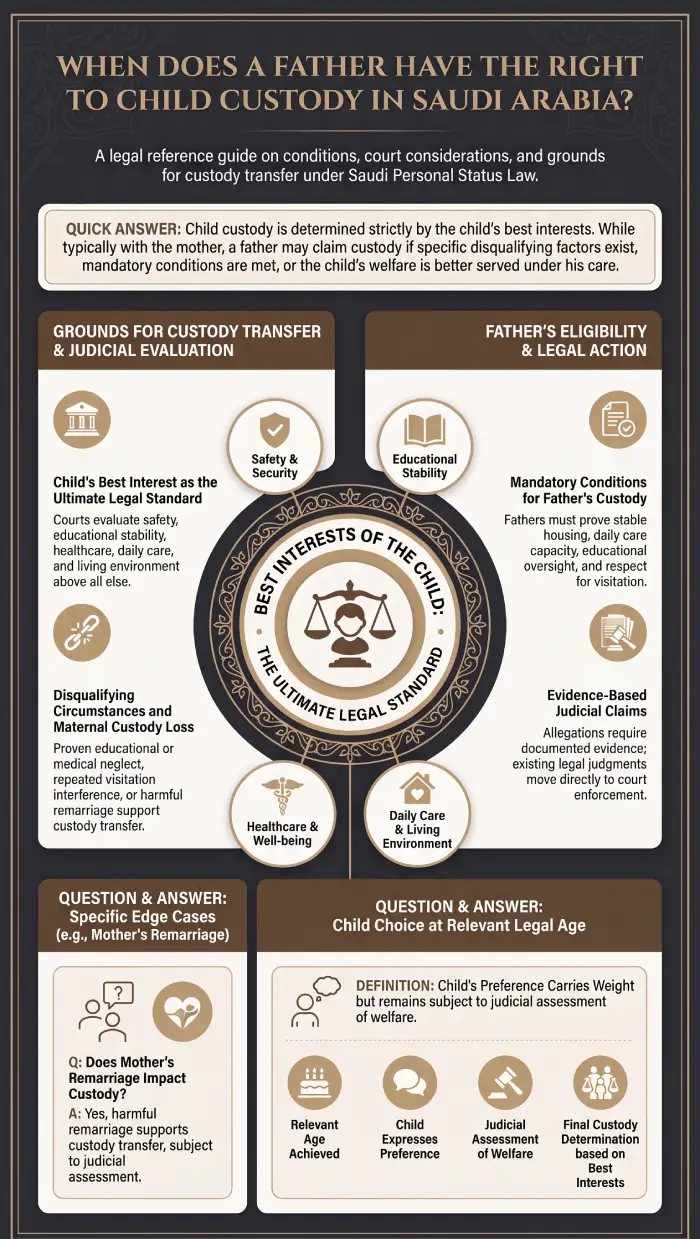
The Legal Rule for Child Custody After Divorce in Saudi Arabia
Saudi custody law does not treat the child as part of the dispute between the parents. The focus is on care, safety, continuity, and stability. Custody is therefore not removed from the mother merely because she sought divorce, nor is it awarded to the father simply because he has greater financial resources or wishes the child to live with him.
In practical terms, the court considers where the child’s interests will be better protected. It may examine whether the current custodian can provide appropriate care, whether the home environment is safe, and whether there are serious circumstances making the existing arrangement harmful or unsuitable.
The statutory order following separation generally places the mother before the father, subject to the applicable custody conditions and the child’s best interests. A broader explanation of custody requirements, age-related considerations, and priority after divorce is available in our guide to the new custody law in Saudi Arabia.
This distinction also answers two different questions. When Can a Father Get Child Custody in Saudi Arabia? concerns the father’s entitlement and whether the circumstances justify transferring custody. The question of when a daughter may live with her father requires a more fact-specific assessment of age, care arrangements, home environment, stability, and her individual needs.
Requirements for a Father Seeking Child Custody in Saudi Arabia
Being the child’s guardian or paying maintenance does not automatically mean that the father should have day-to-day custody. Guardianship, financial maintenance, and custody are legally distinct matters. The father must therefore demonstrate his practical ability to care for the child and manage the child’s daily needs.
Relevant considerations may include the father’s ability to provide care, a stable home environment, and appropriate educational and medical supervision. The case should be presented around the child’s interests rather than as an attempt to prevail in a dispute with the mother.
Legal capacity in this context requires the father to understand and perform the responsibilities associated with custody in a manner that protects the child. Financial ability does not mean exceptional wealth. The issue is whether essential needs can be met, including suitable housing, education, medical treatment, supervision, and daily care.
A father’s custody application should establish a stable alternative rather than merely criticise the mother’s circumstances. Where the facts involve several issues or supporting documents need to be organised, a child custody lawyer in Jeddah can assess the facts and determine which legal procedure corresponds to the case.
A well-prepared application may address:
- Suitable and safe accommodation for the child.
- Regular educational and medical supervision.
- The father’s ability to provide daily care.
- Respect for the other parent’s visitation rights.
- A clear plan for the child’s continuing stability.
A father’s custody claim becomes more persuasive when the facts are specific and supported by evidence. Broad allegations such as “the mother is unfit” are generally less useful unless accompanied by identifiable events, records, or other supporting material.
When Can the Mother Lose Custody and Custody Transfer to the Father?
A mother’s custody may be affected when a relevant custody condition is no longer satisfied or when circumstances materially harm the child’s interests. Ordinary disagreement between the parents, however, is not by itself sufficient to justify a transfer of custody.
The court considers the reasons relied upon in the application and the evidence supporting them. Where those reasons are serious and established, the court may examine whether custody should be removed from the mother and transferred to the father or another entitled custodian.
Circumstances that may affect custody include serious neglect, inability to provide adequate care, an unsuitable home environment, repeated obstruction of visitation, or the mother’s remarriage where the resulting circumstances materially affect the child’s welfare.
Neglect in a custody case usually involves more than an isolated mistake. The relevant concern is repeated or serious conduct affecting the child, such as leaving the child without adequate care, failing to obtain necessary medical treatment, or allowing recurring school absences without reasonable intervention.
A father seeking to rely on neglect should avoid general descriptions. Each incident should be linked to a date, its consequences for the child, and supporting evidence. Relevant material may include school records, documented communications, medical reports, attendance records, or a consistent pattern of other evidence.
Repeated interference with visitation does not necessarily result in an automatic loss of custody. It may nevertheless become significant where it occurs without a legitimate reason, damages the child’s relationship with the father, or indicates misuse of the custody arrangement.
These considerations are central to determining when a father can get child custody in Saudi Arabia, because the court examines the actual effect of the circumstances on the child rather than relying on the label attached to the allegation.
Does the Mother’s Remarriage Automatically Transfer Custody to the Father?
The mother’s remarriage is one of the issues that commonly gives rise to custody disputes. It should not, however, be treated as an automatic rule under which custody immediately transfers to the father. Remarriage may provide grounds for requesting a transfer, but the child’s interests and the surrounding circumstances remain material.
Some fathers consider bringing a custody claim after the mother remarries, particularly where her new husband is unrelated to the child. The existence of the marriage alone should not be the only factual basis relied upon. The application should explain how the new circumstances have affected the child’s care, stability, or welfare.
A more accurate legal approach is therefore not: “The mother remarried, so custody transfers immediately.” The relevant proposition is that the mother’s remarriage may support an application to transfer custody where its consequences affect the child’s best interests.
For example, the father may seek to establish that the remarriage led to a material change in housing, reduced supervision, an unsuitable environment, disruption of schooling, or substantial interference with the child’s relationship with the father.
Where the child is a daughter, the assessment may require additional attention to her particular circumstances. A general answer to when custody of a daughter transfers to her father may therefore be misleading, because age, living arrangements, care, stability, and individual needs may all be relevant.
Child Custody After the Child Reaches the Age at Which Preference Is Considered
As a child becomes older, their preference about living with either parent may carry greater weight. That preference does not remove the court’s authority to assess the child’s best interests, nor does it automatically determine the outcome.
If the child expresses a preference to live with the father, this may support the father’s application. The stronger approach is to show why that preference corresponds with genuine welfare considerations, such as educational stability, regular supervision, continuity of care, or a safer and more appropriate living environment.
The court may consider why the child has expressed that preference, the child’s maturity, and the nature of the relationship with both parents. A preference motivated primarily by avoiding reasonable parental supervision, schooling, or discipline may not carry the same weight as a preference connected to genuine welfare considerations.
Age also does not displace other relevant circumstances. A child’s preference may be influential when it aligns with their best interests, but it may receive less weight where the proposed environment would be unstable or where adequate daily supervision cannot be demonstrated.
For this reason, a child’s preference is one factor in assessing when a father can get child custody in Saudi Arabia, rather than an independent guarantee that custody will transfer.
Filing a Father’s Child Custody Claim in Saudi Arabia
A custody statement of claim should not consist of broad accusations. Each relevant fact should be connected to its effect on the child’s care, education, health, safety, or stability.
The claim should identify the parties and the child, explain the legal and factual basis for requesting the transfer, set out the material events, refer to supporting documents, and end with a clear request for the appropriate custody order or related relief.
A template for a father’s custody claim may be useful for understanding basic structure, but it cannot replace a case-specific assessment. A claim based on neglect differs from one arising after the mother’s remarriage. Both differ from proceedings involving failure to surrender the child or enforcement of an existing custody judgment.
Where the father has documents concerning neglect, repeated denial of visitation, remarriage, or refusal to surrender the child, those documents should be reviewed together with the procedural history before deciding whether the appropriate route is a fresh custody claim, another substantive application, or enforcement.
When Is a New Custody Claim Not the Correct Procedure?
Not every custody problem requires a new custody lawsuit. If the father already holds an enforceable judgment awarding him custody and the judgment is not being complied with, the appropriate route may be enforcement rather than filing another substantive custody claim.
Where a previous judgment awarded custody to the mother, the father may instead need to challenge the judgment through the applicable procedure or bring a new request based on later material changes, depending on the procedural stage and the facts that have arisen.
Care is also required with documents described as a father’s waiver of custody or an agreement to relinquish custody of children. Custody is connected to the child’s welfare and should not be treated in the same way as a purely financial right that can be permanently waived without regard to later circumstances. A standard form should therefore not be used without considering its effect on residence, visitation, travel, and daily care.
Where the father seeks a transfer because of remarriage or neglect, the more relevant procedure may be an application to transfer custody or remove custody from the current custodian, depending on the circumstances. In a remarriage case, the application should not merely state that the mother has remarried. It should explain how the resulting situation affects the child’s interests or materially changes the child’s living environment.
If the issue concerns proving or documenting an existing custody arrangement rather than transferring custody between parents, see the steps for obtaining a custody document in Saudi Arabia to understand the distinction between documentation, a custody dispute, and challenging an existing decision.
Documents That May Support the Father’s Custody Application
The documents needed in a father’s custody case depend on the reason relied upon and the procedural route being taken.
| Type of Case | Examples of Potentially Relevant Documents |
|---|---|
| Mother’s remarriage | Evidence of the marriage and material showing its effect on the child |
| Educational neglect | School reports, repeated absence records, communications with the school |
| Medical neglect | Medical reports, treatment appointments, prescriptions, follow-up records |
| Denial of visitation | Messages, visitation judgments, enforcement records, documented communications |
| Enforcement of custody judgment | Final judgment, enforcement application details, information concerning the obligated party |
| Child’s preference | Evidence of age, current living arrangements, and circumstances surrounding the preference |
The value of a document depends on what it proves. A large number of records is not necessarily more persuasive than a smaller set that clearly establishes a repeated event, its date, and its effect on the child.
Legal Review & Editorial Check
This article has been reviewed for legal clarity, terminology, and consistency with the applicable Saudi legal framework.
|
Saudi Arabia
|
License No. 7053637679
Frequently Asked Questions About When a Father Can Get Child Custody
1. When Can a Father Get Child Custody in Saudi Arabia?
A father may seek custody when the court finds that the child’s best interests are better served in his care.
2. Does the Mother’s Marriage Affect Child Custody?
It may affect custody in some circumstances, but marriage does not automatically end the mother’s custody.
3. Can Neglect Cause a Mother to Lose Custody?
Yes. Serious and proven neglect affecting the child’s care, education, health, or safety may support a custody claim by the father.
4. Can a Father Get Custody if the Mother Prevents Visitation?
Repeatedly preventing lawful visitation may be considered by the court, particularly when it affects the child’s interests.
When Can a Father Get Child Custody in Saudi Arabia? The question cannot usually be determined by one circumstance, such as the mother’s remarriage or interference with visitation. The assessment depends on the child’s best interests, the applicable custody requirements, and the strength of the evidence placed before the court.
Circumstances that may support the father’s position include serious educational or medical neglect, loss of a relevant custody condition, an unsafe or unsuitable environment, repeated interference with visitation, relocation that materially affects the child, the child expressing a preference to live with the father where that preference is relevant, or an existing judgment awarding custody to the father.
An existing custody judgment in the father’s favour may also change the procedural route. If the other party refuses to surrender the child, the issue may move from establishing entitlement to enforcing an existing judicial decision.
Before filing a claim or challenge, the father should organise the relevant events, documents, and procedural history. The correct route may be a custody claim, a challenge to an existing judgment, a new application based on changed circumstances, or enforcement of an existing order.
For an initial review of the appropriate procedural route, you may contact BMS Legal to determine whether the circumstances call for custody proceedings, a challenge to an existing decision, or enforcement.
Official References: