
Refusal to pay maintenance in Saudi Arabia is not simply a matter of delayed payment. It becomes particularly significant when maintenance has already been established by a judgment or enforceable instrument, yet the beneficiary still does not receive the amount due. This raises practical questions: How do you enforce a maintenance judgment in Saudi Arabia? When does delayed payment become non-compliance with the judgment? What happens under Article 46? And what consequences may follow if non-payment continues?
In many cases, the difficulty is not obtaining the judgment itself but knowing what to do next. A maintenance claim, enforcement proceedings, monthly wage deductions, and the Maintenance Fund are different legal stages. Choosing the correct route determines whether the entitlement remains unpaid or moves into actual enforcement.
If there is a refusal to pay maintenance, the first question is whether you should begin enforcement immediately or whether you still need to understand how to file a maintenance claim in Saudi Arabia before entering the enforcement stage.
This guide explains the route that generally follows non-payment and the practical steps available to protect and recover maintenance entitlements.
Refusal to Pay Maintenance After Judgment: Quick Answer
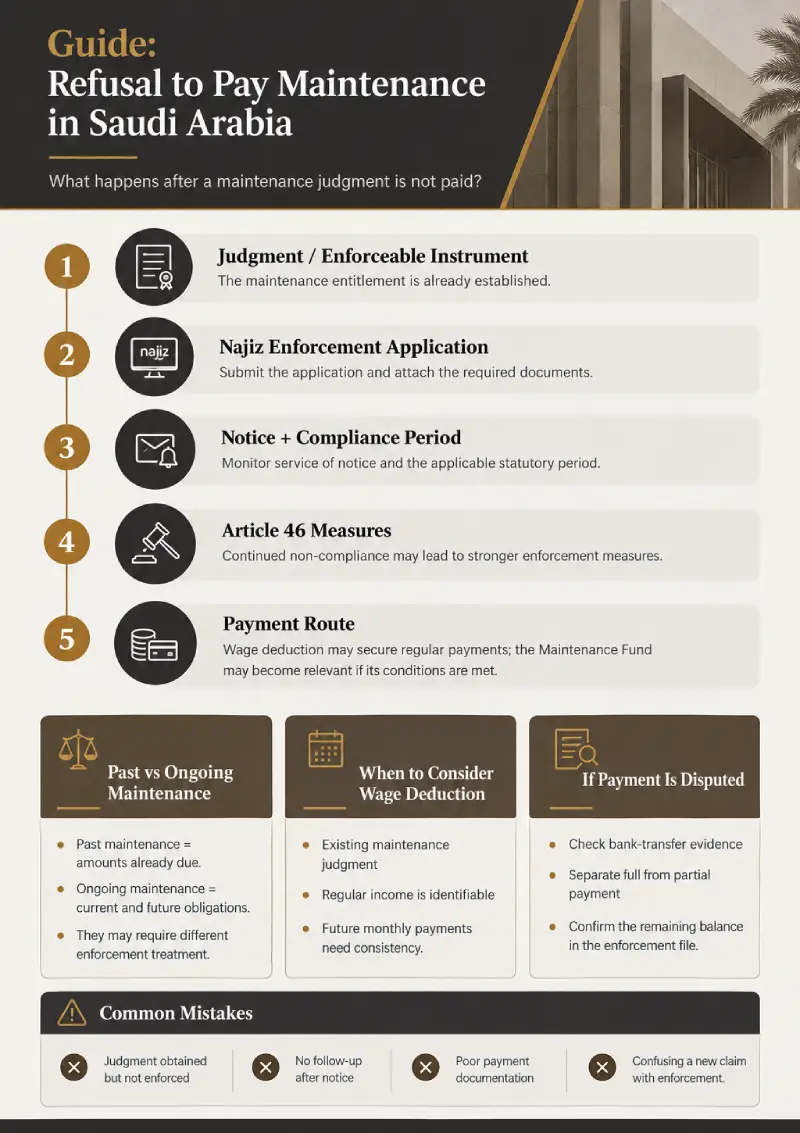
When refusal to pay maintenance occurs after a judgment has been issued, the usual starting point is to submit an enforcement application through Najiz. You then monitor service of notice, the applicable statutory period, and any enforcement measures that follow.
If the debtor continues to refuse to comply with the maintenance judgment after being formally notified, the case may proceed to Article 46 measures. Depending on the circumstances, further applications may then become relevant, including a request for monthly wage deductions. In certain cases, the Maintenance Fund may also become available once its applicable requirements have been satisfied.
It is important to distinguish an isolated delay from persistent non-payment within an active enforcement file. A delay before enforcement begins is different from continued failure to pay after formal notice and expiry of the relevant period. This is where the consequences of refusal to pay maintenance must be understood as part of the enforcement process rather than simply as delayed payment.
After the Judgment: Where Do You Start?
Once you have a valid judgment or other enforceable instrument, the next step is generally to submit an enforcement application through the Najiz platform. You may also consider consulting a maintenance lawyer in Jeddah if you need to assess the appropriate next step before filing or when collection has stalled.
The enforcement application is what moves the entitlement from a judgment on paper into an active enforcement process. The clearer and more accurate the application is from the outset, the lower the risk of avoidable procedural delays.
The initial steps are generally:
- Log in to Najiz through National Access.
- Open the enforcement services section.
- Submit a new enforcement application.
- Enter the required information accurately.
- Attach the enforceable instrument and required documents.
- Provide the correct IBAN.
- Monitor the application after formal notice is served.
Incomplete or inaccurate information can delay an enforcement file at an early stage even where the underlying right is already established. Having a judgment is therefore not enough by itself; the enforcement application must also be prepared correctly.
There is no single enforcement period that applies to every case. Timing may depend on the method of service, accuracy of the information provided, the type of enforceable instrument, the debtor’s circumstances, and whether identifiable income or assets are available for enforcement.
If the enforcement debtor does not comply after receiving notice, the file may move to a more advanced enforcement stage. Continued monitoring matters because some cases require a further application or procedural step rather than simply opening the file and leaving it unattended.
Article 46 and the Consequences of Refusal to Pay Maintenance
If non-compliance with a maintenance judgment continues after formal notice and expiry of the relevant statutory period, the case enters a more serious stage before the Enforcement Court. Article 46 measures are among the main procedures considered when beneficiaries seek information about the consequences of refusing to pay maintenance.
In practical terms, Article 46 means that the matter has moved beyond a straightforward request for voluntary compliance into a stronger stage of enforcement. The consequences are not identical in every case because the underlying circumstances may differ. However, continued disregard of enforcement proceedings after the required steps have been completed is no longer treated as a simple payment delay.
The consequences of refusal to pay maintenance are also not identical in every file. There is a significant difference between a debtor who claims to have made partial payments, a debtor who disputes the amount outstanding, and a debtor who fails to pay despite a clear obligation and completed enforcement procedures.
The enforcement process may include:
- Article 46 measures where payment remains outstanding after notice and completion of the applicable enforcement requirements.
- Enforcement detention where persistent non-compliance is established and the judge considers such an order warranted.
- Attachment of bank accounts and other enforcement measures connected with the order.
- Travel restrictions and suspension of certain services, depending on the status and circumstances of the enforcement file.
- Wage deductions where the objective is to ensure that future maintenance is paid regularly.
The consequences of refusal to pay maintenance therefore extend beyond describing the failure itself. Enforcement measures are intended to move the entitlement from a judgment on paper to actual payment received by the beneficiary.
Monthly Wage Deductions: When Are They Most Useful?
In many cases, the problem is not limited to collecting outstanding maintenance. The more difficult issue is ensuring that future payments arrive regularly. This is where a wage deduction order can become particularly useful.
If payment repeatedly fails each month, or if manual follow-up becomes burdensome, regular deductions may provide a more structured way to secure ongoing maintenance.
A wage deduction may be particularly relevant where:
- A maintenance judgment already exists but payments remain irregular.
- Regular payment of future maintenance is the main concern.
- Repeated monthly enforcement has become burdensome.
- The enforcement debtor has a known and regular source of income.
Past maintenance should not be confused with future maintenance deducted from salary. You may also need to understand child maintenance after divorce in Saudi Arabia to distinguish a payment default from a separate dispute over the amount of maintenance itself.
Ongoing maintenance also has a strong position under Saudi law because it is treated as a priority debt ahead of other debts, unlike past maintenance. This distinction can be important where the enforcement debtor has several financial obligations competing against the same income.
When Can Your Case Move to the Maintenance Fund?
The Maintenance Fund is not normally the first step after refusal to pay maintenance. It comes after an earlier enforcement stage. If you are trying to determine when the Fund may become relevant, the practical answer is that the maintenance file must already have entered enforcement and progressed through the required preceding stages.
Some beneficiaries assume that having a maintenance judgment is enough to move directly to the Maintenance Fund. In practice, the sequence is different. The process begins with a judgment or enforceable instrument, followed by enforcement proceedings and Article 46 measures. The Maintenance Fund may then become relevant where its applicable conditions are met.
| Situation | Closest Route | When It Is Used |
|---|---|---|
| No judgment or enforceable instrument exists | Maintenance claim | When the original entitlement still needs to be established |
| A judgment exists but collection has not started | Enforcement application | After a judgment or enforceable instrument is available |
| Non-payment continues after notice | Article 46 and subsequent measures | When payment remains outstanding during enforcement |
| Regular monthly payment is required | Wage deduction | When structured monthly payment is the more appropriate solution |
| Collection is unsuccessful and the requirements are met | Maintenance Fund | After enforcement and Article 46, subject to applicable conditions |
The Maintenance Fund may not operate in exactly the same way in every situation. If the case involves international travel, residence outside Saudi Arabia, or other special circumstances, those issues should be assessed early rather than assuming that payments will continue under the same arrangements in every case.
If the Debtor Claims Payment or Has Paid Only Part of the Amount
One of the more complicated situations arises when the judgment itself is clear but the dispute later shifts to a different question: was the maintenance actually paid?
A simple assertion of payment may not resolve the issue. The enforcement file must be examined to determine what evidence supports or contradicts the alleged payment and whether the amount paid satisfies the obligation in full or only in part.
A bank transfer can be important evidence, but its practical value depends on how clearly it identifies the payment. A transfer with a clear date, amount, and payment description is generally easier to assess. If the transfer is ambiguous or poorly documented, the dispute may continue.
Partial payment also does not automatically mean that the enforcement case has ended. The relevant questions are how much has actually been paid, what remains outstanding, and how the balance affects the next stage of enforcement.
Where payments have been partial or irregular, the file should be reviewed systematically before another procedural step is taken. An early legal review may save time compared with allowing the dispute to become more complicated during enforcement.
Situations That Require Closer Attention
The applicable approach may differ depending on the type of maintenance and the identity of the beneficiary. With child maintenance, regular payment is often the central issue because delayed payments can directly affect day-to-day needs.
Spousal maintenance involves different questions concerning the underlying entitlement and claims relating to previous periods. For that reason, it may be useful to understand monthly spousal maintenance in Saudi Arabia and when entitlement may cease before deciding on the next enforcement step.
You should also distinguish ongoing maintenance from past maintenance. Ongoing maintenance concerns current and future obligations, while past maintenance concerns amounts that became due previously but remain unpaid.
This distinction has practical consequences. It can affect the wording of the application, the amount being pursued, and the order in which enforcement priorities are addressed.
Where the case concerns children, maintaining regular payments will often be the immediate priority. For spousal maintenance, the underlying entitlement and its surrounding circumstances may require closer examination. Following divorce, the focus will often shift from establishing the right to maintenance toward enforcing and organising payment.
Mistakes That Can Delay Recovery
One of the most common mistakes is obtaining a maintenance judgment but failing to submit it for enforcement. Another is confusing a new maintenance claim with an existing enforcement file, even though each procedure serves a different purpose.
Problems also arise when payments are poorly documented or when decisions are made based on a general understanding of the situation without checking what has actually happened within the enforcement file.
Common mistakes include:
- Relying on the judgment without submitting an enforcement application.
- Failing to monitor the file after notice has been served.
- Overlooking a wage deduction request when regular payment is needed.
- Failing to document payments clearly.
- Confusing past maintenance with ongoing maintenance.
- Treating every refusal to pay maintenance as though the circumstances were identical.
If your case involves refusal to pay maintenance or failure to comply with a maintenance judgment, it may be useful to review our guide to maintenance for a wife and children after divorce to understand the wider legal context before determining the next step.
Frequently Asked Questions About Refusal to Pay Maintenance
1. What should I do if maintenance is not paid after a judgment?
Submit an enforcement application through Najiz and monitor the file after notice is served. If non-compliance continues, further enforcement measures may apply.
2. What happens under Article 46 if maintenance remains unpaid?
If the debtor does not comply after the applicable notice and statutory period, Article 46 enforcement measures may be applied, depending on the circumstances of the case.
3. Can maintenance be deducted directly from the debtor’s salary?
A wage deduction request may be relevant where regular maintenance payments are required and the debtor has a known, regular source of income.
4. When can I apply to the Maintenance Fund?
The Maintenance Fund may become relevant after enforcement proceedings have progressed and its applicable requirements have been satisfied. A maintenance judgment alone does not necessarily mean that the Fund is immediately available.
Refusal to pay maintenance in Saudi Arabia becomes an enforcement issue once the entitlement has been established but payment is not made. If you already have a judgment or enforceable instrument, the practical starting point is generally enforcement. From there, the file should be monitored to determine whether the next stage involves Article 46 measures, a wage deduction request, or another enforcement step appropriate to the circumstances.
The key distinction is between establishing the right to maintenance and enforcing payment of an entitlement that has already been established. That distinction determines the appropriate procedure from the outset.
If your situation extends beyond maintenance and also involves divorce, custody, or visitation, you may wish to review the page for a family lawyer in Jeddah before deciding on the next step.
At BMS Legal, the approach is based on clarity before action: identifying the appropriate procedural step, explaining the documents required, and determining the route that most closely fits the circumstances of the case.
Official Sources: