
Inheritance and Estates in Saudi Arabia begin with identifying the legal heirs, determining the deceased’s assets and debts, and then selecting the appropriate method of division. Knowing each heir’s general share is not enough because an estate may include real estate, bank accounts, debts, a will, powers of attorney, or a minor among the heirs.
An estate may be straightforward when the heirs agree and the assets are clearly identified. It may become disputed when an heir refuses division or documents are withheld. Heirs should therefore arrange the necessary steps before dealing with estate funds, signing a division agreement, or selling inherited property.
The Saudi Ministry of Justice and Najiz provide electronic services relating to heirship documentation, estate inventory, and consensual estate division through the Estate Platform. The platform provides a unified digital process intended to facilitate estate division and protect heirs’ rights through automated procedures.
This guide focuses on the practical process: heirship documentation, estate inventory, inheritance shares, estate division, estate division claims, inherited real estate, heirs’ representatives, and when an inheritance lawyer may be required.
Inheritance and Estates in Saudi Arabia: Where Do Estate Procedures Begin?
Estate procedures generally begin by establishing the death, obtaining the heirship document, and identifying the deceased’s assets and liabilities. The heirs then determine whether consensual division is possible when the assets are clear and everyone agrees, or whether a judicial route is required because of refusal or dispute.
Following the correct sequence protects heirs from common mistakes, such as distributing part of the estate before identifying outstanding debts or selling property before establishing the legal status of every heir. It also prevents confusion between heirship determination, which identifies the persons entitled to inherit, and estate inventory, which identifies the property available for division.
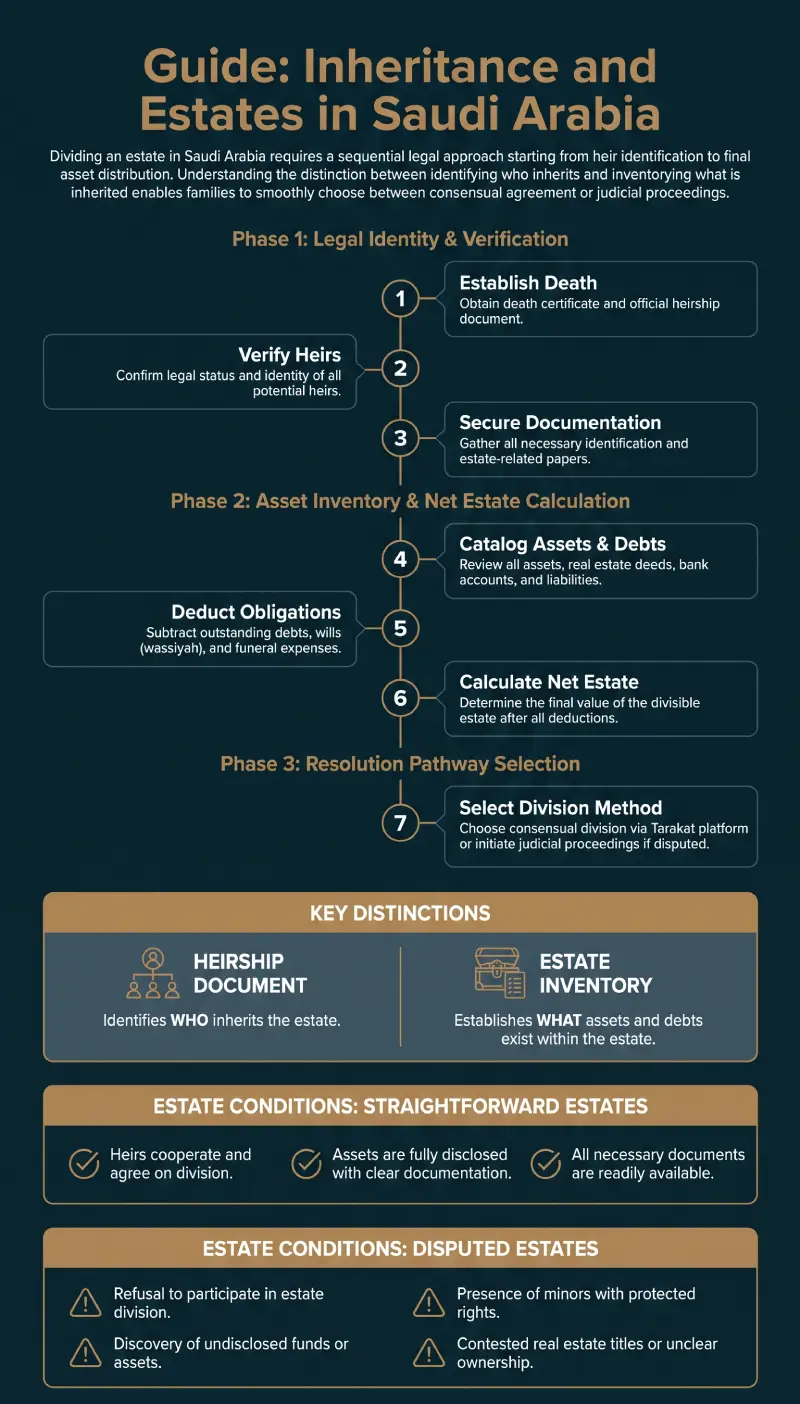
Steps for Dividing an Estate in Saudi Arabia
Estate division in Saudi Arabia generally passes through seven practical steps, beginning with establishing the death and ending with selecting the appropriate division route. This sequence does not replace the detailed requirements of each procedure, but it provides heirs with a clear roadmap before proceeding with heirship documentation, estate inventory, or litigation.
| Step | Procedure | Purpose |
|---|---|---|
| 1 | Establish the death | Begin the formal estate procedures |
| 2 | Obtain the heirship document | Identify the heirs and their inheritance shares |
| 3 | Inventory the estate | Identify funds, real estate, and debts |
| 4 | Review the documents | Examine deeds, powers of attorney, and previous agreements |
| 5 | Determine the net estate | Account for debts, wills, and rights preceding distribution |
| 6 | Consider consensual division | Where the heirs agree and the assets are clear |
| 7 | Consider judicial proceedings | Where division is refused or distribution is obstructed |
Where the first six stages are clear and agreed upon, the estate is generally closer to consensual division. If the inventory is obstructed, an heir refuses to cooperate, or a dispute arises over real estate, the matter may require legal review before further action.
When Is an Estate Relatively Straightforward?
An estate is generally straightforward when the heirs are known and agree on the process, with no complicated real estate or disputed debts. Clear title deeds, updated records, and cooperation among the heirs can also facilitate consensual division.
In this situation, the heirs may consider consensual estate division through the appropriate electronic process. The Ministry of Justice explains that the service begins by accessing the Estate Platform through National Unified Access, selecting the relevant service, and starting the application.
Signs That Estate Division Has Become Disputed
An estate becomes disputed when an heir refuses division, controls inherited property, or an heirs’ representative fails to disclose the estate funds. A dispute may also arise where there is a will, a minor heir, a debt, or property that cannot readily be divided.
Repeated requests or informal promises between heirs may not resolve these situations. The documents should first be organised before determining whether the appropriate route is settlement, consensual division, a claim for an inheritance share, or an estate division claim.
When Does an Estate Require Legal Action?
Legal action may need to be considered where the estate includes real property, an heir refuses division, or an authorised representative does not account for the funds. Careful review may also be required where there are unresolved debts, a will, a minor heir, or assets omitted from the inventory.
| Situation | Potential Route |
|---|---|
| Heirs agree and assets are clear | Consensual estate division |
| Assets remain unidentified | Estate inventory |
| An heir refuses division | Settlement or estate division claim |
| Dispute over the family home | Review the deed and consider division or sale |
| Heirs’ representative does not disclose funds | Accounting or review of the power of attorney |
| Minor heir or debts are involved | Legal review before division |
Where the matter involves real estate, refusal to divide, or an heirs’ representative who does not disclose estate assets, reviewing the documents with an Inheritance and Estates Lawyer in Jeddah may help identify the appropriate route before escalation.
Difference Between Inheritance, an Estate, and Heirship Determination in Saudi Arabia
Using accurate terminology helps identify the correct procedure from the outset. Inheritance refers to the transfer of an heir’s entitlement in the deceased’s property after death under the applicable Sharia and statutory rules.
The estate comprises the assets, financial rights, and liabilities left by the deceased. These may include cash, real estate, shares, vehicles, receivables, and debts owed by or to the deceased.
Inheritance should not be treated as an isolated mathematical calculation. An heir’s entitlement may change depending on the presence of another heir, a debt, a will, or an impediment to inheritance. Proper estate division therefore does not begin merely by identifying the heirs; the components of the estate must also be examined.
The following table explains the practical difference between heirship determination and estate inventory, a distinction that is central to understanding Inheritance and Estates in Saudi Arabia:
| Comparison | Heirship Determination | Estate Inventory |
|---|---|---|
| Purpose | Identify heirs and their shares | Identify the deceased’s assets and debts |
| Main question | Who inherits? | What did the deceased leave? |
| Stage | Before dealing with the estate | Before final distribution |
| Practical effect | Establishes the heirs’ legal status | Prepares the estate for division or dispute |
| Electronic process | Heirship documentation service | Estate inventory through the Estate Platform |
The heirship document establishes the heirs and their shares, but it does not itself transfer real estate or distribute estate funds. Najiz explains that the heirship service allows a document to be issued containing information about the deceased, the heirs, and their shares.
The document is therefore an important starting point rather than the completion of the estate process. The heirs must still identify the estate assets, examine outstanding debts, and then agree on division or select the appropriate legal route if a dispute exists.
Heirship Documentation Through Najiz: When Do You Need It?
Heirship determination identifies the persons entitled to inherit and their respective shares, giving them the legal standing required to continue estate procedures.
The document is currently generally referred to as an heirship document, while many people still use terms equivalent to an heirship deed or certificate when searching for older documents.
You may need to obtain an electronic heirship document through Najiz where an estate must be divided, real estate remains registered in the deceased’s name, financial accounts exist, or an heir seeks to claim an inheritance share. It becomes particularly important where heirs are in dispute or an estate inventory is required before distribution.
The heirship document does not mean that the estate has already been divided. It establishes who inherits, but it does not distribute funds or transfer real estate. The estate assets and debts must therefore be identified before the appropriate division route is selected.
Several common mistakes should be avoided:
- Treating the heirship document as the final division of the estate.
- Delaying issuance of the document where multiple assets exist.
- Failing to review older or non-electronic documents.
- Beginning distribution before identifying the estate and its debts.
The Saudi Estate Platform: Its Role in Identifying and Dividing Estate Assets
The Estate Platform is an electronic route designed to facilitate estate procedures, including estate inventory and division among heirs. The platform serves heirs seeking to divide an estate by agreement or through the available compulsory procedures, depending on the circumstances.
What Is an Estate Inventory and When Is It Required?
An estate inventory identifies the money, assets, rights, and debts left by the deceased before distribution.
This differs from heirship determination because heirship identifies the persons entitled to inherit, while estate inventory identifies the property subject to division.
The Ministry of Justice provides an official Estate Inventory Service. The procedure begins by accessing the Estate Platform through National Unified Access, selecting the estate inventory service, and choosing the deceased person concerned.
An estate inventory is required when heirs need to identify the deceased’s assets before division. It becomes particularly important where the estate includes real estate, financial accounts, ownership interests, debts, or unclear financial rights.
Partial funds should generally not be distributed before the full estate position is established. Additional debts or assets may later emerge and affect the division, or a dispute may arise over property omitted from the original inventory.
How the Estate Platform Relates to Estate Division
The Estate Platform provides a process for managing division between heirs through the services available on the platform.
The Ministry of Justice explains that its Consensual Estate Division Service displays completed estate inventory applications and allows cash, investment, and real-estate assets to be divided according to the applicable procedures.
This does not mean every estate can be completed electronically without review or dispute. Some cases require settlement, examination of documents, or judicial proceedings where the heirs cannot reach agreement.
Practical Difference Between Estate Inventory and Estate Division
Estate inventory means identifying the deceased’s assets, rights, and debts. Estate division means distributing the net estate among the heirs after debts, liabilities, and any applicable will have been addressed.
The heirs may therefore complete the estate inventory successfully but remain unable to divide the estate because of inherited property or an heir’s refusal.
Where the assets remain unclear or the estate contains real property and debts, completing the estate inventory before inheritance distribution becomes an essential preliminary step.
Documents Required Before Estate Division
Preparing documents before starting estate procedures can reduce delays and help identify the correct route. It can also show whether the matter is suitable for consensual division or requires an estate inventory or judicial division claim.
| Document | When It May Be Required |
|---|---|
| Death certificate | Beginning of estate procedures |
| Heirship document | Establishing the heirs and their shares |
| Real-estate title deeds | Where the estate includes a house or land |
| Bank or asset information | Preparing the estate inventory |
| Powers of attorney | Where an heirs’ representative has been appointed |
| Previous agreements | Where a previous division or relinquishment exists |
| Communications between heirs | Where refusal or dispute exists |
Not every document is required in every estate. Available documentation nevertheless helps a lawyer or legal adviser understand the matter efficiently and identify the actual legal issue rather than relying solely on descriptions of the family dispute.
Inheritance Shares: How Should They Be Understood Before Division?
Inheritance shares are not determined solely according to the heirs’ preferences or private agreement. They are governed by the applicable Sharia and statutory inheritance rules.
Understanding the shares before division is necessary because an incorrect allocation may lead to a later objection or a new dispute.
Asking “How much inheritance am I entitled to?” in isolation is insufficient. The presence of a wife, father, mother, sons, daughters, or siblings may affect the distribution of the estate.
Debts, a will, or a minor heir may also affect the process. In these circumstances, obtaining advice from a Personal Status Lawyer in Jeddah experienced in inheritance matters may assist in assessing the estate as a whole.
Wife’s Share of Inheritance in Saudi Arabia
A wife’s inheritance from her husband differs according to whether the deceased left an inheriting descendant.
If the husband dies without an inheriting descendant, the wife is entitled to one quarter (1/4) of the estate after the rights attached to the estate have been addressed. If the deceased has an inheriting descendant, the wife is entitled to one eighth (1/8). Where the deceased had more than one wife, they share that prescribed portion.
For example, where a man dies leaving a wife and children, the wife’s prescribed share is one eighth, after which the remainder is distributed among the other entitled heirs according to their shares.
If he leaves no son, daughter, or other inheriting descendant, the wife’s prescribed share is one quarter, subject to examination of the other heirs.
Shares of Sons and Daughters in the Estate
Sons and daughters commonly participate in estate division as descendants and may receive the remainder after the prescribed shares have been allocated.
Where sons and daughters inherit together, the established rule is generally that a male receives the share of two females from the portion allocated to them after prior rights and prescribed shares have been addressed.
Where there is one daughter and no son, she may be entitled to one half (1/2) in the applicable circumstances. Where there are two or more daughters and no son, they may collectively be entitled to two thirds (2/3), subject to the applicable inheritance conditions.
The final inheritance entitlement should not be calculated from these rules alone. The existence of a spouse, father, mother, debts, or a will may affect the net estate available for distribution.
Circumstances Affecting Inheritance Shares Before Estate Division
Inheritance shares cannot be calculated using a single rule applicable to every estate. The entitlement may change according to the combination of heirs and whether there is a minor, will, debt, or property requiring valuation.
| Circumstance | Why Review May Be Required |
|---|---|
| Wife and children | The wife’s share differs depending on descendants |
| Daughters without sons | Other heirs must also be considered |
| Father or mother | Their shares may vary depending on descendants or siblings |
| Minor heir | Transactions require additional legal care |
| Will or debt | Its effect must be examined before distribution |
Estate Division Routes: Consensual or Judicial?
Estate division in Saudi Arabia generally follows two principal routes: consensual division where the heirs agree, or judicial division where agreement cannot be reached.
The appropriate route depends on whether the heirs and estate assets are clearly identified and whether the matter involves real property, a minor heir, or an objection among the heirs.
Calculating inheritance in Saudi Arabia is particularly relevant before consensual division because the heirs should understand the applicable shares before distributing estate assets. A verbal agreement may be insufficient, particularly where the estate includes real property, substantial funds, or relinquishment by one or more heirs.
The Ministry of Justice provides consensual estate division through the Estate Platform. The procedure begins through National Unified Access and includes the relevant cash, investment, and real-estate assets recorded in the completed estate inventory.
When Does Estate Division Move to Court?
Estate division may move to court when an amicable division cannot resolve the disagreement.
This can occur where an heir refuses to sign, estate assets remain unclear, the heirs disagree about property valuation, a minor is involved, or an heirs’ representative does not properly account for transactions.
Random distributions or informal promises should be avoided in these circumstances. The documents should first be reviewed to determine whether the appropriate route is a documented settlement, an estate division claim, or a claim for a specific inheritance entitlement.
Going to court does not necessarily eliminate the possibility of settlement. Judicial proceedings may provide a structured route for obtaining documents, addressing continued obstruction, and resolving the division.
Estate Division Claim When an Heir Refuses to Cooperate
An estate division claim is a legal route used where heirs cannot agree on distribution.
It commonly becomes relevant where an heir refuses division, controls part of the estate, obstructs the sale of inherited property, or refuses to provide relevant documents.
Proceedings should not be commenced merely because of a temporary family disagreement. The obstruction should materially affect the heirs’ rights.
Before starting a claim, the heirship document, evidence identifying estate assets, and any correspondence or documents showing the refusal or dispute should be organised.
When Is an Estate Division Claim Appropriate?
An estate division claim may be appropriate when amicable division has failed, an heir refuses to cooperate, or estate assets cannot be distributed through a straightforward family agreement.
It may also be necessary where the dispute concerns property that cannot easily be divided or where an heirs’ representative fails to provide a clear account of estate funds.
Before filing the claim, an heir generally needs to establish their legal status through the heirship document and provide evidence of estate property, such as a title deed, financial statement, power of attorney, contract, or correspondence showing refusal or delay.
Difference Between Refusing Division and Claiming an Inheritance Share
Refusal to divide may involve disagreement about the method of distribution, property valuation, or management of estate assets.
A claim for an inheritance share is more specific where the estate assets are known but an heir has not actually received their entitlement.
Where the estate has not been inventoried, identifying the assets should generally precede a claim for a specific share. A precise claim cannot properly be based on unidentified property because the estate’s assets and liabilities must first be determined.
A refusal to divide should not automatically be characterised as fraud or criminal conduct. The legal classification depends on the facts and documents and on whether the matter is a civil inheritance dispute or involves conduct requiring another legal route.
If an heir continues to obstruct distribution, the next step may involve a compulsory real-estate estate division claim depending on the property and available documents.
Inherited Real Estate and Selling the Family Home
Real estate is a common source of inheritance disputes because property cannot always be divided as easily as cash.
The family home may be occupied by one heir, land may be difficult to subdivide, or the heirs may disagree about the property’s market value.
Inherited property is commonly held jointly among the heirs before formal division or transfer. Each heir therefore holds an undivided interest rather than an individually identified physical portion.
Problems arise when some heirs wish to sell and others refuse, or where one heir occupies or uses the property exclusively without a clear agreement.
When an Heir Refuses to Sell Inherited Property
If an heir refuses to sell inherited property, possible solutions begin with attempting agreement on a sale, purchasing the refusing heir’s share, or physically dividing the property where legally and practically possible.
If agreement cannot be reached, the heirs may need to use the appropriate legal procedure for terminating joint ownership and determining how the property should be dealt with.
One heir should not independently sell jointly inherited property without regard to the rights of the other heirs. Likewise, leaving property in unresolved joint ownership for years may increase disputes and delay the heirs’ ability to benefit from their entitlements.
Can the Family Home Be Sold Without Every Heir’s Consent?
An inherited family home should not be treated as the individual property of one heir while it remains part of the estate.
A voluntary sale requires the involvement of the persons holding the relevant rights, while a dispute may require the applicable legal procedure depending on the ownership structure and supporting documents.
Where an heir refuses to sell, the title deed and heirship document should be examined together with the available methods of division or sale.
Less contentious alternatives may include relinquishment, one heir purchasing another heir’s share, or obtaining an agreed valuation of the property.
When Can Inherited Property Be Transferred?
Transfer of inherited property generally follows confirmation of the heirs, the extent of ownership, and the agreed or judicial method of dealing with the property.
Transfer is therefore not normally the first step before heirship determination and the method of division have been established.
Where a title deed is old or has not been updated, its status may need to be addressed before further transactions. Updating the documentation can help prevent later delays in sale or estate division.
Heirs’ Representative: When Can Accounting or Removal Be Requested?
An heirs’ representative does not own the estate. The representative acts within the authority granted by the heirs and within the purposes covered by the relevant power of attorney.
Problems may arise where the representative retains documents or funds, delays distribution, or fails to provide a clear account of estate assets and transactions.
A power of attorney does not provide unlimited authority. Its wording and scope should therefore be examined to determine whether transactions were within the representative’s powers and whether they served the interests for which authority was granted.
Accounting by an Heirs’ Representative When the Estate Is Not Distributed
Accounting by an heirs’ representative means requesting a clear statement of the funds and transactions handled on behalf of the heirs.
This may include bank statements, sale contracts, receipts, transfers, rental income records, and expenses connected with estate assets.
Where the representative refuses to provide information, an appropriate legal route may need to be considered. Any request should be based on identifiable documents, transactions, and facts rather than general allegations or personal disagreements.
Removing a Representative Who Exceeds Their Authority
The heirs may seek to remove or revoke the authority of a representative where confidence has been lost, the representative has exceeded the granted powers, or estate distribution has been obstructed.
The appropriate route depends on the form of the power of attorney, the number of principals, and the nature of the transactions undertaken.
The authority and completed transactions should be reviewed before action is taken. In some cases, the issue may simply involve poor communication; in others, specific transactions may justify accounting or further legal action.
Withdrawal or Concealment of Estate Funds
Withdrawal of a deceased person’s funds or concealment of estate assets requires careful legal assessment.
Such conduct should not automatically be characterised as criminal without examining the date of the transaction, the person’s legal status, the authority relied upon, and the financial documentation.
Some cases remain civil estate disputes, while others may require a different legal assessment.
Where there are indications of an unauthorised transaction, evidence should first be collected. Relevant material may include bank transfers, receipts, correspondence, powers of attorney, and documents identifying the source and use of the funds.
Where an heirs’ representative does not disclose the accounts or delays distribution, accounting for the representative’s handling of estate assets may need to be considered before broader judicial proceedings.
Challenging an Estate Division and Its Validity
An estate division may be challenged where a material issue affects its validity or fairness.
Regret after completing a division is not sufficient by itself. There should be an identifiable problem involving the documentation, consent, inheritance shares, or property included in the division.
A challenge may be appropriate where an heir was omitted, estate property was concealed, or the distribution was based on materially incorrect information.
Issues may also arise where the division occurred under pressure, the value of the assets was unclear, or the legal position of a minor heir was not properly addressed.
Difference Between a Challenge, Invalidity, and Rescission
A challenge disputes the division or its outcome.
Invalidity concerns a fundamental defect affecting the basis of the division, such as omission of a relevant heir, a material error concerning the property divided, or a defect affecting valid consent.
Rescission may instead concern an estate division or relinquishment agreement whose terms were not performed or which is affected by another legally recognised ground.
Using the correct legal characterisation matters because each route may have different procedural consequences and documentary requirements.
| Issue | Potential Effect |
|---|---|
| Omission of an heir | May affect the entire division |
| Concealment of an estate asset | May support correction or a further claim |
| Material error in inheritance shares | May require recalculation |
| Duress or deception | May affect validity of consent |
| Minor heir not properly considered | Requires specific legal examination |
The existence of one of these circumstances does not automatically invalidate the estate division. It indicates that the facts and documents should be examined before selecting the appropriate remedy.
Importance of Documents Before Challenging Estate Division
A properly supported challenge should not be based solely on a feeling that the division was unfair.
Relevant evidence may include the heirship document, estate division agreement, records of estate assets, evidence of the alleged error, and correspondence supporting the challenge.
The file should therefore be organised before proceedings begin. Depending on the circumstances, the appropriate remedy may involve correcting the division, claiming an unpaid inheritance share, rescinding an agreement, or filing a judicial claim.
When Do You Need an Inheritance and Estates Lawyer?
Not every estate requires litigation or court proceedings. Some cases, however, benefit from early legal assessment.
Legal review becomes particularly relevant where the estate assets are unclear or the matter involves real property, a minor heir, debts, a will, an heirs’ representative, or refusal to divide.
The need for an Inheritance and Estates Lawyer in Jeddah becomes more apparent where an heir obstructs division, controls inherited property, or an authorised representative does not account for estate funds.
Review is also important before signing a relinquishment or estate division agreement because the legal consequences may become difficult to reverse after implementation.
Role of an Inheritance Lawyer in Estate Inventory and Division Claims
An inheritance lawyer can organise the documentation, review the heirship document and title deeds, and assess whether consensual or judicial division is the appropriate route.
Legal assistance may also include preparing applications and submissions in an estate division claim or a claim for an unpaid inheritance entitlement.
At BMS Legal, the facts are reviewed first and the available options are then explained to the client without guaranteeing a particular result.
Depending on the circumstances, those options may include consensual division, a claim for an inheritance share, or an estate division claim.
What Should You Provide Before Requesting Legal Advice?
Before requesting advice concerning an estate or inheritance dispute, prepare the available documents as far as possible.
The file does not need to be complete at the outset, but the available documentation can help establish the appropriate route.
Relevant documents may include:
- The heirship document or information relating to its application.
- Death certificate or details of the deceased.
- Real-estate title deeds or deed numbers, where available.
- Available information about estate assets and debts.
- Powers of attorney relating to the estate.
- Any previous division or relinquishment agreement.
- Correspondence showing refusal or obstruction.
Licensed Saudi Law Firm
License No. 7053637679
Jeddah, Saudi Arabia
Frequently Asked Questions About Inheritance and Estates in Saudi Arabia
1. What is the first step in Inheritance and Estates in Saudi Arabia?
The process generally begins with obtaining the heirship document, followed by identifying the estate’s assets and debts before division.
2. What is the difference between heirship determination and estate inventory?
Heirship determination identifies the persons entitled to inherit and their shares, while estate inventory identifies the deceased’s assets, rights, and debts.
3. Does the heirship document mean the estate has been divided?
No. The document establishes the heirs’ legal status and shares but does not itself distribute funds or transfer inherited real estate.
4. How do I obtain an heirship document through Najiz?
The document can be requested electronically through the relevant Najiz or Estate Platform service according to the applicable electronic requirements.
5. When do I need an estate inventory?
An estate inventory is particularly important where there is real estate, bank accounts, debts, unidentified assets, or disagreement about the extent of the estate.
6. Can an estate be divided before debts are paid?
Debts and rights attached to the estate should be examined before distribution because inheritance shares apply to the net distributable estate.
Inheritance and Estates in Saudi Arabia can be approached through seven practical steps beginning with proper identification of the heirs and estate before any distribution occurs.
A sound division requires both an heirship determination and an accurate estate inventory. Real property should not be dealt with until ownership interests and inheritance shares are clear.
Where the estate is straightforward and the heirs agree, consensual division may be the appropriate route. Where there is a dispute, inherited property, an heirs’ representative, or unidentified assets, the documents should be organised before escalation.
The practical sequence is to obtain the heirship document, inventory the estate, address debts and prior rights, and then determine whether consensual or judicial division is appropriate.
Where an estate remains undivided or a dispute exists between heirs, you can contact BMS Legal to submit the available heirship and estate documents and identify the appropriate legal route.
Official Sources: