
The White Weapon Assault Penalty in Saudi Arabia depends on the nature of the act, the offender’s intent, and the resulting harm. Threatening someone with a knife is different from actually stabbing them, just as a limited injury differs from permanent disability or death. There is therefore no single prison term that applies to every case. The court considers the circumstances of the assault, the evidence, the injury, and the rights arising from the incident before deciding the case.
These factors become particularly important when a weapon is used during a fight, when one party claims self-defense, or when the victim waives a private claim. Such cases fall within the broader framework of physical assault penalties in Saudi Arabia. However, where a cutting or piercing instrument is used, the type of weapon, the manner in which it was used, and the resulting harm become central to the legal assessment.
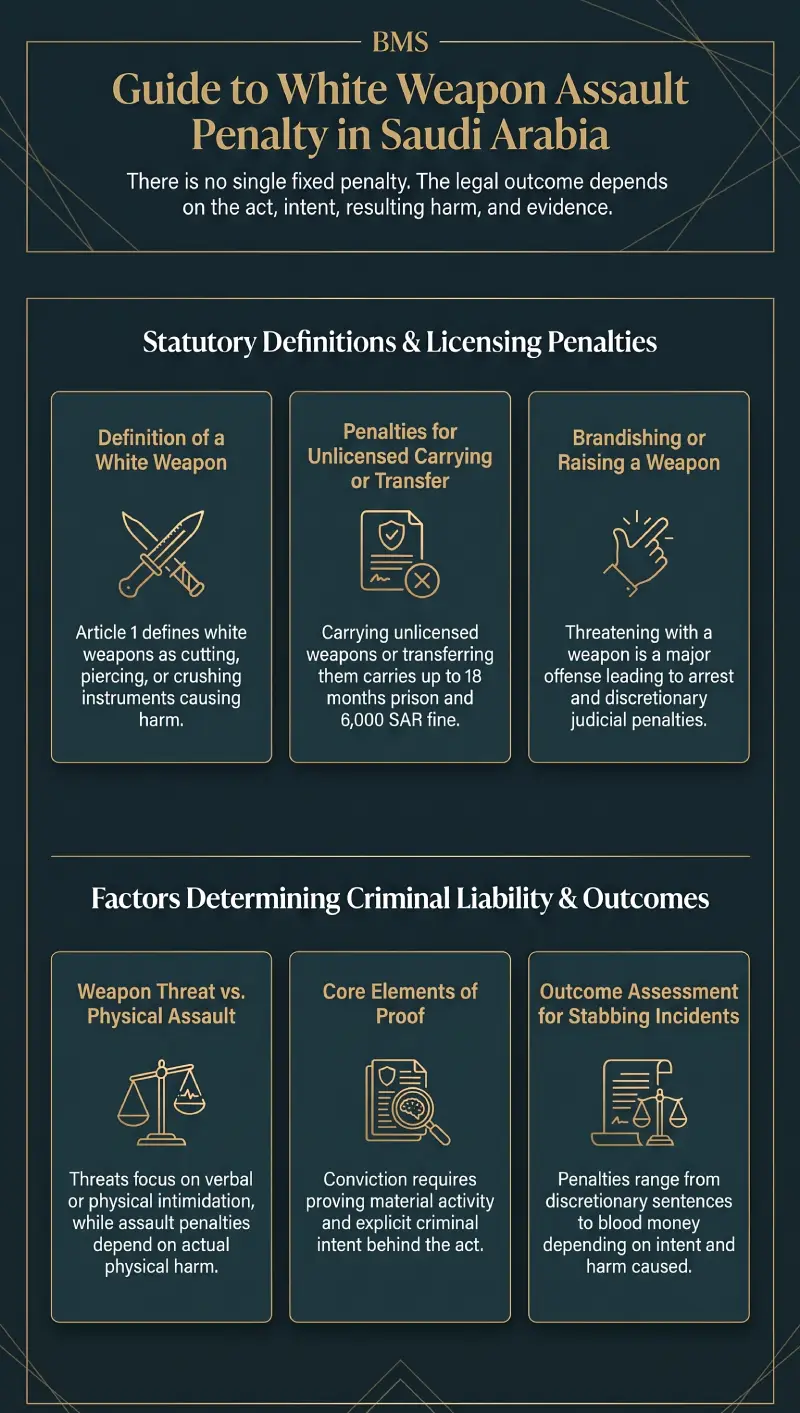
There is no single fixed White Weapon Assault Penalty in Saudi Arabia. The legal outcome depends on the act, intent, resulting harm, and evidence. Threatening or raising a knife differs from actual stabbing, while serious injury, permanent disability, or death may affect the legal characterization of the case. A criminal penalty may only be imposed after conviction and trial in accordance with Article 3 of the Saudi Law of Criminal Procedure.
What Is a White Weapon Under Saudi Law?
A white weapon is not limited to a knife. Article 1 of the Saudi Law of Weapons and Ammunition defines white weapons as cutting, piercing, crushing, or blunt instruments. The statutory examples include swords, daggers, knives, arrows, spears, spear-tipped sticks, knuckle weapons, and other instruments falling within the same category.
This definition identifies the type of instrument, but it does not by itself determine the White Weapon Assault Penalty. The presence of a knife or dagger does not establish the legal outcome of a case. It is also necessary to determine how the instrument was used, whether the conduct was limited to a threat or developed into an actual stabbing, the nature of any resulting injury, and the intent that may be inferred from the circumstances.
For this reason, the penalty for a knife assault varies according to the conduct established before the court. The incident may involve a threat without physical injury, actual use of the weapon causing a wound, or an assault resulting in more serious consequences. This distinction prevents the statutory definition of a weapon from being confused with the criminal responsibility arising from its use against another person.
What Is the White Weapon Assault Penalty in Saudi Arabia?
Determining the White Weapon Assault Penalty begins with establishing what actually happened. Article 3 of the Saudi Law of Criminal Procedure provides that no criminal penalty may be imposed except after conviction for an act prohibited under Sharia or law and following a trial conducted in accordance with the applicable legal requirements. A penalty therefore cannot be determined solely from the type of weapon or from describing the incident simply as a “stabbing.”
The principal factors vary according to the outcome:
| Assault scenario | Factors affecting the legal assessment |
|---|---|
| Threatening or raising a knife | Nature of the threat, surrounding circumstances, and evidence |
| Assault without injury | Conduct, intent, and evidence establishing the incident |
| Stabbing causing a wound | Nature of the injury and medical report |
| Serious bodily injury | Extent of harm and its medical consequences |
| Permanent disability | Proof of disability and its causal connection to the assault |
| Death | Cause of death, intent, and causal connection between the act and the result |
| Self-defense | Nature of the danger, sequence of events, and evidence |
The absence of physical injury does not automatically eliminate potential liability. A threat or assault may still be established through witness testimony, recordings, or other evidence. When a stabbing causes a wound, the medical report becomes important in establishing the nature and consequences of the injury. Attribution of the assault to the accused, however, must still be assessed through the remaining evidence.
The resulting harm becomes particularly significant where the assault causes serious injury, permanent disability, or death. Accordingly, the penalty for stabbing with a knife in Saudi Arabia cannot be reduced to a fixed number. The legal issue before the court changes according to the intent, outcome, and facts established by the evidence.
What Is the Difference Between Threatening Someone With a White Weapon and Stabbing?
A threat with a white weapon may occur without causing bodily injury, whereas stabbing involves physically using the instrument against the victim’s body. This distinction changes the facts and evidence that the competent authorities need to examine and explains why the penalty for threatening someone with a knife may differ from the consequences of an actual stabbing.
Where a person raises or brandishes a knife, the manner of the conduct, accompanying statements, context of the dispute, witnesses, and recordings may all become relevant. The mere presence of a knife is not enough to establish a particular form of assault. The weapon must be connected to the alleged conduct through evidence.
Where the knife is actually used and the victim is injured, the medical report, nature of the wound, and causal relationship between the act and the injury become additional considerations. This distinction is important when assessing a knife threat or raising a knife against another person compared with an assault that results in actual bodily injury.
When Does the Legal Characterization of a Knife Stabbing Change?
Not every knife stabbing is legally characterized in the same way. The assessment requires consideration of intent, the resulting harm, the circumstances surrounding the incident, and the evidence. Article 163 of the Saudi Law of Criminal Procedure provides that the court bases its judgment on the evidence presented during the proceedings, making evidentiary analysis central to determining responsibility.
The manner in which the weapon was used, the location of the injury, the sequence of events, and statements made before or during the assault may reveal facts relevant to intent. However, a particular intent should not be presumed merely because a stabbing occurred. The White Weapon Assault Penalty therefore depends on the legal characterization supported by the established facts.
This distinction is particularly important when the issue is whether the conduct involved an intent to kill or only an intent to cause injury. The outcome alone does not necessarily establish intent, and one party’s description of the incident does not determine its characterization without supporting evidence and circumstances considered by the investigating authority and the court.
How Do a Fight and Self-Defense Affect the Case?
Using a knife during a fight requires identifying each participant’s role, who initiated the assault, who used the weapon, and the specific conduct attributed to each person. The involvement of several people in the same altercation does not mean they bear identical responsibility, and describing the incident simply as a “fight” is insufficient to determine the penalty for a fight involving a white weapon.
Recordings, witness testimony, medical reports, and official records can help reconstruct the sequence of events, particularly where the participants provide conflicting accounts. The Saudi Law of Criminal Procedure regulates the collection of information and evidence, witness testimony, and seizure of items connected to an offence. Article 164 also allows the court to summon any person whose testimony it considers necessary.
Where a party relies on self-defense, making the claim alone does not determine liability. The nature of the danger, who initiated the assault, the manner of the response, the sequence of events, and the surrounding evidence become relevant to the assessment. Each incident therefore requires an individual review rather than applying the same conclusion to every fight involving a knife or other white weapon.
How Do Public Rights, Private Rights, and Waiver Affect the Case?
A white weapon assault may involve both a public criminal claim and a private claim, and each can affect the continuation of proceedings differently. Article 22 of the Saudi Law of Criminal Procedure provides that a victim’s or heir’s pardon does not prevent the continuation of the public criminal action. A waiver therefore does not necessarily bring the entire criminal case to an end.
The private claim concerns the rights of the person harmed by the offence. Article 153 of the Law permits a person who suffers harm from an offence to seek compensation under the circumstances and procedures prescribed by law. Article 151 further provides that abandoning a private claim does not affect the public criminal action.
The terms and consequences of any settlement or waiver should therefore be understood before it is signed, particularly where the incident resulted in injury or a financial claim. Waiving a private claim does not automatically terminate the public proceedings, while compensation or other private rights cannot be reduced to a single amount without examining the harm, documents, and circumstances of the case.
How Is a White Weapon Assault Proven?
Proving an assault does not necessarily depend on one piece of evidence. Medical reports, witness testimony, recordings, digital evidence, official incident records, and the weapon itself may collectively establish how the incident occurred and connect it to the person concerned. The Saudi Law of Criminal Procedure provides for criminal investigation officers to identify offenders and collect the information and evidence required for investigation and prosecution.
Article 54 of the Implementing Regulations of the Law of Criminal Procedure explains that examination of a crime scene may include searching for traces, fingerprints, bloodstains, examining objects, and photographing the scene. Preserving evidence and avoiding interference with the scene or relevant objects may therefore be important after an incident.
A medical report can document the existence, nature, and consequences of an injury, but it does not by itself identify the person who caused it. Attribution may require witness testimony, recordings, admissions, or other circumstantial evidence. Once a case reaches the investigation or trial stage, consulting a criminal lawyer in Jeddah can assist with organizing the facts, reviewing the evidence, and identifying the requirements of each party’s position at the relevant procedural stage.
What Should You Do After a White Weapon Assault?
Obtain medical treatment when necessary, report the incident to the competent authority, document any injuries, and preserve recordings, messages, and witness details connected with the incident. Avoid deleting digital evidence or interfering with the weapon or scene where doing so could affect examination and evidence collection.
The provisions governing preliminary inquiry and investigation under the Saudi Law of Criminal Procedure regulate the collection of information, seizure of objects connected with an offence, witness testimony, and the use of experts. Article 4 also provides that every accused person has the right to appoint a representative or lawyer to defend them during both the investigation and trial stages. Understanding the current procedural stage is therefore important before giving a statement or taking another legal step.
Where the file includes a medical report, summons, investigation, or dispute concerning evidence, reviewing the facts with a law firm in Jeddah that has a criminal-law team can help identify the relevant documents, procedural route, and scope of legal work before the next step is taken, without assuming a particular outcome.
This article was reviewed for the accuracy of information concerning the White Weapon Assault Penalty, legal characterization of the incident, public and private rights, and evidentiary procedures, with reference to the Saudi laws and official sources cited alongside the relevant legal information.
Frequently Asked Questions About the White Weapon Assault Penalty
What is the White Weapon Assault Penalty in Saudi Arabia?
There is no single fixed penalty. The outcome depends on the act, intent, resulting injury, evidence, and legal characterization of the case.
How long is the prison sentence for stabbing someone in Saudi Arabia?
There is no single prison term applicable to every stabbing case. The outcome depends on the intent, injury, evidence, and circumstances established before the court.
Is stabbing someone with a knife considered attempted murder?
Not automatically. The legal characterization depends on the proven intent, manner of using the knife, location of the injury, circumstances, and supporting evidence.
Does the victim’s waiver end a white weapon assault case?
Not necessarily. A waiver of the private claim does not automatically terminate the public criminal action, which may continue depending on the case.
Can self-defense apply in a knife assault case?
Self-defense depends on the circumstances, including the nature of the danger, who initiated the assault, the response, sequence of events, and available evidence.
How is a white weapon assault proven?
Evidence may include medical reports, witness testimony, CCTV recordings, digital evidence, official records, physical evidence, and other relevant circumstances.
White Weapon Assault Penalty in Saudi Arabia: 7 Key Cases explains why the legal outcome does not depend on the type of weapon alone. It is affected by the conduct, intent, resulting harm, evidence, and rights arising from the incident. The seven cases are threatening or raising a knife, assault without injury, stabbing causing a wound, serious bodily injury, permanent disability, death, and a claim of self-defense.
If the incident has resulted in a report or investigation, or if you have a medical report, recording, or witnesses, the appropriate approach begins with identifying the procedural stage and organizing the evidence before deciding how to respond, pursue a claim, or enter into a settlement. At BMS Legal Law Firm and Legal Consultancy, each matter begins with a review of the relevant facts and documents, followed by a clear explanation of the available options, scope of legal services, and next procedural step without promising a predetermined outcome. Pasted text.