
The public property assault penalty in Saudi Arabia varies according to the nature of the conduct, whether the damage was intentional or resulted from negligence or other causation, and the type of public facility affected. The Public Utilities Protection Law provides different penalties that may include imprisonment, fines, and compensation for damage. The legal consequences of damaging public property therefore cannot be determined from the value of the damage alone; the conduct and the applicable statutory provision must first be identified.
What Is the Public Property Assault Penalty in Saudi Arabia?
The public property assault penalty in Saudi Arabia depends on the specific form of conduct established in the case. The law does not impose one uniform penalty for every instance of damage. It distinguishes between intentional damage, causing damage without intent, unlawful use of public utilities, tampering, and certain forms of interference with roads and public facilities.
Article 5 of the Public Utilities Protection Law provides that a person who intentionally damages any public utility extension or facility, or cuts or disables it, may be punished by imprisonment for a period not exceeding two years and a fine not exceeding SAR 100,000, or either of these penalties. The provision applies to the principal offender and participants.
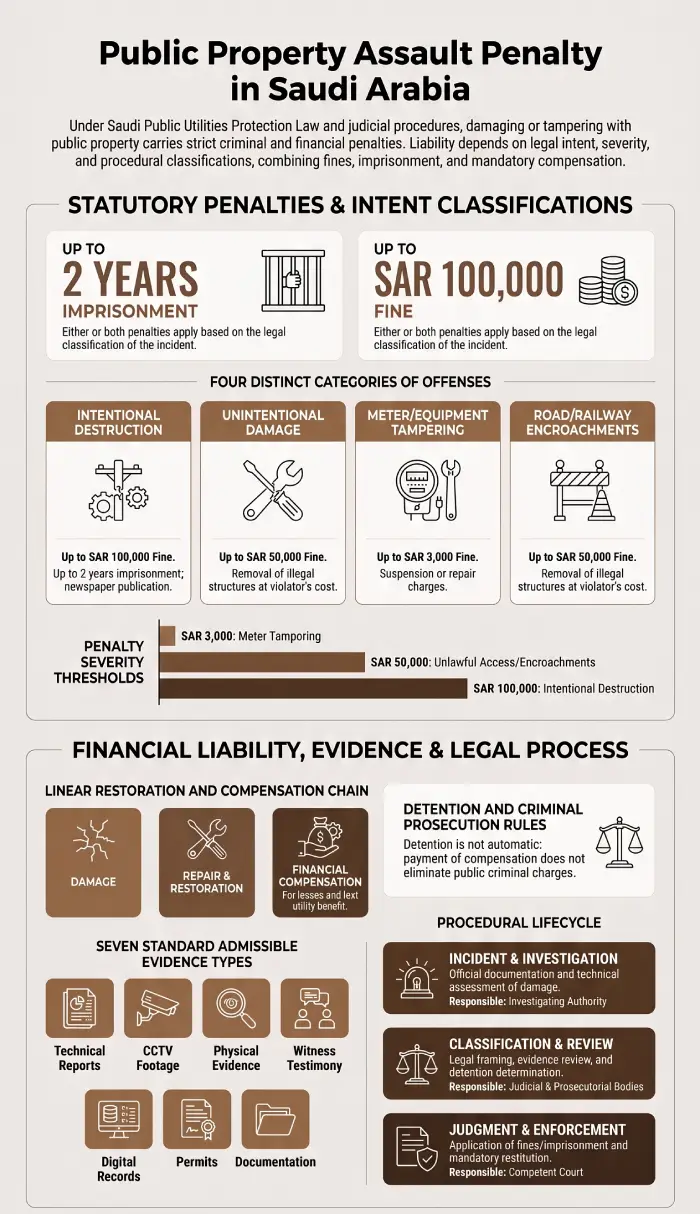
Penalty for Intentionally Damaging or Vandalizing Public Property
The penalty for damaging public property applies to intentional conduct where a person’s will is directed toward causing damage, cutting an extension, or disabling a public facility. The facility does not necessarily have to be completely destroyed. Damage to part of a network or interference with a facility’s operation may fall within the provision where the other elements of liability are established.
The mere existence of damage does not automatically mean that the maximum penalty will apply. The manner in which the damage occurred, the person’s role, the evidence of intent, and the type of public facility involved must be established. These factors help distinguish intentional public property damage from damage caused without intent.
When Can Imprisonment and a Fine Apply?
The possibility of imprisonment under Article 5 arises where intentional damage, cutting, or disabling of a public utility is established. The actual penalty imposed within the statutory limits depends on the judgment and the circumstances of the incident.
Where an incident is under investigation or a person is accused of intentionally damaging public property, consulting a criminal lawyer in Jeddah can help assess the evidence, determine whether intent can be established, and understand its effect on the legal characterization and potential penalty.
What Is the Difference Between Damage, Encroachment, and Tampering With Public Utilities?
This distinction is important because the penalty for public property damage is not necessarily the same as the penalty for every form of interference or tampering. The law contains separate provisions for certain conduct depending on what was done and the consequences that followed.
Damage involves causing harm to a public facility. Cutting involves separating or severing one of its extensions, while disabling means preventing the facility from performing its function. Encroachment may involve unlawfully obtaining a benefit from a public utility or using part of a road or railway right-of-way in violation of the applicable rules.
Damage, Cutting, and Disabling
The law addresses intentional damage, cutting, and disabling together under Article 5. Accordingly, the penalty for damaging public property in Saudi Arabia is not limited to cases involving complete destruction. Damage that materially affects a facility or its service may be sufficient where the statutory requirements are met.
The physical result must, however, be distinguished from intent. A facility may be proven to have been damaged while the question of whether the damage was intentional remains unresolved, particularly where the damage resulted from construction work or an error during execution.
Encroachment or Tampering Without Complete Damage
Article 7 imposes a fine of up to SAR 50,000 for certain forms of encroachment on public utility facilities or networks for the purpose of obtaining an unlawful benefit. It also covers specified forms of interference with roads, railways, and their rights-of-way.
Article 8 addresses other forms of tampering, including specified conduct involving water and electricity meters or public telephone equipment.
The conduct must therefore be identified before determining the applicable public property tampering penalty, because tampering, encroachment, and intentional damage are not identical legal classifications.
Does the Penalty Change if Public Property Damage Was Unintentional?
Yes. Intent is an important factor in determining which statutory provision applies. The absence of established intent does not necessarily eliminate liability. The law contains a separate provision for causing damage to public utility extensions, cutting them, or disabling them where the intentional conduct described in Article 5 has not been established.
Article 6 provides for a fine of up to SAR 100,000 for a person who causes damage to public utility extensions, cuts them, or disables them. It also contains additional provisions where the person responsible is a contractor.
Intentional Damage to Public Property
In an intentional damage case, establishing intent is a key issue because Article 5 expressly refers to intentional conduct. The circumstances of the incident, the method used, recordings, technical reports, and statements by the parties may therefore affect the assessment of whether the damage was deliberate.
Calling an incident “vandalism” is not enough to determine the legal outcome. The actual conduct and the evidence contained in the case file must be examined.
Causing Damage Without Intent
Where intent is not established, liability may still arise under Article 6 or the applicable executive rules, depending on the nature of the violation.
The responsible person may also be required to compensate for damage caused to the public facility or third parties and to bear repair costs in accordance with the applicable provisions.
Accordingly, the penalty for unintentional public property damage is not necessarily limited to compensation. A separate fine may apply in addition to the cost of repairing the damage.
What Cases May Have Different Penalties?
Identifying the specific conduct helps determine the statutory provision most relevant to the incident. The following table summarizes seven situations addressed by the law or its executive rules, without assuming that every similar incident automatically receives the same legal treatment.
| Case | Main statutory consequence |
|---|---|
| Intentional damage, cutting, or disabling | Imprisonment of up to 2 years and a fine of up to SAR 100,000, or either penalty |
| Causing damage to public utility extensions | Fine of up to SAR 100,000 |
| Damage caused by a contractor | Fine, with possible restrictions on contracting where the statutory requirements apply |
| Encroachment for unlawful benefit from a public utility | Fine of up to SAR 50,000, depending on the case |
| Encroachment on roads, railways, or their rights-of-way | Fine depending on the type of violation |
| Tampering with certain utility meters or equipment | Fine according to the provision governing the conduct |
| Facilitating another person’s unlawful benefit from a public utility | Fine under Article 9 |
The Executive Rules of the Public Utilities Protection Law provide additional details concerning certain road and stormwater drainage violations. They also confirm that collection of fines and compensation does not prevent the continuation of procedures for referral for imprisonment where Article 5 applies.
How Is Public Property Vandalism or Damage Proven?
Establishing the incident does not depend solely on proving that damage occurred. The case may also require evidence identifying who caused the damage, how it occurred, whether it was intentional, the value of the damage, and the connection between the conduct and the loss.
The evidence varies according to the circumstances. It may include official reports, technical assessments, photographs, recordings, facility plans, excavation permits, or documents relating to contractor work.
For this reason, the evidence should generally be assessed as a whole rather than relying on a single item.
Technical Evidence and Its Effect on Liability
A technical report can establish the location and nature of the damage and the cost of repairing it. It may also help determine whether the damage was connected to excavation, construction, or cutting a utility extension.
In contractor-related cases, plans, instructions, and permits may be particularly important because Article 2 requires appropriate precautions before work that could affect public utilities.
A camera recording or witness statement establishing that an act occurred does not necessarily resolve every element of the case. Intent, the extent of the damage, and the responsibility of each participant may still require further examination.
Does Public Property Vandalism Automatically Lead to Detention?
Not every incident involving public property damage should automatically be treated as grounds for detention. Detention is a procedural matter that depends on the legal classification, the facts, and the applicable statutory conditions. It does not arise simply because the word “vandalism” appears in a report.
A case should therefore be assessed against the current rules concerning offenses that may justify detention, together with the value of the damage, whether the conduct was intentional, and the status of any private claim.
A person who has been detained or summoned for questioning should focus on the incident report, available evidence, and legal characterization rather than attempting to predict the outcome solely from the name given to the offense.
Must the Person Responsible Pay for the Damage?
An incident involving damage to public property may result in a financial obligation separate from any criminal fine.
Article 11 of the Public Utilities Protection Law provides for compensation for damage suffered by the public facility or third parties, including repair costs and compensation for benefits lost as a result of the violation.
The competent authority may also require the violator to carry out the repair or may arrange for the repair and recover the related costs from the responsible person.
It is therefore important to distinguish between compensation for the actual damage and a fine imposed as a penalty for the violation.
Does Paying Compensation Cancel the Penalty?
Paying repair costs or compensation does not automatically eliminate all legal consequences of the case.
The executive rules confirm that collection of fines and compensation does not prevent the continuation of procedures for referral to the competent court to impose the imprisonment penalty provided under Article 5 where its conditions are satisfied.
The effect of payment must therefore be assessed according to the procedural stage, the type of decision, and the statutory provision involved rather than being treated as a general substitute for the criminal penalty.
What Happens After a Public Utility Violation Is Recorded?
The procedure depends on the type of violation and the nature of the penalty involved. The law provides for violations to be recorded, established, and investigated according to the applicable procedures. The matter is then handled according to the relevant rules governing fines, compensation, or imprisonment.
Article 13 provides for the Board of Grievances to have jurisdiction over the imprisonment penalty provided under the law, while compensation and fines are assessed and imposed in accordance with the rules issued by the competent minister.
It is therefore important to distinguish between challenging a fine or compensation decision and proceedings relating to an imprisonment penalty.
Where a fine or compensation decision has been issued and you wish to challenge it, consulting an administrative lawyer in Jeddah may help review the decision, notification date, issuing authority, and the appropriate legal procedure for challenging it.
When Does a Public Property Case Require Legal Review?
Legal review becomes particularly important where there is a dispute concerning intent, the value of the damage, the responsibility of more than one person, or where the accused is a contractor or represents a company.
It is also important where a fine or compensation decision has been issued and may require a formal challenge.
Start by collecting the incident report, technical assessment, issued decision, documents establishing the value of the damage, and any photographs, recordings, permits, or work-related documents.
The appropriate legal step can then be assessed based on the actual case rather than taking action before understanding its effect on the file.
The BMS Legal working process begins with reviewing the relevant facts and documents before identifying the available options and scope of action.
A law firm in Jeddah can also review the matter and explain the applicable legal options without requiring sensitive details to be disclosed at the initial stage.
Frequently Asked Questions About Public Property Assault Penalties
1. What is the penalty for assaulting public property in Saudi Arabia?
The penalty depends on the nature of the violation. Intentional damage to public utility facilities may result in imprisonment of up to two years and a fine of up to SAR 100,000, or either penalty.
2. Can vandalizing public property result in imprisonment?
Yes. Intentional destruction, cutting, or disabling of public utility facilities may be punishable by imprisonment of up to two years, a fine of up to SAR 100,000, or either penalty.
3. What is the difference between intentional and unintentional damage?
Intentional damage involves deliberately destroying, cutting, or disabling a public utility. Unintentional damage occurs without such intent and is subject to different legal provisions and penalties.
4. Does paying for the damage cancel the penalty for assaulting public property?
Not necessarily. Paying compensation does not automatically cancel the applicable criminal penalty. Compensation and criminal penalties are separate legal consequences.
5. Who bears the cost of repairing the damaged facility?
The party responsible for the damage may be required to pay the costs of repairing the damaged public utility, in addition to compensation for other applicable losses.
Public Property Assault Penalty in Saudi Arabia: 7 Cases summarizes seven situations that may receive different legal treatment depending on whether the conduct involved intentional damage, causing damage, encroachment, or tampering, as well as the type of public utility and the consequences of the incident.
A case may involve both a fine and compensation, while intentional damage falling within Article 5 may carry imprisonment within the statutory limit.
The correct assessment therefore begins with identifying the conduct, applicable provision, evidence, and value of the damage rather than assuming that one penalty applies to every case. Where there is an incident report, investigation, fine, or compensation decision, reviewing the documents before taking action can help identify the appropriate legal course.