
How to calculate inheritance in Saudi Arabia starts with identifying the legal heirs, determining the net estate, and then calculating each heir’s share. It is not enough to rely on the inheritance percentage alone, because an estate may include debts, a will, real estate, bank accounts, or minor heirs.
The Saudi Ministry of Justice provides an inheritance calculation service that helps determine the inheritance share of each heir, the applicable percentage, and the amount of that share based on the information entered. The service requires the total value of the estate, the deceased’s gender, and answers to questions relating to the surviving heirs before displaying the result.
Quick Answer: How to Calculate Inheritance
Inheritance is calculated by identifying the heirs who were alive at the time of death, determining the deceased’s assets and liabilities, and then deducting applicable debts and any valid will before distribution.
The heirs’ shares are then determined under the Saudi Personal Status Law, after which those percentages are converted into monetary amounts or actual shares depending on the nature of the estate. The law expressly regulates inheritance by prescribed shares, residuary entitlement, or kinship according to the circumstances.
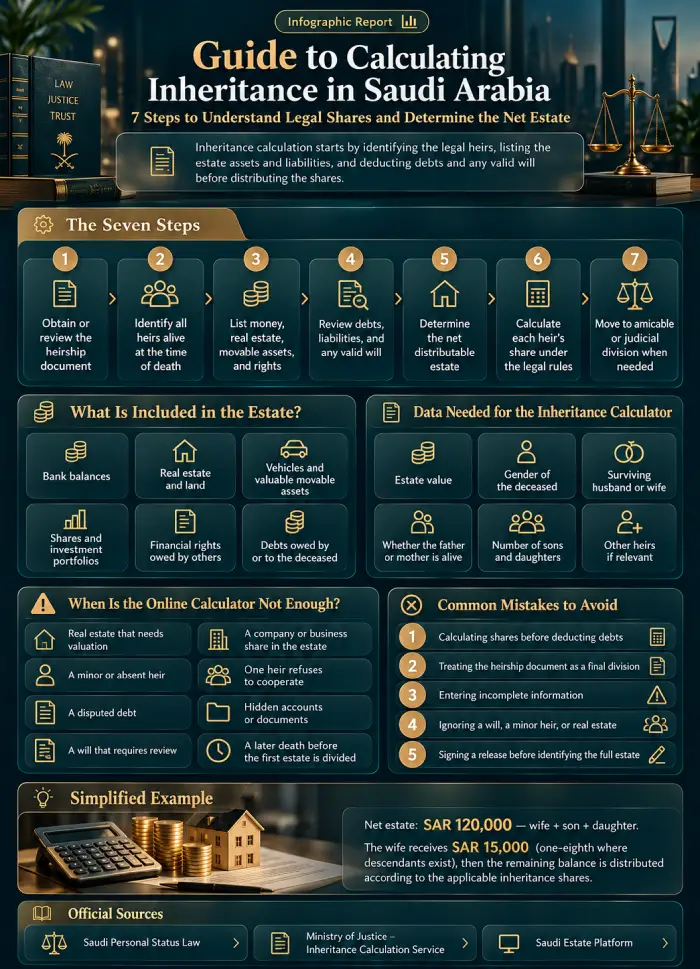
In practical terms, the process can be summarized in seven steps:
- Obtain or review the heirship document.
- Identify all heirs who were alive at the time of death.
- Identify the money, real estate, movable assets, and financial rights forming part of the estate.
- Review debts, liabilities, and any valid will.
- Determine the net distributable estate.
- Calculate each heir’s applicable inheritance share.
- Proceed with consensual or judicial estate division where necessary.
What Does Inheritance Calculation Mean in Saudi Arabia?
Inheritance calculation means determining each heir’s share of the net estate after identifying the heirs and the rights and liabilities that must be addressed before distribution.
This includes identifying heirs with prescribed shares, residuary heirs, and persons who may be excluded from inheritance or whose shares may change because another heir exists. The applicable shares are then converted into monetary amounts or interests in particular assets.
Inheritance calculation is different from estate division. The calculation answers the question, “How much is each heir entitled to?” Estate division, however, involves actually transferring or distributing the estate assets among the heirs.
Estate division may take place by agreement among the heirs or may require judicial proceedings where a dispute exists or an agreement cannot be reached.
| Procedure | Meaning | Result |
|---|---|---|
| Inheritance calculation | Determining each heir’s share | Numerical inheritance entitlement |
| Heirship determination | Officially establishing the heirs | Official heirship document |
| Estate inventory | Identifying the deceased’s assets and debts | Record of assets and liabilities |
| Estate division | Actual distribution among the heirs | Agreement or judicial procedure |
Inheritance calculation is therefore one step within a broader estate process that starts with establishing the heirs, continues with identifying the estate, and ultimately leads to distribution.
For the broader legal and procedural picture, see our guide to inheritance and estates in Saudi Arabia.
Who Are the Legal Heirs Before Inheritance Is Calculated?
Before applying any inheritance calculation, it is necessary to identify the legal heirs who were alive when the deceased died.
The principal categories may include the husband or wife, father, mother, sons, daughters, and, in certain circumstances, other relatives such as siblings, grandfather, or grandmother.
The Saudi Personal Status Law provides that inheritance may arise through a prescribed share, residuary entitlement, a combination of both, or kinship, depending on the circumstances.
For practical purposes, heirs can be grouped into three main categories:
- Heirs with prescribed shares: heirs whose shares are determined under the applicable inheritance rules, such as the husband, wife, father, mother, or daughter in certain cases.
- Residuary heirs: heirs who may receive what remains after prescribed shares have been distributed, or who may inherit the estate where no prescribed-share heir takes precedence.
- Excluded or affected heirs: persons whose inheritance may be excluded or reduced because another heir with a closer or stronger entitlement exists.
| Heir | Common Situation | Effect of Descendants |
|---|---|---|
| Husband | Inherits from his deceased wife | His share decreases where the deceased has descendants |
| Wife | Inherits from her deceased husband | Her share decreases where the deceased has descendants |
| Mother | Inherits from her son or daughter | Her share may decrease where descendants or multiple siblings exist |
| Father | Inherits depending on whether children exist | May inherit through a prescribed share or residuary entitlement |
| Daughter | May inherit through a prescribed share or residuary entitlement | Her share may change where a son exists |
This is why questions concerning a wife’s inheritance from her husband, a husband’s inheritance from his wife, or a mother’s inheritance from her son cannot be answered accurately without identifying the other heirs who were alive at the relevant time.
Steps for Calculating Inheritance in Saudi Arabia
Understanding how to calculate inheritance in Saudi Arabia requires following the correct sequence: establish the heirs, identify the estate, and determine the net amount available for distribution.
This sequence becomes particularly important where the estate is substantial, includes real estate, involves a minor heir, or there is disagreement over debts.
The first step is obtaining or reviewing the heirship document if one has already been issued.
The Ministry of Justice explains that heirship-related procedures are available electronically through the relevant inheritance services and the Estate Platform.
Before beginning the calculation, heirs may therefore need to understand how to obtain a Najiz Electronic Inheritance Deed, which is commonly used to identify the deceased, the heirs, and their recognized inheritance shares before dealing with banks, real estate, or other estate assets.
After that, the heirs move to identifying the estate itself. An estate may include:
- Bank balances and investment accounts.
- Real estate, land, and residential property.
- Vehicles and valuable movable assets.
- Shares, investment portfolios, and accrued returns.
- Rental income and financial rights owed by third parties.
- Established debts owed to or by the deceased.
The Ministry of Justice provides estate inventory procedures through the Estate Platform. This demonstrates an important distinction: identifying who the heirs are is different from identifying what assets and liabilities form part of the estate.
Before distribution, established debts, applicable liabilities, and any valid will should be reviewed.
For example, if the apparent estate value is SAR 500,000 and the estate is subject to an established debt of SAR 100,000, the inheritance calculation begins from SAR 400,000 rather than from the entire apparent value.
Calculating Inheritance Through Najiz and the Ministry of Justice
The Saudi inheritance calculator can provide an initial indication of the heirs’ respective shares.
It is most useful where the heirs are clearly identified and there is no significant dispute over the number of heirs, estate value, or outstanding debts.
The official Saudi Ministry of Justice Inheritance Calculation Service allows users to enter the estate amount and relevant information concerning the deceased and heirs in order to calculate the resulting shares.
To use the calculator more accurately, prepare:
- Total estate value or known net estate value.
- Gender of the deceased.
- Whether there is a surviving husband or wife.
- Whether the father or mother is alive.
- Number of sons and daughters.
- Whether siblings or other potentially relevant heirs exist.
- Any information that may affect exclusion or reduction of an inheritance share.
Despite its usefulness, the calculator does not by itself complete the actual division of an estate.
It does not transfer ownership of real estate, document a division agreement, resolve a dispute among heirs, or determine the value of assets that require valuation.
If the estate includes real estate, debts, or a dispute among the heirs, BMS Legal may review the documents and help clarify the appropriate route before division, whether the matter concerns calculating shares, identifying estate assets, consensual division, or judicial proceedings.
Practical Examples of How Inheritance Shares Are Calculated
Examples can help explain inheritance calculations, but they cannot be applied automatically to every estate.
The presence of even one additional heir may change the outcome, particularly where exclusion rules apply or where debts, a will, or non-cash assets are involved.
| Situation | How the Calculation Is Considered |
|---|---|
| Wife and children | The wife receives her applicable share and the balance is distributed among the children according to the circumstances |
| Husband and daughters | The husband’s share is considered first, followed by the daughters’ and any other heirs’ shares |
| Sons and daughters | The remaining estate after prescribed shares is distributed according to the applicable residuary rule |
| Mother, father, and children | The parents’ shares vary depending on the existence of descendants |
| Estate containing real estate | Valuation, agreement, or an appropriate division procedure may be required |
In the case of a wife inheriting from her husband, a frequent question is: How much does a wife inherit?
The answer depends on whether the deceased left descendants. A wife’s share differs depending on whether children or other qualifying descendants exist. Where there is more than one wife, the applicable wife’s share is shared among them.
When moving from inheritance calculation to actual distribution, see how to divide inheritance in Saudi Arabia to understand how calculated entitlements are converted into actual distribution among heirs.
Similarly, determining a husband’s inheritance from his deceased wife requires establishing whether she left descendants who affect his applicable share.
Simplified Example
Assume that the net estate is SAR 120,000 and the surviving heirs are a wife, one son, and one daughter.
Where descendants exist, the wife receives one-eighth of the estate, which in this example equals SAR 15,000. The remaining amount is then distributed between the son and daughter under the applicable inheritance rule, assuming that no other heirs affect the calculation.
What Is Deducted From the Estate Before Inheritance Is Distributed?
Estate distribution does not always begin with the gross value of the visible assets. It begins with the net estate after reviewing rights and liabilities that must be addressed before distribution.
This is one of the most important stages in how to calculate inheritance in Saudi Arabia, because calculating inheritance shares before identifying relevant obligations can result in an inaccurate distribution.
Before distributing the estate, review:
- Established debts owed by the deceased.
- Documented financial liabilities.
- Rights attached to a specific estate asset.
- A valid will within its applicable limits and conditions.
- Necessary estate-management expenses where properly documented.
- Financial rights that have not yet been included among the identified estate assets.
A will should be reviewed in terms of its validity, wording, limits, and intended beneficiary.
If there is a dispute concerning a will or debt, the matter may move beyond a straightforward inheritance calculation and require legal assessment.
If the net estate decreases after debts or liabilities are deducted, the monetary amount ultimately received by each heir will also decrease.
For this reason, knowing only the percentage is not enough to determine the final amount, particularly where the estate contains loans, real estate, or unresolved financial obligations.
When Is an Online Inheritance Calculation Not Enough?
An online inheritance calculation is useful in straightforward cases, but it may not be sufficient where the estate requires document review or asset valuation.
This commonly occurs where the estate includes real estate, a minor heir, a disputed debt, a will, or disagreement over the disclosure of estate assets.
Do not rely solely on the inheritance calculator where:
- Real estate requires valuation, sale, or division.
- An heir is a minor or absent.
- A debt is disputed or insufficiently documented.
- A will requires review of its validity, conditions, or limits.
- A company or business interest forms part of the estate.
- One heir refuses to cooperate or sign a division agreement.
- Documents, bank accounts, or estate assets may not have been disclosed.
- An heir dies after the original deceased but before the first estate is divided.
Where real estate, debts, or disagreements among heirs are involved, calculating the inheritance percentage alone may not resolve the matter.
An Inheritance & Estates Lawyer in Jeddah may assist with reviewing the relevant documents and identifying the appropriate route for estate division rather than simply calculating the numerical share.
The official Saudi Estate Platform is designed to facilitate estate-related processes, including estate inventory and division, through electronic procedures.
The Role of an Inheritance Lawyer in Estate Calculation and Division
An inheritance lawyer may become relevant when the matter moves beyond simply determining a percentage and requires a legal procedure.
This can arise where there is a dispute, real estate, a minor heir, a will, debts, or uncertainty concerning the assets forming part of the estate.
If the estate is connected with a wider family dispute, such as disagreement among heirs, issues relating to a will, or the interests of a minor, it may also be appropriate to consult a Family Lawyer in Jeddah.
A lawyer may assist by:
- Reviewing the heirship document and the information recorded in it.
- Examining estate, asset, and debt documentation.
- Explaining the distinction between heirship determination, calculation, and division.
- Determining whether consensual division is possible.
- Preparing the appropriate judicial route where an heir refuses to cooperate.
- Protecting the rights of minors or absent heirs through the applicable procedures.
- Reducing avoidable errors before an agreement among the heirs is signed.
If an agreement cannot be reached or an heir refuses to cooperate, an estate division claim may become the appropriate route depending on the nature of the assets and the dispute.
Before signing any agreement among heirs, prepare the heirship document, real-estate information, bank statements, and documents relating to debts.
BMS Legal may also be contacted for an initial assessment of the estate and clarification of the appropriate next step.
Common Mistakes When Calculating Inheritance
Inheritance-calculation errors often result from acting too quickly or relying on general information without reviewing the actual estate.
Some mistakes may affect the eventual division, create disputes among heirs, or result in an agreement that does not properly address the estate.
Common mistakes include:
- Distributing money before reviewing debts and liabilities.
- Treating the heirship document as the final division of the estate.
- Relying on an undocumented verbal calculation.
- Entering incomplete information into the inheritance calculator.
- Ignoring the existence of a will, minor heir, or real estate.
- Assuming that siblings always inherit.
- Signing a release before the entire estate has been identified.
- Dividing real estate without valuation or a clear agreement.
- Ignoring the effect of an heir dying before the original estate is distributed.
An heirship document does not mean that the estate has already been divided.
It establishes who the heirs are, but it does not necessarily determine how inherited real estate will be sold, how individual assets will be allocated, or how a dispute among the heirs will be resolved.
This guide explains how inheritance is calculated in Saudi Arabia using the applicable Saudi legal framework and official inheritance services.
Prepared by: BMS Legal Content Team
General legal information only. Inheritance shares may vary depending on the heirs, debts, will, and nature of the estate assets.
Frequently Asked Questions About How to Calculate Inheritance
How is inheritance calculated in Saudi Arabia?
Inheritance is calculated by first identifying the heirs, determining the net estate, and then allocating the applicable shares under the Saudi Personal Status Law.
What is the easiest way to calculate inheritance?
A useful initial method is to use the Ministry of Justice inheritance calculator through the official electronic service, provided that the heirs’ and estate information is entered accurately.
Is the Saudi inheritance calculator official?
Yes. The inheritance calculation service is provided through the Saudi Ministry of Justice and calculates each heir’s share according to the information entered.
Is calculating inheritance through Najiz enough to divide an estate?
No. The calculator helps determine inheritance shares, but it does not replace heirship documentation, estate inventory, transfer of assets, or documentation of the final estate division.
How to Calculate Inheritance in Saudi Arabia: 7 Steps can be understood through seven main steps: identify the heirs, determine the estate assets, review debts and any valid will, establish the net estate, calculate each heir’s applicable share, and then move to the appropriate division procedure.
The official inheritance calculator can provide a useful initial indication of the applicable shares, but it does not itself complete estate distribution.
Where an estate includes real estate, a minor heir, a will, debts, or disagreement among heirs, knowing the inheritance percentage alone is not enough. The correct next step may involve an estate inventory, consensual division, or judicial proceedings.
In inheritance matters, mistakes often arise not only from an incorrect percentage, but from following the wrong procedural sequence or relying on incomplete documentation.
Official Sources: