
How to divide inheritance in Saudi Arabia does not begin with distributing money immediately. It starts with identifying the entire estate, determining the heirs, and reviewing debts and obligations. The process may be straightforward when the assets are clear and the heirs agree, but it can become complicated when the estate includes a house or land.
In Saudi Arabia, knowing the legal inheritance share alone is not enough. An heir’s share does not become an asset in their possession without completing the necessary procedures. This becomes particularly important when the estate includes rental income, checks, gold, real estate, or when one of the heirs refuses to cooperate.
This guide explains how to divide inheritance in Saudi Arabia in practical terms, with particular attention to estates involving houses, land, and rental income. It also explains when an agreed division may be appropriate and when an inheritance division claim may become necessary.
For a broader understanding before dealing with the division itself, see the Guide to Inheritance and Estates in Saudi Arabia to understand heir identification, inheritance shares, and the available estate-division procedures.
How to Divide Inheritance in Saudi Arabia: The Short Answer
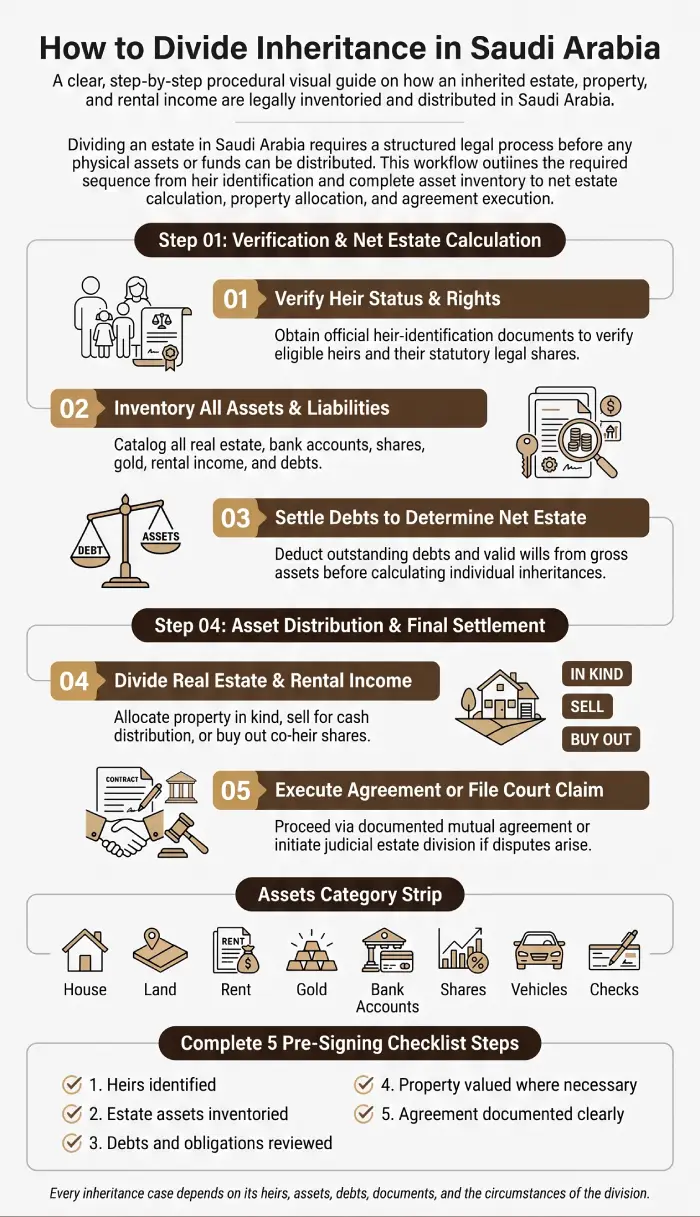
Inheritance is distributed after identifying the heirs, determining the estate assets, settling debts, and carrying out any valid will within its applicable limits. The inheritance shares are then calculated, after which the estate may be divided by agreement between the heirs or through the courts when an agreement cannot be reached.
Knowing an heir’s theoretical share is not enough. The estate may include a house, land, rental income, or other assets that require separate procedures. The relevant documents should therefore be organized before selling property, transferring ownership, or signing an inheritance-division agreement.
What Does Inheritance Division Mean in Saudi Arabia?
Inheritance division means converting an heir’s general legal share into an actual share of money, property, or another estate benefit. This does not happen simply because the deceased has died. Documents must establish the heirs and identify the assets forming part of the estate.
The estate includes the money, rights, and obligations left by the deceased, such as real estate, bank accounts, gold, shares, and other assets. Inheritance, by contrast, refers to what the heirs are entitled to receive after taking the relevant debts, obligations, and valid will into account.
When considering how to divide an inheritance, it is important to understand that inheritance distribution is not merely a mathematical calculation. The heir’s share may be clear while the underlying asset cannot easily be divided, such as a small house or a limited parcel of land.
The requirements for dividing an estate therefore extend beyond calculating shares. They include establishing the heirs, identifying the estate, determining debts, and deciding how houses, land, rental income, gold, and other assets should be handled.
This creates an important distinction between knowing an inheritance share and actually receiving it. The inheritance share gives the heir a right, but converting that right into money or identifiable property requires appropriate documents and procedures.
Steps for Dividing Inheritance in Saudi Arabia
The process of dividing an inheritance in Saudi Arabia generally moves through identification, inventory, calculation, and distribution. Estate assets should not normally be distributed or sold before the net estate and its obligations are established.
From Identifying the Heirs to Identifying the Estate
The first step is obtaining the relevant heir-identification document, because it establishes the persons entitled to inherit and their applicable shares. This is different from identifying the estate itself, which focuses on the assets, rights, and debts left by the deceased.
If the heir document has not yet been issued, it is useful to review the steps for obtaining an electronic heir-identification deed through Najiz before starting the estate inventory or signing an agreement between the heirs.
The estate inventory may include real estate, bank accounts, shares, vehicles, gold, rental income, debts, and business interests. This is essential when determining how the estate should ultimately be divided.
If the deceased owned a rented house, land, checks, or financial obligations, these should be included in the estate inventory. An incomplete division may create a later dispute, particularly if an undisclosed asset is discovered after an agreement has been signed.
From Settling Debts to Calculating the Heirs’ Shares
After identifying the assets, debts, obligations, and any valid will should be considered before distribution. The division should be based on the net estate rather than simply on the total value of the assets visible to the heirs.
An inheritance calculator can provide an initial estimate of each heir’s share when the relevant information is entered. However, it remains a supporting tool and does not replace reviewing the documents, particularly where the estate is disputed.
A more detailed review may be necessary where there is a minor heir, a will, an unclear debt, or disputed real estate. In such cases, the issue is not simply the amount of the inheritance share but how that share can actually be transferred or delivered.
Division by Agreement or Through the Courts
When the assets are clear and all heirs agree, an agreed estate division may be a practical way to proceed. If an heir refuses to cooperate, documents are withheld, or real estate cannot be sold or divided by agreement, an inheritance division claim may become necessary.
Where the division becomes complicated or a dispute arises between the heirs, consulting an inheritance lawyer in Jeddah can help clarify the appropriate legal route before filing a claim or signing an unclear agreement.
The Difference Between Identifying the Heirs and Identifying the Estate
Confusing heir identification with estate identification is a common reason for delays in inheritance division. The first establishes who the heirs are, while the second identifies the assets and rights that will actually be divided.
| Comparison | Heir Identification | Estate Identification |
|---|---|---|
| Main question | Who are the heirs? | What did the deceased leave? |
| Contents | Heirs and applicable shares | Real estate, accounts, debts, and rights |
| Practical effect | Establishes heir status | Prepares the estate for actual division |
| Common mistake | Treating it as final distribution | Ignoring it before sale or distribution |
An heir-identification document alone does not necessarily complete the process for selling property, distributing rental income, or releasing funds to the heirs. There may be an outdated property deed, an undisclosed bank account, undocumented gold, or a check payable to the heirs.
An estate inventory helps determine what can actually be distributed and which obligations must be dealt with first. This can reduce disputes, particularly where the estate contains several properties or continuing rental income.
If undisclosed assets are discovered, the relevant facts should be documented and disclosure should be sought through the appropriate legal procedures. Taking control of an estate asset without accounting for it may lead to a rights dispute depending on the circumstances and available evidence.
How Are Inheritance Shares Calculated?
The calculation of inheritance shares begins with determining the net estate rather than simply looking at the gross amount of money or property. The assets, debts, and valid will must therefore be considered before calculating each heir’s share.
Common searches include inheritance division between sons and daughters, inheritance division between a wife and children, and inheritance where the deceased has no children. There is no single result that applies to every case because the presence or absence of another heir can change the calculation.
Where sons and daughters inherit in circumstances in which the applicable rules provide for this distribution, the male heir may receive the share of two females. Where there are no children, the outcome depends on the presence of a spouse, parents, siblings, and other heirs.
| Common situation | Point to consider |
|---|---|
| Wife and children | The wife’s applicable share is determined first, with the remainder distributed according to the applicable inheritance rules |
| Sons and daughters | In applicable cases, a male heir receives the share of two female heirs |
| No children | The distribution depends on the presence of parents, siblings, spouse, and other heirs |
| Real estate only | The division may require valuation, sale, or financial adjustment |
| Minor heir | The applicable legal representation and protection of the minor’s interests must be considered |
An inheritance calculator can assist with straightforward numerical cases, but it does not resolve disputes concerning property ownership, use, or valuation. It may also be insufficient where assets are registered ambiguously or debts are disputed.
Dividing an Inherited House and Rental Income
An inherited house can be one of the most sensitive estate assets because it combines financial value with family considerations. It should therefore be treated as jointly inherited property rather than as the individual property of the person who occupies or manages it.
Where several heirs own the property jointly, the house or land may remain held in undivided ownership. If the heirs cannot reach an agreement, one of them may need to seek a legal division or assert their share in the property.
Where the inheritance dispute is connected with other family matters involving guardianship, minors, or family disputes, consulting a personal status lawyer may help clarify how the estate issue interacts with other personal-status matters.
Living in an Inherited House
When considering the legal position of living in an inherited house, a distinction should be made between occupation with the heirs’ consent and occupation that is disputed. If the heirs agree that one of them may remain in the property, it is preferable to document the period and how the benefit of occupation will be treated.
If one heir occupies the property alone and prevents the others from using it, the other heirs may have grounds to seek their share of the benefit derived from the property, depending on the circumstances. Previous occupation of the deceased’s house does not by itself make the occupant the sole owner.
There is no single answer to the question of how to divide a house between heirs. The appropriate solution may involve selling the property, renting it out, or transferring ownership to one heir in return for compensating the others.
Some heirs search for the procedures for selling an inherited house when agreement on division or use cannot be reached. The practical starting point is to identify the heirs and the property, obtain an appropriate valuation, and then consider an agreed sale or the applicable judicial route.
Dividing Rental Income Among Heirs
If the house is rented, the rental income is a benefit arising from the inherited asset. It should therefore be accounted for among the heirs according to their applicable shares, after considering expenses and obligations connected with the property.
It is advisable to establish who receives the rent, how property expenses are recorded, and when rental proceeds are distributed. If one heir collects the rent alone, the other heirs may need a clear accounting of amounts received, periods covered, and related expenses.
Where the dispute concerns a house, land, or rental income, the estate issue may overlap with property and co-ownership matters. A real estate lawyer may be consulted where the legal route needs to be clarified.
Dividing Inherited Land and Real Estate Among Heirs
Dividing land among heirs differs from dividing cash because real estate may not always be physically divisible. The land may be too small, legally unsuitable for subdivision, or its value may be materially affected by physical division.
An in-kind division may be appropriate where the land can be subdivided into independent portions without significant harm. Each heir may then receive a defined portion, or a financial adjustment may be used to balance the respective shares.
If subdivision is not possible or one heir refuses to sell without offering an alternative solution, a sale or liquidation process may become relevant. The circumstances should be examined carefully rather than assuming that a particular method of sale automatically applies.
Some estate asset sales or liquidation procedures may involve the Enforcement and Liquidation Center (Infath) where there is an appropriate referral or applicable procedure. The use of a public auction should not be assumed automatically; the nature of the asset and the applicable judicial process must be considered.
Where there is one property and a large number of heirs, obtaining a valuation may be a useful starting point. The heirs can then consider a sale, an internal purchase by one heir, continued rental, or judicial division depending on their respective positions.
Dividing Gold, Checks, and Movable Assets
Movable assets can be just as important as real estate because they may be easy to transfer or difficult to value later. They can include gold, jewelry, watches, vehicles, valuable furniture, checks, and amounts owed to the deceased.
When asking how gold should be divided among heirs, the practical starting point is to establish whether the gold was actually owned by the deceased. It may then be valued and distributed in cash or divided physically if the heirs agree.
Gold should not automatically be treated as belonging to the daughters or the wife simply because it was found in the family home. Ownership must be distinguished between the deceased’s property, the wife’s property, gifts, and items whose ownership is unclear.
The requirements for cashing a check payable to heirs generally depend on establishing heir status and determining who is authorized to act before the relevant institution. A bank or other institution may require a power of attorney or specific supporting documents before releasing or transferring funds.
It is preferable that no heir receives money on behalf of everyone else without clear documentation. If a payment is received, the amount, date, recipient, and distribution method should be recorded to prevent the check from becoming the subject of a later dispute.
What Happens When Some Heirs Refuse to Divide the Estate?
When some heirs refuse to divide an estate, the nature of the refusal should be identified before selecting a legal procedure. The issue may concern selling property, handing over documents, distributing rental income, or disclosing bank accounts.
Refusal becomes particularly significant when it prevents other heirs from receiving their rights, delays property documentation, or allows one heir to collect rental income without accounting to the others. At this stage, messages, contracts, rental statements, and evidence of previous requests should be preserved.
Depending on the circumstances, the appropriate route may involve an inheritance division claim, a claim for an inheritance share, or an accounting claim concerning benefits derived from estate property. The correct procedure depends on the type of asset, the extent of the dispute, and the available documents.
A claim to redistribute an inheritance may require a specific basis, such as an asset that was omitted from the original division. It may also arise where there was a material defect affecting the agreement rather than simply because an heir later regrets an earlier division.
If the appropriate legal route is unclear, you can contact a Jeddah law firm to review the documents and identify the next step based on the nature of the estate and the dispute.
Required Documents and Common Mistakes
Preparing the documents before dividing the estate can reduce delays and prevent disputes between heirs. A final agreement should not be signed before the key documents concerning the heirs, assets, debts, and obligations have been reviewed.
| Category | Practical examples | Common mistake |
|---|---|---|
| Death and heir evidence | Death certificate, heir document, identification documents, powers of attorney | Starting a sale before heir status is established |
| Asset inventory | Bank accounts, shares, gold, vehicles, checks | Dividing money before identifying all assets |
| Real estate and rent | Property deeds, lease agreements, maintenance receipts | Ignoring rental income received after the death |
| Debts and will | Financing agreements, claims, written will | Distributing assets before checking obligations |
| Heirs’ agreement | Division agreement, handover record, property valuation | Relying on a short, undocumented agreement |
Common mistakes include treating the house as belonging only to the person living in it or ignoring rental income collected by one heir. Another frequent mistake is distributing available cash immediately and discovering later that debts or claims reduce the net estate.
Another issue frequently searched online concerns how a pension is distributed among heirs. This should be treated separately because pensions and social-insurance benefits are not necessarily handled in the same way as inherited property.
The distribution of pension benefits depends on the rules and eligibility requirements of the relevant authority rather than on the rules governing division of a house, land, gold, or checks.
When the heirs agree to distribute the assets, the agreement should clearly identify the property, the shares, and the method of delivery or transfer. It should also explain how rental income received before and after the agreement will be treated.
This article explains how to divide inheritance in Saudi Arabia based on the applicable Saudi legal framework and the procedures followed for identifying heirs, establishing the estate, settling debts, and distributing inherited assets.
Because inheritance cases may involve multiple heirs, real estate, debts, rental income, or disputes over distribution, the applicable procedure can vary depending on the circumstances of each estate.
Frequently Asked Questions About How to Divide Inheritance
1. How is inheritance divided in Saudi Arabia?
Inheritance is divided after identifying the heirs, establishing the estate, settling applicable debts and obligations, and determining each heir’s legal share under Saudi law.
2. How is an inherited house divided among heirs?
An inherited house may be divided by agreement among the heirs, sold and its proceeds distributed, or dealt with through the court when an agreement cannot be reached.
3. What happens if one of the heirs refuses to divide the inheritance?
If the heirs cannot reach an agreement, an entitled heir may pursue the appropriate legal procedure to request division of the estate and protect their inheritance rights.
4. What documents are required to divide an inheritance?
The required documents generally include the heir-identification deed, documents proving ownership of estate assets, and relevant financial or property records. The exact requirements depend on the estate.
How to divide inheritance in Saudi Arabia can generally be understood through five practical stages: identify the heirs, identify the estate assets, settle debts and applicable obligations, calculate the inheritance shares, and choose either an agreed division or the appropriate judicial route.
If the estate includes a house, land, rental income, checks, or an heir who refuses to cooperate, a verbal agreement should not be relied upon. Gather the documents first, separate undisputed assets from disputed ones, and determine the appropriate legal procedure before filing a claim.
What if an estate has not been divided or some heirs refuse to sell the property?
BMS Legal can review the available documents and help identify the appropriate route, which may include an agreed division, documenting an agreement, claiming an inheritance share, or pursuing an inheritance division claim where appropriate. No outcome is guaranteed; the relevant options, procedures, and risks should be assessed before taking action.
Official Sources:
أبقيت الروابط الداخلية الموجودة في النسخة العربية، لكن ترجمت الـanchor text نفسه إلى صياغة إنجليزية طبيعية، بما فيها Jeddah law firm بدلاً من ترجمة حرفية غير طبيعية. كما أبقيت رابط الإنفوغرافيك كما هو لأن ملف الصورة الحالي عربي، ويمكن لاحقاً إنشاء نسخة إنجليزية منه.
ولم أترجم صندوق الثقة أو الـCTA الافتتاحي، كما طلبت.