
A Najiz Electronic Inheritance Deed is the common name used for the document that identifies the deceased, the heirs, and their legally recognized inheritance shares. Heirs generally need this document before dealing with banks, real estate, estate distribution, or other procedures involving the deceased’s assets.
The document does not mean that the estate has already been distributed, nor is it sufficient by itself to dispose of every inherited asset. It is, however, an important first step before identifying the estate, arranging an amicable distribution, or pursuing judicial proceedings when a dispute exists between heirs.
The inheritance determination procedures in Saudi Arabia follow an organized electronic process. It generally starts by accessing the relevant service, then entering the applicant’s information, the deceased’s details, the heirs’ information, and witness details. After reviewing and submitting the application, it is followed until the document is issued or any missing requirements are requested.
Obtaining a Najiz Electronic Inheritance Deed in 9 Steps
A Najiz electronic inheritance deed is obtained through electronic judicial services after signing in through the National Unified Access service, selecting the relevant heirship service, and entering information about the deceased, heirs, and witnesses. The application should then be reviewed before submission.
This route is generally suitable when the information is complete and there is no old document requiring digitization or previous error requiring correction.
If there is a minor heir, an old deed, a missing heir, or a death outside Saudi Arabia, submitting a new electronic application may not be sufficient. In such cases, the documents should first be reviewed to determine whether the appropriate route is a new issuance, digitization, correction, or judicial procedure.
Many people search for how to obtain an inheritance deed, but the more important question is whether the particular case qualifies for direct electronic issuance or requires a different route. The answer depends on the type of document, the completeness of the information, and whether a special circumstance or dispute exists.
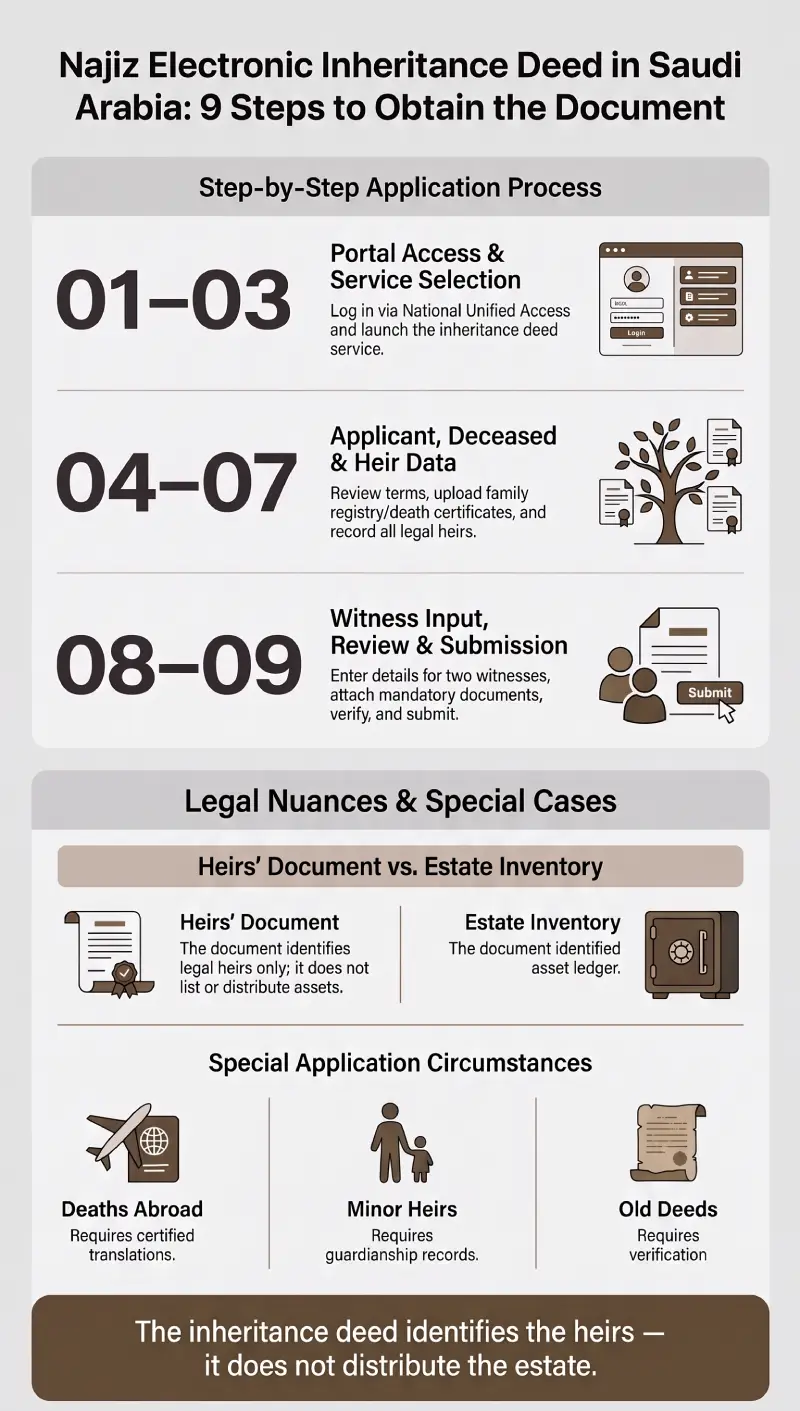
Steps to Obtain an Electronic Inheritance Deed Through Najiz
Obtaining an electronic inheritance deed follows an organized process. It is preferable to complete the application after preparing all relevant documents. The practical steps are generally as follows:
- Sign in through the National Unified Access service to Najiz or the relevant inheritance platform.
- Select the electronic services related to inheritance and estates.
- Open the service for issuing an heirship determination or heirs’ document.
- Review the declarations and requirements before starting the application.
- Enter the applicant’s information and legal capacity.
- Enter the deceased’s information exactly as shown in the official documents.
- Add the heirs and witnesses and verify each family relationship.
- Upload any documents required for special circumstances.
- Review the application, save it, submit it, and monitor its status.
If you have an old inheritance deed, issuing a new document may not be the appropriate route. You may first need to digitize the old document so it can be used electronically, particularly if it does not appear in your account or cannot be verified through the available services.
Before submitting the application, review every field as if you were checking a final legal document. Make sure that no heir has been omitted, no name has been duplicated, and no incorrect family relationship has been entered.
When Is the Electronic Process Sufficient?
The electronic process is generally sufficient when the basic information is clear and there are no missing documents or inconsistencies among the heirs. It is also suitable when there is no old document requiring digitization and no previous error requiring correction.
In such cases, the applicant can prepare the heirship application with accurate information and review all fields before submission. The applicant’s information and legal capacity are among the details required in the application, whether the applicant is an heir, an authorized representative, or another person with the appropriate legal capacity.
When Is the Application Alone Not Enough?
An electronic application may not be sufficient when the case involves a material error, an old inheritance deed that has not been digitized, or an heir who was not included. Legal review may also be appropriate when the estate involves a minor, a death outside Saudi Arabia, or a dispute concerning heirship or inheritance shares.
If the case is complicated, do not repeatedly submit new applications without first identifying the reason for the problem. Review the documents first to determine whether the case requires a new issuance, digitization, correction, or judicial procedure.
If the case involves a minor, an old deed, a death outside Saudi Arabia, or a dispute between heirs, BMS Legal can review the documents and help identify the appropriate route before submission.
What Does the Document Mean?
An inheritance deed is the commonly used term for the document identifying the heirs of a deceased person. Modern electronic services may instead refer to it as an heirs’ document or an heirship determination document.
The document answers a specific question: who are the heirs, what is their relationship to the deceased, and what inheritance shares are legally recognized for them? It does not automatically transfer assets, determine the total value of the estate, or resolve an existing dispute between the parties.
When people ask what is inheritance determination, the short answer is that it is the process of establishing the persons legally entitled to inherit following a death. In Saudi Arabia, legal inheritance determination concerns establishing that status through a documented judicial process so that the relevant authorities can deal with the heirs.
Common Name and Official Terminology
Many people search for terms such as inheritance deed, electronic inheritance determination, or Najiz electronic inheritance deed. These expressions are commonly understood in practice, but they ultimately refer to the relevant service for issuing an heirship determination or heirs’ document.
It is therefore useful to understand both terms. Inheritance deed reflects the terminology commonly used by the public, while heirs’ document or heirship determination is closer to the terminology used in modern electronic judicial services.
Does the Document Distribute the Estate?
No. The document establishes the identity of the heirs and their legally recognized shares. The distribution of real estate, bank accounts, shares, movable assets, and debts requires additional procedures depending on the nature of the assets and whether the heirs agree.
For this reason, issuing the document should not be treated as the end of the estate process. It is the starting point for organizing the heirs’ legal relationship and may be followed by identifying the estate, an amicable distribution, or filing an inheritance claim when a dispute exists.
Heirs vs. Estate: The Practical Difference
Confusing the heirs’ document with the estate inventory is one of the most common mistakes in inheritance matters. The first identifies the persons entitled to inherit, while the second identifies the assets, rights, and liabilities left by the deceased.
| Comparison | Heirs’ Document | Estate Inventory |
|---|---|---|
| Purpose | Identifies the entitled heirs and their shares | Identifies assets and debts |
| Scope | Persons and their legal status | Real estate, accounts, shares, and other assets |
| Stage | Usually before distribution | After the entitled heirs are identified |
| Result | Judicial document | Record of estate assets and liabilities |
| Use | Banks, real estate, and judicial procedures | Distribution, liquidation, and settlement of rights |
The inheritance deed is the first key document for dealing with the deceased’s assets, but it does not identify every component of the estate. The heirs should therefore identify assets and debts before signing any distribution agreement.
After the document is issued, heirs will often need a broader understanding of the inheritance and estate process in Saudi Arabia, particularly when moving from establishing heirship to identifying and distributing the estate.
What Does the Document Establish?
The document establishes information concerning the deceased, the heirs, their relationship to the deceased, and their legally recognized shares as stated in the document. It also helps heirs communicate with entities that require a judicial document before dealing with the deceased’s assets.
The document does not, by itself, establish every detail of the deceased’s assets. The estate may include real estate, bank accounts, shares, receivables owed to the deceased, or debts owed by the deceased.
When Does the Family Need an Estate Inventory?
An estate inventory becomes important when the deceased’s assets are not clearly known or when multiple properties and financial accounts are involved. It is also important where there are debts, wills, or objections by some heirs concerning the assets forming part of the estate.
Requirements for Obtaining the Document
The requirements for inheritance determination begin with an established death, accurate information about the deceased and the heirs, and a clear legal capacity for the applicant. The required information and supporting documents must be submitted in a manner that allows the relevant authority to review the application without inconsistencies or missing information.
The main requirements for obtaining an inheritance deed can be summarized as follows:
- Accurate and complete information about the deceased.
- A complete and accurate list of all heirs.
- Clear legal capacity for the applicant or authorized representative.
Knowing how to complete the application technically is not enough. The information entered must be checked carefully so that no heir is omitted and no incorrect legal status is attributed to any party.
Information Concerning the Deceased
The deceased’s information should match the official documents, including the relevant identification or residency information and date of death. An error at this stage may delay the application or result in a request for correction before the document can be issued.
If the death occurred outside Saudi Arabia, additional documents or certifications may be required depending on the circumstances. A death occurring outside the Kingdom should therefore not automatically be treated in the same way as a death registered inside Saudi Arabia.
Information Concerning the Heirs
All legally entitled heirs should be included without excluding anyone because of age, gender, or a family dispute. This includes a minor heir, an absent heir, or a person who died after the deceased where that person had acquired an inheritance right at the relevant time.
Omitting an heir may create problems later when dealing with banks or real estate. Depending on the nature of the error, the file may require a correction to the inheritance deed or another legal procedure.
Applicant or Authorized Representative
The applicant’s legal capacity must be clear, whether the applicant is an heir, an authorized representative, or a legal guardian of a minor. Where an application is submitted through a power of attorney, the authorization should be valid and suitable for the procedure.
A lawyer for inheritance matters may be useful where there is a dispute, heirs outside Saudi Arabia, or an old deed. In such circumstances, the power of attorney should clearly state the relevant authority and should not leave uncertainty about the representative’s powers.
Required Documents
The documents required for inheritance determination vary depending on the circumstances of the death, the nationality of the parties, and whether the case involves minors or an authorized representative. The application generally requires information about the deceased, a list of heirs, witness information, and evidence of the applicant’s legal capacity.
| Item | Commonly Required Information |
|---|---|
| Deceased | Name, identification or residency number, date of death |
| Heirs | Name, identification, family relationship, relevant status |
| Applicant | Name, legal capacity, identification, contact details |
| Witnesses | Name, identification, date of birth, mobile number |
| Special circumstances | Power of attorney, guardianship document, foreign death document, old deed |
The clearer and more complete the documents are, the lower the likelihood of the application being returned because of missing or inconsistent information. Images and files should therefore be checked before uploading, particularly when dealing with a lost inheritance deed or a replacement inheritance document.
Deceased and Heir Information
The deceased’s information includes the details necessary to identify the person and establish the fact of death. These details should match official records. The list of heirs should include names, identification numbers, family relationships, and special circumstances such as a minor heir or an heir who subsequently died.
For complex family situations, do not rely solely on memory or informal family statements. Use official documents to verify the information and review the complete list before submission so that problems do not arise later during distribution or when dealing with the relevant authorities.
Witnesses and the Applicant
The service requires witness information within the application, so these details should be prepared before submission. Review the identification information, dates of birth, and contact details carefully.
Entering inaccurate information may delay the application or result in a request for correction.
The applicant is the person submitting the request or the person holding the relevant legal capacity. Depending on the circumstances and documents, this may be an heir, an authorized representative, or a legal guardian of a minor.
Mistakes That Can Delay the Application
Most problems involving inheritance documents arise from incomplete documents or selecting an unsuitable service. A mistake that appears minor during submission may later become apparent when dealing with a bank, property, or estate distribution.
| Problem | Appropriate Action |
|---|---|
| Old deed does not appear electronically | Check the digitization process before submitting a new application |
| Heir was omitted | Correct the process before relying on the document |
| Minor heir is involved | Verify legal capacity and guardianship |
| Death occurred outside Saudi Arabia | Prepare required certifications or translations |
| Application was rejected | Review the reason and correct the deficiency |
| Estate includes real estate | Review title deeds and transfer requirements |
Omitting an Heir or Entering Incorrect Information
Omitting an heir is one of the most serious errors because it affects inheritance shares and the reliability of the document. An heir should not be excluded because of a family dispute, geographical distance, or difficulty communicating with that person.
Entering a name that does not match the official records, an incorrect identification number, or an incorrect date of birth may also delay the application. Information should therefore be matched against official documents rather than family usage or informal records.
Selecting the Wrong Service
If the family’s objective is to identify the deceased’s bank balances or real estate, a later process may be required after the inheritance document is issued. If the objective is simply to establish who the heirs are, electronic issuance will generally be the starting point.
Estate distribution does not begin automatically when the document is issued. The assets and debts should first be identified, followed by determining the appropriate method of distribution or disposition based on the heirs’ agreement or the judicial process.
Missing Witness Information or an Inadequate Power of Attorney
Missing witness information may cause the application to be returned or delayed until the required details are completed. An unclear power of attorney may also be insufficient if it does not grant appropriate authority for the relevant procedure.
When an authorized representative is involved, review the wording of the power of attorney before submitting the application. The authorization should correspond to the actual procedure rather than relying on an unclear general power of attorney.
Processing Time and Fees
The time required to issue the document varies according to the completeness of the application and how quickly any comments or deficiencies are addressed. A single processing period cannot be guaranteed for every case because applications may be affected by documents, witnesses, or special circumstances.
Processing may be faster when all information is complete and there are no comments on the application. It may take longer where a minor heir is involved, a power of attorney requires review, a supporting document is missing, or an old deed requires digitization.
The issuance service appears among the electronic judicial services without a direct service fee in the published service information. However, external costs may arise for translation, certification, power of attorney arrangements, or legal consultation.
If the application remains pending without a clear explanation, review the application status and any comments shown in the account. If a legal issue or material deficiency appears, professional review may be appropriate before resubmitting the application.
Inquiry and Printing
After the document is issued, heirs may need to download it, verify it, or provide it to a particular entity. The process may differ depending on whether the document is a recent electronic document or an older document that has not been digitized.
An inquiry can be made through the relevant service depending on the type and status of the document. Some cases may require the document number, date, court information, or other verification details.
If the document is electronic and available through the beneficiary’s account, it may be downloaded or printed using the available options. A clear copy should be retained for use when dealing with banks, estate procedures, or other relevant authorities.
If the document does not appear, it may be an old document that has not been digitized, or the search information may be incorrect. The appropriate solution may be to inquire about the non-electronic document or submit a digitization request rather than repeatedly submitting a new issuance application.
Digitizing an Old Inheritance Deed
Digitizing an old inheritance deed is different from issuing a new document. Digitization is intended to convert a previously issued paper document into an electronic record that can be handled and verified through electronic judicial services.
Digitization may be required when you have an old paper inheritance deed that does not appear electronically or when an entity requires a verifiable electronic document. It may also become relevant when dealing with real estate, banks, or an electronic procedure requiring a current document reference.
A new issuance creates a document based on the current application. Digitization, by contrast, converts an existing old document into an electronic record that can be queried and verified.
If the deed has been lost, a different procedure may be required to obtain a replacement or verify its details. This is why it is important to distinguish between a replacement inheritance deed and the digitization of an existing document.
Rejection, Correction, and Adding an Heir
An application may be rejected because of missing documents, inadequate supporting files, or unclear legal capacity on the part of the applicant. A correction to an inheritance deed may also be required if there is an error in an heir’s name or family relationship or if a party was omitted.
Potential reasons for rejection include incomplete witness information, unclear attachments, or inconsistencies among the names of the heirs. An application may also encounter problems where the applicant’s legal capacity is unclear, the power of attorney is unsuitable, or an old deed requires digitization.
Correcting an inheritance deed after issuance requires following the appropriate procedure based on the nature of the error. Minor errors are different from omitting an heir or entering an incorrect legal status.
Adding an heir to an inheritance deed is a sensitive matter because it changes the effect of the document and the recognized inheritance shares. The issue should therefore be handled through the applicable legal procedure rather than through an informal amendment or continued reliance on an outdated copy.
If there is an error in the document, gather the issued copy and the correct supporting documents before submitting another application. Then determine whether the case requires correction, digitization, a new application, or legal review.
In cases involving rejection, an omitted heir, or a material error in the document, consulting a Jeddah inheritance lawyer may help determine whether the appropriate route is correction, digitization, or another estate-related procedure.
In cases involving rejection or incorrect heir information, do not submit a new application before identifying the reason for the problem. BMS Legal can help determine whether the appropriate route is correction, digitization, or an independent estate-related procedure.
Special Cases
Some cases do not follow the ordinary process because they involve a minor, an authorized representative, or a death outside Saudi Arabia. In these circumstances, particular attention should be given to the supporting documents and legal capacity because an error may affect the validity or acceptance of the procedure.
When a minor is among the heirs, the minor should be included in the list and the inheritance share should not be disregarded. The person legally representing the minor must also be taken into account, particularly when the process later moves to dealing with inherited money or property.
An application may be submitted through a power of attorney if the authorization is valid and appropriate for the procedure. The authority granted should not be vague where the representative will handle heir information or follow up on the application on behalf of the heirs.
A deceased person who died outside Saudi Arabia may require certified or translated death documents depending on the relevant authority and circumstances. A resident or non-Saudi national may also need to establish the family relationship and death through documents appropriate to the case.
When Is Legal Review Appropriate?
Not every case requires a lawyer, particularly when the information is clear and there is no dispute. Some circumstances, however, make legal review useful before submission because an error can lead to rejection or complicate the later distribution of the estate.
If one heir refuses to provide information, disputes another person’s status as an heir, or objects to the application, the appropriate process may change. The issue may no longer be a platform problem but a legal dispute that exists before the heirship documentation is completed.
The case may require determining whether the appropriate route is an heirship documentation request, a judicial inheritance claim, or another type of legal proceeding. The procedure for filing an inheritance claim should therefore be considered only when litigation is actually the appropriate route.
If the estate includes real estate, bank accounts, or debts, the heirs’ document is only the first step. The assets must then be identified. The heirs can subsequently determine the method of distributing the estate based on their agreement or the applicable judicial process.
What Happens After the Document Is Issued?
After obtaining a Najiz electronic inheritance deed, the actual organization of the estate begins. The document establishes the heirs’ status for dealing with relevant entities, but it does not complete the distribution, resolve disputes, or identify every asset left by the deceased.
Heirs may then move to identifying the estate, communicating with banks, reviewing real estate, and arranging either an amicable or judicial distribution. The appropriate route depends on the assets, whether a minor is involved, and whether the heirs agree or disagree.
If the deceased’s assets are unclear, the family may need to identify the estate after the inheritance document has been issued. This can include identifying real estate, bank accounts, shares, debts, and other outstanding financial rights.
The issuance of the document does not automatically mean that inherited real estate can be sold. The property title, the heirs’ legal status, any minor heir, the consent or authority of the relevant parties, and any debts or restrictions must be considered before the transaction.
Do you have an old inheritance deed or an estate that includes real estate?
If the case involves an old deed, an omitted heir, or real estate forming part of the estate, you can contact a Jeddah law firm to present the documents and determine the appropriate next legal step.
Why Choose BMS Legal?
Clear legal guidance for inheritance and estate matters in Saudi Arabia.
Licensed Saudi Law Firm
Legal services provided in accordance with Saudi regulations and professional standards.
Inheritance Legal Support
Guidance on inheritance deeds, heirs, estate procedures, and related legal matters.
Clear Before You Proceed
We clarify the legal position, required documents, and available procedures before action is taken.
Confidential & Professional
Your information and documents are handled with professional confidentiality and legal care.
Important: An electronic inheritance deed identifies the heirs and their recognized shares. It does not, by itself, distribute the estate or transfer ownership of inherited assets.
Frequently Asked Questions About a Najiz Electronic Inheritance Deed
1. What is a Najiz electronic inheritance deed?
It is an official document that identifies the deceased’s heirs and their recognized inheritance shares.
2. Does the inheritance deed divide the estate?
No. It identifies the heirs but does not itself distribute the deceased’s assets among them.
3. What documents are required to issue it?
The required information generally includes the deceased’s details, heirs’ information, applicant details, witnesses, and supporting documents for special cases.
4. How can I obtain the inheritance deed?
The application is submitted electronically through the Najiz platform by completing the required information, uploading documents, reviewing the application, and submitting it.
Najiz Electronic Inheritance Deed: 9 Steps in Saudi Arabia to obtain it is the starting point for organizing an estate file, not the end of the process. The document establishes the heirs and their recognized shares, but it does not distribute the assets or, by itself, authorize every financial or real estate transaction.
An error involving an heir, witness, or supporting document may affect later stages. The file should therefore be reviewed before submission, with a clear distinction between the heirs’ document and the estate inventory. An incomplete document should not be relied upon for distribution or financial transactions.
If the case involves a minor, an old deed, a death outside Saudi Arabia, or a dispute between heirs, early legal review can help determine the appropriate route and reduce the risk of rejection or repeated procedures.
Official References: