
Mutual termination of employment in Saudi Arabia means that the employee and employer agree to end the employment relationship by mutual consent. Under Saudi Labor Law, the employee’s consent to such termination must be in writing.
A mutual termination agreement does more than state the employee’s final working day. It may also affect outstanding payments, end-of-service benefits, the termination process, and the reason recorded with the relevant authorities.
Before signing, both parties should therefore understand the financial consequences, clearly determine the termination date, and ensure that the wording accurately reflects what has actually been agreed. The legal effect may vary depending on the type of employment contract, its terms, the employee’s length of service, and the circumstances surrounding termination.
In brief:
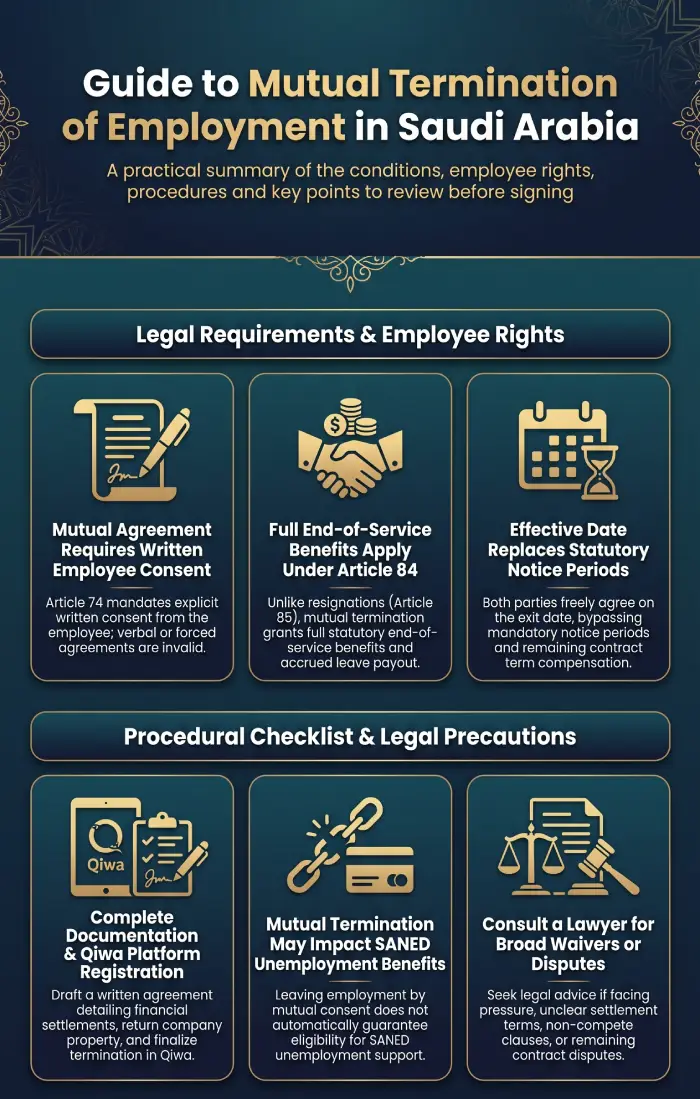
Mutual Termination of Employment is permitted under Article 74 of the Saudi Labor Law, provided that the employee’s consent is in writing. The agreement should clearly state the termination date, financial entitlements, payment arrangements, and any continuing obligations to reduce the risk of later disputes.
What Does Mutual Termination of Employment Mean?
Mutual termination of employment occurs when both the employee and employer agree to bring the employment contract to an end, rather than one party terminating it unilaterally.
This form of termination is one of the situations governed by Saudi Labor Law in relation to the ending of an employment relationship. The consequences may differ depending on the reason for termination, the type of contract, and the rights arising in each case.
More specifically, Article 74 of the Saudi Labor Law provides for termination by agreement between the parties, subject to the employee’s written consent.
Mutual termination therefore rests on two key elements: agreement between the parties and written confirmation of the employee’s consent.
Is Mutual Termination the Same as Contract Rescission?
The phrase “mutual rescission of an employment contract” is sometimes used informally, but where both parties agree to end the relationship, the more accurate description is generally termination by mutual agreement.
A termination initiated by only one party may be subject to different rules concerning notice, justification, or compensation. The legal consequences therefore depend on how the employment relationship actually ended, rather than on the label used by either party.
What Are the Conditions for Mutual Termination in Saudi Arabia?
Mutual termination requires genuine agreement between the employee and employer, together with the employee’s written consent.
In practice, a well-drafted agreement should do more than state that the employment relationship has ended. It should clearly record the matters that affect the rights and obligations of both parties.
These normally include:
- details of the employee, employer and employment contract;
- the employee’s written consent;
- the effective termination date;
- outstanding rights and amounts payable;
- the payment date and method; and
- any obligations that lawfully continue after termination.
An employer may propose a mutual termination, but the employee is not automatically required to accept it. Likewise, an employee’s wish to leave does not become a mutual termination unless the employer also agrees.
When Should Final Employment Dues Be Paid?
Article 88 of the Saudi Labor Law regulates the settlement of an employee’s financial rights after employment ends.
Where the employer ends the employment relationship, wages and financial entitlements must generally be settled within one week. Where the employee is the party ending the relationship, the period may extend to two weeks.
For this reason, a mutual termination agreement should clearly state the amount payable, when payment will be made, and the agreed payment method instead of relying on broad or ambiguous wording.
What Rights Does an Employee Have After Mutual Termination?
An employee’s rights do not disappear simply because the employment relationship ends by agreement.
The parties should identify all entitlements that have accrued up to the termination date based on Saudi Labor Law, the employment contract and the circumstances of the case.
The main items that may need to be reviewed include:
- salary due up to the termination date;
- contractual or regulatory financial entitlements;
- payment for accrued but unused annual leave;
- end-of-service benefits;
- any additional amount agreed between the parties; and
- the service certificate and the return of the employee’s documents.
Knowing only the total settlement amount may not be enough. If there is a disagreement over salary, leave balance or end-of-service benefits, each component should be identified separately before the agreement is signed.
Is an Employee Entitled to End-of-Service Benefits After Mutual Termination?
As a general rule, mutual termination of employment in Saudi Arabia is subject to the ordinary rules governing end-of-service benefits and does not become a resignation merely because the employee agreed to the termination.
Article 84 provides that the end-of-service award is calculated on the basis of half a month’s wage for each of the first five years of service and one month’s wage for each subsequent year. A proportionate amount is also calculated for fractions of a year.
The legal classification is important because employee resignation under Saudi Labor Law is governed by separate rules and may have different consequences, including rules affecting end-of-service benefits.
Cases involving commissions, bonuses or variable remuneration may require closer review before the final settlement amount is accepted.
Mutual Termination of a Fixed-Term Contract Before Expiry
An employee and employer may agree to terminate a fixed-term employment contract before its stated expiry date, provided that the requirements for mutual termination are satisfied and the employee’s consent is in writing.
However, the existence of a remaining contract period does not automatically mean that compensation under Article 77 becomes payable.
Article 77 concerns compensation in cases where a contract is terminated for an unlawful reason. In a fixed-term contract, compensation may in some circumstances be linked to the wages due for the remaining contract period, subject to the contract terms and the conditions for applying that provision.
This distinction is particularly important in cases involving employee compensation for early termination of a fixed-term contract, because the consequences depend on why the contract ended, which party terminated it, and whether a statutory basis for compensation exists.
In a genuine mutual termination, the parties may agree on an additional settlement amount, but that is different from assuming that compensation for the entire remaining term is automatically due.
Is a Notice Period Required for Mutual Termination?
Where both parties agree to terminate the contract, they may specify the effective termination date directly in the agreement.
This should not be confused with unilateral termination of an indefinite-term employment contract.
For monthly paid employees, Article 75 regulates notice periods so that an employee terminating an indefinite-term contract generally gives at least 30 days’ notice, while an employer terminating such a contract generally gives at least 60 days’ notice.
With mutual termination of employment, the agreed termination date should instead be stated clearly in the written agreement.
How Is Mutual Termination Processed and Documented?
A structured process helps both parties understand what has been agreed and what remains to be completed after signing.
The process may be organised as follows:
- agree on the reason and effective date of termination;
- identify outstanding rights and amounts payable;
- prepare a written termination agreement;
- review the wording and financial settlement before signing;
- complete the relevant electronic procedure; and
- settle outstanding amounts and return documents and company property.
Terminating the Contract Through Qiwa
The Saudi Ministry of Human Resources and Social Development provides an electronic service for terminating active employment relationships through the Qiwa platform.
The process includes accessing employment contracts, selecting the relevant contract, choosing the termination option, entering the reason and effective date, reviewing the information, and submitting the request through the platform. Ministry of Human Resources and Social Development
The termination reason recorded electronically should reflect what actually occurred between the parties rather than being selected merely to obtain a preferred financial or insurance outcome.
Does Mutual Termination Affect SANED Eligibility?
Yes. The way an employment relationship ends may directly affect entitlement to SANED unemployment insurance.
SANED generally requires that the insured person did not leave employment voluntarily. The General Organization for Social Insurance treats an agreement between the employee and employer to terminate the employment contract as relevant to this voluntary-leaving requirement.
For that reason, mutual termination of employment in Saudi Arabia should not be assumed to qualify an employee automatically for SANED. The actual reason for termination and the remaining eligibility requirements should be checked before relying on potential SANED benefits.
What Should a Mutual Termination Agreement Include?
Clear drafting reduces uncertainty over what the parties have actually agreed.
A mutual termination agreement should generally address:
- employee and employer details;
- the date and reference of the employment contract;
- a clear statement that both parties agree to termination;
- the employee’s written consent;
- the effective termination date;
- financial entitlements and settlement amounts;
- the payment date and method;
- return of company property and employee documents; and
- any obligations that lawfully continue after termination.
A standard form should not be treated as automatically suitable for every employment relationship. Contract terms, length of service, remuneration and termination arrangements may differ significantly from one case to another.
Sample Mutual Termination of Employment Agreement
The following wording may be used as a basic starting point and adapted to the circumstances of the particular employment relationship:
Mutual Termination of Employment Agreement
This agreement is entered into between:
First Party: [Employer / Company Name]
Second Party: [Employee Name]Whereas the parties are bound by an employment contract dated [date], they have mutually agreed to terminate the employment relationship with effect from [termination date].
The parties acknowledge that the employee has provided written consent to the termination and that the final employment entitlements include, where applicable:
- salary due up to the termination date;
- payment for accrued unused annual leave;
- end-of-service benefits; and
- any additional agreed settlement amount: [if applicable].
The amounts due shall be paid in accordance with the agreed payment arrangements and the applicable legal requirements.
The employee shall return any company property, equipment and documents in their possession, while the employer shall provide the employee with the service certificate and return any documents belonging to the employee.
Employer Signature: __________
Employee Signature: __________
Date: __________
This sample does not replace a review of the underlying employment contract, particularly where the agreement involves a settlement amount, a substantial remaining contract term, a non-compete clause, or a dispute over employee entitlements.
When Should a Saudi Employment Lawyer Review the Agreement?
Legal review becomes more important where the consequences of termination are unclear or where the financial and contractual issues cannot be resolved from the wording of the agreement alone.
Particular care may be needed where:
- there is a dispute over end-of-service benefits;
- a substantial period remains under a fixed-term contract;
- commissions or bonuses remain unsettled;
- the agreement contains a broad release or waiver;
- a non-compete obligation applies;
- the stated reason for termination differs from what actually occurred; or
- one party alleges pressure to accept the agreement.
This is different from situations where the employee ends the relationship independently, because termination of an employment contract by an employee in Saudi Arabia may take the form of resignation, termination of an indefinite-term contract, or another legally recognised route.
Where the agreement involves disputed entitlements, a remaining contract period, a broad release, or an unclear termination reason, consulting a Saudi employment lawyer in Jeddah can help clarify the contract terms, settlement amounts and available options before signing.
Frequently Asked Questions About Mutual Termination of Employment
Can an Employee Refuse a Mutual Termination Proposal?
Yes. Mutual termination requires agreement by both parties, and Article 74 requires the employee’s consent to be in writing. If the employee does not accept the proposal, the employment relationship has not ended by mutual agreement, and any later termination may need to be assessed separately.
Can the Parties Agree on an Additional Settlement Payment?
Yes. The parties may agree on an additional payment beyond the employee’s existing entitlements. The agreement should distinguish that extra amount from salary, unused leave, end-of-service benefits and other accrued rights so that the basis of the settlement remains clear.
Can a Mutual Termination Agreement Be Challenged After Signing?
There is no single answer for every case. The outcome depends on the validity and wording of the agreement, the circumstances in which it was signed, and the grounds relied upon to challenge it. The agreement, communications and surrounding facts should be reviewed before conclusions are drawn.
Must a Final Release Be Signed Together With the Termination Agreement?
Not necessarily. A final release and the termination agreement do not have to be treated as one document in every case. What matters is understanding which rights the release covers, when it is signed, what amounts have actually been settled, and the effect of its wording.
Does Mutual Termination Automatically Qualify an Employee for SANED?
No. SANED eligibility should not be assumed merely because employment ended by agreement. Since voluntary departure may affect eligibility, the actual reason for termination and all other SANED conditions should be checked before relying on the benefit.
Mutual Termination of Employment in Saudi Arabia: 7 Key Points Before Signing is not simply about signing a document that ends the employment relationship. It requires clarity on consent, the effective termination date, financial entitlements, end-of-service benefits, the contract type, Qiwa procedures and the effect of the termination reason on SANED.
Before signing, the parties should review the settlement amount, accrued leave, end-of-service benefits, the stated reason for termination and the information that will be recorded through the relevant employment systems. Greater clarity at this stage can reduce uncertainty and help both parties understand the consequences of the agreement.
A law firm in Jeddah such as BMS Legal for Law Firm and Legal Consultations can review the employment contract, mutual termination agreement and related financial entitlements, then explain the available options and procedural steps before the final decision is made.