
Employee Contract Termination in Saudi Arabia is not governed by a single rule. The legal consequences depend on the contract type, the reason for termination, and the legal route used. The employee may resign, terminate an indefinite-term contract, leave without notice under Article 81, or end the employment relationship during probation. Identifying the correct route before leaving is particularly important when a fixed term remains or a compensation claim may arise.
When Can an Employee Terminate an Employment Contract?
Determining whether an employee can end the employment relationship begins with identifying the contract type and the actual reason for leaving. Saudi Labor Law distinguishes between expiry of a fixed-term contract, termination of an indefinite-term contract, resignation, and an employee leaving without notice. These distinctions affect notice requirements, compensation, and the financial rights arising when employment ends.
Under the Saudi Labor Law published by the Ministry of Human Resources and Social Development, Article 74 identifies several grounds for ending an employment contract, including mutual agreement, expiry of the contractual term, resignation, and termination by either party in an indefinite-term contract under Article 75. Therefore, describing an action simply as “contract termination” is insufficient; the applicable legal basis must also be identified.
| Employee’s Situation | Provision to Review |
|---|---|
| Terminating an indefinite-term contract for a legitimate reason | Article 75 |
| Submitting a resignation | Article 79 bis |
| Leaving employment without notice | Article 81 |
| Ending employment during probation | Articles 53 and 54 |
| Ending a fixed-term contract before expiry | Contract terms, reason for termination, and Article 77 |
The contract type determines the first legal route to examine, while the reason for leaving determines which provisions apply to the circumstances. Both factors should therefore be considered together because the employee’s description of the departure alone does not determine its legal consequences.
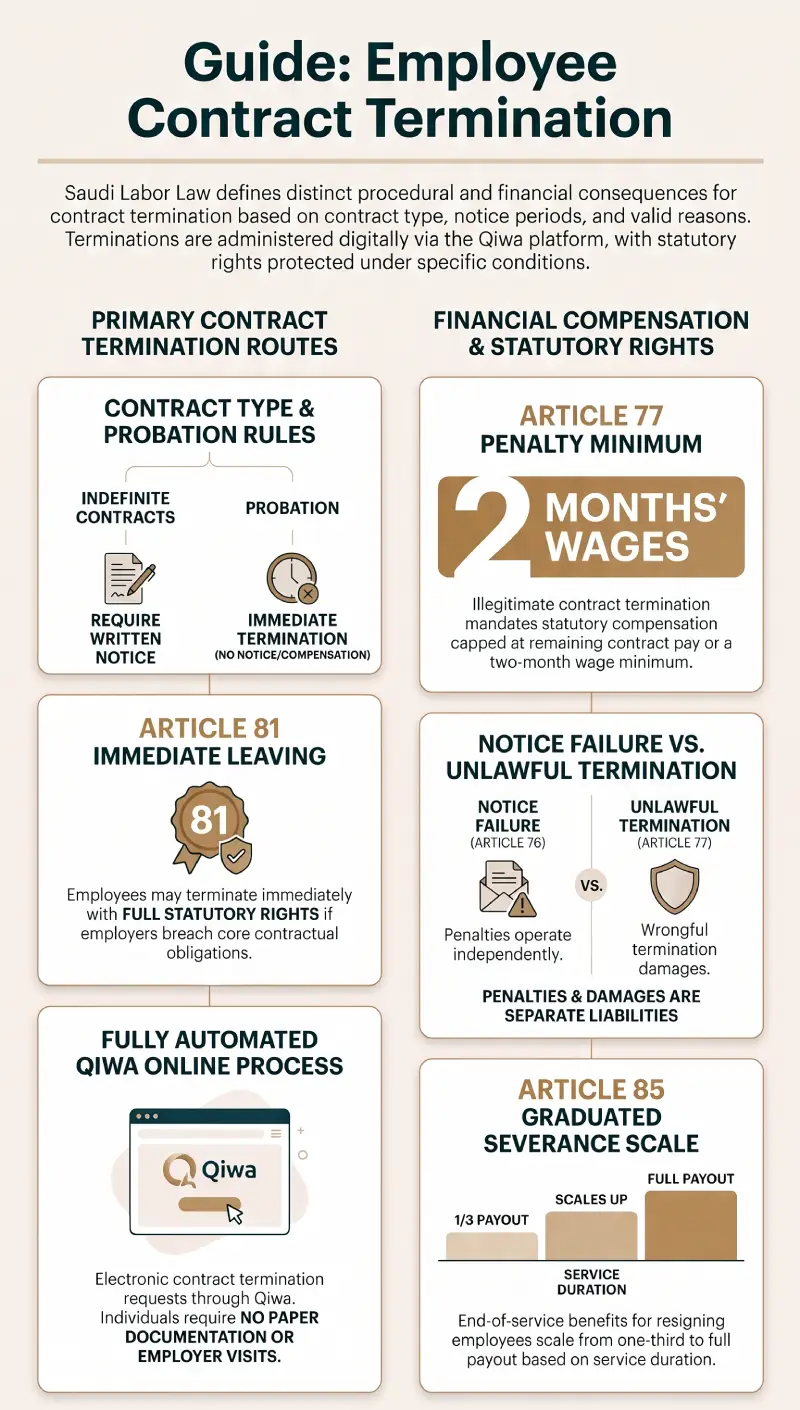
How Does the Contract Type Affect Employee Contract Termination?
The contract type directly affects the termination process and its potential consequences. The employee should first determine whether the employment contract is fixed-term or indefinite-term. A distinction must also be made between a fixed-term contract expiring on its agreed date and an employee seeking to terminate it before that date, because the two situations do not produce the same legal outcome.
Employee Termination of a Fixed-Term Contract
A fixed-term employment contract ordinarily ends upon expiry of its agreed term under the provisions governing termination of employment. If an employee seeks to terminate the contract before that date, the reason for termination and contractual provisions should be examined before determining whether compensation may arise and how it may be calculated.
Where termination is for an illegitimate reason and the contract does not specify compensation, Article 77 of Saudi Labor Law makes the wages for the remaining contractual period the compensation benchmark for the affected party in a fixed-term contract, subject to the statutory minimum of two months’ wages. An employee should therefore not assume that all remaining salaries automatically become payable without first examining the contract and the legal basis for termination.
Employee Termination of an Indefinite-Term Contract
Saudi Labor Law permits an employee to terminate an indefinite-term contract for a legitimate reason, subject to written notice. Article 75 of Saudi Labor Law requires an employee to provide at least 30 days’ notice where wages are paid monthly. A 30-day notice period also applies when wages are not paid monthly.
If the required notice period is not observed, Article 76 provides for compensation to the other party equivalent to the employee’s wages for the unobserved notice period, unless the parties have agreed to a higher amount. This obligation is distinct from compensation for termination for an illegitimate reason under Article 77, so the two should not be treated as the same financial liability.
When Can an Employee Leave Without Notice Under Article 81?
Article 81 allows an employee to leave employment without notice while retaining statutory rights when one of seven specified circumstances exists. This right is distinct from resignation and ordinary termination of an indefinite-term contract. The facts must therefore genuinely fall within one of the statutory cases before Article 81 is relied upon.
Saudi Labor Law Article 81 covers an employer’s failure to fulfil essential obligations, fraud at the time of contracting, assigning substantially different work contrary to Article 60, the forms of assault specified by law, treatment involving cruelty, injustice, or insult, a serious workplace hazard that the employer fails to remedy, and employer conduct that effectively causes the employee to appear as though they terminated the contract themselves.
The official Saudi Labor Law published by the Ministry of Human Resources and Social Development provides the statutory framework governing these circumstances. An ordinary workplace disagreement does not automatically trigger Article 81. Its application depends on the facts and supporting evidence, making contracts, correspondence, payroll records, notices, and other relevant documents important when a dispute is anticipated.
What Is the Difference Between Employee Contract Termination and Resignation?
Not every Employee Contract Termination amounts to resignation. Saudi Labor Law treats resignation as an independent ground for ending an employment contract and assigns specific rules to it. Article 75, by contrast, governs termination of indefinite-term contracts, while Article 81 permits an employee to leave without notice when one of its statutory circumstances exists.
| Issue | Termination Under Article 75 | Resignation | Article 81 |
|---|---|---|---|
| Legal basis | Legitimate reason | Employee’s request | Specified statutory circumstance |
| Application | Indefinite-term contract | Under resignation rules | One of seven statutory cases |
| Notice | Under Article 75 | Under resignation provisions | No notice |
| Rights | Depends on circumstances | Subject to resignation rules | Employee retains statutory rights |
Under the rules governing resignation under Saudi Labor Law, an employee’s resignation request is deemed accepted if 30 days pass without a response from the employer. The employer may postpone acceptance for up to 60 days when the interests of work require it, subject to the applicable statutory requirements.
The employee may also withdraw a resignation request within seven days from submission unless the employer has already accepted it before the withdrawal. Resignation therefore follows a different legal route from leaving under Article 81, and the two should not be used interchangeably without first determining the actual reason for departure.
Does an Employee Pay Compensation for Terminating an Employment Contract?
An employee does not become liable for compensation merely because the employee initiated termination. Liability depends on the reason for termination, the contract type, and the contractual terms. Where termination is for an illegitimate reason and the contract does not specify compensation, Article 77 governs compensation payable to the affected party.
According to the official Saudi Labor Law, compensation for an indefinite-term contract is calculated at 15 days’ wages for each year of service, while the benchmark for a fixed-term contract is the wages for the remaining contractual period. The compensation provided for under Article 77 may not be less than two months’ wages.
Failure to comply with the notice period for an indefinite-term contract is instead governed by Article 76. Notice compensation should therefore not be conflated with compensation under Article 77. The employment contract should also be reviewed because a contractual compensation clause may affect how the amount is determined when its conditions are satisfied.
For this reason, the question “Will I have to pay all remaining salaries under my contract?” cannot be answered solely by looking at the remaining term. The contract type, reason for termination, and contractual provisions must be considered. Where a fixed term has substantial time remaining, a law firm in Jeddah can review the compensation clause, termination grounds, and remaining contractual period to identify potential liabilities before the employment relationship ends.
What Rights Does an Employee Have After Contract Termination?
An employee does not lose statutory rights merely because the employee initiated termination. The amount ultimately due depends on the reason employment ended, length of service, and applicable wage. Article 84 establishes the general framework for calculating end-of-service benefits, while Article 85 addresses entitlement where the employment relationship ends through resignation.
Where the employee terminates the contract, Article 88 requires the employer to settle the employee’s rights within no more than two weeks. The deadline for settlement should be distinguished from the calculation of those rights, because the amount depends on wages, length of service, the reason for termination, and other contractual entitlements.
A different result applies where termination occurs during probation. Articles 53 and 54 require the probation period to be expressly stated in the employment contract and limit its total duration to 180 days. If the contract ends during probation, neither party is entitled to compensation because of that termination, and the employee is not entitled to an end-of-service award for it.
How Can an Employee Terminate an Employment Contract Through Qiwa?
The Ministry of Human Resources and Social Development provides an electronic service for terminating a documented employment contract when the service requirements are met. The employee must have an active employment contract on Qiwa, and there must be no other pending contractual termination request for the same contract.
According to the Ministry’s official Termination of Contractual Relationship service, the employee signs in to Qiwa Individuals, selects “Services” and then “Employment Contracts,” chooses the relevant contract, selects “Terminate Contract,” enters the reason and last working date, reviews the information, and submits the request.
The Ministry describes the service as fully automated and states that no documents are required to complete the request. This does not remove the importance of retaining evidence relating to Employee Contract Termination. Correspondence, the employment contract, and wage records may become relevant if a later dispute arises concerning the termination grounds, compensation, or outstanding entitlements.
What Should You Review Before Employee Contract Termination?
Start by checking the contract type, expiry date, and any compensation clause, then identify the actual reason for leaving. Determine whether the circumstances amount to resignation, termination of an indefinite-term contract, a case falling under Article 81, or termination during probation.
The applicable notice period should also be checked, and copies of the employment contract, correspondence, and documents supporting the reason for termination should be retained. The termination should not be recorded as a resignation or an Article 81 case unless the facts support that characterization, because the chosen legal route may affect compensation and other rights arising from termination.
Fixed-term contracts, potential compensation claims, and disputes over Article 81 may require closer examination of the contract and evidence. Consulting a labor lawyer in Jeddah can help clarify the consequences of termination and identify relevant evidence before an employee takes a step that may create financial obligations.
Frequently Asked Questions About Employee Contract Termination
Can an Employee Terminate an Employment Contract in Saudi Arabia?
Yes. An employee may end an employment relationship, but the applicable route and consequences depend on the contract type and reason for leaving. The situation may involve resignation, termination of an indefinite-term contract, leaving under Article 81, or termination during probation.
Can an Employee Terminate a Fixed-Term Contract Before It Expires?
A fixed-term contract may end before its agreed expiry in circumstances recognized by law or by agreement between the parties. If termination is for an illegitimate reason, compensation may become payable to the affected party under Article 77. The termination grounds and contractual compensation provisions should therefore be reviewed.
Is Employee Contract Termination the Same as Resignation?
Not always. Resignation has its own provisions under Saudi Labor Law, while termination of an indefinite-term contract may fall under Article 75. Article 81 also permits an employee to leave without notice when specified circumstances exist.
When Can an Employee Leave Work Without Notice?
Article 81 allows an employee to leave without notice while retaining statutory rights in seven specified circumstances. These include certain employer breaches, fraud at contracting, specified forms of assault or degrading treatment, and a serious workplace hazard.
Does an Employee Have to Pay the Remaining Salaries When Terminating a Contract?
Not automatically. If a fixed-term contract is terminated for an illegitimate reason and does not contain a specified compensation provision, Article 77 uses wages for the remaining contractual period as the compensation benchmark, subject to the statutory minimum.
When Must an Employee's Final Entitlements Be Paid After Termination?
Where the employee terminates the employment contract, Article 88 requires the employer to settle the employee's rights within no more than two weeks. The amount due depends separately on wages, length of service, the reason for termination, and other applicable rights.
The key question before leaving employment is: Employee Contract Termination: 7 Cases and Compensation. The answer does not depend solely on an employee’s decision to leave. It also depends on the contract type, termination grounds, compensation provisions, and whether Article 81 applies. In its seven specified cases, Article 81 permits an employee to leave without notice while retaining statutory rights, whereas other forms of termination follow different rules.
The appropriate first step is therefore to review the employment contract and identify the actual reason for leaving before completing the termination. Where the remaining contract term, compensation, or application of Article 81 is disputed, a legal review can clarify the employee’s rights and potential obligations before an action is taken that may have financial consequences.
ملاحظة واحدة قبل النشر: الأنكور الأخير في النسخة العربية هو «محامي عمالي معتمد». لم أضع له رابطاً تخمينياً؛ لأن البحث أكد وجود صفحة/مسار Labor Lawyer in Jeddah داخل الموقع، لكن نتيجة البحث لم تُظهر لي URL المباشر للصفحة بما يكفي لاعتماده دون اختلاقه. أما بقية الروابط فقد تحققت من صفحاتها الإنجليزية الفعلية، وليس بمجرد استبدال /en/ في الروابط العربية. BMS Legal